GUJING(000596)

Search documents
全面复盘酒企八大发展阶段,和君万字详解精准破局策略
Sou Hu Cai Jing· 2025-10-14 08:59
Core Insights - The common response strategy for liquor companies at different stages is the synergistic development of "stabilizing the fundamentals" and "seeking innovation" [2][61] - The white liquor industry has experienced eight distinct stages, each facing unique market challenges and core pain points, necessitating the identification of key drivers and factors for successful transitions to the next stage [3][4] Industry Overview - As of June 2025, the number of large-scale white liquor enterprises (annual revenue over 20 million RMB) has decreased from 1,593 in 2017 to 887, indicating a trend of market share and profits concentrating among leading companies [4] - The production of white liquor has seen a decline, with a reported 6.5% year-on-year decrease in June 2025 and a cumulative 5.8% decrease in the first half of 2025 [2] Company Development Stages - The eight stages of liquor company development are characterized by specific sales scales and corresponding market strategies, emphasizing systematic upgrades in products, channels, brands, and organization [3][4] - Each stage has distinct characteristics, market performance, core pain points, and breakthrough strategies, which are essential for companies to navigate their growth effectively [7][13][24][34][40] Market Dynamics - The industry is witnessing a continuous increase in concentration, with a clear "pyramid" structure where a small number of top companies capture most of the industry's profits, while numerous small enterprises struggle for survival and growth [6][12] - The competitive landscape is shifting towards a focus on brand recognition and consumer engagement, moving away from reliance on government-related consumption [53] Strategic Recommendations - Companies are encouraged to integrate artificial intelligence into their strategic planning, organizational structure, and business processes to drive intelligent development and upgrade traditional industries [2][19] - Emphasis on product focus, pricing stability, and channel management is crucial for companies at various stages to enhance their market presence and profitability [9][22][27][37] Conclusion - The liquor industry must adapt to current challenges by restructuring brand, product, regional, and channel strategies while leveraging organizational upgrades and AI technology to overcome growth bottlenecks [61]






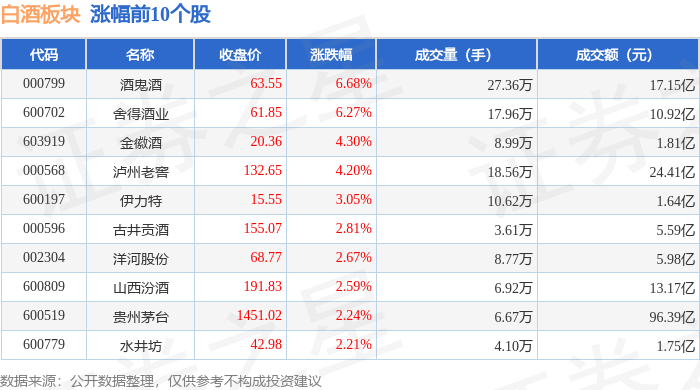
白酒板块10月14日涨2.4%,酒鬼酒领涨,主力资金净流入11.29亿元
Zheng Xing Xing Ye Ri Bao· 2025-10-14 08:39
Core Insights - The liquor sector experienced a 2.4% increase on October 14, with Jiu Gui Jiu leading the gains [1] - The Shanghai Composite Index closed at 3865.23, down 0.62%, while the Shenzhen Component Index closed at 12895.11, down 2.54% [1] Liquor Sector Performance - Jiu Gui Jiu (code: 000799) closed at 63.55, up 6.68% with a trading volume of 273,600 shares and a transaction value of 1.715 billion [1] - She De Jiu Ye (code: 600702) closed at 61.85, up 6.27% with a trading volume of 179,600 shares and a transaction value of 1.092 billion [1] - Jin Hui Jiu (code: 616809) closed at 20.36, up 4.30% with a trading volume of 89,900 shares and a transaction value of 181 million [1] - Lu Zhou Lao Jiao (code: 000568) closed at 132.65, up 4.20% with a trading volume of 185,600 shares and a transaction value of 2.441 billion [1] - Yi Li Te (code: 600197) closed at 15.55, up 3.05% with a trading volume of 106,200 shares and a transaction value of 164 million [1] - Guo Jing Gong Jiu (code: 000596) closed at 155.07, up 2.81% with a trading volume of 36,100 shares and a transaction value of 559 million [1] - Yang He Guo Fen (code: 002304) closed at 68.77, up 2.67% with a trading volume of 87,700 shares and a transaction value of 598 million [1] - Shan Xi Fen Jiu (code: 600809) closed at 191.83, up 2.59% with a trading volume of 69,200 shares and a transaction value of 1.317 billion [1] - Gui Zhou Mao Tai (code: 600519) closed at 1451.02, up 2.24% with a trading volume of 66,700 shares and a transaction value of 9.639 billion [1] - Shui Jing Fang (code: 600779) closed at 42.98, up 2.21% with a trading volume of 41,000 shares and a transaction value of 175 million [1] Capital Flow Analysis - The liquor sector saw a net inflow of 1.129 billion from main funds, while retail funds experienced a net outflow of 664 million [1] - Main fund inflows for Gui Zhou Mao Tai amounted to 529 million, while retail funds saw a net outflow of 382,400 [2] - Main fund inflows for Wu Liang Ye were 326 million, with retail funds experiencing a net outflow of 162 million [2] - She De Jiu Ye had main fund inflows of 85.6 million, while retail funds saw a net outflow of 82.1 million [2] - Lu Zhou Lao Jiao had main fund inflows of 83.7 million, with retail funds experiencing a net outflow of 1.53 billion [2] - Jiu Gui Jiu had main fund inflows of 76.1 million, while retail funds saw a net outflow of 995.3 million [2] - Guo Jing Gong Jiu had main fund inflows of 54.2 million, with retail funds experiencing a net outflow of 612.4 million [2]


短线防风险 91只个股短期均线现死叉
Zheng Quan Shi Bao Wang· 2025-10-14 06:25
Core Viewpoint - The A-share market is experiencing a decline, with the Shanghai Composite Index down by 0.47% and a total trading volume of 2,104.034 billion yuan as of 14:01 [1]. Group 1: Market Performance - The Shanghai Composite Index is at 3,871.31 points, reflecting a decrease of 0.47% [1]. - A total of 91 A-shares have seen their 5-day moving averages cross below their 10-day moving averages, indicating potential bearish trends [1]. Group 2: Notable Stocks - Hongxing Co. (001209) has a 5-day moving average of 18.33 yuan, down 1.39% today, with a distance of -2.53% from its 10-day moving average [1]. - Huayi Technology (688071) shows a significant drop of 5.62%, with its 5-day moving average at 40.79 yuan, which is -2.43% lower than its 10-day moving average [1]. - Top Group (601689) has decreased by 5.54%, with a 5-day moving average of 73.56 yuan, -2.42% from its 10-day moving average [1].



双节白酒动销平淡,关注内需政策:——食品饮料行业周报-20251013
Guohai Securities· 2025-10-13 13:01
Investment Rating - The report maintains a "Recommended" rating for the food and beverage industry [1] Core Views - The overall sales of liquor during the recent double festival are weak, with a year-on-year decline of 20%-30%, aligning with previous expectations. High-end brands like Moutai and Wuliangye performed relatively well, while lower-tier brands faced significant pressure [5] - The price stability of liquor during the double festival is noted, with slight increases observed post-festival. The report suggests monitoring price trends as e-commerce promotions begin [5] - The upcoming Sugar and Wine Conference is expected to provide marginal feedback, with the industry showing signs of bottoming out. The report emphasizes the importance of this event for potential recovery opportunities [6][7] Summary by Sections Recent Trends - The food and beverage sector has underperformed the Shanghai Composite Index, with a 0.61% increase compared to the index's 1.80% rise over the past two weeks [14] - The soft drink segment saw the highest increase of 9.98%, while several companies like Zhuangyuan Pasture and Yangyuan Beverage led the gains [14] Key Companies and Earnings Forecast - The report highlights several key companies with their respective earnings per share (EPS) and price-to-earnings (PE) ratios, recommending stocks such as Kweichow Moutai, Wuliangye, and Luzhou Laojiao for investment [25] - The report provides a detailed table of key companies, their stock prices, and projected earnings for 2024, 2025, and 2026, indicating a bullish outlook for several firms [25] Investment Strategy - The report suggests that recent policy changes may improve macroeconomic expectations, potentially enhancing both valuation and performance in the food and beverage sector. The overall valuation remains low, justifying the "Recommended" rating [8][23] - Specific recommendations include high-end liquor brands and popular consumer goods, indicating a diversified investment strategy across different segments of the food and beverage industry [8][23]



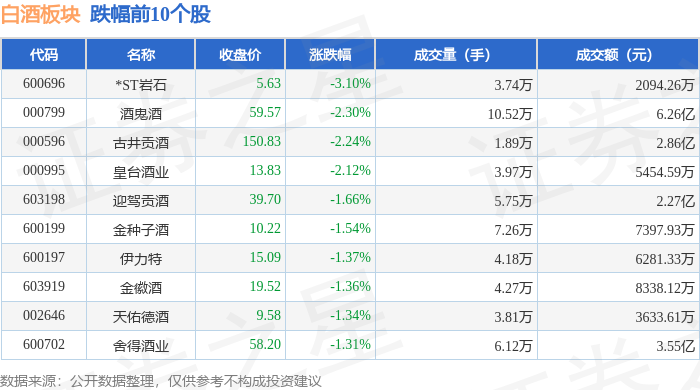
白酒板块10月13日跌0.87%,*ST岩石领跌,主力资金净流出11.33亿元
Zheng Xing Xing Ye Ri Bao· 2025-10-13 12:38
Market Overview - The liquor sector experienced a decline of 0.87% on October 13, with *ST Rock leading the drop [1] - The Shanghai Composite Index closed at 3889.5, down 0.19%, while the Shenzhen Component Index closed at 13231.47, down 0.93% [1] Individual Stock Performance - *ST Rock (600696) closed at 5.63, down 3.10% with a trading volume of 37,400 shares and a turnover of 20.94 million yuan [1] - Other notable declines include: - Si Gu Dian (000799) down 2.30% to 59.57 with a volume of 105,200 shares [1] - Gujing Gongjiu (000596) down 2.24% to 150.83 with a volume of 18,900 shares [1] - Huangtai Liquor (000995) down 2.12% to 13.83 with a volume of 39,700 shares [1] Capital Flow Analysis - The liquor sector saw a net outflow of 1.133 billion yuan from main funds, while retail funds had a net inflow of 579 million yuan [1] - The table of capital flow indicates that major stocks like Kweichow Moutai (6150009) had a net outflow of 4.91 million yuan, while retail investors contributed a net inflow of 29,500 yuan [2] - Luzhou Laojiao (000568) experienced a net outflow of 1.74 million yuan from main funds but saw a retail net inflow of 8.366 million yuan [2]


美团闪购引爆名酒销售!吃喝板块随市回调,估值跌至十年低位!抄底时机到了?
Xin Lang Ji Jin· 2025-10-13 11:53
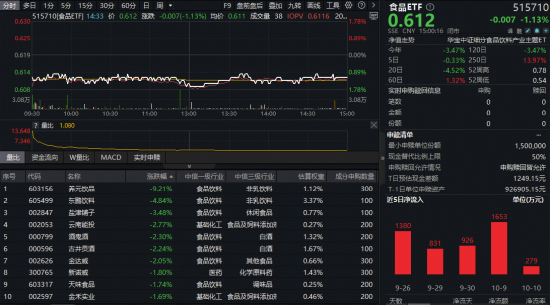
Core Viewpoint - The food and beverage sector continues to experience a pullback, with significant declines in major stocks, particularly in the liquor segment, while the Food ETF (515710) shows signs of increased investment interest despite the downturn [1][3][5]. Group 1: Market Performance - The Food ETF (515710) fluctuated throughout the day, with an intraday drop of 1.78% and a closing decline of 1.13% [1]. - Major consumer goods stocks, especially in the liquor category, saw substantial declines, with Yangyuan Beverage down 9.21%, Dongpeng Beverage down 4.84%, and Yanjinpuzi down 3.48% [1][3]. - Over the past five trading days, the Food ETF has attracted a total investment of 50.68 million yuan, and over the last ten days, it has exceeded 110 million yuan [1]. Group 2: Sales Growth in Liquor - During the National Day and Mid-Autumn Festival period, premium liquor brands experienced significant sales growth, with Moutai's sales increasing nearly tenfold year-on-year, and Wuliangye's sales growing nearly threefold [3]. - The rise in sales for these brands indicates a strong premium pricing capability in the instant retail channel, which is becoming a new growth driver for liquor companies [3]. Group 3: Industry Outlook - Analysts suggest that the food and beverage sector is currently at a favorable valuation point, with the food index's price-to-earnings ratio at 20.31, marking a low point in the last decade [3]. - The white liquor sector is expected to see a recovery in sales during peak seasons, with strong performance from leading companies and ongoing supply-side improvements [4]. - The overall sentiment in the liquor market is improving, with some leading companies signaling price stability and channel support [5].




古井贡酒入围《经济观察报》2024—2025年度受尊敬企业
Jing Ji Guan Cha Wang· 2025-10-13 10:05
Core Insights - Gujinggong Liquor (000596) has been recognized as a respected enterprise for the 2024-2025 period by Economic Observer, highlighting its excellent performance in quality operations, innovation breakthroughs, and social contributions [1] Financial Performance - The company has achieved positive growth in key financial metrics including operating revenue, net profit, total assets, and R&D expenses for three consecutive years [1]
食品饮料行业周报:双节白酒动销符合预期,关注景气度较高的子行业龙头-20251013
CHINA DRAGON SECURITIES· 2025-10-13 09:51
Investment Rating - The investment rating for the food and beverage industry is "Recommended" [2][27]. Core Views - The performance of the liquor sector during the recent Mid-Autumn Festival and National Day was in line with market expectations, with an overall sales decline of 20%-30% [24][28]. - The report suggests focusing on leading companies in sub-industries with high growth potential and lower valuations after recent corrections [27][29]. Summary by Sections Recent Market Performance - The food and beverage sector experienced a slight decline, with the Shenwan Food and Beverage Index falling by 0.29%, ranking 27th among Shenwan's primary industries [5][27]. - Sub-industries such as dairy (+1.13%), condiments (+0.74%), and meat products (+0.60%) showed positive growth, while other liquor categories saw declines [14][27]. Liquor Industry Insights - The report indicates that high-end liquor brands like Moutai, Wuliangye, and Fenjiu performed relatively well despite the overall market downturn [24][28]. - The report anticipates continued pressure on the overall financial performance of the liquor sector as it enters the third-quarter reporting period [28]. Consumer Goods Sector - The soft drink and snack sectors maintain a high level of market vitality, with companies like Dongpeng Beverage and Yanjinpuzi showing growth potential [29]. - The report highlights that the soft drink category is a necessity for daily outings, suggesting resilience in growth during holiday periods [29]. Key Company Focus - The report emphasizes the importance of monitoring companies such as Guizhou Moutai, Luzhou Laojiao, and Wuliangye for their stable performance in the high-end liquor market [28]. - It also recommends attention to regional leaders like Shanxi Fenjiu and Gujing Gongjiu for their resilience [28]. Price Fluctuations - Recent price movements for key liquor products include an increase in the price of Feitian Moutai, with the price per bottle rising from 1760 RMB to 1765 RMB for loose bottles and from 1780 RMB to 1795 RMB for packaged bottles [19][21]. - The average price of fresh milk remained stable at 3.04 RMB per kilogram, while other commodity prices such as sugar and soybeans showed slight fluctuations [21][21]. Company Announcements - Dongpeng Beverage is in the process of issuing H-shares and has updated its listing application with the Hong Kong Stock Exchange [24][29]. - Guangzhou Restaurant reported a 1.75% increase in mooncake sales compared to the previous year, with total sales reaching 13.98 million boxes [26]. Earnings Forecasts - The report provides earnings per share (EPS) forecasts for key companies, with Guizhou Moutai projected to have an EPS of 74.38 RMB in 2025, while Dongpeng Beverage is expected to reach 8.51 RMB [30][31]. - The price-to-earnings (PE) ratios for these companies indicate a favorable investment outlook, with Moutai at 19.2 and Dongpeng at 36.6 [30].

浙商证券:双节动销表现平淡 预计25Q3大部分酒企业绩仍同比下行
智通财经网· 2025-10-13 06:56
Core Viewpoint - The overall performance of the liquor industry in Q3 2025 is under pressure, with slow payment collection, increased inventory, and weak batch prices due to the impact of the "ban on alcohol" [1][2] Payment Collection - The payment collection progress for liquor companies in Q3 2025 has slowed down significantly, with only Kweichow Moutai expected to maintain a collection rate similar to previous years, while other companies face relative pressure [1][2] Sales Performance - The sales performance in Q3 2025 is under pressure, particularly in June and July due to the "ban on alcohol," although there has been some improvement in August and September. Kweichow Moutai has shown resilience with significant sales growth in August and September, with a year-on-year increase exceeding 20% [2][3] Inventory Levels - After a slight decrease in inventory levels in Q1 2025, the overall inventory in the liquor industry has accumulated due to a significant slowdown in sales since Q2 2025. The inventory is expected to decrease during the Mid-Autumn Festival and National Day, but channel inventory may not see significant reduction [2][3] Batch Prices - Batch prices for most liquor products are under pressure due to the "ban on alcohol" and aggressive promotional activities during the festive season. High-end liquor prices, such as Feitian Moutai, have dropped to 1750-1800 RMB, while other products like Wuliangye have also seen price declines [2][3] Price Segment Analysis - High-end liquor: Kweichow Moutai is expected to maintain growth, while Wuliangye and Luzhou Laojiao may face slight pressure in Q3 2025 - Mid-range liquor: Significant differentiation is expected, with Shanxi Fenjiu showing stable performance, while other brands may benefit from low base effects - Regional leaders: Brands like Gujinggongjiu and Yingjia Gongjiu are still adjusting and may be significantly impacted by the "ban on alcohol" [3][4] Earnings Forecast - Overall, liquor companies are expected to face pressure, with most companies' performance in Q3 2025 projected to decline year-on-year. However, Kweichow Moutai is anticipated to achieve revenue and profit growth, while others like Wuliangye and Shanxi Fenjiu may perform relatively steadily [4] Investment Recommendations - The company suggests focusing on bottom-range allocation opportunities in the liquor sector, recommending leading brands like Kweichow Moutai, Shanxi Fenjiu, and Wuliangye, as well as other brands with growth potential and lower valuations [5]

低度白酒是趋势,但不是风口
Sou Hu Cai Jing· 2025-10-13 05:54
Core Viewpoint - The emergence of low-alcohol liquor is a long-term trend in the industry, but it is not expected to rapidly become a mainstream market segment [2][4][22]. Demand Matching - Low-alcohol liquor faces challenges in matching consumer preferences, particularly in the low-end market where consumers prefer higher alcohol content, typically above 40 degrees [3][5]. - The mid-range market, targeting middle-class consumers, struggles to meet quality-price ratios, as low-alcohol options often fail to match established quality benchmarks [7]. Market Constraints - The high-end market has shrunk due to anti-corruption measures, limiting the consumption scenarios for low-alcohol liquor, which requires strong brand leadership to penetrate this segment [8][12]. - Technical barriers exist in producing low-alcohol liquor that maintains desirable flavor profiles and stability, which hinders rapid market growth [9][10]. Market Maturity Timeline - The transition to low-alcohol liquor as a mainstream choice will take 3-5 years, requiring significant industry investment in consumer education and brand development [12][22]. - Competition from other low-alcohol beverages poses a challenge, necessitating differentiation in flavor and style [12]. Lack of Market Leadership - The absence of strong benchmark brands in the low-alcohol segment limits its growth potential, as seen in previous successful market trends [13][15]. Consumer Perception Issues - Misconceptions equating low alcohol content with low value hinder the market's growth, necessitating a shift in consumer perception [15][22]. - The marketing of low-alcohol liquor is challenged by the decline of traditional retail channels, requiring direct engagement with consumers [15][22]. Industry Resistance - Internal resistance within companies to shift focus from high-alcohol to low-alcohol products complicates market entry and expansion [19][22]. - Regulatory standards regarding alcohol content restrict the development of low-alcohol products, impacting market dynamics [19]. Strategic Recommendations - Companies should focus on steady development rather than chasing fleeting trends, ensuring alignment with consumer maturity and market conditions [22][24]. - Targeting the mid-range market (100-300 yuan) is crucial for breaking into the low-alcohol segment, with strategies to gradually expand into higher and lower markets [23]. - Collaboration with light bottle liquor can enhance market competitiveness and broaden consumer appeal across different segments [25].