
GREE(000651)

Search documents
格力电器:公司自2021年率先推出“内销家用空调十年免费包修”政策
Zheng Quan Ri Bao· 2025-12-18 13:45
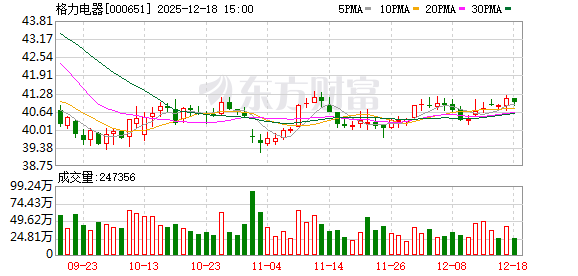
证券日报网讯 12月18日,格力电器在互动平台回答投资者提问时表示,公司自2021年在行业内率先推 出"内销家用空调十年免费包修"政策,底气源于公司在核心科技自主创新、产品品质严苛把控以及售后 体系持续完善等方面的长期坚持与深厚积累。 (文章来源:证券日报) ...


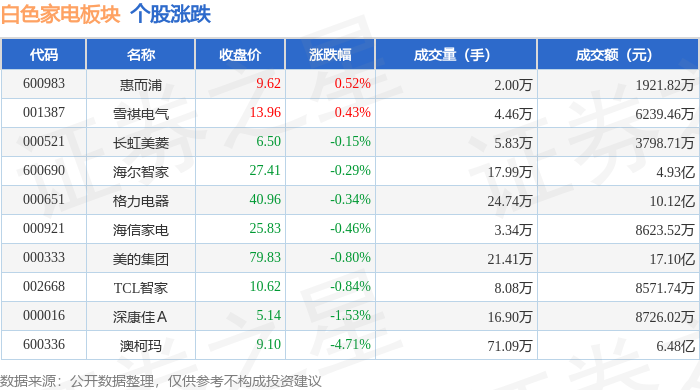
白色家电板块12月18日跌0.62%,澳柯玛领跌,主力资金净流入1155.01万元
Zheng Xing Xing Ye Ri Bao· 2025-12-18 09:02
Market Overview - The white goods sector experienced a decline of 0.62% on December 18, with Aucma leading the drop [1] - The Shanghai Composite Index closed at 3876.37, up 0.16%, while the Shenzhen Component Index closed at 13053.98, down 1.29% [1] Individual Stock Performance - Whirlpool (600983) closed at 9.62, up 0.52% with a trading volume of 20,000 shares and a turnover of 19.2182 million yuan [1] - Snowball Electric (001387) closed at 13.96, up 0.43% with a trading volume of 44,600 shares and a turnover of 62.3946 million yuan [1] - Changhong Meiling (000521) closed at 6.50, down 0.15% with a trading volume of 58,300 shares and a turnover of 37.9871 million yuan [1] - Haier Smart Home (600690) closed at 27.41, down 0.29% with a trading volume of 179,900 shares and a turnover of 493 million yuan [1] - Gree Electric (000651) closed at 40.96, down 0.34% with a trading volume of 247,400 shares and a turnover of 1.012 billion yuan [1] - Hisense Home Appliances (000921) closed at 25.83, down 0.46% with a trading volume of 33,400 shares and a turnover of 86.2352 million yuan [1] - Midea Group (000333) closed at 79.83, down 0.80% with a trading volume of 214,100 shares and a turnover of 1.710 billion yuan [1] - TCL Smart Home (002668) closed at 10.62, down 0.84% with a trading volume of 80,800 shares and a turnover of 85.7174 million yuan [1] - Deep Blue Konka A (000016) closed at 5.14, down 1.53% with a trading volume of 169,000 shares and a turnover of 87.2602 million yuan [1] - Aucma (600336) closed at 9.10, down 4.71% with a trading volume of 710,900 shares and a turnover of 648 million yuan [1] Capital Flow Analysis - The white goods sector saw a net inflow of 11.5501 million yuan from institutional investors, while retail investors contributed a net inflow of 56.1258 million yuan [1] - However, there was a net outflow of 67.6759 million yuan from speculative funds [1] Detailed Capital Flow by Company - Midea Group (000333) had a net inflow of 10.2 million yuan from institutional investors, but a net outflow of 11.9 million yuan from speculative funds [2] - Gree Electric (000651) saw a net inflow of 13.5475 million yuan from institutional investors, with a net outflow of 30.2722 million yuan from retail investors [2] - Hisense Home Appliances (000921) had a net inflow of 5.6853 million yuan from institutional investors, but a net outflow of 6.9064 million yuan from retail investors [2] - Changhong Meiling (000521) experienced a net outflow of 26.61 million yuan from institutional investors [2] - Whirlpool (600983) had a net outflow of 35,100 yuan from institutional investors [2] - Snowball Electric (001387) saw a net outflow of 1.3889 million yuan from institutional investors [2] - TCL Smart Home (002668) had a net outflow of 6.753 million yuan from institutional investors [2] - Deep Blue Konka A (000016) experienced a significant net outflow of 15.4027 million yuan from institutional investors [2] - Haier Smart Home (600690) had a net outflow of 21.8413 million yuan from institutional investors [2] - Aucma (600336) faced a substantial net outflow of 63.8104 million yuan from institutional investors [2]




格力电器:致力于为全球消费者创造美好生活
Zheng Quan Ri Bao· 2025-12-18 08:14
Core Viewpoint - Gree Electric Appliances has established a strong presence in international markets with its own brand matrix, achieving nearly 70% of its export sales from self-owned brands, which is leading in the industry [2] Group 1: Brand and Market Presence - Gree has developed a brand matrix that includes GREE, TOSOT, and KINGHOME, which covers various international markets [2] - The company’s self-owned brand split air conditioners rank among the top in market share in North America, Canada, Europe (Hungary, Poland), and Asia (Saudi Arabia, UAE, Indonesia, Laos) [2] Group 2: Future Strategy - Gree plans to deepen cooperation with local partners and enhance market promotion efforts to further increase market share [2] - The company is committed to its brand mission of "making the world love Chinese manufacturing" and aims to create a better life for global consumers [2]
格力电器:公司已将利用滑雪场景进行营销策划的建议转达给市场部门参考
Zheng Quan Ri Bao Zhi Sheng· 2025-12-18 08:13
Core Viewpoint - Gree Electric Appliances has acknowledged investor suggestions regarding marketing strategies utilizing ski resort themes, indicating a focus on brand rejuvenation and insights into consumer trends among younger demographics [1] Group 1 - The company expressed gratitude for the marketing suggestion from investors [1] - Insights into hot trends and young consumer habits are seen as providing innovative ideas for brand rejuvenation [1] - The suggestion has been forwarded to the marketing department for consideration [1]
格力电器:公司2024年未收购汽车制造企业
Zheng Quan Ri Bao Wang· 2025-12-18 07:47
Group 1 - The core viewpoint of the article is that Gree Electric Appliances (000651) has confirmed it will not acquire an automotive manufacturing company in 2024 [1] Group 2 - Gree Electric Appliances responded to investor inquiries on its interactive platform [1] - The announcement clarifies the company's strategic direction for the upcoming year [1]
格力电器:公司会持续研究AI技术在更广泛场景中的应用
Zheng Quan Ri Bao Wang· 2025-12-18 07:44
Core Viewpoint - Gree Electric Appliances emphasizes the importance of artificial intelligence (AI) technology in its operations, integrating it into production, research and development, and customer service to enhance efficiency and accuracy in service responses [1] Group 1 - The company has developed an intelligent customer service system and an after-sales knowledge base using AI technology [1] - Gree Electric Appliances is committed to ongoing research into broader applications of AI technology [1]
在-25℃的祖国东极,董明珠为“中国制造”正名
Xin Lang Cai Jing· 2025-12-18 03:38
Core Viewpoint - Gree Electric successfully conducted a "100-hour live extreme cold survival challenge" in Fuyuan, Heilongjiang Province, showcasing the heating performance of its air conditioners in temperatures as low as -25°C, emphasizing the strength of Chinese manufacturing and core technology [1][8]. Group 1: Event Overview - The event took place from December 11 to 15, 2025, in Fuyuan, known as China's coldest city, providing an ideal environment to test air conditioning performance under extreme conditions [1][9]. - Gree's live demonstration highlighted the stability of its air conditioning products, maintaining indoor temperatures around 20°C despite outdoor temperatures dropping to -25°C [2][9]. Group 2: Technology and Quality Assurance - Gree's Chairman, Dong Mingzhu, addressed the "aluminum replacing copper" issue, stating that while aluminum can be a substitute, it does not yet meet the same technical standards as copper, which is crucial for product reliability [2][10]. - Copper constitutes about 20% of the cost of air conditioners, and Gree maintains a high standard of quality assurance, including a ten-year free repair policy, to ensure product reliability [3][10]. Group 3: Brand Development and Market Strategy - Gree has transitioned from "product export" to "brand export," achieving over 70% brand recognition in international markets, with significant presence in over 190 countries [4][11]. - The company’s strategy emphasizes quality as a core component of its brand identity, which has led to a high customer trust level and a low after-sales failure rate of less than 0.02% [5][12]. Group 4: Corporate Philosophy and Market Position - Gree avoids participating in price wars within the domestic appliance industry, focusing instead on innovation and quality to achieve sustainable growth [7][13]. - The choice of Fuyuan for the extreme cold challenge symbolizes Gree's commitment to quality and innovation, reflecting a spirit of exploration and resilience in challenging environments [7][13].
董明珠回应铝代铜争议,格力坚持铜管可靠性
Xin Lang Cai Jing· 2025-12-18 02:03
董明珠对空调行业"铝代铜"的公开回应引发广泛关注,她强调格力坚持使用铜管的核心原因是铝材在长 期可靠性和技术保障上仍无法与铜媲美。 一、格力立场与技术争议 明确拒绝铝代铜 董明珠表示,铝在导热性(铜的导热系数约为铝的1.6倍)、耐腐蚀性(尤其酸性环境)及长期冷热循 环下的稳定性(铝膨胀系数高易导致焊口开裂)存在天然缺陷。尽管格力已研究铝代铜技术多年,但铝 材仍无法达到铜管同等质量保障,因此"不敢保证替代后的产品寿命"。 格力官方回应称,目前没有铝代铜计划,铜材在长期可靠性方面的优势是技术替代的前提。 铝材的技术瓶颈 成本与资源压力驱动 物理性能差距:铝的导热效率仅为铜的60%,需增大换热面积补偿;耐腐蚀性弱,潮湿环境易氧化;膨 胀系数高,长期冷热循环可能引发制冷剂泄漏。 验证不足:实验室数据与实际工况存在差异,铝管空调在极端环境(如高湿度、高盐雾)的长期可靠性 缺乏大规模市场验证。 二、行业联盟的推进动因 铜价高企:2025年铜价突破1万美元/吨,单台空调铜材成本占比达20%-30%,而铝价仅为铜的1/4,替 换后可降低单台成本约400元,对年销千万台的企业利润影响显著。 资源安全:中国铜资源进口依赖度超80 ...
美的海尔小米抱团推空调铝代铜,为何董明珠特立独行?
Sou Hu Cai Jing· 2025-12-17 23:13
Core Viewpoint - The home appliance industry is witnessing a rare trend of collaboration among major air conditioning companies to promote a self-regulatory convention regarding the use of aluminum in air conditioning systems, while Gree, a leading player, has not joined this initiative [2][4][14]. Industry Collaboration - Major brands such as Midea, Haier, and others have announced a self-regulatory convention to prohibit malicious attacks and promote the characteristics of aluminum heat exchanger air conditioners [2]. - Gree, traditionally a leader in the industry, has publicly stated it does not have plans to adopt aluminum in place of copper, citing concerns over aluminum's technical capabilities [2][11]. Market Reactions - Gree's stock price has risen despite the industry's shift towards aluminum, while the stocks of companies that joined the convention have shown volatility, indicating challenges in the widespread adoption of aluminum [5]. - The rising copper prices have led to increased costs for air conditioning manufacturers, prompting discussions about the potential benefits of switching to aluminum [6][10]. Cost Analysis - The cost of copper is significantly higher than aluminum, with copper prices reaching approximately 93,500 yuan per ton compared to aluminum at around 21,862.5 yuan per ton [7]. - The use of copper in air conditioning units accounts for about 26% to 33% of the total cost, with high-end models using up to 40% [9]. - If aluminum were to replace copper, Midea could save approximately 23.2 billion yuan, Gree 17.3 billion yuan, and Haier 12.4 billion yuan in costs [10]. Technical Considerations - Gree has expressed concerns about aluminum's durability and reliability, stating that aluminum components may have a shorter lifespan compared to copper, which could conflict with their commitment to a ten-year warranty [11][12]. - The industry consensus suggests that while aluminum can be used in non-pressurized components, it is not suitable for critical parts of the cooling system due to issues like corrosion and welding difficulties [11][12]. Consumer Perception - A significant portion of consumers (68%) prioritize whether an air conditioner is made of copper when making purchasing decisions, indicating that Gree's commitment to copper may enhance its brand perception [15]. - The push for aluminum in the industry is partly driven by government strategies to promote resource efficiency, but consumer trust in aluminum's performance remains a concern [14][16].



大消费行业主题报告
2025-12-17 15:50
Summary of Key Points from Conference Call Records Industry Overview - The conference call discusses the **large consumption sector**, highlighting the emergence of new consumer demands that drive growth in the sector through new products (personalized, green, low-carbon), new channels (snack chains, discount formats), and new business models (diverse consumption scenarios) supported by the "14th Five-Year Plan" [1][2]. Core Insights and Arguments - **Traditional Consumption Recovery**: The traditional consumption sector is expected to recover by 2026, driven by the release of residents' purchasing power and policy measures aimed at boosting employment and income stability. The food and beverage industry is stabilizing, with the liquor sector showing signs of fundamental stability and dairy products expected to recover quickly [1][5]. - **Commodity Market Trends**: The commodity market has shown a trend of high followed by low prices, with the government implementing various promotional policies to stimulate service consumption and domestic demand. The Ministry of Commerce has issued opinions to expand service consumption, aiming to enhance residents' quality of life and stimulate domestic demand potential [1][6][7]. - **Emerging Consumer Demands**: New consumer demands are impacting the large consumption sector through three main directions: the development of new products that meet diverse and personalized needs, the optimization of new channel structures, and the promotion of new business models that foster diverse consumption scenarios [2][4]. Important but Overlooked Content - **Social Services Sector Changes**: The social services sector is evolving to meet changing consumer demands, with slight increases in beauty care and retail sectors. Key areas of investment include outdoor sports, gold and jewelry, and cultural and trendy IPs, with recommendations for companies like Anta Sports and Lao Pu Gold [8][22]. - **Tourism Market Trends**: The tourism market is gradually recovering, with leading companies like Ctrip and Huazhu Group adapting through technological innovation and marketing to meet the new demands of both young and elderly consumers. China Duty Free's Hainan business has benefited significantly from new duty-free policies [9][10]. - **Food and Beverage Sector Stability**: The food and beverage sector is stabilizing, with the liquor market facing challenges but showing resilience in mass consumption. The snack sector is experiencing performance differentiation, while dairy product demand is steady and supply is gradually clearing [12][17]. - **Investment Opportunities in Agriculture**: The agriculture, forestry, animal husbandry, and fishery sectors present investment opportunities, particularly in pig farming and the pet industry, which is growing due to demographic changes and emotional needs [3][13][19]. - **Household Appliance Sector**: The household appliance industry is seeking structural highlights amid steady growth, with a focus on high-dividend white goods and improving profit margins in black goods. The market for robotic vacuum cleaners is also expected to grow due to technological advancements [20][21]. This summary encapsulates the key points discussed in the conference call, providing insights into the large consumption sector and its various components, along with potential investment opportunities and market trends.

