
ZGXT(000831)

Search documents
F35停产、光刻机断供,中国稀土出手直击命门,特朗普制裁成笑话
Sou Hu Cai Jing· 2025-10-25 08:18
Core Viewpoint - China's Ministry of Commerce announced stricter export controls on rare earth-related items and technologies, impacting the entire industry chain from mining to manufacturing, including foreign rare earth products with over 0.1% Chinese components [1][10] Group 1: Impact on Global Supply Chain - The new regulations are described as "almost unprecedented" by the Wall Street Journal, indicating the significant impact on global supply chains [1] - China accounts for 69% of the global rare earth production, but its real leverage lies in its control over refining and separation technologies [3] - The U.S. military's F35 program has faced supply risks due to reliance on Chinese rare earth materials, highlighting the critical nature of these resources [3][5] Group 2: Effects on Specific Companies - ASML, a key player in the semiconductor industry, may face delivery uncertainties for its EUV lithography machines due to the new regulations affecting essential rare earth materials [5] - MP Materials, the largest U.S. rare earth producer, is unable to provide a complete supply chain, as the U.S. lacks the necessary refining and separation capabilities [7][8] Group 3: Strategic Timing and Broader Implications - The timing of China's announcement coincided with U.S. actions against Chinese companies, suggesting a strategic response to regain control in trade negotiations [10] - China's export control measures are framed as a standard international practice aimed at safeguarding national security and interests [10][12] - The establishment of an export licensing system allows for continued commercial use while restricting military applications, creating uncertainty for foreign companies [12] Group 4: Long-term Industry Development - China's rare earth industry has developed a complete supply chain over decades, emphasizing the importance of technological accumulation and industry resilience [14] - The recent export controls underscore the significance of resource control in modern technological competition, where both technological advancement and supply chain integrity are crucial [14]



美国终于低头!中国稀土卡脖子让美方让步,资金大举抄底这些股票
Sou Hu Cai Jing· 2025-10-25 07:54
Group 1 - The U.S. threatened to impose a 100% tariff on China starting November 1, but the situation quickly shifted towards a more conciliatory tone from U.S. officials, including Trump, who hinted at a potential visit to China early next year [2][4] - China dominates the global supply of medium and heavy rare earth elements, accounting for 99% of the market, making it essential for U.S. manufacturing and high-tech development [4] - The easing of tensions led to a significant rebound in stock markets, with U.S. tech companies reaching historical highs and A-shares also experiencing a strong recovery, particularly in high-tech sectors [5][6] Group 2 - High-tech sectors such as AI, the Nvidia supply chain, Apple supply chain, Tesla supply chain, robotics, and semiconductors are seeing strong rebounds due to their solid performance and growth potential [5][6] - The market may experience volatility until a final trade agreement is reached, but optimism surrounding the upcoming summit could shift investment focus from safe-haven assets to high-tech growth stocks [6][8] - The recent turnaround in U.S.-China relations presents new investment opportunities, particularly in high-tech growth stocks, which are expected to remain in the spotlight [8]

中国稀土管制才5天,美国战争部突然急忙抢购3000吨锑锭!
Sou Hu Cai Jing· 2025-10-25 05:53
Core Viewpoint - China's announcement to strengthen rare earth export controls has triggered significant global market reactions, impacting high-tech industries and military supply chains worldwide [1][4]. Group 1: China's Rare Earth Dominance - China dominates global rare earth production, accounting for over 60% of total output and more than 80% of refining [1]. - The new export controls will include heavy rare earth elements such as holmium, erbium, thulium, and ytterbium, along with processing equipment and software, set to take effect from November 8 [4]. - In 2024, the U.S. is expected to import over 10,000 tons of rare earth concentrates from China, making up 85% of its total imports [5]. Group 2: Market Reactions and U.S. Response - Following China's announcement, rare earth prices surged, with dysprosium oxide prices increasing by 15% within a week [5]. - The U.S. Department of Defense made significant purchases, including $500 million for cobalt alloys and $245 million for antimony ingots, totaling 3,000 tons, in response to the tightening supply [3]. - U.S. military production lines face risks of stagnation due to reliance on Chinese imports, particularly for antimony, which the U.S. has not produced domestically for 24 years [7]. Group 3: Strategic Implications - The competition for mineral resources between China and the U.S. has intensified, with both countries responding to each other's export controls and tariffs [11]. - The U.S. has initiated efforts to establish a "Mineral Security Partnership" to create alternative supply chains, but new mining projects typically require three to five years to become operational [5]. - Antimony's global demand is growing at 5% annually, with China supplying 60% of the market, highlighting the strategic importance of this material for both military and civilian applications [7][9].
中国稀土重拳出击,欧美全线崩盘,连NASA都撑不住了
Sou Hu Cai Jing· 2025-10-25 05:52
Core Viewpoint - China has shifted from passive resistance to active retaliation in the escalating trade war with the U.S., using rare earths as a strategic leverage point, causing significant global political and economic upheaval [2][6]. Group 1: China's Actions - On October 9, China's Ministry of Commerce announced strengthened controls on rare earth exports, adding five new types to the existing seven and implementing a "0.1% rule" for heavy rare earth metals in certain materials, marking a historic first for strict regulation of trace rare earths [6]. - Following this, Chinese customs issued four new announcements that comprehensively restricted the export of rare earth materials, lithium batteries, and artificial graphite anode materials, leading to turmoil in the global technology supply chain [6][9]. Group 2: Impact on Global Players - The primary target of China's rare earth retaliation is perceived to be the U.S., but the European Union is the actual victim, particularly countries like Germany, the Netherlands, and France, which rely heavily on manufacturing and had hoped to lead the global clean energy transition [6][11]. - The semiconductor industry, especially the Dutch company ASML, which relies heavily on rare earths, felt immediate pressure, prompting calls for negotiations with China [7]. - The U.S. was caught off guard, with critical projects like NASA's lunar missions and Boeing's military contracts facing disruptions due to the rare earth controls [7][11]. Group 3: European Response and Challenges - The EU's attempt to retaliate found it in a difficult position, as the U.S. preemptively implemented sanctions that could affect European companies with Chinese ties, leading to a "double bind" situation for Europe [9]. - China also announced special port fees for vessels with significant U.S. investment, further complicating the global shipping industry and impacting European nations [9]. Group 4: Importance of Rare Earths - The situation has highlighted the critical role of rare earths in modern industries, including semiconductors, electric vehicles, wind energy, aerospace, and high-tech products, with China controlling nearly 90% of global rare earth refining capacity [11]. - Japan, despite efforts to reduce dependence on Chinese rare earths, still relies on them for 60% of its needs, reflecting the broader vulnerability of nations reliant on these materials [12].
冲中国稀土地位?一觉醒来,美澳85亿稀土协议落地,誓破中国垄断
Sou Hu Cai Jing· 2025-10-24 10:15
Core Viewpoint - The recent $8.5 billion rare earth agreement between the US and Australia aims to reduce dependence on China for critical minerals, but significant challenges remain in establishing a competitive supply chain [1][28]. Group 1: Agreement Details - The US and Australia plan to invest over $3 billion in Australian rare earth mining projects within the next six months, targeting a total of $53 billion in extractable minerals [6]. - The agreement focuses not only on mining but also on establishing processing facilities in Australia, with plans to produce 100 tons of gallium annually, a key material for advanced radar and electronic systems [8]. Group 2: China's Dominance - China holds nearly half of the world's known rare earth reserves, with significant deposits of heavy rare earths critical for advanced military technology [11]. - The country has a complete rare earth industry chain, controlling 90% of the global separation and purification processes, which gives it substantial bargaining power in the market [14][24]. Group 3: Challenges for the US and Australia - The US and Australia face significant hurdles in replicating China's established rare earth processing capabilities, particularly in the complex and environmentally challenging separation and purification processes [13][17]. - The US has a history of outsourcing its rare earth industry, leading to a lack of domestic expertise and technology, which poses a challenge in re-establishing a competitive supply chain [22][27]. Group 4: Long-term Implications - The $8.5 billion agreement is viewed as a signal of the US's commitment to developing an independent rare earth supply chain, but it is unlikely to disrupt China's dominance in the short term [30]. - The focus should be on technological advancements and high-end applications to maintain a competitive edge, rather than solely on financial investments [30].
小金属板块10月24日涨2.32%,厦门钨业领涨,主力资金净流入5.35亿元
Zheng Xing Xing Ye Ri Bao· 2025-10-24 08:21
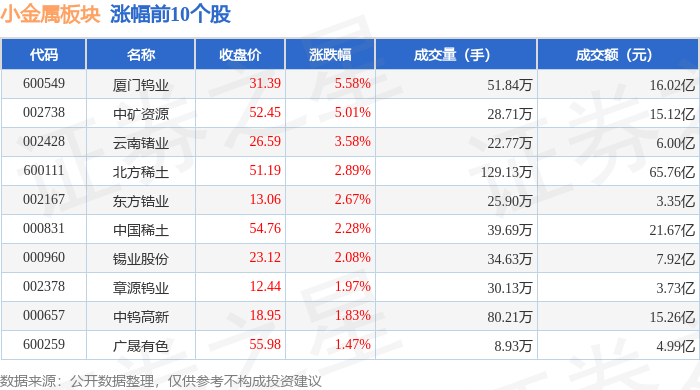
Core Insights - The small metals sector experienced a rise of 2.32% on October 24, with Xiamen Tungsten leading the gains [1] - The Shanghai Composite Index closed at 3950.31, up 0.71%, while the Shenzhen Component Index closed at 13289.18, up 2.02% [1] Small Metals Sector Performance - Xiamen Tungsten (600549) closed at 31.39, up 5.58%, with a trading volume of 518,400 shares and a transaction value of 1.602 billion [1] - Zhongkuang Resources (002738) closed at 52.45, up 5.01%, with a transaction value of 1.512 billion [1] - Yunnan Tin (002428) closed at 26.59, up 3.58%, with a transaction value of 600 million [1] - Northern Rare Earth (600111) closed at 51.19, up 2.89%, with a transaction value of 6.576 billion [1] - Other notable performers include China Rare Earth (000831) and Xiyang Co. (600259), with increases of 2.28% and 1.47% respectively [1] Capital Flow Analysis - The small metals sector saw a net inflow of 535 million from main funds, while retail funds experienced a net outflow of 216 million [2] - Main funds showed significant net inflows in Northern Rare Earth (2.68 million) and Xiamen Tungsten (1.35 million) [3] - Retail funds had notable outflows in Xiamen Tungsten and China Rare Earth, indicating a shift in investor sentiment [3]


西方硬碰中国稀土,疯狂施压引发全球震荡,格局逆转恐难实现
Sou Hu Cai Jing· 2025-10-24 06:47
Core Viewpoint - The article discusses the strategic partnership between the US and Australia aimed at reducing dependence on Chinese rare earths, highlighting the challenges and complexities involved in reshaping the global rare earth supply chain [1][12]. Group 1: Strategic Initiatives - A significant agreement worth $8.5 billion was signed between Australian Prime Minister Albanese and US President Trump to end reliance on Chinese rare earths [1]. - The US and Australia plan to invest $1 billion each within six months to leverage an additional $5 billion in private capital for developing a new rare earth supply chain [3]. - The US Department of Defense will support the establishment of a gallium refining plant by Alcoa in Western Australia, with an expected annual output of 100 tons [4]. Group 2: Company Developments - Lynas has secured a $258 million contract from the US to build a heavy rare earths plant in Texas, aiming for trial production in 2027 and commercial operations in 2028 [4]. - Noveon, the only permanent magnet manufacturer in the US, plans to build a magnet materials factory in Texas, targeting military and electric vehicle sectors [5]. - Iluka Resources is advancing in the refining sector with a plant in Eneabba, Western Australia, expected to start operations by the end of 2026, supported by $1.6 billion from the Australian government [9]. Group 3: Market Dynamics - The Australian government has established a strategic reserve pool of AUD 1.2 billion and introduced a price floor mechanism to foster a "Western mineral alliance" [7]. - Western Australia is attracting 45% of global rare earth exploration funding, with 89 active projects in the region [9]. - The stock market reflects investor enthusiasm for mining companies, with significant price increases as they are seen as crucial for future energy and defense supplies [10]. Group 4: Technical Challenges - The real challenge lies in the refining process of rare earths, which is complex and has significant technical barriers, making it difficult to replicate China's established processes [10][12]. - MP Materials and Lynas have made progress in light rare earth mining, but their refining capabilities remain limited, with a high percentage of refined materials still needing to be processed in China [11]. - China's dominance in rare earth refining, with 92% of global capacity, poses a significant hurdle for US and Australian efforts to establish an independent supply chain [11][12].

APEC前欲温和,特朗普怒斥卢特尼克,中国稀土夺回节奏
Sou Hu Cai Jing· 2025-10-24 05:50
Group 1 - The U.S. is facing internal conflicts regarding its China policy, highlighted by a recent incident where Secretary of Commerce Lighthizer was criticized for unapproved sanctions against Chinese tech companies, disrupting the White House's diplomatic strategy ahead of APEC [1] - China's tightening of rare earth material exports has significant implications for high-end manufacturing, semiconductors, clean energy, and military industries, directly challenging the U.S. "de-risking" strategy [1][2] - The U.S. has implemented various measures such as tariffs and technology restrictions, but these have not effectively pressured China, which is accelerating its self-research and supply chain restructuring in critical areas [1] Group 2 - The impact of rare earth controls is not limited to individual components but leads to a chain reaction affecting production lines, R&D delays, and financial pressures on companies, which will be reflected in quarterly reports [2] - The current chaotic situation in U.S. policy-making is attributed to a "grab the spotlight" culture, where agencies act independently rather than in a coordinated manner, resulting in a perception of disorder rather than strength [2] - The ongoing geopolitical competition has entered a phase of precise strikes and long-term attrition, requiring the U.S. to stabilize its strategy, clarify objectives, and improve coordination among departments to regain initiative [4]
急急急!要不到中国稀土,欧盟电话打到北京,答应帮中方解决麻烦
Sou Hu Cai Jing· 2025-10-24 05:33
Core Viewpoint - The EU is softening its stance towards China regarding rare earth supply issues, recognizing the critical dependence on Chinese resources for its high-tech industries, particularly in the context of electric vehicles and semiconductors [1][3][11] Group 1: EU's Position and Actions - The EU expressed understanding of China's export controls on rare earths, indicating a willingness to assist in resolving issues related to ASML, a Dutch semiconductor company [1][3] - The EU's previous hardline approach has shifted to seeking cooperation with China, driven by the urgent need to secure rare earth supplies for its industries [1][7] - The upcoming EU-China export control dialogue in Brussels will be crucial for assessing the outcomes of this cooperation [9] Group 2: Implications of US-China-EU Dynamics - The US has been attempting to align the EU with its strategy to contain China, creating a dilemma for the EU regarding its dependence on Chinese rare earths and market access [5][11] - The EU's communication with China can be seen as a counter to US strategies, highlighting the necessity of dialogue for stable supply chains [7] - The EU's evolving stance reflects a broader change in the global power dynamics of the supply chain, with China emerging as a key player in resource governance [11] Group 3: Future Prospects - If the EU can facilitate the resumption of ASML's operations, it may lead to a breakthrough in EU-China economic relations [11] - The EU's ability to navigate its relationship with the US while addressing its own resource needs will be critical for achieving its long-term goals, such as carbon neutrality and the transition away from fossil fuels [11]
中国稀土涨2.17%,成交额7.21亿元,主力资金净流入885.22万元
Xin Lang Cai Jing· 2025-10-24 02:26
Core Viewpoint - China Rare Earth's stock price has shown significant volatility, with a year-to-date increase of 95.01%, but a recent decline of 2.67% over the last five trading days [1] Company Overview - China Rare Earth Group Resources Technology Co., Ltd. is located in Jiangxi Province and was established on June 17, 1998, with its listing date on September 11, 1998. The company specializes in rare earth smelting separation and technology research and services [1] - The main revenue composition includes rare earth oxides (63.51%), rare earth metals and alloys (35.95%), other (0.35%), and technology service income (0.18%) [1] Financial Performance - For the first half of 2025, China Rare Earth achieved operating revenue of 1.875 billion yuan, a year-on-year increase of 62.38%, and a net profit attributable to shareholders of 162 million yuan, reflecting a growth of 166.16% [2] - Cumulative cash dividends since the A-share listing amount to 346 million yuan, with 124 million yuan distributed over the past three years [3] Shareholder Information - As of September 19, 2025, the number of shareholders for China Rare Earth reached 230,000, an increase of 6.66% from the previous period, with an average of 4,614 circulating shares per person, a decrease of 6.25% [2] - The top ten circulating shareholders include Hong Kong Central Clearing Limited and Southern CSI 500 ETF, with notable increases in their holdings [3] Market Activity - On October 24, the stock price rose by 2.17% to 54.70 yuan per share, with a trading volume of 721 million yuan and a turnover rate of 1.25%, resulting in a total market capitalization of 58.049 billion yuan [1] - The stock has appeared on the "Dragon and Tiger List" six times this year, with the most recent instance on October 13, where net purchases amounted to 267 million yuan [1]