
ZGXT(000831)

Search documents
冲击中国稀土地位?美澳签85亿协议,却露软肋:12种矿产依赖进口
Sou Hu Cai Jing· 2025-10-24 00:18
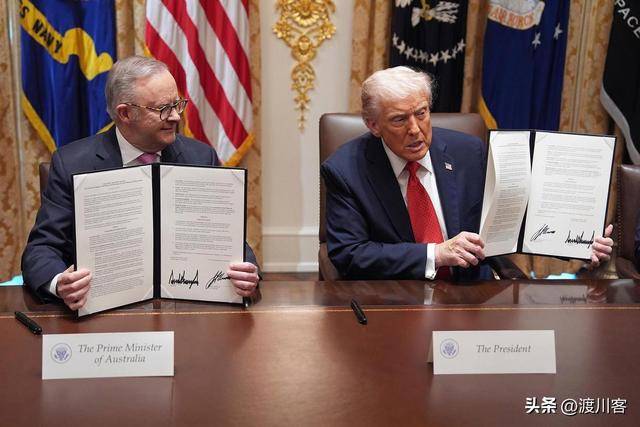
Core Viewpoint - The recent $8.5 billion rare earth agreement between the US and Australia is seen as largely symbolic, with significant challenges remaining for the US to reduce its dependence on China for rare earth materials [2][6][22]. Group 1: Agreement Details - The agreement was signed on October 20, with Trump expressing confidence that the US would have an abundance of rare earths within a year [2]. - The deal involves both countries committing $1 billion each over six months to stimulate private investment in rare earth processing facilities [11][24]. - The agreement is perceived as a facade, with Australia’s Prime Minister Albanese aware that the timeline for achieving independence from China is unrealistic [11][24]. Group 2: Current Industry Landscape - The US is heavily reliant on imports for 12 critical minerals, with rare earths being 100% imported, despite having domestic mining resources [6][19]. - China dominates the rare earth supply chain, controlling over 90% of the refining and processing, and holding a significant number of patents [4][22]. - Japan's historical attempts to reduce reliance on China for rare earths have shown limited success, with current dependence still at 58% despite significant investments [13][15]. Group 3: Production Capacity - Lynas, the largest rare earth producer outside of China, has a processing capacity of 5,000 tons per year, while Chinese companies can produce significantly more, with one company alone producing 50,000 to 60,000 tons in 2023 [17][19]. - The US's attempts to build a domestic supply chain have faced numerous obstacles, including environmental regulations and a lack of investment from major corporations [19][21]. Group 4: Future Outlook - The projected timeline for the US to establish a complete rare earth supply chain is estimated to take over a decade and require more than $250 billion, which is not feasible given the rapid pace of technological advancement [21][26]. - The recent agreement is viewed as insufficient to address the underlying issues of supply chain dependency on China, with experts suggesting that mere agreements will not resolve the complexities of the industry [22][26].


黄金反弹 国际油价大涨超5%;扭亏为盈!英特尔公布最新财报;重磅发布会 今天上午10时举行丨每经早参
Mei Ri Jing Ji Xin Wen· 2025-10-23 22:45
Group 1 - The 14th National People's Congress Standing Committee of China is holding its 18th meeting from October 24 to 28 in Beijing [3] - The 2025 World Top Scientists Forum will take place in Shanghai from October 24 to 26 [3] - The U.S. stock market saw all three major indices rise, with the Nasdaq up 0.89%, S&P 500 up 0.58%, and Dow Jones up 0.31% [5] Group 2 - The Chinese government reported that the number of applications for the 2025 automobile trade-in subsidy has exceeded 10 million, with over 57.2% of the vehicles being new energy vehicles [7] - E-commerce in China has shown healthy growth, with online retail sales increasing by 9.8% in the first three quarters of the year [10] Group 3 - Intel reported a third-quarter adjusted earnings per share of $0.23, compared to a loss of $0.46 in the same period last year, with revenue of $13.65 billion, a 2.8% year-over-year increase [27] - NIO has achieved a significant increase in delivery volume, surpassing 10,000 units in a single week for the first time [22] Group 4 - Boeing appointed Landon Loomis as the new president of Boeing China, indicating a strategic focus on the Chinese market [20] - JD.com reported a successful auction for its "National Good Car" with a final bid of 78.19 million yuan, reflecting strong market interest [18]



普京:布达佩斯会晤更像是改期而非取消;黄金反弹,国际油价大涨超5%;扭亏为盈!英特尔公布最新财报;重磅发布会,今天上午10时举行丨每经早参
Mei Ri Jing Ji Xin Wen· 2025-10-23 22:05
每经编辑|陈鹏程 王晓波 1 中国十四届全国人大常委会第十八次会议10月 24日至28日在北京举行 2 欧元区10月综合PMI初值公布 ③美国9月核心CPI、10月密歇根大学消费者信心 指数等数据公布 4 2025世界顶尖科学家论坛将于10月24日至26 日在上海举办 ⑤日本9月CPI公布 1 党的二十届四中全会审议通过"十五五"规划建议 中国共产党第二十届中央委员会第四次全体会议,于2025年10月20日至23日在北京举行。全会由中央政治局主持。中央委员会总书记习近平作了重要讲话。 全会听取和讨论了习近平受中央政治局委托所作的工作报告,审议通过了《中共中央关于制定国民经济和社会发展第十五个五年规划的建议》。习近平就 《建议(讨论稿)》向全会作了说明。(央视新闻) 2 中共中央将于24日上午举行新闻发布会 介绍和解读党的二十届四中全会精神 中共中央将于10月24日上午10时举行新闻发布会,介绍和解读党的二十届四中全会精神。中央广播电视总台及新华网、中国网等将对新闻发布会进行直播。 (央视新闻) 3 隔夜市场 美股三大指数集体收涨,纳指涨0.89%,标普500指数涨0.58%,道指涨0.31%;大型科技股多数上 ...

美国警告断供就踢出SWIFT,中国稀土管制升级直击美国军工与芯片命门
Sou Hu Cai Jing· 2025-10-23 18:58
Core Viewpoint - The international competition over rare earth elements has intensified, particularly following China's announcement of export controls, which significantly impacts the U.S. high-tech sector [1][4]. Group 1: Background of U.S.-China Technology Competition - The U.S. has initiated comprehensive technology restrictions against China, including high-end chip bans and efforts to isolate Huawei, indicating a clear intent to block China's technological advancements [3]. - Initially, China adopted a restrained approach, hoping to gain leverage in future negotiations, but the increasing aggressiveness of U.S. strategies led to a shift in China's stance [3][6]. Group 2: China's Export Control Announcement - On October 9, 2025, China's Ministry of Commerce announced stricter controls on rare earth exports, including new regulations on five elements and stringent approvals for semiconductor-related exports, with military-related exports being largely denied [4]. - China dominates the global rare earth market, producing 65% of the world's supply and holding 49% of reserves, with a market share of 85% in refining and separation technologies [4]. Group 3: U.S. Response and Reactions - Following China's announcement, the U.S. experienced panic, with trade representatives attempting to reach out to China but receiving no response for three days, leading to a drastic change in U.S. tone from arrogance to humility [5]. - U.S. Treasury Secretary offered to extend tariff exemptions in exchange for easing export controls, but China remained resolute in its strategy [5]. Group 4: Implications for U.S. Military and Industry - The U.S. military heavily relies on rare earth elements, with 87% of core military equipment dependent on these resources, making any disruption in supply a significant risk for U.S. defense production [6]. - The U.S. threats to exclude Chinese companies from global markets and the SWIFT payment system are seen as largely bluster, given the critical dependence on rare earths for military capabilities [5][6]. Group 5: Global Supply Chain and Market Reactions - Countries like Australia and Canada are calling for the development of local supply chains, but experts believe it will take 5 to 10 years to close the gap with China due to high technical barriers [8]. - The rare earth price surged by 30% following the announcement, causing declines in U.S. chip stocks and raising concerns among defense contractors [11]. Group 6: Strategic Developments and Future Outlook - China is expanding its currency swap agreements and has seen a doubling in cross-border settlements in RMB, indicating a move towards financial independence from the U.S. [11]. - The historical context of China's previous export restrictions in 2010, which led to a tenfold price increase, suggests that current policies are more structured and less susceptible to WTO intervention [12]. - The ongoing rare earth competition is expected to accelerate the internationalization of the RMB and contribute to a multipolar global economic landscape [13].

中国稀土集团:严格落实出口管制政策 依法合规开展工作
智通财经网· 2025-10-23 12:21
智通财经APP获悉,10月23日,中国稀土集团召开2025年三季度经济运行分析会。会议部署了四季度重 点工作,强调要严格落实出口管制政策,依法合规开展工作;抓好生产经营攻坚,全力稳产保供;抓好 国企改革攻坚,提升治理水平;抓好科技创新攻坚,增强发展动能;抓好项目推进攻坚,加快发展步 伐;抓好风险防控攻坚,筑牢发展底线。 会议指出,今年以来,面对复杂严峻的外部环境,集团公司上下认真贯彻落实习近平总书记重要指示批 示精神,始终坚持以高质量发展为引领,迎难而上、扎实工作,集团公司整体发展态势保持稳中有进。 聚焦价值创造,经营业绩稳步增长;聚焦增储上产,资源保障持续强化;聚焦区域协同,业务结构持续 优化;聚焦强链补链,项目建设提速增效;聚焦瘦身健体,压减治亏深化攻坚;聚焦效能提升,深化改 革纵深推进。 会议强调,要深刻领会党的二十届四中全会关于当前国内外形势的科学判断和对未来发展方向的战略擘 画,善于在挑战中寻求机遇,在困难中锻炼能力,统筹高质量发展与高水平安全实现良性互动。要强化 整合推进,优化产业布局结构;强化科技创新,持续增强核心功能和核心竞争力;强化企业能力建设, 着力提升经营管理质效;强化深化改革攻坚,持续 ...
中国稀土集团:严格落实出口管制政策,依法合规开展工作
Xin Lang Cai Jing· 2025-10-23 12:04
Core Insights - The China Rare Earth Group held an economic operation analysis meeting for Q3 2025, focusing on key tasks for Q4 [1] Group 1: Key Focus Areas - Emphasis on strict implementation of export control policies and compliance in operations [1] - Commitment to production and operational challenges to ensure stable production and supply [1] - Focus on state-owned enterprise reform to enhance governance levels [1] Group 2: Innovation and Development - Prioritization of technological innovation to boost development momentum [1] - Acceleration of project advancement to enhance development pace [1] - Strengthening risk prevention measures to solidify the development baseline [1]
中国稀土集团:严格落实出口管制政策
Zheng Quan Shi Bao Wang· 2025-10-23 12:01
Core Viewpoint - The China Rare Earth Group held an economic operation analysis meeting for Q3 2025, outlining key tasks for Q4, emphasizing strict adherence to export control policies and enhancing production stability [1] Group 1: Key Tasks for Q4 - The company will focus on strict implementation of export control policies and conducting operations in compliance with laws [1] - There will be an emphasis on stabilizing production and supply to ensure operational continuity [1] - The company aims to enhance governance levels through state-owned enterprise reform initiatives [1] Group 2: Innovation and Development - The company plans to strengthen technological innovation to boost development momentum [1] - Project advancement will be prioritized to accelerate the pace of development [1] Group 3: Risk Management - The company will focus on risk prevention to establish a solid foundation for development [1]

中国稀土:严格落实出口管制政策,依法合规开展工作
Xin Lang Cai Jing· 2025-10-23 12:01
Core Viewpoint - The China Rare Earth Group held an economic operation analysis meeting for Q3 2025, focusing on key tasks for Q4 and emphasizing strict implementation of export control policies [1] Group 1: Key Tasks for Q4 - The company will ensure compliance with export control policies and conduct operations legally [1] - There will be a strong focus on production and operational challenges to stabilize production and supply [1] - The company aims to enhance governance levels through state-owned enterprise reform initiatives [1] Group 2: Innovation and Development - Emphasis will be placed on technological innovation to boost development momentum [1] - The company plans to accelerate project advancement to enhance development pace [1] Group 3: Risk Management - There will be a focus on risk prevention to establish a solid development foundation [1]
稀土行业供需格局有望迎来拐点,稀土ETF嘉实(516150)近2周规模增长超26亿元同类居首!
Sou Hu Cai Jing· 2025-10-23 02:10
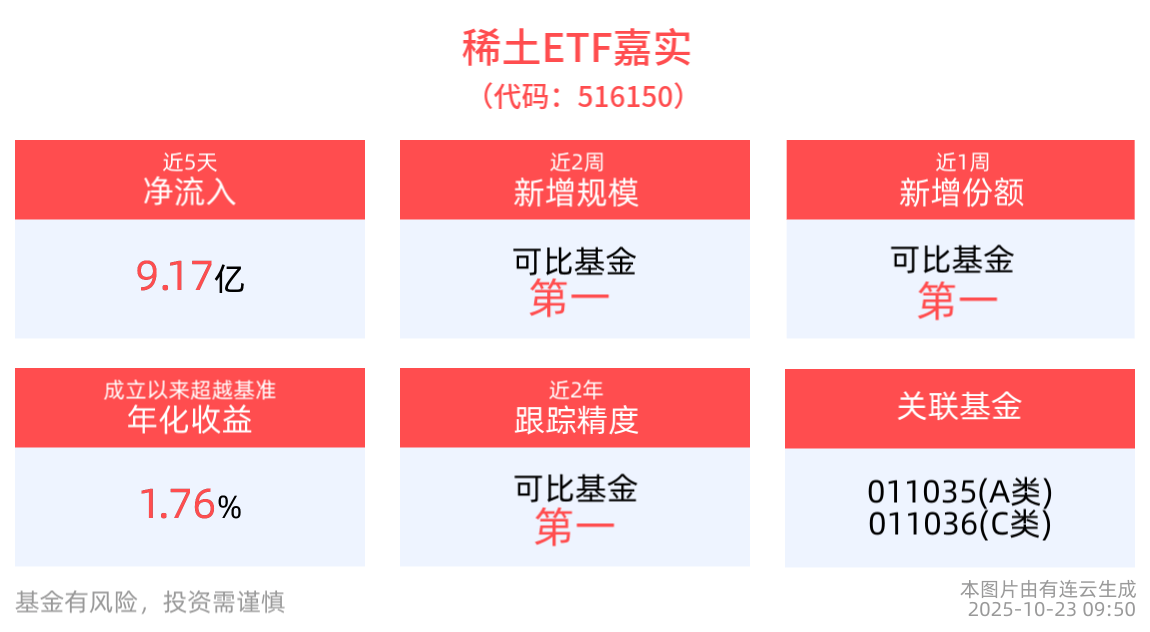
Group 1: Liquidity and Performance of Rare Earth ETF - The liquidity of the Rare Earth ETF managed by Jiashi reached a trading volume of 97.241 million yuan [3] - Over the past two weeks, the scale of the Rare Earth ETF increased by 2.632 billion yuan, marking significant growth and ranking first among comparable funds [3] - In terms of shares, the ETF saw an increase of 10.7 million shares in the past week, also ranking first among comparable funds [3] - In the last five trading days, there were net inflows on three days, totaling 917 million yuan [3] - As of October 22, the net value of the Rare Earth ETF has risen by 88.51% over the past two years, ranking 88th out of 2358 index equity funds, placing it in the top 3.73% [3] - The highest monthly return since inception was 41.25%, with the longest consecutive monthly increase being four months and a maximum increase of 83.89% [3] Group 2: Market Dynamics and Policy Impact - The Ministry of Commerce, in conjunction with the General Administration of Customs and other departments, has issued multiple export control policies, highlighting the strategic nature of rare earth resources [4] - The combination of regulatory constraints and declining imports has strengthened the rigidity of rare earth supply [4] - Demand from sectors such as new energy vehicles, consumer electronics, variable frequency air conditioners, and wind power is expected to continue rising, providing strong support for rare earth prices [4] - Emerging fields like robotics, low-altitude economy, and industrial motors are anticipated to open up long-term demand growth opportunities [4] - The supply-demand dynamics in the rare earth industry are expected to reach a turning point, with a continued recommendation for strategic allocation in the rare earth industry chain [4] Group 3: Top Weighting Stocks in Rare Earth Industry - The top ten weighted stocks in the China Rare Earth Industry Index account for 61.96% of the index, including Northern Rare Earth, Wolong Electric Drive, Lingyi Technology, China Rare Earth, Shenghe Resources, Gree Environmental, Goldwind Technology, Baotou Steel, Xiamen Tungsten, and China Aluminum [3]



中国稀土为何这么强
Si Chuan Ri Bao· 2025-10-22 22:57
Core Insights - The recent announcements by the Ministry of Commerce regarding export controls on rare earths mark a shift in China's approach from point control to a comprehensive chain management strategy, responding to the U.S. "50% rule" [1] - Rare earths are critical for high-tech manufacturing, with China dominating the global market, accounting for nearly 70% of production and possessing the entire supply chain [2][3] - China's technological edge in rare earth processing is supported by a significant number of patents and proprietary extraction techniques, with 82% of new global patents in this field attributed to Chinese companies [2][3] Industry Overview - Rare earths, comprising 17 metal elements, are essential in various advanced manufacturing sectors, including electric vehicles, wind energy, and electronics, influencing both current manufacturing capabilities and future technological competitiveness [2] - The U.S. relies heavily on imports from China, with 70% of its rare earth imports sourced from China, despite having its own mineral reserves [2][4] - The barriers to entry in the rare earth industry are primarily due to the complexities of refining and processing, areas where China holds a significant advantage [2][3] Technological Leadership - China's dominance in rare earth technology is attributed to decades of development, with a complete industrial chain established from mining to processing and application [3][5] - The late academician Xu Guangxian played a pivotal role in developing extraction theories that propelled China's rare earth industry forward [3] - The U.S. has fallen behind in rare earth processing technology after outsourcing these operations in the 1990s, leading to a loss of domestic capabilities [3][4] Future Outlook - The upcoming Rare Earth Management Regulations set to be implemented in October 2024 will encourage innovation and the development of new technologies in the rare earth sector, aiming for high-end, intelligent, and green development [5] - The emphasis on strengthening the domestic industrial base and supply chain resilience is crucial for maintaining competitiveness in the global market [6] - The focus on core technologies and the stability of supply chains is essential for addressing vulnerabilities and ensuring long-term economic security [6]