WLY(000858)

Search documents
11只白酒股下跌 贵州茅台1522.01元/股收盘
Bei Jing Shang Bao· 2025-09-10 08:53
从个股来看,贵州茅台收盘价达1522.01元/股,上涨1.13%;五粮液收盘价达128.06元/股,下跌0.57%; 山西汾酒收盘价达205.92元/股,上涨0.06%;泸州老窖收盘价达139.58元/股,下跌0.52%;洋河股份收 盘价达73.31元/股,下跌0.62%。 北京商报讯(记者 刘一博 冯若男)9月10日尾盘,沪指3812.22点上涨0.13%。白酒板块2364.85点收盘 上涨0.14%,其中11只白酒股下跌,贵州茅台1522.01元/股收盘。 开源证券在公告中指出:"酒企轻装上阵后,有望与后续行业回暖同频共振,资金布局意愿逐步提升。 部分白酒开瓶率已有向好迹象,我们判断基本面底部区间已渐行渐近。" ...





白酒板块9月10日涨0.53%,*ST岩石领涨,主力资金净流入8.96亿元
Zheng Xing Xing Ye Ri Bao· 2025-09-10 08:30
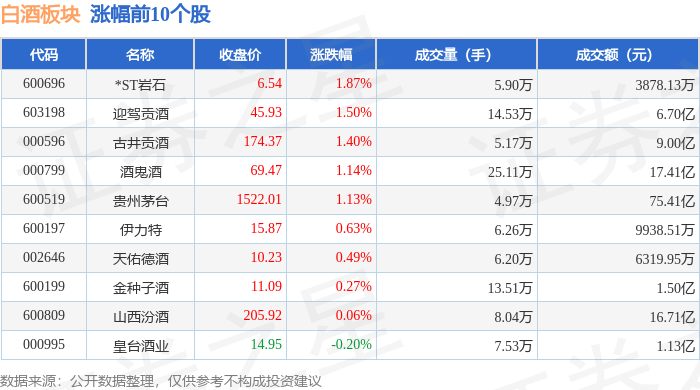
Core Insights - The liquor sector experienced a slight increase of 0.53% on September 10, with *ST Yanshi leading the gains [1] - The Shanghai Composite Index closed at 3812.22, up 0.13%, while the Shenzhen Component Index closed at 12557.68, up 0.38% [1] Liquor Sector Performance - The following companies showed notable performance: - *ST Yanshi: Closed at 6.54, up 1.87% with a trading volume of 59,000 shares and a transaction value of 38.78 million [1] - Yingjia Gongjiu: Closed at 45.93, up 1.50% with a trading volume of 145,300 shares and a transaction value of 670 million [1] - Gujing Gongjiu: Closed at 174.37, up 1.40% with a trading volume of 51,700 shares and a transaction value of 900 million [1] - Jiu Gui Jiu: Closed at 69.47, up 1.14% with a trading volume of 125,110 shares and a transaction value of 1.741 billion [1] - Kweichow Moutai: Closed at 1522.01, up 1.13% with a trading volume of 49,700 shares and a transaction value of 7.541 billion [1] Capital Flow Analysis - The liquor sector saw a net inflow of 896 million from main funds, while retail funds experienced a net outflow of 148 million [2] - The following companies had significant capital flow: - Kweichow Moutai: Main fund net inflow of 827 million, retail fund net outflow of 372,700 [3] - Jiu Gui Jiu: Main fund net inflow of 54.21 million, retail fund net outflow of 91.93 million [3] - Yingjia Gongjiu: Main fund net inflow of 31.79 million, retail fund net outflow of 31.19 million [3]


专家学者齐聚宜宾李庄古镇解码“长江美酒河”
Zhong Guo Xin Wen Wang· 2025-09-10 06:26
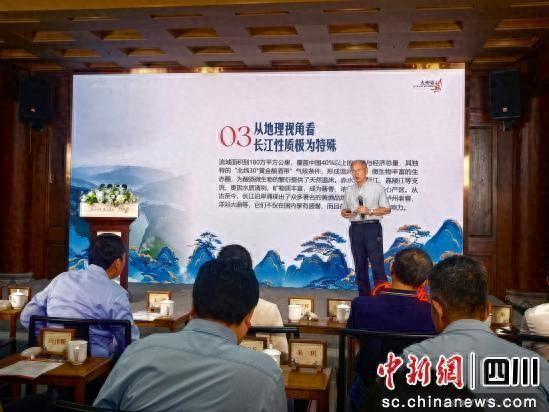
Group 1 - The event "Big Names Talk about Sichuan Wine" focused on the theme "Yangtze River, the Beautiful Wine River," highlighting the relationship between the Yangtze River and wine production, with experts from various fields participating to explore this connection [1][3] - The Yangtze River is home to over 80% of China's famous wines, establishing it as a "world-class wine river," with discussions on its unique characteristics from geographical, agricultural, cultural, brewing, economic, and social responsibility perspectives [3][4] - The event featured keynote speeches from prominent figures, emphasizing the cultural significance of the Yangtze River and its role in Chinese civilization, with a call to protect and promote the cultural ecology of the "Yangtze Wine River" [3][4] Group 2 - Experts discussed the historical and cultural depth of the wine culture in the Yangtze River region, asserting that the concept of "Yangtze Wine River" must be promoted globally to showcase its unique charm and value [6] - The Yangtze Economic Belt is identified as a crucial strategic area for national development, with the wine industry being a key pillar that supports high-quality development in this region [6][4] - The event underscored the importance of integrating the development of the wine industry with the Yangtze Economic Belt, positioning brands like Wuliangye as leaders in promoting high-quality development in the region [6][4]
五粮液也向年轻人低头了
Sou Hu Cai Jing· 2025-09-10 04:00
是白酒需要年轻人,而非年轻人需要白酒 作者丨岳轻 编辑丨罗素 曾经有知乎网友在"房价什么时候才能跌"的问题下回答了这么一段话:像邮票、古董、玉石、书画、白酒等年轻人不玩了的领域,都是既得利益者着急寻 找接盘侠的重灾区。 白酒特别是高度白酒,作为上述领域中最"亲民"的消费选项、这两年一直被频繁讨论是否崩塌的问题。当初某知名酒企掌门那句"并不担心未来市场的问 题,年轻人到了一定岁数就会喝白酒"的言论犹在耳边,但没想到这届年轻人固执的超乎想象。 直到今年8月,秉着山不过来我就过去的态度,各大酒企开始密集的宣布推出低度酒系列,而且领头的居然是白酒品牌唯二T0级的五粮液——官宣推出低 度新品29°五粮液·一见倾心。 T0级出手自然不俗。此次、一见倾心共设计高端轻奢装500ml/1瓶/399元,百变个性装100ml/3瓶/300元,仅两天内就预售破万。再加上邓紫棋的代言,颇 有要在年轻受众群中刷屏的架势。 不过和这"盛况"对应的,是五粮液8月27日晚公布的2025半年报:营收527.7亿,同比增长4.19%。净利润194.9亿,同比增长2.28%。拿下了2015至2025这 十年中报里最差的增长速度。 还是那些老调重弹的 ...

酒香也怕巷子深,茅台五粮液们的中秋考
Sou Hu Cai Jing· 2025-09-09 04:33
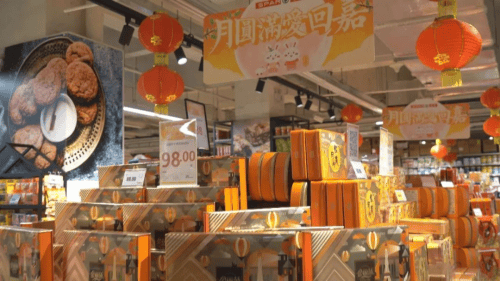
随着中秋佳节临近,酒水市场再度进入传统的销售冲刺阶段。 作为下半年最重要的消费节点之一,中秋国庆"双节"历来被酒业寄予厚望,往往能够贡献全年超过20% 的销售额。 然而,在表面热烈的营销造势之下,行业正面临高库存、动销慢与消费分化所带来的长期压力。今年中 秋,酒企与经销商在热战之余,更多了几分冷思考。 八月初起,各大酒企的"中秋战役"便已悄然打响。 线下商超中,茅台、五粮液、国窖1573等高端品牌礼盒被陈列于最醒目位置,而百元价位段的地产酒、 光瓶酒与新兴低度酒则组成辅助矩阵,试图覆盖自饮、宴席与礼品等多重场景。 线上阵地的竞争则更为激烈。 电商平台推出大规模补贴与限时秒杀,酒企也加码自有小程序和直播带货,强调"一键下单,极速配 送"。例如泸州老窖推出的中秋定制款"福禄黄葫芦",在淘宝平台搜索量短期内迅速上升,反映出品牌 对礼赠市场的精准捕捉。 不难发现,今年酒企推出新品的节奏显著早于往年。茅台推出500ml×4瓶装飞天茅台,降低整箱购买门 槛,切入中小规模宴饮与家庭场景;古井贡酒与舍得酒业则推出低度产品,迎合年轻消费者与健康饮酒 趋势。无论是规格创新还是品类拓展,都显示出行业对当前消费疲软态势的主动应对。 ...
中国白酒追踪:茅台、五粮液批发价跌幅收窄;绍兴宴席受政策拖累情况有所缓解-China Spirits Tracker_ Moutai_Wuliangye wholesale price decrease narrowed; Mitigating policy drag on banquets in Shaoxing
2025-09-09 02:40
8 September 2025 | 8:25PM HKT Leaf Liu +852-3966-4169 | leaf.liu@gs.com Goldman Sachs (Asia) L.L.C. Christina Liu +852-2978-6983 | christina.liu@gs.com Goldman Sachs (Asia) L.L.C. Valerie Zhou +852-2978-0820 | valerie.zhou@gs.com Goldman Sachs (Asia) L.L.C. Goldman Sachs does and seeks to do business with companies covered in its research reports. As a result, investors should be aware that the firm may have a conflict of interest that could affect the objectivity of this report. Investors should consider t ...
去西湖办一场特别婚礼 西湖情五粮液玫瑰婚典进京推介|XIN消费
Sou Hu Cai Jing· 2025-09-08 22:37
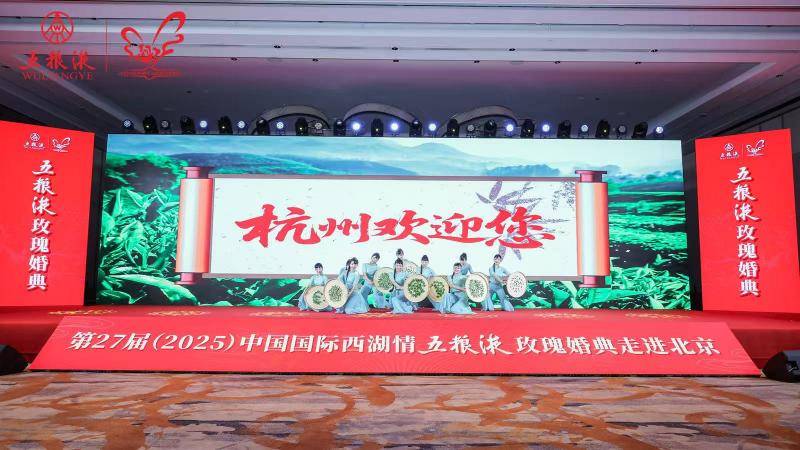
Group 1 - The 27th China International Xihu Love Five Grains Liquid Rose Wedding will take place in Beijing on September 8, 2025, showcasing wedding culture through artistic performances and immersive experiences [1] - The theme of this year's wedding is "Chinese-Italian Love City, Composing Love Poems Together, Building a Harmonious Life," linking the cultural heritage of Hangzhou, China, and Verona, Italy, and inviting couples from both countries [3] - The event will feature a one-kilometer red carpet rose avenue at the West Lake, where couples will walk hand in hand, and will include a boat ride on the West Lake to celebrate love [3] Group 2 - Jiang Jia, Vice General Manager of Yibin Wuliangye Co., expressed the company's expectation that the Rose Wedding will serve as a sweet witness to the enduring love of couples in Beijing [4]
深耕婚庆市场 西湖情五粮液玫瑰婚典系列活动进京“迎新”
Bei Jing Shang Bao· 2025-09-08 14:19
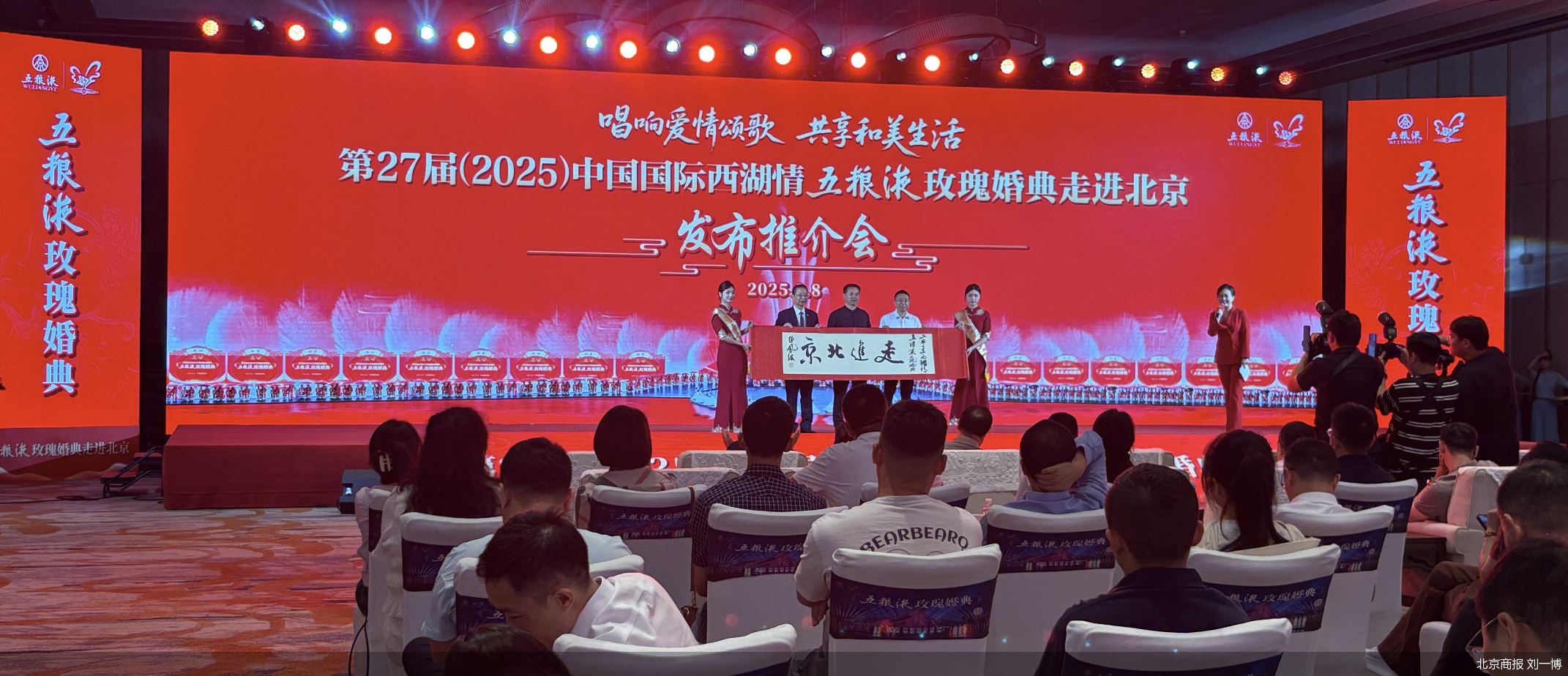
Group 1 - The 27th (2025) China International West Lake Rose Wedding Ceremony was held in Beijing with the theme "Singing the Love Song, Sharing a Harmonious Life" [1][3] - The event featured creative artistic performances and immersive interactive experiences to showcase the cultural connotation of the wedding ceremony [1][3] - The ceremony aims to connect the love culture of Hangzhou, China, and Verona, Italy, inviting international couples to celebrate their love in Hangzhou [3] Group 2 - Jiang Jia, Vice General Manager of Yibin Wuliangye Co., expressed the company's commitment to creating eternal promises for couples through the Rose Wedding Ceremony [3] - The event included traditional Chinese cultural elements, such as calligraphy and the performance of the Yue Opera, enhancing the romantic atmosphere [4] - A DIY area for traditional Chinese herbal sachets became a highlight, allowing guests to engage with cultural memories [4]
五粮液(000858):稳健经营,跨越周期
Dongxing Securities· 2025-09-08 10:52
Investment Rating - The report maintains a "Strong Buy" rating for Wuliangye [2][6] Core Views - Wuliangye achieved revenue of 52.771 billion yuan in H1 2025, a year-on-year increase of 4.19%, and a net profit attributable to shareholders of 19.492 billion yuan, up 2.28% year-on-year. The Q2 revenue was 15.831 billion yuan, with a slight increase of 0.1% year-on-year, while net profit decreased by 7.58% to 4.632 billion yuan [3] - The gross margin for liquor products was 82.20%, a decrease of 0.39% year-on-year, primarily due to increased market investment and lower pricing strategies for certain products [3] - The company has improved its cash flow, with a 12% increase in cash received from sales in Q2 and an 18.4% increase in operating cash flow [4] - Wuliangye is focusing on channel development, adding 7,990 new purchasing terminals and enhancing its market influence through various initiatives [5] - The company plans to distribute a cash dividend of 12.301 billion yuan for 2024, with a payout ratio of 70.01%, indicating strong shareholder returns [6] Financial Performance Summary - In H1 2025, Wuliangye's liquor products saw a 4.6% increase in revenue, with a 12.7% increase in sales volume, while the average price per ton decreased by 7.2% [3] - The company’s sales expense ratio in Q2 was 18.88%, an increase of 1.54 percentage points year-on-year, attributed to increased promotional spending [4] - The forecast for 2025 indicates a net profit of 32.012 billion yuan, a 0.5% increase year-on-year, with an EPS of 8.25 yuan [6] - The total market capitalization of Wuliangye is approximately 487.18 billion yuan, with a PE ratio of 14.12 times [7]
五粮液亮相“可持续商业全球行”2025瑞士日内瓦站
Cai Jing Wang· 2025-09-08 05:08
Core Insights - The "Sustainable Business Global Tour" 2025 was held in Geneva, Switzerland, featuring multiple events including the "Sustainable Brand Creation" international cooperation seminar and the signing of the "Sustainable Brand Creation Vision Geneva Initiative" by 24 Chinese companies [1][3] Group 1: Sustainable Development Initiatives - The initiative emphasizes the critical role of the business community in achieving the United Nations' 2030 Sustainable Development Agenda, particularly in its final five years [3] - The "Sustainable Brand Creation" initiative aims for world-class companies to integrate sustainability into their business and brand value creation through practical measures such as strategic focus, technological innovation, and social responsibility [3][5] Group 2: Company Contributions - Wuliangye, as a representative of Chinese liquor, showcased its sustainable development strategies and shared its unique "Soil, Heat, Electricity, Water" circular system, which effectively reduces carbon footprints and enhances farmers' income [5] - The company aims to act as a practitioner of green development and long-termism, continuously creating sustainable brand practices [5][7] Group 3: Event Significance - The event provided a significant platform for global business exchanges and cooperation, highlighting Wuliangye's commitment to sustainable development and its contributions to the global sustainability agenda [7][9] - The "Sustainable Business Global Tour" 2025 is part of a broader initiative to engage the business sector in the UN's sustainable development goals, with participation from various international organizations [9]