
HGTECH(000988)

Search documents
光模块产业链 多家上市公司谋求扩产
Zheng Quan Ri Bao· 2025-09-22 23:34
Core Viewpoint - The announcement by Huigreen Ecological Technology Group regarding the lease agreement for a photonic industry park reflects a broader trend of capacity expansion in the optical module industry, driven by surging AI computing demands [1] Industry Expansion - The optical module industry is experiencing a wave of capacity expansion, with major companies focusing on technological upgrades and production capacity to seize market opportunities [2][3] - Huigreen Ecological has signed contracts to build production bases for 450 million optical modules with a total investment of 700 million yuan, indicating significant growth in production scale and technology [2] - Other companies like Shanghai Cambridge Technology and Zhongji Xuchuang are also ramping up production of high-end products, including 1.6T and 800G optical modules, to meet rising demand [2] Market Demand and Growth - The demand for 400G and 800G optical modules remains strong, with the 1.6T optical module expected to become a key growth driver by 2025 [2] - The global optical module market is projected to grow from $11.2 billion in 2020 to $17.8 billion in 2024, with a compound annual growth rate of 12.2% [3] - In China, the optical module market is expected to reach approximately 70 billion yuan by 2025, reflecting a growth of 12.22% from the previous year [3] Performance Metrics - Leading domestic optical module companies have reported significant sales growth, with Xinyi Sheng's sales volume reaching 6.95 million units in the first half of 2025, a year-on-year increase of 112.5% [4] - Huagong Technology reported a revenue of 3.744 billion yuan from its connectivity business in the first half of 2025, a 124% increase year-on-year, with expectations of substantial growth in AI-related optical module shipments [4] Supporting Factors - The growth in the optical module industry is supported by a surge in AI computing infrastructure both domestically and internationally, with major tech companies increasing their procurement of high-speed optical modules [5] - Policy support from the Chinese government, including guidelines for enhancing data infrastructure, is expected to further stimulate the optical module market [5] - The long-term opportunities in the optical module industry are driven by the continuous iteration of AI technology, expanding demand, and supportive policies [5]


光模块产业链多家上市公司谋求扩产
Zheng Quan Ri Bao· 2025-09-22 16:14
Core Viewpoint - The announcement by Huylv Ecological Technology Group regarding the lease agreement for a photonic module production base reflects the overall expansion trend in the photonic module industry, driven by the surging demand for AI computing power [1] Industry Expansion - The photonic module industry is experiencing a wave of expansion, with major companies increasing production capacity to meet the growing demand for 400G and 800G modules, while 1.6T modules are expected to become a key growth driver in the next three years [2] - Huylv Ecological has signed a contract for a production base capable of producing 450 million photonic modules with a total investment of 700 million yuan, indicating significant enhancements in scale, technology, and research capabilities [2] - Other companies like Shanghai Cambridge Technology and Zhongji Xuchuang are also ramping up production, focusing on high-end products like 1.6T and 800G modules to maintain delivery capabilities amid rising industry demand [2] Market Demand and Growth - The demand for photonic modules is being fueled by an exponential increase in AI computing needs, with the industry poised for a comprehensive growth phase driven by technological upgrades and market dynamics [3] - The global photonic module market is projected to grow from $11.2 billion in 2020 to $17.8 billion in 2024, with a compound annual growth rate (CAGR) of 12.2%, and is expected to reach $23.5 billion by 2025 [3] - In China, the photonic module market is anticipated to grow to approximately 70 billion yuan by 2025, reflecting a year-on-year increase of 12.22% in 2024 [3] Performance Metrics - Leading domestic photonic module companies have reported significant sales growth, with New Yisong's sales volume reaching 6.95 million units in the first half of 2025, a year-on-year increase of 112.5% [4] - Huagong Technology reported a revenue of 3.744 billion yuan from its connectivity business in the first half of 2025, marking a 124% increase, with expectations of substantial growth in AI-related module shipments [4] Supporting Factors - The demand for photonic modules is further supported by the ongoing construction of computing infrastructure both domestically and internationally, with major tech companies like Nvidia and Google driving the need for high-speed module procurement [5] - Policy support from the Chinese government, including guidelines for enhancing data infrastructure, is expected to facilitate the growth of the photonic module market [5] - The long-term opportunities in the photonic module industry are attributed to the synergy of continuous AI technology iterations, expanding demand, and supportive policies [5]
全球算力基建加速,密集催化提升预期
2025-09-22 00:59
Summary of Key Points from Conference Call Industry Overview - The telecommunications industry is experiencing accelerated infrastructure development, driven by significant investments from large domestic and international companies, as well as technological innovations [3][4] - Emerging technologies such as CPO, OIO, and hollow fiber optics are gaining attention, further propelling industry growth, particularly in the optical communication sector [3] Company Insights - Leading companies in the telecommunications sector, such as Xuchuang and Xinyi, currently have relatively low valuations, but their Q3 performance is expected to exceed market expectations, potentially boosting their market value [1][4] - The supply chain for silicon photonics is rapidly expanding, with suppliers like Tower planning to significantly increase production capacity by June next year [1][6] - Companies like Xuchuang and Yuanjie are anticipated to maintain stable growth due to the increasing penetration of silicon photonics [8] Emerging Technologies - New technologies like OCS and CPU are impacting the telecommunications industry but will not completely replace traditional technologies. Leading companies are expected to maintain their strong positions while benefiting from the growth of second-tier companies like Cambridge and Huylv [5] - The introduction of liquid cooling technology is necessary due to increased power consumption of optical modules in the 3.2T era [10][11] Market Dynamics - The domestic market is more event-driven, focusing on short-term catalysts, while the overseas market emphasizes long-term investment value based on industry trends and performance [7] - The upcoming Huawei super node architecture is expected to generate significant demand for 800G connections, benefiting companies like Guangxun Technology and Huagong Technology [12][20] Future Outlook - The silicon photonics supply chain is projected to grow robustly, with significant increases in production capacity expected in the near future [6][8] - The next generation of optical interconnect technologies, such as CPC and CPU, is being actively discussed, with potential advancements in materials and electrical connection architectures [9] - Key events like the ECOC conference and OCP summit are anticipated to catalyze developments in the overseas computing power chain [13] Investment Recommendations - It is advisable to focus on leading companies in the main sectors while also monitoring second-tier companies for breakthrough opportunities and the long-term trading potential brought by new technologies [1][7][20]

量子计算有望加速落地
Orient Securities· 2025-09-21 02:00
Investment Rating - The report maintains a "Positive" investment rating for the electronic industry, indicating an expected return that is stronger than the market benchmark by over 5% [6]. Core Viewpoints - Quantum computing is becoming a key focus for governments worldwide, with significant investments from leading companies like NVIDIA, suggesting an acceleration in the commercialization of quantum computing [3][9]. - The report highlights the ongoing advancements in quantum computing technology and its applications, with notable developments from both domestic and international companies [8][9]. Summary by Sections Investment Recommendations and Targets - Quantum computing is identified as a priority technology for governments, with companies like NVIDIA actively investing in the sector. This trend is expected to enhance the commercialization process [3][9]. - Recommended stocks include leading domestic quantum computing firms such as Guoshun Quantum (国盾量子), which focuses on quantum security chips, and other companies like Tengjing Technology (腾景科技) and Huagong Technology (华工科技) that are involved in quantum technology projects [3][9]. Industry Overview - The report discusses the recent IPO guidance from Benyuan Quantum and a $1 billion Series E funding round for PsiQuantum, which has reached a valuation of $7 billion [8]. - NVIDIA's strategic investments in various quantum computing companies, including Quantinuum and QuEra Computing, indicate a diversified approach to harnessing quantum computing opportunities [8]. - The report notes that both domestic and international quantum computing enterprises are making strides in commercial applications, with advancements in sectors like weather forecasting and financial analysis [8].




深股通本周现身51只个股龙虎榜
Zheng Quan Shi Bao Wang· 2025-09-19 13:56
Group 1 - The article highlights that 51 stocks appeared on the Long-Short list this week, with 37 showing net purchases from the Shenzhen Stock Connect [1] - The top three stocks with the highest net purchases were Changying Precision, Kaimete Gas, and Shanzi Gaoke, with net purchases of 407.68 million, 293.35 million, and 247.44 million respectively [1] - The average increase for the stocks with net purchases was 12.34%, outperforming the Shanghai Composite Index, which fell by 1.30% [1] Group 2 - The stock with the largest increase was Boliang Optoelectronics, which saw a cumulative rise of 47.15% this week [1] - There were 14 stocks with net sales, with Huagong Technology and Sanhua Intelligent Control having the largest net sales of 439.84 million and 180.36 million respectively [2] - The detailed table lists various stocks along with their net purchases, weekly price changes, and turnover rates, indicating significant trading activity [1][2]


A500指数本周微涨0.02%,国联安、兴业基金领涨丨A500ETF观察
2 1 Shi Ji Jing Ji Bao Dao· 2025-09-19 11:04
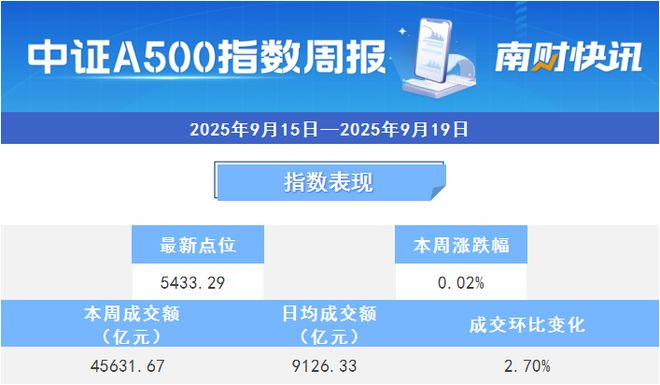
Index Performance - The CSI A500 Index experienced a slight increase of 0.02%, closing at 5433.29 points on September 19 [5] - The average daily trading volume for the week was 9126.33 billion yuan, reflecting a week-on-week increase of 2.7% [5] Component Stocks Performance - The top ten gainers for the week included: - Junsheng Electronics (600699.SH) with a rise of 44.25% - Shanghai Construction (600170.SH) up by 31.70% - Sanhua Intelligent Control (002050.SZ) increasing by 20.72% [3] - The top ten losers for the week included: - Northern Rare Earth (600111.SH) down by 12.20% - Junshi Biosciences (688180.SH) decreasing by 9.84% - Xiamen Tungsten (000960.SZ) falling by 9.45% [3] Fund Performance - A total of 39 CSI A500 funds mostly saw increases, with the top performer being Guolian An with a rise of 0.424% [5] - The total scale of CSI A500 funds reached 1865.27 billion yuan, with the largest funds being Huatai Baichuan (221.82 billion yuan), Guotai Fund (204.94 billion yuan), and E Fund (204.55 billion yuan) [5] Economic Context - The Federal Reserve lowered the benchmark interest rate by 25 basis points to a range of 4.00%-4.25% on September 17, restarting the rate cut cycle [6] - Short-term market expectations for rate cuts have been largely priced in, potentially leading to volatility as actual policy effects and economic data unfold [6] - In the medium to long term, the Fed's rate cuts are expected to positively impact the A-share market, with a stronger yuan improving foreign investment sentiment [6]


工业母机概念下跌2.11%,8股主力资金净流出超亿元
Zheng Quan Shi Bao Wang· 2025-09-19 09:36
Market Performance - As of September 19, the industrial mother machine concept declined by 2.11%, ranking among the top declines in concept sectors, with stocks like Bojie Co., Ltd. hitting the daily limit down, while Rongtai Co., Ltd., Julun Intelligent, and Baoxin Technology also saw significant declines [1][2] - In contrast, 16 stocks within the sector experienced price increases, with Huagong Technology, Anda Intelligent, and Pangu Intelligent leading the gains at 4.05%, 3.63%, and 3.54% respectively [1] Capital Flow - The industrial mother machine sector saw a net outflow of 2.487 billion yuan, with 77 stocks experiencing net outflows, and 8 stocks seeing outflows exceeding 100 million yuan. Julun Intelligent led the outflow with 735 million yuan [1][2] - Notable stocks with significant net outflows included Huichuan Technology, Shuanglin Co., Ltd., and Aiston, with outflows of 289 million yuan, 242 million yuan, and 148 million yuan respectively [1][2] - Conversely, the stocks with the highest net inflows included Huagong Technology, Gree Electric, and Guojin Precision Engineering, attracting net inflows of 269 million yuan, 119 million yuan, and 9.128 million yuan respectively [1][4] Stock Performance - The top decliners in the industrial mother machine sector included Julun Intelligent (-6.41%), Huichuan Technology (-1.09%), and Shuanglin Co., Ltd. (-5.32%) [1][2] - Stocks such as Bojie Co., Ltd. and Keli'er saw declines of 10.00% and 6.25% respectively, indicating significant downward pressure on these companies [2][3] - On the other hand, stocks like Huagong Technology and Anda Intelligent showed resilience with gains of 4.05% and 3.63% respectively, highlighting a divergence in performance within the sector [1][4]

机械设备行业9月19日资金流向日报
Zheng Quan Shi Bao Wang· 2025-09-19 09:33
Market Overview - The Shanghai Composite Index fell by 0.30% on September 19, with 16 out of the 28 sectors rising, led by coal and non-ferrous metals, which increased by 1.97% and 1.19% respectively. The automotive and pharmaceutical sectors saw the largest declines, down by 1.94% and 1.41% respectively [1] Fund Flow Analysis - The main funds in the two markets experienced a net outflow of 58.733 billion yuan, with 8 sectors seeing net inflows. The non-ferrous metals sector led with a net inflow of 872 million yuan, followed by the media sector with a 0.49% increase and a net inflow of 692 million yuan [1] - A total of 23 sectors experienced net outflows, with the computer sector leading at 10.723 billion yuan, followed by the automotive sector with an outflow of 7.929 billion yuan. Other sectors with significant outflows included machinery, electrical equipment, and pharmaceuticals [1] Machinery Sector Performance - The machinery sector declined by 0.60%, with a net outflow of 7.793 billion yuan. Out of 530 stocks in this sector, 131 rose, 5 hit the daily limit up, while 390 fell, with 5 hitting the daily limit down [2] - Within the machinery sector, 153 stocks saw net inflows, with 5 stocks exceeding 100 million yuan in net inflow. The top stock was Shanhe Intelligent, with a net inflow of 442 million yuan, followed by Huagong Technology and Sany Heavy Industry with inflows of 269 million yuan and 249 million yuan respectively [2] - The sector also had 26 stocks with net outflows exceeding 100 million yuan, led by Julun Intelligent, with an outflow of 735 million yuan, followed by Yingweike and Changsheng Bearing with outflows of 516 million yuan and 439 million yuan respectively [3] Top Gainers in Machinery Sector - The top gainers in the machinery sector included: - Shanhe Intelligent: +10.00%, turnover rate 24.24%, net inflow 441.59 million yuan - Huagong Technology: +4.05%, turnover rate 9.87%, net inflow 268.59 million yuan - Sany Heavy Industry: +5.29%, turnover rate 1.71%, net inflow 248.63 million yuan [2] Top Losers in Machinery Sector - The top losers in the machinery sector included: - Julun Intelligent: -6.41%, turnover rate 20.49%, net outflow -734.81 million yuan - Yingweike: -4.66%, turnover rate 8.34%, net outflow -516.39 million yuan - Changsheng Bearing: -7.40%, turnover rate 12.33%, net outflow -438.93 million yuan [3]




柔性屏板块震荡拉升,欧菲光涨停
2 1 Shi Ji Jing Ji Bao Dao· 2025-09-19 02:39
Group 1 - The flexible display sector experienced significant fluctuations, with O-film Technology reaching the daily limit increase [1] - Huagong Technology rose over 7%, indicating strong market interest [1] - Other companies such as Debang Technology, Dongcai Technology, and Wanrun Technology also saw increases in their stock prices, reflecting a broader positive trend in the sector [1]


华工科技股价涨5.02%,方正富邦基金旗下1只基金重仓,持有3500股浮盈赚取1.54万元
Xin Lang Cai Jing· 2025-09-19 02:39
Group 1 - The core viewpoint of the news is that Huagong Technology has experienced a significant stock price increase, rising 5.02% on September 19, with a total market value of 92.48 billion yuan and a cumulative increase of 35.29% over the past seven days [1] - Huagong Technology's main business includes laser devices, laser processing equipment, holographic anti-counterfeiting products, optical components, and electronic components, with revenue composition being 49.08% from optoelectronic devices, 25.46% from sensitive components, 21.97% from laser processing equipment, 2.77% from holographic films, and 0.72% from leasing and others [1] - The stock has a trading volume of 4.767 billion yuan and a turnover rate of 5.26% as of the report [1] Group 2 - According to data from the top ten heavy stocks of funds, one fund under Fangzheng Fubon has a significant holding in Huagong Technology, with the Fangzheng Fubon CSI 500 ETF reducing its holdings to 3,500 shares, representing 0.62% of the fund's net value [2] - The Fangzheng Fubon CSI 500 ETF has achieved a year-to-date return of 26.17% and a one-year return of 60.37%, ranking 1923 out of 4222 and 1588 out of 3805 respectively [2] - The fund manager, Yu Runze, has been in position for 3 years and 187 days, with the best fund return during this period being 28.32% [3]