
GOTION(002074)

Search documents
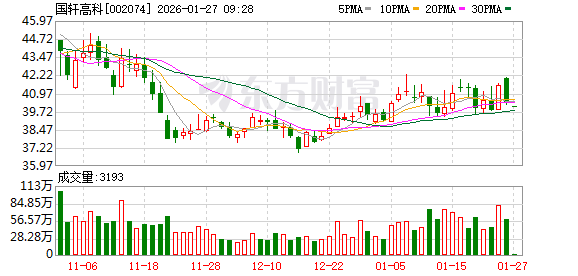
国轩高科:0.2GWh全固态电池中试产线已于去年上半年完成并投产,2GWh量产线设计工作正按计划推进
Mei Ri Jing Ji Xin Wen· 2026-01-27 01:28
Group 1 - The core point of the article is that Guoxuan High-Tech has made progress in the design and production of solid-state battery pilot lines, with a 0.2 GWh pilot production line expected to be completed and operational in the first half of 2025 [2] - The design work for the 2 GWh mass production line is progressing as planned [2]


国轩高科:公司目前正围绕客户对G垣准固态电池差异化需求开展针对性验证
Mei Ri Jing Ji Xin Wen· 2026-01-27 01:28
Group 1 - The company is currently focusing on targeted verification based on customer differentiated demands for G-type quasi-solid-state batteries [2] - The pilot production line for all-solid-state batteries has been put into operation and has completed internal vehicle verification, with the design work for the mass production line progressing as planned [2]
国轩高科(002074.SZ):全固态电池中试线已投产并完成内部装车验证
Ge Long Hui· 2026-01-27 01:11
Group 1 - The company is currently focusing on targeted validation based on customer differentiated demands for G-type solid-state batteries [1] - The pilot production line for all-solid-state batteries has been put into operation and has completed internal vehicle verification [1] - The design work for the mass production line is progressing as planned [1]
国轩高科:全固态电池量产线设计工作正按计划推进
2 1 Shi Ji Jing Ji Bao Dao· 2026-01-27 00:53
Core Viewpoint - Guoxuan High-Tech is actively validating differentiated customer demands for G-Cell solid-state batteries and has commenced production on its pilot line for all-solid-state batteries, with internal vehicle testing completed and mass production line design progressing as planned [1] Group 1 - The company is focusing on targeted validation based on customer needs for G-Cell solid-state batteries [1] - The pilot production line for all-solid-state batteries has been launched and internal vehicle testing has been completed [1] - The design work for the mass production line is advancing according to schedule [1]
2026年碳酸锂基本面或重归紧平衡
Shang Hai Zheng Quan Bao· 2026-01-26 19:16
Market Dynamics - The main contract for lithium carbonate experienced significant volatility, initially rising by 6.84% to a high of 189,400 yuan/ton, before closing down 6.56%, indicating a bearish sentiment in the market [1] - By 2026, the supply-demand relationship in the lithium carbonate market is expected to improve significantly, with most supply increases concentrated in the second half of the year [1][4] - The demand for lithium carbonate is increasingly driven by the energy storage sector, which is becoming a new engine for growth [1][10] Regulatory Changes - Recent updates in mining licenses for lithium mines in Yichun indicate a shift in focus to lithium mining, with the process of license renewal expected to take a long time, potentially 1.5 to 3 years or more [2][3] - The regulatory environment is tightening, with new solid waste management regulations potentially impacting lithium production and increasing supply constraints [6][7] Supply Constraints - The transition to lithium mining in Yichun could affect existing production capacity by approximately 95,000 tons, with long-term expansion plans of about 274,000 tons also impacted [4] - The processing of lithium slag remains a significant challenge for lithium mining companies, with the potential for increased costs and regulatory hurdles [8][9] Demand Trends - The demand for lithium from the energy storage sector is expected to grow significantly, with estimates indicating that the total shipment of energy storage batteries in China reached 430 GWh in the first three quarters of 2025, surpassing the total for 2024 [10] - The global market for lithium batteries, particularly in the electric vehicle and energy storage sectors, is projected to continue growing rapidly, with expectations of a new wave of production and export activity in 2026 [11][12]



新能源+AI周报(第40期20260118-20260124):储能量价齐升,太空、AI主题延续-20260126
Tai Ping Yang Zheng Quan· 2026-01-26 15:01
Investment Rating - The report does not provide specific investment ratings for the industry sectors mentioned [2]. Core Insights - The overall industry strategy focuses on the simultaneous rise in energy storage volume and price, with ongoing themes in space and AI [3]. - The new energy vehicle supply chain is entering an upward cycle, benefiting companies like CATL and EVE Energy due to the electrification upgrade and optimization of energy storage patterns [3]. - By the end of December 2025, China's electric vehicle charging infrastructure is expected to reach 20.092 million units, a year-on-year increase of 49.7% [3]. - Global energy storage battery shipments are projected to reach 640 GWh in 2025, a year-on-year increase of 82.9%, with CATL maintaining a leading position [3][25]. - The solid-state battery sector is entering a critical phase of engineering and industrialization, with companies like Xiamen Tungsten and Peking University Technology benefiting [4]. Summary by Sections Energy Storage and New Energy - The energy storage trend continues to improve, with companies like Sungrow Power and Huaneng Power benefiting from a significant increase in domestic procurement, which exceeded 100 GWh for the first time [5]. - The average price of lithium battery storage systems has rebounded by 6.39% to 0.5226 yuan/Wh [5]. - AI expansion and global grid upgrades are driving demand for power equipment, benefiting companies like TBEA and Sanyuan Electric [5]. Lithium Carbonate and Battery Materials - The supply and demand for lithium carbonate are exceeding expectations, with companies like Salt Lake Potash and Hunan Youneng benefiting from favorable market conditions [4]. - The cost of phosphoric iron lithium cathode materials has increased, with processing fees rising by 318.7 yuan/ton compared to November averages [4][27]. AI and Robotics in New Energy - The integration of AI and humanoid robots in the new energy sector is gaining traction, with companies like Zhejiang Rongtai and Keda Li benefiting from advancements in robotics [7]. - Tesla's shift towards becoming a robotics company is expected to create new growth cycles, with significant implications for the automotive industry [7][26]. Market Trends and Projections - The report highlights that the global energy storage battery shipment is expected to reach 1,090 GWh in 2026, a year-on-year increase of 70% [25]. - The market for commercial energy storage products is evolving, with larger capacity batteries becoming mainstream and driving innovation in the sector [29].



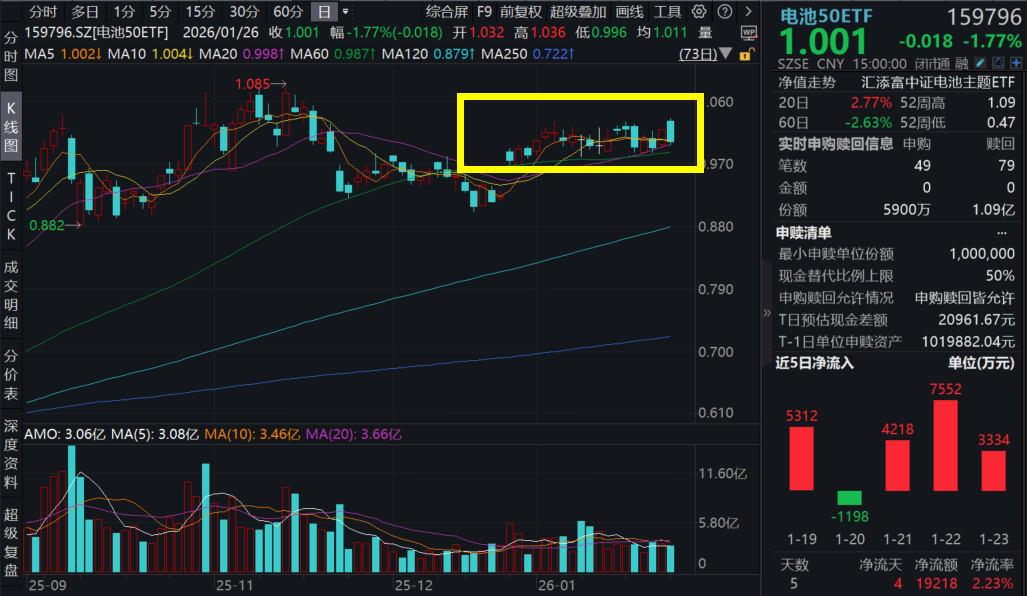
三花智控跌超3%,电池50ETF(159796)跌1.77%延续箱体震荡!2025年业绩前瞻,电池板块表现为何如此亮眼?
Xin Lang Cai Jing· 2026-01-26 09:33
Core Viewpoint - The A-share market experienced fluctuations on January 26, with cyclical sectors leading gains while growth sectors retreated. The Battery 50 ETF (159796) closed down by 1.77%, with funds attracting over 150 million yuan in the previous three days [1]. Group 1: Market Performance - The Battery 50 ETF (159796) saw most of its constituent stocks decline, with significant drops including Sanhua Intelligent (down over 3%) and Guoxuan High-Tech (down over 2%) [3]. - The top ten constituent stocks of the Battery 50 ETF showed a range of declines, with the largest drop being 3.89% for Sanhua Intelligent and the smallest being 1.43% for Ningde Times [4]. Group 2: Earnings Forecasts - Recent earnings forecasts for 2025 from leading battery companies indicate strong performance, with 11 out of 13 companies reporting year-on-year growth. Leading the pack is Sanhua Intelligent, with a projected profit increase of 424% to 529% [5]. - The projected net profit for Sanhua Intelligent is between 1.5 billion yuan and 1.8 billion yuan, while other companies like Daoshih Technology and Tianci Materials also show significant growth forecasts [5]. Group 3: Demand and Industry Outlook - The battery sector's strong performance is attributed to steady growth in demand for power batteries and explosive growth in energy storage batteries. The demand is expected to continue rising, with new technologies like solid-state batteries opening up new market opportunities [6]. - By December 2025, domestic lithium iron phosphate battery installation volume is expected to reach 79.8 GWh, a year-on-year increase of 30.82%, while power battery exports are projected to hit 19.0 GWh, up 47.29% year-on-year [7]. Group 4: Technological Developments - Solid-state batteries are anticipated to see significant breakthroughs, with policy support and emerging industries driving demand. The production of semi-solid batteries is expected to exceed 10 GWh by 2025, with a focus on leading battery cell companies and material firms [7]. - The Battery 50 ETF (159796) has a high content of solid-state batteries (45%) and energy storage (18.7%), positioning it to benefit from the growth in these sectors [8][10]. Group 5: Investment Strategy - The battery sector's fundamentals and technological catalysts are expected to support strong stock performance. Given the complexity of the industry, index investment may be a more effective strategy to capture opportunities in the battery sector [7]. - The Battery 50 ETF (159796) is noted for its leading scale and low management fee of 0.15% per year, making it an attractive option for investors looking to capitalize on the battery sector's growth [12].


2025年固态电池市场回顾:从“概念狂飙”走向“产业落地”
鑫椤锂电· 2026-01-26 08:03
Core Viewpoint - The year 2025 is recognized as the "year of solid-state battery industrialization," marking a significant transition from experimental technology to mass production, reshaping the energy storage industry at an astonishing pace [1]. Group 1: Technological Breakthroughs and Capacity Implementation - In 2025, solid-state batteries achieved substantial breakthroughs in energy density and industrialization processes, with CATL's sulfide solid-state battery reaching an energy density of 500Wh/kg, and EVE Energy's first solid-state battery successfully rolling off the production line [3][4]. - Major companies like GAC Group and EVE Energy are establishing production lines for solid-state batteries, with GAC's line capable of producing batteries over 60Ah and EVE's Chengdu base being unveiled [3]. Group 2: Beneficiary Segments: Equipment and Materials - The demand for solid-state battery-specific equipment is surging due to the need for new manufacturing processes, leading equipment manufacturers like Xian Dai Intelligent and Winbond Technology to launch dedicated production lines [5]. - The solid-state battery industry is witnessing a critical period for pilot lines from 2025 to 2026, with equipment orders expected to be fulfilled ahead of schedule [5]. Group 3: Industry Development Anchors: Policies, Standards, and Leading Enterprises - Solid-state batteries are included in China's "New Energy Storage Manufacturing Industry High-Quality Development Action Plan," with support for R&D and pilot verification, while global competitors like the EU and the US are also accelerating their efforts [12]. - The first national standard for solid-state batteries is set to be published in September 2026, establishing China's leadership in the next generation of battery technology [13]. - Leading companies like CATL and BYD are planning to demonstrate small-scale production by 2027, indicating a strategic approach to validate technology feasibility [14]. Group 4: Future Application Rhythm: Gradual Penetration from Specialized to Mass Markets - From 2025 to 2027, solid-state batteries are expected to first penetrate specialized and high-end markets, including drones and high-end electric vehicles, which are sensitive to weight, safety, and energy density [16]. - Between 2027 and 2030, solid-state batteries will gradually enter high-end consumer and luxury electric vehicles, paving the way for broader market adoption [17]. - Post-2030, solid-state batteries are anticipated to flourish in mainstream passenger vehicles and general energy storage, leveraging cost control and supply chain scale effects [18]. Conclusion - The year 2025 marks a pivotal transition for solid-state batteries from "technically feasible" to "commercially visible," indicating a significant shift in the industry landscape [19][20].


国泰海通:锂电材料价格环节迎来上涨 26年需求周期有望开启
智通财经网· 2026-01-26 06:20
Core Viewpoint - The report from Guotai Junan highlights the significant growth in global energy storage battery shipments, projecting a total of 640 GWh in 2025, which represents an 82.9% year-on-year increase. Domestic manufacturers are expected to ship 621.5 GWh, also reflecting an 82.8% growth, while overseas shipments are anticipated to reach 18.5 GWh, marking an 85% increase [1][2]. Group 1: New Energy Vehicles and Energy Storage - The global sales of new energy vehicles (NEVs) are projected to reach 23.54 million units in 2025, a 29.1% increase year-on-year, with China accounting for 70.3% of the total sales. Sales in Europe and the US are expected to be 3.77 million and 1.6 million units, respectively, showing growth rates of 30.5% and 1.72% [1]. - For energy storage, the forecast for 2026 indicates that global shipments of energy storage batteries could reach 1,090 GWh, representing a 70% year-on-year increase [2]. Group 2: Price Trends and Material Supply - Starting from June 2025, a tightening supply-demand situation for domestic energy storage cells has initiated a price increase cycle, with prices for lithium hexafluorophosphate and lithium carbonate rising since September. The underlying logic for these price increases is driven by supply-demand dynamics, where strong downstream demand leads to improved profitability in the materials sector [3]. - The lithium battery industry is experiencing an improved supply-demand balance, with major battery manufacturers like CATL ramping up production. However, the materials sector faces significant financial pressures due to high debt levels and the need for capital turnover amidst new capacity releases [3]. Group 3: Future Demand and Policy Support - The demand cycle for 2026 is expected to be bolstered by continued domestic policies such as trade agreements in Europe and China, as well as the reintroduction of electric vehicle purchase subsidies in Germany. The Chinese market is projected to see a 94% year-on-year increase in new energy storage orders and collaborations, reaching 35.3 GWh in 2025 [4]. - The updated export tax rebate policy for battery products, effective from January 2026, is anticipated to advance overseas demand for new energy products [4]. Group 4: Investment Recommendations - The report suggests focusing on lithium-related materials such as lithium iron phosphate, lithium carbonate, and lithium hexafluorophosphate, as well as heavy asset-related sectors like separators. Recommended stocks include Shengxin Lithium Energy (002240.SZ) and others in the lithium materials sector [5]. - Additionally, leading battery manufacturers with strong pricing power and supply-demand imbalances are highlighted, with recommendations for stocks like CATL (300750.SZ) and others [5].





动力锂电:告别过剩思想,拥抱锂电材料大周期
GUOTAI HAITONG SECURITIES· 2026-01-26 04:35
Investment Rating - The report assigns an "Overweight" rating for the lithium battery materials industry [1] Core Insights - The report emphasizes the shift away from excess supply mentality, highlighting the potential for non-linear profit growth among leading companies in the lithium battery materials sector due to rigid supply against continuously growing demand [3][4] - It suggests a focus on lithium-related materials such as lithium iron phosphate, lithium carbonate, hexafluorophosphate, and aluminum foil, while also considering heavy asset-related materials like separators [4] - The report forecasts significant growth in the electric vehicle (EV) market and explosive growth in energy storage, with global EV sales expected to reach 23.54 million units in 2025, a 29.1% increase year-on-year [4] - It notes that the energy storage battery shipments are projected to reach 640 GWh in 2025, marking an 82.9% year-on-year growth [4] - The report anticipates a demand cycle to commence in 2026, supported by favorable domestic and international policies [4] Summary by Sections Investment Recommendations - The report recommends focusing on leading companies in the lithium battery materials sector, including 盛新锂能 (Shengxin Lithium Energy), 湖南裕能 (Hunan Youneng), 天赐材料 (Tianci Materials), and others, while also highlighting battery leaders like 宁德时代 (CATL) and 亿纬锂能 (EVE Energy) [4][7] Market Data - The report provides operational data for several listed companies in the lithium battery sector, indicating varying levels of profitability and cash flow, with 宁德时代 (CATL) showing a net profit of 49 million in Q3 2025 and a debt-to-asset ratio of 61% [6] - It includes a table summarizing earnings per share (EPS) and price-to-earnings (PE) ratios for key companies, with 宁德时代 (CATL) having an EPS of 14.90 for 2025E and a PE ratio of 23.29 [7]