GOTION(002074)

Search documents
中国人形机器人与电动车供应链考察要点-China humanoid robot & EV supply chain tour takeaways
2026-01-29 10:59
Summary of Conference Call Notes Industry Overview Humanoid Robot and EV Supply Chain - The conference focused on the China humanoid robot and EV supply chain sector, with meetings held from January 19-22, 2026, involving various companies in the robotics and automotive sectors [1] - Major component suppliers are preparing for the debut of Tesla's Optimus Gen 3 in the first half of 2026, with batch shipments expected in the second half of 2026 [1] - Suppliers for Unitree's humanoid robot anticipate significant year-over-year shipment growth in 2026, leading to over 100% growth in humanoid robot-related sales [1] - Key component manufacturers are increasing production capacity and expect cost reductions through mass production and product standardization [1] Auto/EV OEMs & Supply Chain Sales Trends and Cost Pressures - Weak auto and EV sales trends are continuing into January 2026, attributed to cuts in EV purchase tax subsidies and incomplete trade-in subsidies [2] - Chery plans to launch new models post-Lunar New Year in February 2026 [2] - BOM (bill of materials) costs for EV models are estimated to increase by approximately RMB4,500-5,000 due to rising prices of lithium carbonate, memory, copper, and aluminum [2] - Seyond expects price reductions in LiDAR, which may alleviate some cost pressures for OEMs [2] Battery Sector Growth and Cost Management - CALB and Gotion are targeting over 50% year-over-year shipment growth, aiming for 180 GWh and 150 GWh respectively in 2026, driven by ESS demand and electrification of commercial vehicles [3] - Both companies plan to expand their effective capacities to 200 GWh by 2026 [3] - Upstream cost pressures from lithium carbonate and LiPF6 are expected to be partially passed through to customers, with ESS customers more likely to accept price hikes than EV customers [3] Company-Specific Insights Wolong Electric - Anticipates humanoid robot-related revenue to double year-over-year in 2026, with a projected revenue of around RMB100 million from humanoid robots in 2025 [8] - The company is investing in a data collection center for humanoid robots, focusing on motion capture [8] ZD Leader - Expects humanoid robot-related revenue to increase from RMB50 million in 2025 to over RMB100 million in 2026, driven by orders from a leading local robot maker [9] - The average selling price of its planetary reducers is expected to decline in the long term [9] Changsheng Bearing - Currently, humanoid robot-related revenue accounts for less than 1% of total revenue, but significant growth is expected [10] - Management anticipates a 20% CAGR in the auto industry, supported by rising content value and market share gains [10] Precision Tsugami China - Achieved over 15,000 unit shipments of machine tools in 2025, with a revenue of over RMB5 billion [11] - Management expects over 10% year-over-year shipment growth in 2026, driven by demand from various sectors [11] Seyond - Projects over 1 million units of LiDAR shipments in 2026, with a focus on ADAS products [13] - Expects average selling prices to drop but gross profit margins to improve due to economies of scale [13] Inovance - Expects continued recovery in the factory automation sector, with strong demand from the battery and 3C sectors [14] - New businesses in robotics and industrial software are anticipated to drive long-term growth [15][16] Hengli Hydraulic - Aims for 20-30% revenue growth in 2026, with significant contributions from its partnership with Caterpillar [17] - Targets RMB300-500 million in sales from screw and linear guide business in 2026 [18] CALB - Targets over 180 GWh in battery shipments for 2026, with a focus on mid-to-high-end EV models [19] - Plans to increase production capacity to 200 GWh by 2026 and expects to pass through lithium carbonate price hikes to customers [20][21] JAC - Expects a net loss of RMB1.68 billion in 2025 but aims for 50,000 units shipment for its Maextro brand in 2026 [23] - The Maextro brand is expected to improve profitability in 2026 due to rising capacity utilization [23] Gotion Hi-Tech - Targets 150 GWh in battery shipments for 2026, with significant expansion in production capacity planned [27][28] Chery - Aims for 3 million units in volume sales for 2026, with a 50% penetration rate for EV sales [30] - Expects stable net profit per vehicle despite BOM cost increases [31] Bethel - Projects over 20% revenue growth in 2026, with a focus on new product introductions [32] - Anticipates relatively weak customer orders in the first quarter of 2026 [32] Conclusion - The conference highlighted significant growth opportunities in the humanoid robot and EV sectors, with various companies preparing for increased demand and addressing cost pressures through strategic planning and partnerships.



国轩高科(002074) - 关于第四期员工持股计划预留授予部分非交易过户完成的公告
2026-01-29 09:45
证券代码:002074 证券简称:国轩高科 公告编号:2026-004 国轩高科股份有限公司 关于第四期员工持股计划预留授予部分非交易过户 完成的公告 本公司及董事会全体成员保证信息披露的内容真实、准确和完整,没有虚 假记载、误导性陈述或重大遗漏。 国轩高科股份有限公司(以下简称"公司")分别于 2024 年 4 月 30 日、2024 年 5 月 21 日召开第九届董事会第七次会议和第九届监事会第七次会议及 2023 年年度股东大会,审议通过了《关于<公司第四期员工持股计划(草案)>及其 摘要的议案》及其他相关议案。2025 年 8 月 28 日,公司第九届董事会第十三次 会议审议通过了《关于第四期员工持股计划预留份额调整暨分配的议案》,拟向 不超过 180 名激励对象授予不超过 297.5 万股预留份额。具体内容详见公司于巨 潮资讯网(www.cninfo.com.cn)上披露的相关公告。 根据中国证券监督管理委员会《关于上市公司实施员工持股计划试点的指导 意见》《深圳证券交易所上市公司自律监管指引第 1 号——主板上市公司规范运 作》等法规规定,公司第四期员工持股计划预留授予部分非交易过户现已办理完 成 ...
西部证券晨会纪要-20260129
Western Securities· 2026-01-29 01:37
Group 1: Fund Analysis - The public FOF fund scale increased in Q4 2025, with a new issuance scale of 458.54 billion yuan, primarily in bond-type funds [6][7] - The proportion of positive returns for FOF was 49%, with the top performer being CITIC Securities' selected fund [6][8] - Fund managers are optimistic about the market outlook, focusing on structural opportunities with technology and cyclical sectors as the main themes [6][11] Group 2: Electric Vehicle Market - The European electric vehicle market is entering a new phase, with a projected penetration rate of 29% in 2025 and 35% in 2026 due to supply-side drivers and supportive policies [14][15] - The introduction of affordable electric models by European automakers is expected to stimulate consumer demand significantly [15] - Chinese lithium battery companies are positioned to capitalize on the growth of the European market, enhancing their competitive landscape [14][16] Group 3: Construction and Decoration Industry - The construction state-owned enterprises are expected to benefit from strategic and professional restructuring policies initiated by the state [18][19] - The market share of major construction state-owned enterprises remains relatively low, with significant competition and operational pressure evident [19][20] - Recommendations include companies like China Communications Construction, China Railway, and China Chemical, which are likely to enhance their competitiveness through restructuring [21] Group 4: Beauty and Personal Care - The beauty industry in China is transitioning from incremental expansion to competitive positioning, with domestic brands gaining market share [23][24] - The company aims to achieve 30 billion yuan in sales by 2030, driven by research and development, brand expansion, and global operations [25] - The application of AI in production and marketing is expected to enhance operational efficiency and support long-term growth [25] Group 5: Basic Chemicals - The price of hafnium has surged by 21.64% since the beginning of 2026, driven by high demand in sectors like semiconductors and aerospace [27][28] - The company is advancing its zirconium-hafnium separation project, which is expected to significantly contribute to future earnings [29] - Hafnium's unique properties make it essential in high-tech applications, indicating strong future demand [28] Group 6: Electronics - The company is set to benefit from the high demand for PCB and packaging substrates, with projected net profits for 2025 expected to increase by 68% to 78% [31][32] - The expansion of production capacity is ongoing, with new facilities in Thailand and South China expected to enhance growth potential [33] - The company is recognized as a leading provider of electronic circuit technology, with a positive outlook for future performance [33]





中国电池材料 -价格复苏之路崎岖-China Battery Materials Bumpy Road to Price Recovery
2026-01-28 03:02
Summary of Key Points from the Conference Call on China Battery Materials Industry Overview - The focus is on the battery materials industry, particularly related to lithium iron phosphate (LFP) batteries and the broader electric vehicle (EV) market - The analysis includes the impact of rising costs on battery manufacturers and the implications for downstream demand, especially in energy storage systems (ESS) [1][2][9] Core Insights and Arguments - **Price Trends**: LFP battery cell prices have increased by 8%, while battery costs have surged by 30%, leading to a squeeze in battery margins [1] - **Cost Inflation**: Lithium prices have risen by 46% year-to-date, contributing to an estimated cost inflation of Rmb32/kWh for batteries. The total LFP battery cost has increased by Rmb80/kWh, which may test demand in the coming months [2][11] - **Demand Forecasts**: Battery production guidance from major manufacturers like CATL suggests a growth of 50-70% by 2026, which has raised expectations for raw material demand [3][21] - **Market Dynamics**: The recent surge in costs has shifted the market from a demand-pull to a cost-push scenario, with concerns about EV sales weakness impacting performance [1][9] - **Cost Pass-Through Mechanisms**: Battery manufacturers have mechanisms to pass on metal-linked cost increases to downstream customers, but non-metal cost increases may not be fully passed through [20] Important but Overlooked Aspects - **Investment in Upstream**: Companies like CATL and Gotion are investing in upstream lithium resources to mitigate the impact of rising raw material costs. CATL's self-sufficiency ratio for lithium is expected to be 18% by 2025 [17][18] - **Profit Distribution**: The profit distribution along the battery supply chain is shifting, with downstream manufacturers currently capturing more profit. However, this may change as the market matures and supply chain efficiencies improve [35] - **Policy Impacts**: Changes in Chinese government policy, including export controls and a focus on price recovery, may influence the battery market dynamics and cost structures in 2026 [36] Financial Metrics and Projections - **Battery Demand Growth**: The forecast for total battery demand is projected to grow significantly, with EV battery demand expected to reach 2,096 GWh by 2026, reflecting a 30% year-over-year growth [23] - **ESS Demand**: ESS battery demand is also expected to grow, with projections of 894.5 GWh by 2026, indicating a robust market for energy storage solutions [26] Conclusion - The battery materials industry is facing significant challenges due to rising costs and potential demand weaknesses. However, strategic investments in upstream resources and favorable production guidance from major manufacturers present opportunities for growth. The evolving landscape of profit distribution and policy impacts will be critical to monitor as the market develops.





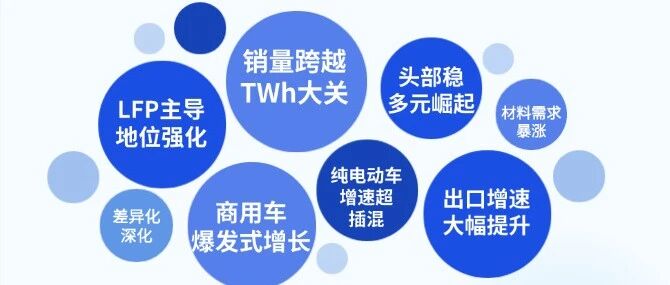
销量首破TWh,2025动力电池上升中的八重变化
高工锂电· 2026-01-27 11:21
Core Viewpoint - In 2025, the power battery industry in China experienced rapid growth, with sales surpassing 1 TWh for the first time, reflecting significant structural changes in exports, material composition, vehicle demand, and market competition [1] Group 1: Sales and Growth - In 2025, the total sales of power batteries reached 1200.9 GWh, a year-on-year increase of 51.8%, significantly higher than the 28.4% growth in 2024 [1] - Cumulative installed capacity was 769.7 GWh, up 40.4% year-on-year, with an increase of 221.3 GWh compared to 2024 [1] Group 2: Export Dynamics - Cumulative exports of power batteries in 2025 reached 189.7 GWh, a year-on-year growth of 41.9%, a substantial increase from the 5.0% growth in 2024 [3] - In December 2025, exports of lithium iron phosphate batteries accounted for 51.3% of total monthly exports, marking a 71.1% year-on-year increase and surpassing the previously dominant ternary batteries [3] Group 3: Battery Type Performance - In 2025, the installed capacity of lithium iron phosphate batteries was 625.3 GWh, representing 81.2% of total installed capacity, with a year-on-year growth of 52.9% [5] - The installed capacity of ternary batteries dropped to 18.7%, with a year-on-year growth of only 3.7%, continuing a downward trend from 10.2% in 2024 [5] Group 4: Commercial Vehicle Growth - The growth of commercial vehicles was explosive, with the installed capacity of pure electric trucks increasing to 17.7%, a year-on-year growth of 168.9% [7] - The average battery capacity of new energy vehicles rose to 55.2 kWh, a year-on-year increase of 18.8% [7] Group 5: Market Structure and Competition - The market competition is evolving from a "dual dominance" to a "stable head and diverse rise," with CATL and BYD maintaining their leading positions but seeing their combined market share decrease from 69.8% to 64.9% [10] - Mid-tier companies like Zhongchuang Innovation and Guoxuan High-Tech are gaining market share, with Guoxuan's installed capacity reaching 43.44 GWh, a year-on-year increase of 1.07 percentage points [12] Group 6: Material Demand and Pricing - The demand for core materials such as lithium iron phosphate and ternary materials surged by over 50% in 2025 [14] - By the end of 2025, the price of battery-grade lithium carbonate reached 150,000 yuan per ton, reflecting a more than 60% increase compared to the end of 2024 [14] Group 7: December Performance Highlights - In December 2025, power battery sales reached 143.8 GWh, a year-on-year increase of 49.2%, while installed capacity was 98.1 GWh, up 35.1% year-on-year [16] - The growth was driven by policy incentives and strong end-user demand, with major automakers launching promotional campaigns to stimulate purchases [15]


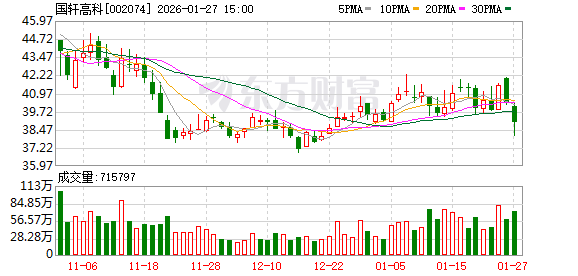
国轩高科:截至2026年1月20日公司股东户数为266364户
Zheng Quan Ri Bao· 2026-01-27 09:08
Group 1 - The core point of the article is that Guoxuan High-Tech reported its shareholder count as of January 20, 2026, which stands at 266,364 households [2]
国轩高科:公司高度重视资产负债率,并致力于优化自身经营效率,提升盈利能力
Zheng Quan Ri Bao Wang· 2026-01-27 08:43
Group 1 - The company emphasizes the importance of its asset-liability ratio and is committed to optimizing operational efficiency and enhancing profitability [1] - A systematic implementation plan has been developed to promote sustainable, healthy, and high-quality development of the company [1]
国轩高科:0.2GWh全固态电池中试产线已于2025年上半年完成并投产
Zheng Quan Ri Bao Wang· 2026-01-27 08:43
Group 1 - The company Guoxuan High-Tech (002074) has completed the pilot production line for 0.2GWh all-solid-state batteries, which is set to be operational in the first half of 2025 [1] - The design work for the 2GWh mass production line is progressing as planned [1]
国轩高科:截至2025年12月31日公司股东户数为260470户
Zheng Quan Ri Bao Wang· 2026-01-27 08:43
Group 1 - The core point of the article is that Guoxuan High-Tech (002074) has reported its shareholder count as of December 31, 2025, which stands at 260,470 households [1]
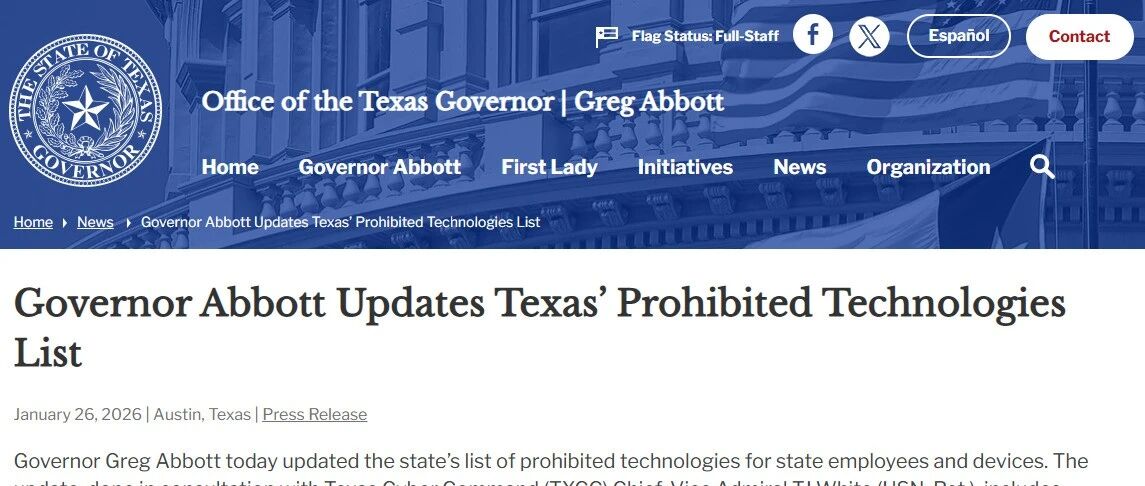
突发!美得州把 26 家中国科技公司拉黑
是说芯语· 2026-01-27 03:09
Core Viewpoint - Texas Governor Greg Abbott has expanded the list of prohibited technologies, adding 26 Chinese tech companies and AI platforms, to mitigate security risks associated with foreign adversaries [1][3][4]. Group 1: Prohibited Technologies - The updated list includes various AI institutions such as Zhipu AI, Baichuan Intelligence, and MiniMax, as well as hardware manufacturers like Hisense and tech companies including ByteDance, Baidu, Alibaba, CATL, and TP-Link [1][6][7]. - The Texas Cyber Command (TXCC) is responsible for assessing threats and identifying high-risk technologies to protect sensitive information [1][5][6]. Group 2: Security Concerns - Governor Abbott expressed concerns about hostile actors using AI and other technologies to harvest user data, manipulate users, and compromise their safety [4][5]. - The TXCC aims to prevent cyber attacks that could lead to the exfiltration of sensitive information to malicious entities globally [5][6]. Group 3: Implementation and Oversight - The prohibition is based on a threat assessment conducted by TXCC, which was established in June 2023 as the largest state-level cybersecurity department in the U.S. [6][1]. - The directive to expand the prohibited technologies list was communicated through a letter to key state officials, emphasizing the need for vigilance against foreign threats [4][5].