GOTION(002074)

Search documents
GGII:2025年中国储能锂电池出货量630GWh 同比增幅达85%
Zhi Tong Cai Jing· 2026-02-06 11:35
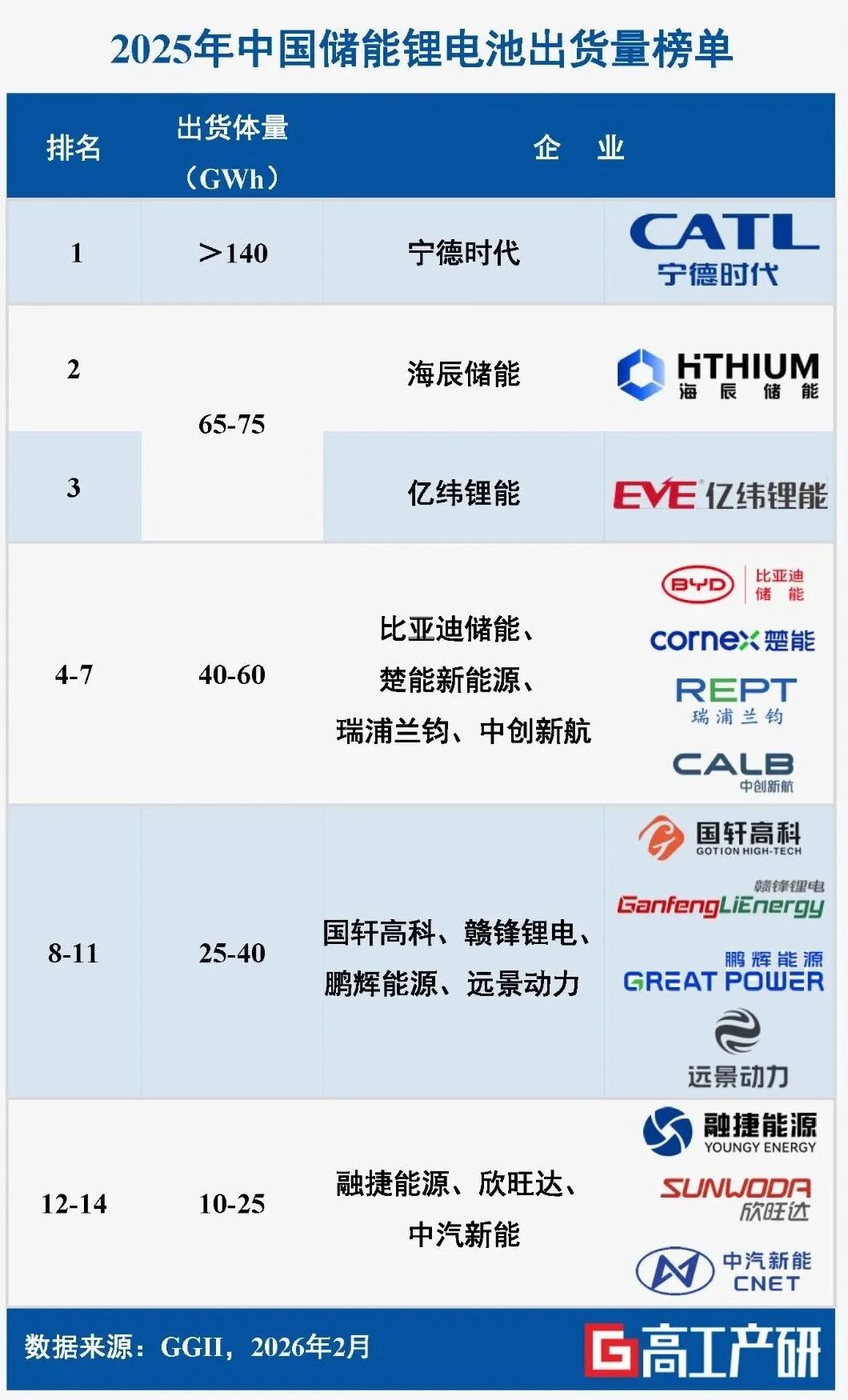
Core Viewpoint - The Chinese energy storage lithium battery market is expected to experience significant growth in 2025, with a shipment volume of 630 GWh, representing an 85% year-on-year increase, and maintaining over 90% of the global market share [1][4]. Group 1: Market Growth Drivers - The growth is driven by three main factors: the gradual exit of mandatory storage policies and the acceleration of independent storage projects in the domestic market, transitioning the industry from "passive configuration" to "active investment" [4]. - The overseas market is boosted by the U.S. installation surge, demand release in emerging markets, and the end of inventory depletion in overseas household storage, leading to strong order growth [4]. - New application scenarios, such as data centers, are contributing to the continuous increase in demand for energy storage cells [4]. Group 2: Competitive Landscape - The top 10 companies in China's energy storage lithium battery shipments for 2025 include CATL, BYD, Hicharge, EVE Energy, and others, which also rank among the top globally [1][2]. - The competition in the household storage lithium battery market in 2025 will focus on specialized production capacity and large-scale delivery capabilities, solidifying the market share and industry position of leading companies [5]. Group 3: Future Trends - In 2026, the household storage lithium battery market is expected to see a relaxation of capacity constraints, with the establishment of a dual mainline product matrix as 100Ah and 314Ah cells become standard options [4][5]. - The global supply chain layout is accelerating, with localized production becoming a key strategy to address trade barriers and raw material sourcing requirements in overseas markets [5]. - The penetration rate of large capacity cells (500+ Ah) is projected to exceed 20% in 2026, with most manufacturers expected to achieve mass production by the second half of the year [9]. Group 4: Market Projections - The energy storage battery market is anticipated to maintain a high growth trend into 2026, with an expected shipment of over 850 GWh, although capacity pressure will remain significant in the first half of the year [8][11]. - The price of energy storage cells is projected to increase by approximately 3-6 cents per Wh due to rising costs of key raw materials, which will be passed down to downstream procurement costs [12].





7家中企包揽84%份额!2025年全球储能电池出货550GWh
Xin Lang Cai Jing· 2026-02-06 11:25
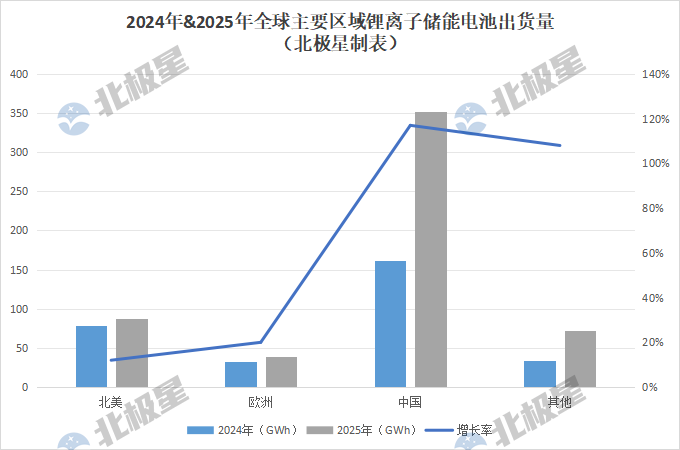
Core Insights - The global lithium-ion energy storage battery shipment reached 550 GWh in 2025, marking a 79% year-on-year increase, indicating rapid expansion in the energy storage industry [1][6][11] Group 1: Market Overview - China, North America, and Europe remain the primary target markets, with China accounting for 352 GWh (64% of global shipments) and a growth rate of 117%, highlighting its role as the core driver of global energy storage supply growth [1][6][11] - North America and Europe are experiencing growth, but their global market share is declining due to faster growth in China and emerging markets, which saw a growth rate of 108% [1][6][11] Group 2: Regional Dynamics - The slowdown in North America's growth rate and its declining global share is linked to U.S. policies, particularly high tariffs on Chinese products, which have impacted the supply of lithium iron phosphate batteries [7][10] Group 3: Company Rankings - The top nine companies in lithium-ion energy storage battery shipments are dominated by Chinese firms, with CATL leading at 167 GWh, holding a 30% market share, while the last two Korean companies account for only 4% [4][9][11] - The dominance of Chinese companies is attributed to the suitability of lithium iron phosphate batteries for energy storage needs, emphasizing safety and cost over energy density [4][9][10] Group 4: Future Outlook - Korean companies are adapting by modifying existing U.S. production lines and focusing on lithium iron phosphate technology to regain market share in North America, with expectations of a gradual recovery in their market presence [10]

【资讯】注资5000万!国轩高科安徽金寨再落子,深化储能大本营布局
Xin Lang Cai Jing· 2026-02-06 11:25
Group 1 - The establishment of Jinzhai Guoxuan Battery Technology Co., Ltd. with a registered capital of 50 million RMB is a strategic move for Guoxuan High-Tech to enhance its core energy storage base in Jinzhai County, Anhui Province [1][6] - The new company will operate under the direct jurisdiction of Hefei Guoxuan High-Tech Power Energy Co., Ltd., indicating a focus on refined and specialized management of core assets in Jinzhai [6][7] - The company’s business scope includes research and development of new materials, battery manufacturing, and sales, which will support the production, research, and market activities of the Jinzhai energy storage industry base [6][7] Group 2 - The Jinzhai project is a significant strategic investment for Guoxuan High-Tech, being the first hundred-billion-level investment project in Jinzhai County, with a total planned capacity of 25 GWh [2][7] - The first phase of the project, signed in May 2022, has a designed capacity of 5 GWh, while the second phase, which commenced in October 2023, involves an investment of 8 billion RMB to build a 20 GWh production line [2][7] - Once fully operational, the project is expected to generate an annual output value of 20 billion RMB, positioning it as a core supply base for GWh-level energy storage products [2][7] Group 3 - Guoxuan High-Tech's investment in Jinzhai is part of its ongoing strategy to deepen its presence in Anhui and strengthen its local advantages, with multiple subsidiaries established across the region [3][8] - The company has created a complete industrial chain covering battery materials, cell manufacturing, PACK packaging, system integration, and battery recycling, enhancing its regional network [3][8] - This "core-satellite" layout reduces supply chain logistics costs and strengthens regional collaboration, creating a localized industrial barrier that is difficult to replicate [3][8] Group 4 - The new company's establishment is primarily aimed at supporting Guoxuan High-Tech's second growth curve in the energy storage sector, which has seen explosive growth globally [4][9] - By 2025, it is projected that new energy storage installations in China will reach 62.24 GW/183 GWh, with cumulative installed capacity expected to hit 136 million kW/351 million kWh [4][9] - Guoxuan High-Tech has positioned energy storage as a strategic pillar, with a comprehensive product matrix covering various core scenarios, and ranked seventh in global energy storage cell shipments in the first half of 2025 [4][10]
国轩高科拟募资50亿!
起点锂电· 2026-02-06 11:16
Group 1 - The core viewpoint of the article is that Guoxuan High-Tech is actively expanding its production capacity in response to the growing demand for batteries, particularly in the electric vehicle sector, by issuing A-shares to raise 5 billion yuan for three major projects totaling 60GWh [2][3][4] - The three projects include a 20GWh power battery project with an investment of 5 billion yuan, a 20GWh new energy battery base project with an investment of 4 billion yuan, and a 20GWh new battery manufacturing base project with an investment of 4 billion yuan [3][5] - Guoxuan's strategy reflects a shift towards advanced battery technologies, indicating that traditional battery technologies have reached their limits, necessitating the development of new production lines [4][5] Group 2 - The company has been increasingly locking in supply contracts for upstream materials, such as a three-year agreement for 870,000 tons of electrolyte with Jiujiang Tianqi and an 18 billion yuan supply contract with Nord [6][7] - Guoxuan is also enhancing its supply chain by establishing new material projects, including the production of high-performance lithium iron phosphate batteries and solid-state batteries, which are expected to improve product quality and production efficiency [7][8] - The establishment of a new company, Jinzhai Guoxuan, focuses on energy storage, indicating a dual-track strategy to strengthen its position in the energy storage market [9][10] Group 3 - Guoxuan's energy storage projects in Anhui are expanding, with a second phase investment of 8 billion yuan for a 20GWh energy storage cell and PACK production line, reinforcing its commitment to energy storage solutions [10] - The company is strategically positioned in Anhui, creating a complete ecosystem with its facilities in Hefei, Lujiang, Feidong, and Jinzhai, which enhances logistical efficiency and regional collaboration [10][11] - Despite being primarily focused on power batteries, Guoxuan recognizes the importance of energy storage and aims to develop this segment significantly in the coming years, with a comprehensive product matrix already in place [10][11]
李缜要把国轩高科做成“宁德时代”?
Xin Lang Cai Jing· 2026-02-06 09:43
Core Viewpoint - Guoxuan High-Tech's net profit is projected to surge by 148% in 2025, with an expected profit of 2.5 to 3 billion yuan, marking a year-on-year growth of 33.31% to 71.40% compared to the previous year [3][39]. Financial Performance - The net profit attributable to shareholders is expected to be between 250 million and 300 million yuan, representing a growth of 107.16% to 148.59% compared to the previous year [5][41]. - The net profit after deducting non-recurring gains is projected to be between 350 million and 450 million yuan, with a year-on-year increase of 33.31% to 71.40% [5][41]. - Basic earnings per share are expected to be between 1.38 yuan and 1.66 yuan, compared to 0.68 yuan in the previous year [5][41]. Business Challenges - Despite impressive financial data, Guoxuan High-Tech faces criticism for its weak core business profitability, heavily relying on government subsidies and non-recurring gains [5][41][51]. - The company reported a significant disparity between net profit and net profit after deducting non-recurring gains, indicating a shortfall in its core business's ability to generate profits [5][41]. - The company has accumulated losses exceeding 14 billion yuan over four consecutive years from 2019 to 2022, with government subsidies amounting to 23.8 billion yuan during this period [24][61]. International Expansion Issues - Guoxuan High-Tech's overseas expansion has faced significant setbacks, including a legal dispute in Michigan, where the state terminated a partnership and sought repayment of 23.7 million dollars due to project delays [29][65]. - The company established a local R&D center in the U.S. in 2014 and acquired a factory in Germany in 2021, but these efforts have not yielded the expected results [25][61]. - The company is currently under pressure to maintain its competitive edge in the solid-state battery sector, which is anticipated to become a key technology in the industry [32][68].
电池板块技术迭代与产业链布局加速推进,电池ETF嘉实(562880)表现亮眼
Jin Rong Jie· 2026-02-06 07:45
Group 1 - The core viewpoint of the articles highlights the strong performance of the battery sector, driven by technological advancements and accelerated industry chain development, with significant gains in stock prices for key companies [1][2] - The CS battery index increased by 2.61%, with notable individual stock performances including Multi-Flor and Zhenyu Technology, which rose over 8% and 7% respectively [1] - The battery ETF managed by Jiashi (562880) saw a 2.44% increase, with a trading volume of 22.759 million yuan and a turnover rate of 2.18%, reflecting a 64.95% increase over the past year [1] Group 2 - Citic Securities indicates that the solid-state battery sector is supported by improvements in the fundamentals of related companies and accelerated industry development, suggesting strong sustainability and investment value [2] - The top ten weighted stocks in the Jiashi battery ETF include CATL, Sungrow Power, and EVE Energy, collectively accounting for over 50.68% of the fund [2] - The current management fee for the Jiashi battery ETF is 0.50% annually, with a custody fee of 0.10% annually [2]




国轩高科拟高位定增募不超50亿元 2021年定增募73亿
Zhong Guo Jing Ji Wang· 2026-02-06 06:27
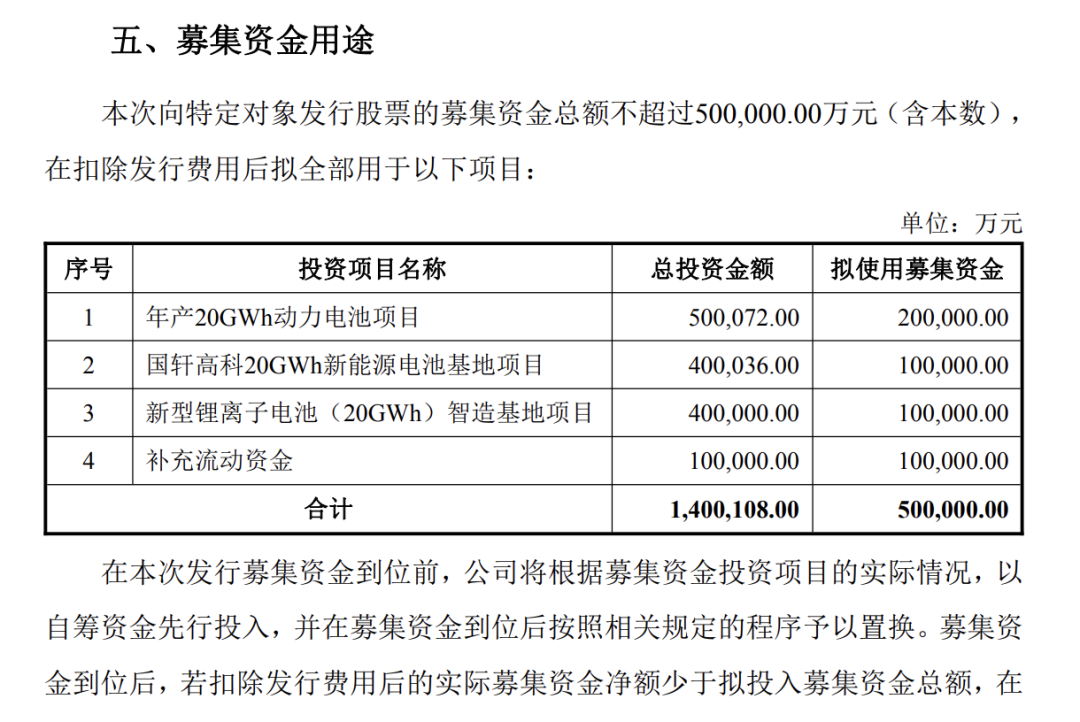
Group 1 - Company Guoxuan High-Tech (002074.SZ) announced a plan to issue A-shares to specific investors, with a maximum of 35 participants, including legal entities and individuals [1] - The total amount to be raised from this issuance will not exceed 500 million yuan, which will be used for various battery projects and to supplement working capital [2][3] - The issuance price will be set at no less than 80% of the average stock price over the 20 trading days prior to the issuance date [1] Group 2 - The projects funded by the raised capital include a 20GWh power battery project, a 20GWh new energy battery base project, and a new lithium-ion battery manufacturing base project, with total investments of approximately 1.4 billion yuan [3] - As of the announcement date, the company has not yet determined the specific investors for the issuance, and whether it constitutes a related party transaction will be disclosed in the issuance report [3] - The company’s total share capital as of December 31, 2025, is 1,814,113,804 shares, with the actual controller being Li Zhan, who holds 17.85% of the shares [4] Group 3 - The company expects a net profit attributable to shareholders of between 250 million and 300 million yuan for the fiscal year, representing a year-on-year growth of 107.16% to 148.59% [6][7] - The net profit after excluding non-recurring gains and losses is projected to be between 35 million and 45 million yuan, reflecting a growth of 33.31% to 71.40% compared to the previous year [6][7] - The basic earnings per share are estimated to be between 1.38 yuan and 1.66 yuan, compared to 0.68 yuan in the previous year [7]
国轩高科拟定增不超过50亿元,加码电池扩产
Huan Qiu Lao Hu Cai Jing· 2026-02-06 06:01
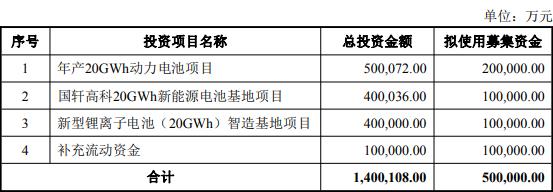
Group 1 - The core point of the article is that Guoxuan High-Tech plans to raise up to 5 billion yuan through a private placement of shares to expand its production capacity in response to the explosive growth in the new energy industry and increasing demand for lithium batteries [1] - The company intends to allocate 2 billion yuan for a 20GWh power battery project, 1 billion yuan for a 20GWh new energy battery base project, and 1 billion yuan for a new lithium-ion battery manufacturing base project, along with working capital [1] - Guoxuan High-Tech has established eight R&D centers globally and is advancing the design of a 2GWh production line, with its high-density quasi-solid-state battery entering the adaptation phase with several automotive companies [1] Group 2 - In terms of performance, Guoxuan High-Tech achieved a revenue of 29.51 billion yuan in the first three quarters of last year, a year-on-year increase of 17.21%, and a net profit attributable to shareholders of 2.533 billion yuan, a significant increase of 514.35% [2] - The company expects to achieve a net profit of approximately 2.5 billion to 3 billion yuan in 2025, representing a growth of 107.16% to 148.59% compared to the previous year's 1.207 billion yuan [2] - However, the non-recurring net profit is projected to be relatively modest at 350 million to 450 million yuan, with a year-on-year growth of 33.31% to 71.40%, indicating a significant gap compared to the net profit attributable to shareholders [2]
拟募资不超50亿!600亿A股公司国轩高科,加码锂电扩产
Zhong Guo Zheng Quan Bao· 2026-02-06 05:44
Core Viewpoint - Guoxuan High-Tech plans to raise up to 5 billion yuan through a private placement of A-shares, with the funds allocated for various battery projects and working capital, in response to the growing demand in the new energy battery market [1][2]. Fundraising Details - The private placement will involve no more than 35 investors, with a total fundraising amount not exceeding 5 billion yuan. After deducting issuance costs, 2 billion yuan will be allocated to the annual production of 20GWh power battery project, 1 billion yuan for the 20GWh new energy battery base project, 1 billion yuan for the new lithium-ion battery (20GWh) manufacturing base project, and 1 billion yuan for working capital [2][3]. Investment Projects - The total investment for the annual production of 20GWh power battery project is 500.072 million yuan, with 200 million yuan from the raised funds. The 20GWh new energy battery base project has a total investment of 400.036 million yuan, with 100 million yuan from the raised funds. The new lithium-ion battery (20GWh) manufacturing base project also has a total investment of 400 million yuan, with 100 million yuan from the raised funds. Additionally, 100 million yuan will be used for working capital [3]. Market Position and Growth - As of February 5, Guoxuan High-Tech's stock price was 37.14 yuan per share, with a market capitalization of 67.4 billion yuan. The company expects its net profit for 2025 to be between 2.5 billion and 3 billion yuan, representing a year-on-year growth of 107.16% to 148.59% [1][4]. The company aims to enhance its production capacity to meet the increasing market demand and provide stable supply for both new and existing customers [4]. Industry Trends - The lithium battery industry is experiencing a significant expansion, with over 282 publicly announced investment projects in 2025, totaling more than 820 billion yuan, reflecting a year-on-year increase of over 74% [5]. Major companies in the sector, such as Fulin Precision and Longpan Technology, are also announcing substantial investment plans to boost production capacity [5].
开盘:三大指数大幅低开 贵金属板块跌幅居前
Xin Lang Cai Jing· 2026-02-06 02:10
Market Overview - The three major indices opened lower, with the Shanghai Composite Index down 0.87% at 4040.30, the Shenzhen Component down 1.09% at 13801.03, and the ChiNext Index down 1.15% at 3222.88 [1] Industry Developments - The Ministry of Industry and Information Technology, along with eight other departments, issued the "Implementation Plan for High-Quality Development of Traditional Chinese Medicine Industry (2026-2030)", aiming to promote the approval of innovative Chinese medicine drugs and cultivate ten major traditional Chinese medicine products [2] - Eleven departments jointly released opinions to enhance the digital service convenience for inbound personnel, targeting significant improvements in internationalization and efficiency by 2027 [2] Company News - Infineon announced a price increase for certain products effective April 1, 2026 [3] - BASF raised TDI product prices by 11% in the Asia-Pacific region, excluding mainland China [4] - HP, Dell, Acer, and Asus are considering sourcing memory chips from chip manufacturers in mainland China for the first time [5] - Bitcoin experienced a significant drop, falling to around $62,000, losing over half its value from a four-month high due to increased market volatility [6] - Jinfu Technology announced plans to acquire 51% stakes in Zhuohui Metal and Lianyi Thermal Energy for 714 million yuan, while Guoxuan High-Tech plans to raise no more than 5 billion yuan through a private placement [11] - The actual controller of Beiliang Technology is under investigation by the Securities Regulatory Commission for alleged market manipulation [13] Commodity Market - COMEX gold futures fell by 3.08% to $4,798.1 per ounce, while COMEX silver futures dropped by 16.64% to $70.35 per ounce [12] - The initial margin for COMEX 100 gold futures was raised from 8% to 9%, and for COMEX 5000 silver futures from 15% to 18% [12] Financial Performance - Amazon reported fourth-quarter sales of $213.39 billion, a year-on-year increase of 13.6%, exceeding expectations of $211.49 billion, with a net profit of $21.19 billion, up 6% year-on-year [12]