Chengxin Lithium(002240)

Search documents
盛新锂能跌2.01%,成交额16.40亿元,主力资金净流出1.02亿元
Xin Lang Zheng Quan· 2026-01-09 05:59
Group 1 - The core viewpoint of the news is that Shengxin Lithium Energy's stock has experienced fluctuations, with a recent decline of 2.01% and a total market capitalization of 32.163 billion yuan [1] - As of January 9, the stock price is reported at 35.14 yuan per share, with a trading volume of 1.64 billion yuan and a turnover rate of 5.03% [1] - The company has seen a year-to-date stock price increase of 2.06%, with significant gains over the past 60 days, rising by 80.11% [2] Group 2 - Shengxin Lithium Energy's main business involves the production and sale of lithium-related products, with 100% of its revenue coming from the new energy sector [2] - As of September 30, the company reported a revenue of 3.095 billion yuan for the first nine months of 2025, a year-on-year decrease of 11.53%, and a net profit attributable to shareholders of -0.752 billion yuan, down 62.96% year-on-year [2] - The company has distributed a total of 929 million yuan in dividends since its A-share listing, with 811 million yuan distributed over the past three years [3]

锂价翻倍,锂企溢价囤矿了
投中网· 2026-01-09 01:50
Core Viewpoint - The lithium industry is experiencing a surge in resource acquisition, with companies like Salt Lake Co. and Shengxin Lithium Energy making significant acquisitions to secure lithium resources amid rising lithium prices and increasing demand [4][5][9]. Group 1: Recent Mergers and Acquisitions - Salt Lake Co. plans to acquire a 51% stake in Minmetals Salt Lake for 4.605 billion yuan, representing a premium of 352.42% [8][9]. - Shengxin Lithium Energy is acquiring the remaining 30% stake in Qicheng Mining for 2.08 billion yuan, achieving full control over key lithium resources [8][9]. - Other companies, including Ganfeng Lithium and Hualian Holdings, are also increasing their investments in lithium mining [7][10]. Group 2: Market Dynamics and Price Trends - Lithium prices have rebounded significantly, with carbonate lithium prices doubling since Q3 of last year, driven by explosive demand growth [5][12]. - The demand for lithium is expected to continue rising, with projections indicating that global lithium demand could reach 2 million tons of lithium carbonate equivalent by 2026 [12][20]. - China's lithium salt production capacity is projected to exceed 1.2 million tons LCE in 2024, accounting for over 65% of global production [12]. Group 3: Strategic Resource Acquisition - Companies are acquiring resources to mitigate raw material cost volatility and ensure stable supply amid geopolitical uncertainties [12][13]. - The acquisition of high-quality resources is seen as essential for companies to maintain competitive advantages in the face of rising lithium prices [12][13]. - The value of mining rights is being restructured as lithium prices rise, with companies aiming to lock in resources at relatively low prices [12][16]. Group 4: Future Outlook - The lithium market is expected to maintain a tight supply-demand balance, with potential supply disruptions from geopolitical factors [20]. - The demand for lithium in energy storage is projected to grow significantly, with expectations that it will surpass demand from the electric vehicle sector by 2026 [20]. - The overall sentiment in the lithium market remains optimistic, with expectations of price stability and potential upward trends in the coming years [19][20].



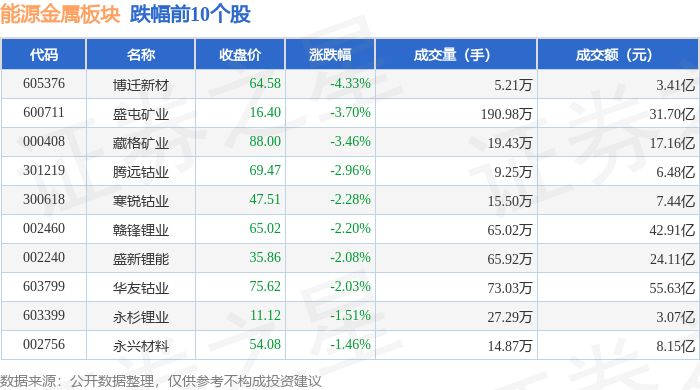
能源金属板块1月8日跌2.4%,博迁新材领跌,主力资金净流出24.37亿元
Zheng Xing Xing Ye Ri Bao· 2026-01-08 08:51
Core Viewpoint - The energy metals sector experienced a decline of 2.4% on January 8, with significant losses in individual stocks, particularly Boqian New Materials, which led the decline with a drop of 4.33% [1] Group 1: Market Performance - The Shanghai Composite Index closed at 4082.98, down 0.07% - The Shenzhen Component Index closed at 13959.48, down 0.51% [1] Group 2: Individual Stock Performance - Boqian New Materials (code: 605376) closed at 64.58, down 4.33% with a trading volume of 52,100 shares and a transaction value of 341 million yuan - Jizhong Mining (code: 600711) closed at 16.40, down 3.70% with a trading volume of 1.9098 million shares and a transaction value of 3.17 billion yuan - Cangge Mining (code: 000408) closed at 88.00, down 3.46% with a trading volume of 194,300 shares and a transaction value of 1.716 billion yuan - Tengyuan Diamond (code: 301219) closed at 69.47, down 2.96% with a trading volume of 92,500 shares and a transaction value of 648 million yuan - Sairui Diamond (code: 300618) closed at 47.51, down 2.28% with a trading volume of 155,000 shares and a transaction value of 744 million yuan - Ganfeng Lithium (code: 002460) closed at 65.02, down 2.20% with a trading volume of 650,200 shares and a transaction value of 4.291 billion yuan - Shengxin Lithium Energy (code: 002240) closed at 35.86, down 2.08% with a trading volume of 659,200 shares and a transaction value of 2.411 billion yuan - Huayou Cobalt (code: 603799) closed at 75.62, down 2.03% with a trading volume of 730,300 shares and a transaction value of 5.563 billion yuan - Yongshan Lithium (code: 6633399) closed at 111.12, down 1.51% with a trading volume of 272,900 shares and a transaction value of 307 million yuan - Yongxing Materials (code: 002756) closed at 54.08, down 1.46% with a trading volume of 148,700 shares [1] Group 3: Capital Flow - The energy metals sector saw a net outflow of 2.437 billion yuan from major funds, while retail investors contributed a net inflow of 1.887 billion yuan and speculative funds saw a net inflow of 550 million yuan [1]




盛新锂能20260107
2026-01-08 02:07
Summary of Shengxin Lithium Energy Conference Call Company Overview - **Company**: Shengxin Lithium Energy - **Industry**: Lithium Mining and Production Key Points Mining Projects - Shengxin Lithium Energy has obtained a mining license for the Mulong Mine, a high-grade lithium mine in the Sichuan region, with plans to start production in 2028, targeting an annual output of approximately 80,000 tons of lithium carbonate equivalent at an estimated non-tax cost of 40,000 RMB per ton [2][3] - The company plans to increase its stake in the Mulong Mine to significantly enhance its lithium resource self-sufficiency, aiming for nearly complete domestic supply [2][4] - The company’s Sabi Star project in Zimbabwe has a high grade of 1.98%, with a target of achieving 35,000 tons of lithium carbonate equivalent by 2026 at a non-tax cost of around 60,000 RMB per ton [2][7] - The company is exploring surrounding areas to extend the lifespan of the Sabi Star project due to limited reserves [2][7] International Expansion - The lithium salt project in Indonesia aims to expand overseas resources and enhance the company's control over the supply chain, despite slightly higher construction and production costs compared to domestic operations [2][7] - The company has sold over 10,000 tons of goods within four months since sales began in August 2026, indicating a positive market response [2][7] Inventory and Sales Strategy - Shengxin Lithium Energy currently has low inventory levels, with major customers like BYD and Zhongchu Innovation maintaining normal pickup rates, resulting in minimal sales pressure [2][8] - The company anticipates producing around 120,000 tons in 2026, with approximately 40% sourced from its own mines and the remainder through outsourcing and purchases [2][8] Pricing and Customer Relations - The company primarily relies on long-term contracts with major clients, with pricing based on industry averages or futures prices [2][8] - Strategic partnerships with companies like Huayou and Zhongchu Innovation are aimed at resource sharing and strategic collaboration [2][8] Future Development and Financial Planning - The overall strategy involves a dual-circulation model, focusing on both domestic and international resource and smelting capabilities to enhance supply chain control and mitigate geopolitical risks [2][11] - The company plans to invest approximately 4 billion RMB in the Mulong Mine, with 3.3 billion RMB already secured through bank loans [3][14] - A planned capital increase of 3.2 billion RMB is underway to support future growth, with participation from strategic investors [3][14] Solid-State Battery and Metal Business - Shengxin Lithium Energy has existing capacity of 500 tons in its metal business and plans to add 2,500 tons to meet the demand in the solid-state battery sector [2][9] - The company has developed advanced technology for ultra-thin metal strips and maintains communication with downstream customers to capitalize on market opportunities [2][9] Environmental and Regulatory Considerations - The company acknowledges the challenges of mining in the Sichuan region due to environmental and safety regulations but believes its experience in complex environments will aid in the development of the Mulong Mine [2][5][6] Employee Incentives - Since entering the lithium industry in 2017, the company has invested significantly in employee incentives, conducting four rounds of incentives to boost morale and performance [2][12] Resource Acquisition Strategy - Shengxin Lithium Energy aims to focus on resource acquisition in regions like Sichuan, South America, and Africa, with a preference for solid minerals while remaining open to opportunities in salt lake projects [2][15][16]
盛新锂能20.8亿“豪赌”锂矿:高溢价收购0收入标的 业绩巨亏债务风险激增
Xin Lang Cai Jing· 2026-01-07 09:51
Core Viewpoint - The acquisition of a 30% stake in Sichuan Qicheng Mining by Shengxin Lithium Energy for 2.08 billion yuan is a strategic move to gain full control over lithium resources, despite the company's ongoing financial challenges [1][3]. Group 1: Acquisition Details - Shengxin Lithium Energy plans to acquire a 30% stake in Sichuan Qicheng Mining for 2.08 billion yuan, leading to full ownership of the company [1]. - The overall valuation of Qicheng Mining is approximately 6.933 billion yuan, significantly higher than its net asset value of 2.118 billion yuan as of August 31, 2025 [1][3]. - The core asset of Qicheng Mining is the Muzhong Lithium Mine, which has a confirmed Li₂O resource of 989,600 tons and an average grade of 1.62%, making it one of the highest-grade lithium mines in Sichuan [1]. Group 2: Financial Performance - Shengxin Lithium Energy reported a revenue of 3.095 billion yuan for the first three quarters of 2025, a year-on-year decrease of 11.53%, with a net loss of 752 million yuan, down 62.96% [1]. - In Q3 2025, the company achieved a revenue of 1.481 billion yuan, a year-on-year increase of 61.07%, but this was insufficient to offset the losses from earlier quarters [1]. - Qicheng Mining's financial performance has raised market concerns, with zero revenue reported and a net loss of 155 million yuan from January to August 2025, following a profit of 35.31 million yuan in 2024 [2]. Group 3: Valuation and Market Context - The valuation of Qicheng Mining reflects a premium of over 200%, with the mining rights of the Muzhong Lithium Mine valued at 8.43 billion yuan and the total equity of Huirong Mining valued at 9.04 billion yuan [3]. - The estimated annual sales revenue from the Muzhong Lithium Mine is projected to be 4 billion yuan [3]. - The lithium salt industry is facing increasing competition, with about 60% of raw materials for Chinese lithium salt companies relying on imports, highlighting supply chain vulnerabilities [4].
供需紧平衡预期提升 碳酸锂"期现"价格开年大涨
Shang Hai Zheng Quan Bao· 2026-01-07 00:09
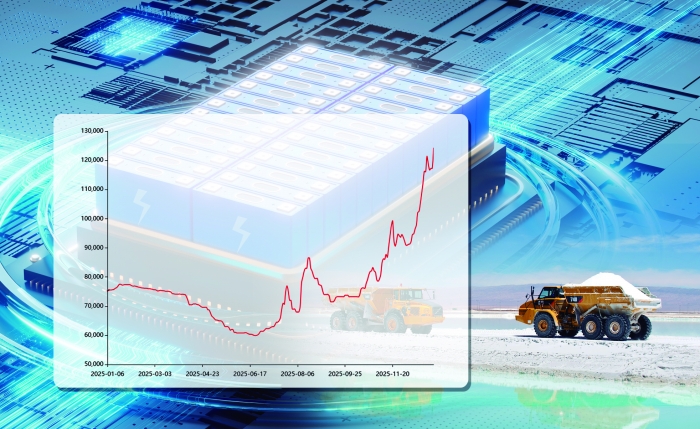
Core Viewpoint - The price of lithium carbonate is experiencing a strong increase due to tightening supply expectations, with significant price jumps observed in early January 2025, reaching a record high of 137,940 yuan/ton [1]. Group 1: Price Trends - Lithium carbonate prices have surged from over 80,000 yuan/ton to 137,940 yuan/ton within two months, driven primarily by increased demand for energy storage [1]. - The average price of battery-grade lithium carbonate reached 132,250 yuan/ton on January 6, 2025, marking a 7,900 yuan increase from January 5 [1]. Group 2: Demand Factors - The demand for lithium carbonate is robust, with a notable "rush to buy" observed in the market, as inventory levels have been rapidly depleting [1]. - The sales of lithium carbonate have been recovering since the second half of 2025, with a significant portion of customers relying on long-term contracts due to high demand [1]. Group 3: Supply Dynamics - Supply constraints are expected to persist, with the lithium market transitioning from oversupply to a tighter balance, influenced by factors such as the uncertain resumption of lithium mining in Jiangxi and geopolitical instability [1]. - The inventory of lithium carbonate has been declining for 19 consecutive weeks, indicating a tightening supply situation [1]. Group 4: Policy Support - Government policies, including subsidies for electric vehicle replacements and expanding energy storage compensation standards, are expected to bolster long-term demand for lithium carbonate [1]. - The domestic policy for electric vehicle trade-ins continues to provide significant financial incentives, enhancing market confidence [1]. Group 5: Future Projections - Global demand for lithium carbonate is projected to reach 202,000 tons by 2026, with a 32% year-on-year increase, driven by a surge in energy storage battery demand [1]. - Supply growth is anticipated to be slower due to previous price weaknesses affecting project timelines, with domestic production expected to increase by approximately 59% in 2026 [1]. Group 6: M&A Activity - The rising lithium carbonate market has sparked increased merger and acquisition activity within the industry, with companies like Salt Lake Co. and Shengxin Lithium Energy making significant investments in lithium resources [1]. - Salt Lake Co. plans to acquire a 51% stake in Wenkang Salt Lake for over 4.6 billion yuan, which will significantly boost its lithium carbonate production capacity [1].
供需紧平衡预期提升 碳酸锂“期现”价格开年大涨
Shang Hai Zheng Quan Bao· 2026-01-06 17:56
Core Viewpoint - The price of battery-grade lithium carbonate has surged due to tightening supply expectations, reaching a new high of 137,940 yuan/ton, with significant increases in both spot and futures prices [2][3]. Supply and Demand Dynamics - The demand for lithium carbonate has been robust, driven primarily by the growth in energy storage needs, leading to a "rush to buy" from downstream customers [3][4]. - Inventory levels of lithium carbonate have been declining for 19 consecutive weeks, indicating strong demand and rapid consumption of existing stocks [5]. - The supply of lithium carbonate is expected to grow by approximately 59% in 2026, while global demand is projected to increase by 32%, highlighting a shift from oversupply to a tighter balance [7]. Policy and Market Confidence - Government policies, such as subsidies for electric vehicle replacements and expanding energy storage compensation standards, are enhancing market confidence in long-term demand for lithium [6]. - The continuation of these policies is expected to support the growth of the lithium carbonate market, particularly in the energy storage sector [6]. Industry Trends and Mergers - The rising prices of lithium carbonate have sparked increased merger and acquisition activity within the industry, as companies seek to secure valuable lithium resources [9][10]. - Notable transactions include Salt Lake Co. acquiring a 51% stake in Minmetals Salt Lake for over 4.6 billion yuan, and Shengxin Lithium Energy's acquisition of a 30% stake in Qicheng Mining for 2.08 billion yuan [9][10].
股份制银行AIC多元投资项目密集落地
Zheng Quan Ri Bao· 2026-01-06 16:39
Group 1 - The core viewpoint of the article highlights the rapid deployment of investment projects by newly established Asset Investment Companies (AICs) under joint-stock banks, focusing on strategic emerging industries and preferring high-quality subsidiaries of listed companies [1][3][4] Group 2 - Since its establishment on November 16, 2025, Xingyin Financial Asset Investment Co., Ltd. has invested over 6 billion yuan in more than 10 projects, targeting sectors such as semiconductors, photovoltaics, lithium mining, and engineering plastics across various regions [2][3] - Xingyin Investment has participated in capital increases for three subsidiaries of listed companies, including a 500 million yuan investment in Sichuan Zhiyuan Lithium Industry, a 300 million yuan investment in Jiangsu Jinfang Technology, and a 700 million yuan investment in Dongyangguang Fluorine [2] Group 3 - The investment strategies of joint-stock bank AICs differ from those of state-owned bank AICs, with the former focusing on emerging industries and technology sectors, while the latter historically concentrated on traditional infrastructure [4][5] - The operational model of joint-stock bank AICs is characterized by a shorter decision-making chain and higher approval efficiency, emphasizing equity investments for high growth returns [4][5] Group 4 - The establishment of AICs has reduced capital consumption for banks, allowing both state-owned and joint-stock banks to complement each other's advantages in serving technology innovation enterprises and projects [6]





珠海盛泽鑫辰科技有限公司成立
Zheng Quan Ri Bao Wang· 2026-01-06 13:49
Group 1 - Zhuhai Shengze Xincheng Technology Co., Ltd. has been established with a registered capital of 50 million yuan [1] - The company's business scope includes supply chain management services, corporate headquarters management, sales of chemical products, sales of metal ores, sales of non-ferrous metal alloys, and corporate management consulting [1] - Shengxin Lithium Energy (002240) holds 100% ownership of the newly established company [1]
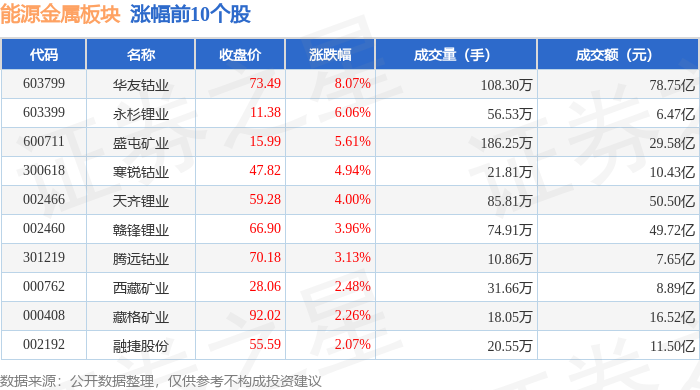
能源金属板块1月6日涨4.11%,华友钴业领涨,主力资金净流入18.78亿元
Zheng Xing Xing Ye Ri Bao· 2026-01-06 08:56
Group 1 - The energy metals sector increased by 4.11% on January 6, with Huayou Cobalt leading the gains [1] - The Shanghai Composite Index closed at 4083.67, up 1.5%, while the Shenzhen Component Index closed at 14022.55, up 1.4% [1] - Key stocks in the energy metals sector showed significant price increases, with Huayou Cobalt rising by 8.07% to a closing price of 73.49 [1] Group 2 - The energy metals sector saw a net inflow of 1.878 billion yuan from main funds, while retail investors experienced a net outflow of 1.272 billion yuan [2] - Major stocks like Huayou Cobalt and Ganfeng Lithium attracted significant main fund inflows, with Huayou Cobalt receiving 4.43 billion yuan [3] - Retail investors showed a negative trend in several stocks, with notable outflows from Ganfeng Lithium and Tianqi Lithium [3]