Hanvon(002362)

Search documents
汉王科技董事长刘迎建:“电子纸正处于持续上升期”
Zhong Guo Jing Ying Bao· 2025-07-01 13:28
Core Insights - The founder and chairman of Hanwang Technology, Liu Yingjian, emphasizes the importance of focusing on forward-looking technologies such as scent recognition and biomimetic robots, while also advocating for retaining core technical personnel for potential future contributions [1][8] - Hanwang Technology has played a crucial role in the Chinese electronic paper industry, being one of the earliest companies to promote e-book readers, despite facing significant competition from Amazon's Kindle [3][4] - The electronic paper market is experiencing a resurgence, with projections indicating a 49.1% year-on-year increase in sales for 2024, positioning Hanwang as a leading brand in this sector [6][7] Company Development - Hanwang Technology's e-book business peaked in 2010 with sales of 1 million units, contributing 880 million yuan to the company's revenue, which accounted for three-quarters of its total revenue at that time [4] - The entry of Amazon's Kindle into the Chinese market in 2013 significantly impacted domestic e-reader manufacturers, leading to a 77% drop in Hanwang's e-book revenue in 2012 [4][5] - Despite challenges, Liu believes in the long-term potential of electronic paper, which is seen as a sustainable product with a growing market, especially in educational and office applications [6][7] Market Trends - The electronic paper market is projected to continue its growth trajectory, with advancements in technology and applications expanding beyond traditional reading devices to sectors like retail, transportation, and healthcare [7][8] - Hanwang Technology is focusing on hardware sales and has shifted its business model away from traditional content-sharing revenue streams [7] - The company plans to introduce a new electronic paper product comparable in size to mobile phone screens, leveraging a mature supply chain to reduce costs [8]


亚马逊Kindle退出中国两年 中国电子纸行业快速发展
Zhong Guo Jing Ying Bao· 2025-07-01 13:28
Core Viewpoint - The Chinese electronic paper industry is experiencing rapid growth despite the exit of Amazon's Kindle from the market, with significant advancements in technology and applications [1][2][3]. Industry Overview - The shipment volume of electronic paper application terminals has reached 379 million units, marking a year-on-year increase of 23.4% [1]. - Nearly 96% of electronic paper modules are manufactured in China, establishing a global supply chain centered around the country [1]. - The display output value of electronic paper technology exceeds $14.9 billion, making it the third-largest display technology after LCD and OLED [1]. Market Dynamics - The primary user terminal for electronic paper is electronic price tags, predominantly in the smart retail sector, followed by electronic paper tablets, which include e-readers, learning machines, and office notebooks [1][3]. - The Chinese electronic paper market is projected to grow at a rate of 30% by 2025, significantly outpacing the global market growth forecast of 9.3% [3]. Product Development - The sales volume of electronic paper tablets in China is expected to reach 1.834 million units in 2024, with a year-on-year growth of 49.1% [4]. - The market for electronic paper learning machines is expanding, with over 1 million units sold in 2024 by a leading company [6]. Future Trends - The future of electronic paper technology includes colorization, larger sizes, and flexibility, with plans to replace 20% of written paper [6]. - The evolution of electronic paper into mainstream terminals is expected to occur in three phases: introduction (2023-2028), rapid development (2028-2035), and popularization (2035-2045) [7]. - Key trends include significant growth in learning machines, increased penetration of color e-paper screens, and a younger user demographic [7].
“泡面神器”Kindle离场后,汉王科技等国内品牌叙事方式变了
Huan Qiu Wang· 2025-07-01 06:08
Core Insights - The exit of Kindle from the Chinese e-book market has created a significant opportunity for domestic brands like Hanwang Technology to fill the void and innovate in the electronic paper industry [1][3][10] Market Opportunities - The Chinese electronic paper market is expected to experience explosive growth, with projected shipments of electronic paper tablets reaching 3.1 million units by 2025, reflecting a growth rate exceeding 30%, significantly higher than the global average of 9.3% [3] - The digital reading market in China is also expanding, with revenue expected to reach 66 billion yuan in 2024, accounting for half of the publishing industry, supported by a user base of 670 million and a total of 63 million works [3] Industry Standards and Ecosystem Development - The establishment of market standards is underway, including quality grading for electronic paper readers and eye protection norms, leading the industry towards a more standardized development path [4] - The electronic paper industry is evolving from a niche market to a mainstream segment, with a focus on multi-modal interaction and AI applications to enhance user experience and productivity [7][9] Technological Advancements - The industry is undergoing a critical transition from black-and-white to color electronic paper, with challenges such as insufficient oxide backplane production capacity and high costs of high-voltage driver ICs [6] - Companies are collaborating to enhance production capabilities and reduce costs, with a focus on full-color, flexible, and large-size electronic paper technologies [6] Scene Expansion - Electronic paper is expanding its applications from reading to office and educational environments, with products like Hanwang's color office tablet M10C targeting light office scenarios [4][5] - The integration of AI in educational tools, such as the Xiaoyuan Learning Machine, is enabling personalized learning experiences, showcasing the potential for electronic paper in educational settings [5] Ecosystem Collaboration - The electronic paper industry is moving towards a collaborative ecosystem that includes advancements in processors, multi-modal interaction, and AI applications, which are essential for achieving annual sales exceeding 100 million units and entering a trillion-yuan market [7][9] - The industry is still in its early stages compared to smartphones and PCs, necessitating the establishment of unified platforms and standards to accelerate development [9]

从“泡面盖”到生产工具:Kindle退场两年 国产电纸书重塑市场生态
Hua Xia Shi Bao· 2025-06-28 11:37
Core Viewpoint - The e-book market in China is experiencing significant growth despite the exit of Kindle, with projections indicating a nearly 50% increase in sales of e-paper tablets in 2024, surpassing 1.83 million units. E-books have evolved into multifunctional productivity tools, but they face competition from AI-driven devices that threaten their traditional advantages [1][2]. Group 1: Market Growth and Trends - The e-book market is expected to become the third major terminal after smartphones and computers, with annual shipments potentially exceeding 100 million units during its growth phase, and prices dropping below 1,000 yuan during the popularization phase, leading to a market size of 100 billion USD [2]. - The growth of the Chinese e-book market is attributed to the increasing popularity of digital reading, paperless office practices, and environmental awareness, supported by government initiatives to expand the application of e-paper technology across various sectors [3]. Group 2: Product Development and Features - Domestic e-book brands are learning from Kindle's experience, focusing on both hardware and software advancements, and diversifying product functionalities beyond reading to include note-taking, annotation, and voice transcription, catering to various user needs [3][4]. - The transition of e-books into productivity tools aligns with market demands, allowing users to efficiently manage work tasks while enhancing the product's competitiveness by expanding its market reach beyond traditional reading [4]. Group 3: Competitive Landscape - E-books maintain a competitive edge over AI devices like headphones and glasses due to their larger screens, better battery life, and superior processing capabilities, making them suitable for deeper office tasks such as document viewing and note-taking [5]. - To enhance competitiveness, e-book manufacturers are encouraged to integrate AI technologies for features like smart document analysis and voice transcription, improve display quality, and create a more open ecosystem that supports third-party applications [5].
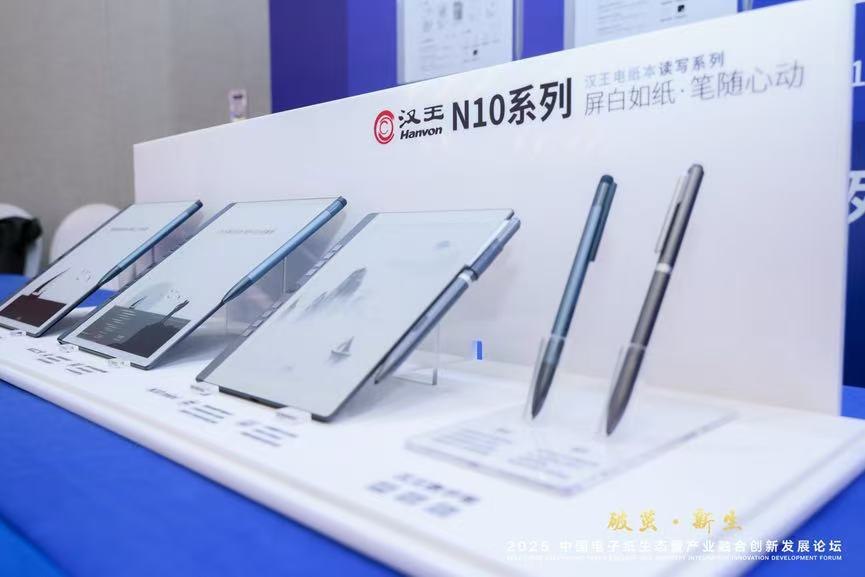
首届中国电子纸生态暨产业融合创新发展论坛在京召开
Zheng Quan Ri Bao Wang· 2025-06-27 11:47
Group 1 - The first China Electronic Paper Ecological and Industrial Integration Innovation Development Forum was held in Beijing, focusing on technology, ecological integration, and market development trends in the electronic paper industry [1] - Hanwang Technology's chairman noted that the exit of Kindle in 2023 caused a temporary setback but stimulated innovation among domestic e-book brands, leading to a vibrant Chinese e-book market [1] - According to the report by Luotu Technology, the total sales of electronic paper tablets in China are expected to reach 1.834 million units in 2024, representing a year-on-year growth of 49.1% [1] Group 2 - Hanwang Technology's vice president described the three development phases of e-books: introduction, rapid development, and popularization, indicating that the current phase is still in the introduction stage [2] - The general manager of E Ink Technology highlighted the broad application scenarios for electronic paper, including its potential to replace tablets in education, and identified three future trends: colorization, flexibility, and large size [2] - The forum marked the initiation of the standard formulation for "Quality Grading and 'Leader' Evaluation Requirements for Electronic Paper Readers," indicating a shift from being "followers" to "rule makers" in the industry [2]
汉王科技领跑电纸书市场:增速174%背后的商业逻辑与千亿市场布局
Cai Jing Wang· 2025-06-27 09:08
Core Insights - Hanwang Technology has achieved remarkable growth in the e-paper book market, driven by a "technology + ecosystem" strategy, with a compound annual growth rate of 174% from 2022 to 2024, outperforming global trends [1] - The company has successfully captured market share by expanding beyond traditional reading scenarios into office and education sectors, leading to significant sales during promotional events [1][2] - The e-paper book market is projected to reach a scale of $100 billion by 2035, with Hanwang positioning itself strategically through industry standards and partnerships to enhance its competitive edge [3] Market Strategy - Hanwang's market strategy has shifted from "stock competition" to "incremental creation," focusing on new market segments and innovative product offerings [1] - The company has integrated various e-book platforms and applications, enhancing the usability of its e-paper books and catering to a broader audience [2] Industry Outlook - The e-paper book market is expected to grow significantly, with predictions of over 100 million units sold by 2035, driven by ecosystem collaboration and cost control [3] - Hanwang's proactive approach in setting industry standards and collaborating with upstream partners is aimed at establishing competitive barriers and controlling supply chain costs [3] - The integration of e-paper technology in sectors like government and education is anticipated to unlock further commercial value [3]
电子纸产业,进入黄金期
2 1 Shi Ji Jing Ji Bao Dao· 2025-06-27 04:54
Group 1 - In 2024, China's data production is expected to grow by 25%, with the core digital economy's added value accounting for about 10% of GDP [1] - The electronic paper industry in China is entering a golden development phase, with total sales of electronic paper tablets projected to reach 1.834 million units in 2024, a year-on-year increase of 49.1% [1] - The electronic paper technology has achieved a display output value of $14.9 billion, ranking among the top three display technologies alongside LCD and LED [1] Group 2 - The exit of Kindle in 2023 caused a temporary setback in the industry, but it has stimulated domestic e-book brands' innovation, with platforms like Yuewen, JD.com, and Dangdang emerging [1] - The development of e-book readers is currently in the introduction phase, with expectations to enter a high-speed growth phase, potentially exceeding annual shipments of 100 million units [1] - The average price of e-book readers is anticipated to drop below 1,000 yuan in the popularization phase, leading to annual shipments surpassing 1 billion units and a market value of $100 billion [1] Group 3 - Five industry trends have been identified: education leading growth, stable rise in e-readers, slowing growth in office products, tripling penetration of color ink screens, and the integration of AI capabilities to enhance user experience [2] - Consumer behavior is shifting due to national subsidy policies, leading to upgrades in consumer choices without reducing budgets [2] - The future direction for e-book products is towards youthfulness and fashion, with a focus on improving user experience through AI [2]

汉王科技(002362) - 关于举行2024年度暨2025年第一季度网上业绩说明会的公告
2025-06-26 09:00
证券代码:002362 证券简称:汉王科技 公告编号:2025-022 1、召开时间:2025年7月2日(星期三)15:00-16:00 2、召开方式:网络互动方式。 3、出席人员:公司董事长刘迎建先生;董事、总裁朱德永先生;董事、 副总裁刘秋童先生;独立董事王莉君女士;副总裁兼董事会秘书周英瑜女 士;财务总监马玉飞女士。 4、参与方式:投资者可以通过全景网"投资者关系互动平台"参与本 次交流,登录网址为:https://ir.p5w.net 二、公开征集问题 汉王科技股份有限公司 关于举行2024年度暨2025年第一季度网上业绩说明会的公告 本公司及董事会全体成员保证信息披露的内容真实、准确、完整,没有虚假记载、 误导性陈述或重大遗漏。 为便于广大投资者更深入全面了解公司情况,进一步加强与投资者的 沟通,做好投资者关系管理工作,汉王科技股份有限公司(以下简称"公 司")定于2025年7月2日在全景网举办2024年度暨2025年第一季度网上业 绩说明会。具体情况如下: 一、本次业绩说明会安排 为充分尊重投资者、提升交流的针对性,现就公司2024年度暨2025年 第一季度业绩说明会提前向投资者公开征集问题,广泛 ...
研判2025!中国自然语言处理行业产业链、相关政策及市场规模分析:技术突破推动行业增长,低成本算力与小样本学习加速技术落地[图]
Chan Ye Xin Xi Wang· 2025-06-08 02:10
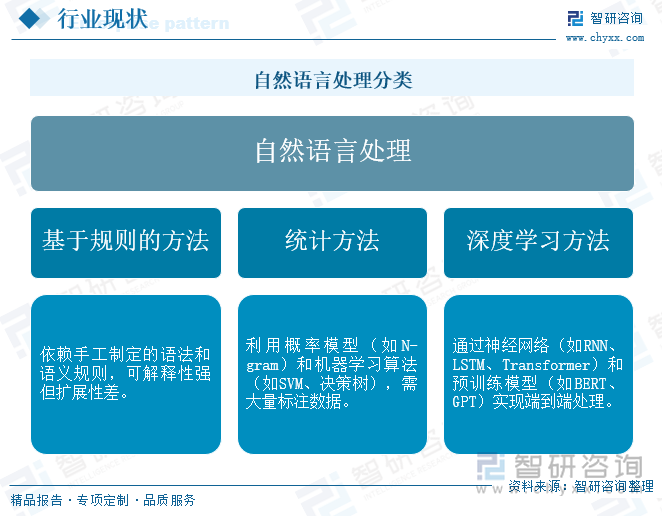
Core Insights - The natural language processing (NLP) industry in China is projected to reach a market size of approximately 12.6 billion yuan in 2024, reflecting a year-on-year growth of 14.55% [1][15] - The cost of model training has significantly decreased due to the "East Data West Computing" initiative, which provides low-cost computing power, and the adoption of few-shot learning frameworks has reduced the demand for training data by 90% [1][15] - Major companies in the NLP sector include Baidu, iFlytek, and Alibaba, each leveraging their technological strengths to capture market share in various applications [2][17][21] Industry Overview - NLP is a crucial branch of computer science and artificial intelligence, aimed at enabling computers to understand, interpret, and generate human language [1][8] - The technology types in NLP are primarily categorized into rule-based methods, statistical methods, and deep learning methods [1][8] Industry Development History - The development of NLP in China has gone through four main stages: the initial phase (1950s-60s) focused on machine translation, the rule-dominated phase (1970s-80s) involved complex rule systems, the statistical learning phase (1990s-2012) integrated statistical models with machine learning, and the deep learning phase (2013-present) is characterized by the dominance of deep learning models and pre-trained language models [4][5][6] Industry Value Chain - The upstream of the NLP industry chain includes hardware devices, data services, open-source models, and cloud services, while the midstream focuses on NLP technology research and development, and the downstream encompasses applications in finance, healthcare, education, and smart manufacturing [1][8] Market Size - The NLP industry in China is experiencing significant growth, with a projected market size of 12.6 billion yuan in 2024, driven by advancements in pre-trained language models and reduced training costs [1][15] Key Companies' Performance - Baidu leads the NLP industry with a strong technological foundation and extensive commercialization, maintaining the largest market share [17][21] - iFlytek excels in voice recognition and machine translation, particularly in the education and healthcare sectors [17][20] - Alibaba has made breakthroughs in machine reading comprehension and natural language understanding, integrating its technology into various business scenarios [17][20] Industry Development Trends - The NLP industry is witnessing a trend towards the integration of large models and multimodal capabilities, enhancing performance and user interaction [24] - There is a growing focus on vertical applications in sectors like healthcare and finance, as well as the integration of NLP with smart hardware [26] - Data security and ethical standards are becoming increasingly important, driving sustainable development in the NLP sector [27]


电子身份证概念涨2.60%,主力资金净流入这些股
Zheng Quan Shi Bao Wang· 2025-05-26 09:10
Group 1 - The electronic ID concept sector rose by 2.60%, ranking 7th among concept sectors, with 38 stocks increasing, including Yuanwanggu hitting the daily limit, and Mind Electronics, Kexin Information, and Xiongdi Technology showing gains of 8.09%, 7.32%, and 5.33% respectively [1][2] - The sector experienced a net outflow of 51 million yuan in main funds, with 17 stocks receiving net inflows, led by Yuanwanggu with a net inflow of 71.37 million yuan [2][3] - The top three stocks by net inflow ratio were Yuanwanggu at 66.30%, Hanwang Technology at 6.06%, and Xinan Century at 5.68% [3][4] Group 2 - The electronic ID concept sector's performance was contrasted with other sectors, such as controllable nuclear fusion which rose by 5.14%, while generic drug consistency evaluation fell by 1.55% [2] - The trading volume and turnover rates varied among stocks, with Yuanwanggu showing a turnover rate of 2.47% and a daily increase of 10.07% [3][5] - Stocks like Geer Software and Jida Zhengyuan faced declines of 0.76% and 0.63% respectively, indicating mixed performance within the sector [1][5]