
BANK OF QINGDAO(002948)

Search documents
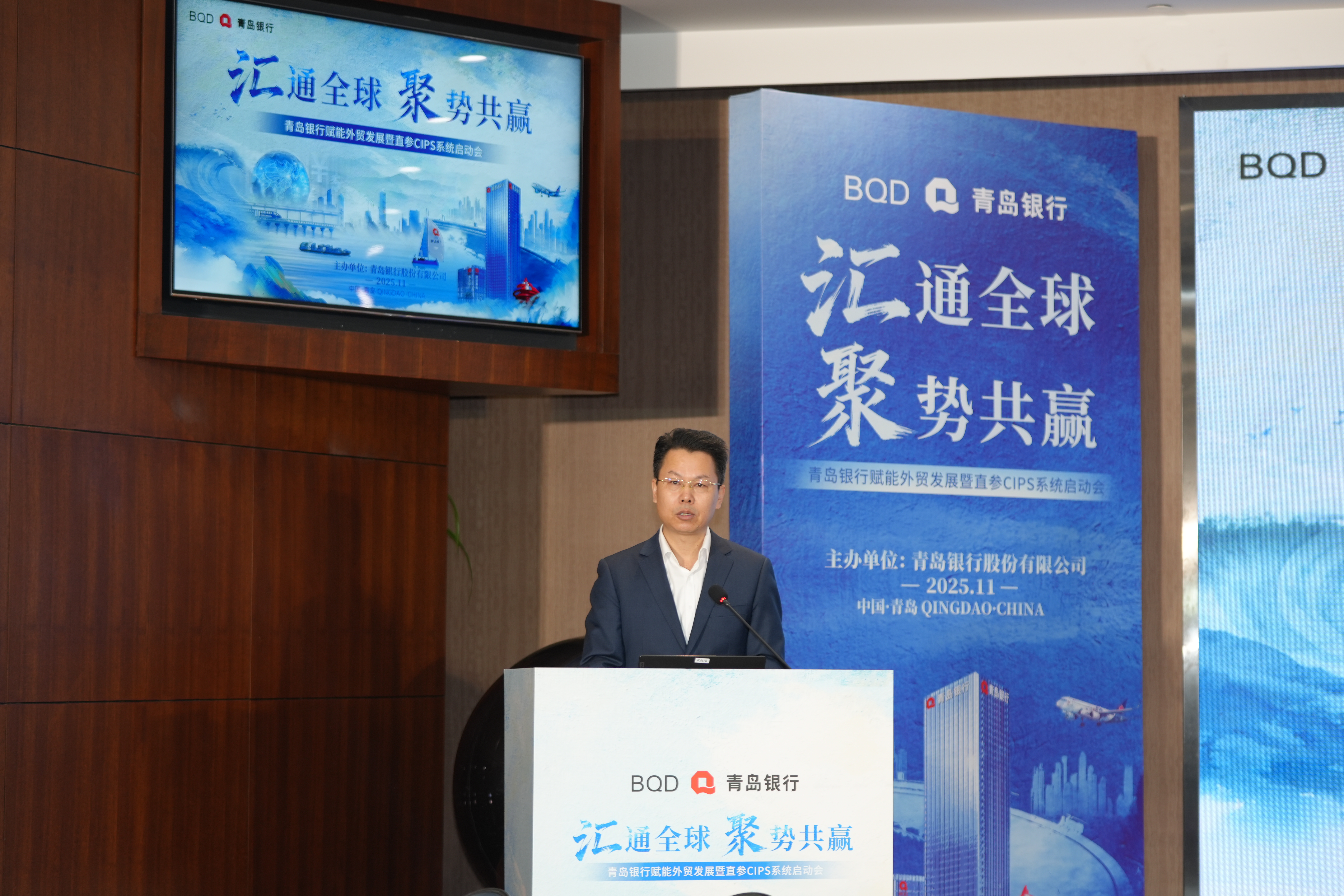
获批全省首家法人银行直参CIPS资格并上线运行,推出17条举措服务青岛高水平开放
Di Yi Cai Jing· 2025-11-18 13:22
Core Viewpoint - Qingdao Bank successfully launched the CIPS direct participation system, aiming to enhance support for foreign trade development and facilitate local brands' international expansion [1][6]. Group 1: International Business Development - Qingdao Bank's international business is projected to exceed $20 billion by 2025, representing a 40% year-on-year growth, serving over 5,000 enterprises [5]. - The cross-border RMB settlement volume is expected to surpass 50 billion yuan, with a year-on-year increase of 52% [5]. Group 2: CIPS System Launch - The CIPS system is a crucial infrastructure for RMB cross-border payment, providing secure, efficient, and low-cost settlement services [6]. - Qingdao Bank is the first legal entity bank in Shandong to obtain direct participation in the CIPS system, enabling point-to-point cross-border RMB clearing [6]. Group 3: Financial Products and Services - Qingdao Bank has developed a comprehensive service system for foreign trade enterprises, including products like "Qingyin Huaitong," "Qingyin Maodai," "Qingyin Huiying," and "Qingyin Chuhaitong" [5]. - The bank launched a white paper outlining 17 key measures to support foreign trade, addressing challenges such as financing difficulties and slow settlements [10]. Group 4: Collaborative Efforts - Qingdao Bank signed a joint action declaration with the Shandong branch of China Export & Credit Insurance Corporation and Qingdao Financing Guarantee Group to support high-quality development of foreign trade enterprises [10]. - The event was supported by CIPS and various financial institutions, highlighting a collaborative approach to enhance cross-border financial services [13]. Group 5: Future Outlook - Qingdao Bank plans to optimize cross-border financial products and services, leveraging the CIPS system to contribute to RMB internationalization and high-level opening-up [16].

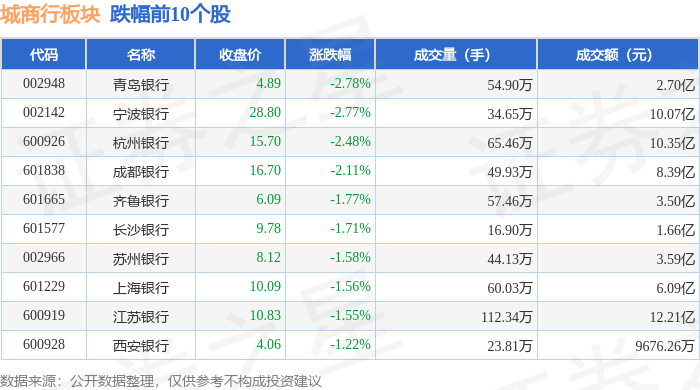
城商行板块11月17日跌1.61%,青岛银行领跌,主力资金净流出3034.02万元
Zheng Xing Xing Ye Ri Bao· 2025-11-17 08:49
Core Viewpoint - The city commercial bank sector experienced a decline of 1.61% on November 17, with Qingdao Bank leading the drop, reflecting broader market trends as the Shanghai Composite Index fell by 0.46% and the Shenzhen Component Index decreased by 0.11% [1] Market Performance - The closing prices and percentage changes for key city commercial banks are as follows: - Qingdao Bank: 4.89, -2.78% - Ningbo Bank: 28.80, -2.77% - Hangzhou Bank: 15.70, -2.48% - Chengdu Bank: 16.70, -2.11% - Qilu Bank: 6.09, -1.77% - Changsha Bank: 9.78, -1.71% - Suzhou Bank: 8.12, -1.58% - Shanghai Bank: 10.09, -1.56% - Jiangsu Bank: 10.83, -1.55% - Xi'an Bank: 4.06, -1.22% [1] Capital Flow - The city commercial bank sector saw a net outflow of 30.34 million yuan from main funds, while speculative funds had a net inflow of 176 million yuan, and retail investors experienced a net outflow of 146 million yuan [1] - Detailed capital flow for selected banks includes: - Qilu Bank: Main net inflow of 67.43 million yuan, speculative net outflow of 26.97 million yuan, retail net outflow of 40.45 million yuan - Suzhou Bank: Main net inflow of 30.20 million yuan, speculative net inflow of 16.46 million yuan, retail net outflow of 46.66 million yuan - Hangzhou Bank: Main net inflow of 27.96 million yuan, speculative net inflow of 61.97 million yuan, retail net outflow of 89.93 million yuan - Qingdao Bank: Main net inflow of 19.35 million yuan, speculative net inflow of 24.55 million yuan, retail net outflow of 43.90 million yuan [2]
年内十余家上市银行 获股东增持
Zhong Guo Ji Jin Bao· 2025-11-17 07:31
Group 1 - Over 10 listed banks have seen significant shareholding increases from shareholders and executives this year, indicating a broader scale of buybacks compared to previous years [1][2] - The increase in shareholding is characterized by a diverse range of stakeholders and a concentration of banks in specific regions [1][3] - This year's buyback activity is occurring during a market uptrend, contrasting with previous years when buybacks were initiated after stock prices fell below net asset value, signaling a shift from defensive to proactive investment strategies [1][4] Group 2 - Notable examples include Changshu Bank, which saw an increase of 561.93 million shares, raising its shareholder's stake to 3.98%, and Qilu Bank, where executives have collectively increased their holdings by approximately 315,000 yuan [2][3] - The participation of local state-owned enterprises has notably increased, with foreign investments also contributing, such as BNP Paribas increasing its stake in Nanjing Bank from 16.14% to 17.02% [3][4] - The overall performance of the banking sector has improved, with 42 A-share listed banks reporting over 4.3 trillion yuan in revenue for the first three quarters, and more than 60% of these banks showing year-on-year revenue growth [4]


青岛银行将调整《“心意存单”存款产品服务协议》部分内容
Jin Tou Wang· 2025-11-17 03:19
Core Points - Qingdao Bank announced adjustments to its "Heart Deposit" product service agreement to enhance product functionality, protect customer rights, and improve customer service experience starting from November 29, 2025 [1] Group 1 - The adjustments include changes to product purchase channel descriptions, anti-money laundering measures, and customer information protection [1]
青岛银行:接受广发证券等投资者调研
Mei Ri Jing Ji Xin Wen· 2025-11-14 10:54
Group 1 - Qingdao Bank (SZ 002948) announced an investor research meeting scheduled for November 14, 2025, from 14:00 to 15:30, where executives and relevant department heads will participate and answer investor questions [1] - For the first half of 2025, Qingdao Bank's revenue composition shows that interest income accounted for 81.78%, while non-interest income made up 7.48% [1] - As of the report date, Qingdao Bank's market capitalization is 29.3 billion yuan [1]

青岛银行(002948) - 2025年11月14日投资者关系活动记录表
2025-11-14 10:36
| | √特定对象调研 □分析师会议 | | --- | --- | | 投资者关系 | □媒体采访 □业绩说明会 | | 活动类别 | □新闻发布会 □路演活动 | | | □现场参观 □其他: 广发证券 倪军、王宇,国泰海通证券 马婷婷,东方证券 屈 | | | 俊,浙商证券 梁凤洁、徐安妮,招商证券 王先爽、文雪阳, 长江证券 马祥云、谢金彤,兴业证券 陈绍兴、曹欣童,光 | | | 大证券 董文欣,东兴证券 林瑾璐,中邮证券 张银新,华 | | 参与单位名称 | 创证券 贾靖、林宛慧,中泰证券 邓美君,国盛证券 朱广 | | 及人员姓名 | 越,西部证券 程宵凯、喻麟靖,国海证券 徐凝碧,华福证 | | | 券 付思雨,开源证券 丁黄石,国寿资产 崔维,中信资管 曾 | | | 征,方正证券 赵大晖,信达澳亚 陈建宇,泰康资产 李鑫, | | | 华安基金 郭昶皓,工银瑞信基金 袁路欣,国泰基金 王韶 | | | 怀,海富通基金 贝敏,鹏华基金 张沁萱,易方达基金 张 | | | 心怡,平安基金 解舒宇,中欧基金 陈巍等。 | | 时间 | 2025 年 11 月 14 日(星期五)14:00-15: ...
青岛银行首席信息官杨斌:中小银行应用AI须先找准方向
Jing Ji Guan Cha Wang· 2025-11-14 04:01
"无论AI(人工智能)如何强大,最终都必须坚持人机协同与流程回滚,确保每一项决策责任明确到人。"青岛银行首席信息官杨斌在2025金融街论坛年会 ·AI+金融专题论坛上,接受经济观察报在内的媒体采访时表示。 杨斌表示,AI的到来,正在深刻改变银行的核心职能。在AI的应用层面,中小银行不能盲目跟风,而应找准方向,结合自身区域特色明确发展路径。 核心能量引擎 在杨斌看来,作为信息技术应用较充分的行业,银行业已从传统"计算"时代迈入"智能"时代。AI不再局限于交易处理、数据存储等基础职能,而是深度渗透 到用户体验优化、产品流程升级和场景生态构建等核心环节,成为驱动银行经营发展的"核心能量引擎"。 杨斌表示,AI对银行业的影响是革命性的。过去,计算机技术主要帮助银行提升效率;如今,AI不仅能进一步提效,还能优化服务体验、提升经营效益, 甚至重塑金融业务底层逻辑。"传统存贷汇业务是行业标配,未来银行的核心竞争力将聚焦于用户信任与口碑,而AI正是构筑这一竞争力的关键要素。"他强 调,AI不再是可有可无的辅助工具,而是需要深度融入银行 DNA的"核心能量引擎"。 然而,当前银行业的AI应用,尤其是对于中小银行而言,仍处于探索 ...

银行研思录25:银行股息率排名与中期分红进度梳理-20251114
CMS· 2025-11-14 03:02
Investment Rating - The report does not explicitly state an investment rating for the banking sector, but it provides detailed insights into dividend yields and distribution processes, which can inform investment decisions. Core Insights - The report outlines the latest dividend yields and mid-term dividend processes for A and H shares of listed banks, emphasizing the importance of accurately calculating dynamic dividend yields to avoid discrepancies across periods [1][2]. - It details the two processes for mid-term dividends following the 2023 revision of the regulatory guidelines, highlighting the conventional and simplified processes for implementing mid-term dividends [2]. - The report provides a comprehensive overview of key dates related to dividend distribution for both A and H shares, including the importance of purchasing shares before the ex-dividend date to qualify for dividends [3][4]. Summary by Sections Dynamic Dividend Yield Calculation - A simplified yet accurate method for calculating dynamic dividend yield is introduced, defined as "rolling 12-month EPS * cash dividend rate / share price," which helps avoid issues related to overlapping or missing annual and mid-term dividends [1]. - The report calculates the cash dividend rate using a standardized approach across different banks, resulting in a clear comparison of dividend yields as of November 13, 2025 [1]. Mid-Term Dividend Processes - The report explains the two processes for mid-term dividends: the conventional process requiring shareholder approval and a simplified process allowing for quicker implementation [2]. - The simplified process is designed to enhance flexibility for companies in distributing mid-term dividends, thereby improving shareholder returns [2]. Dividend Distribution Key Dates - For A shares, investors must purchase shares before the ex-dividend date to receive dividends on the same day, while H shares typically see a delay of about one month for dividend payments [3][4]. - The report outlines the differences in the dividend distribution timeline between A and H shares, emphasizing the need for investors to be aware of these timelines to maximize their returns [3][4]. Mid-Term Dividend Progress - As of November 13, 2025, 31 A-share banks have confirmed mid-term dividends, while 11 H-share banks have also confirmed their dividend distributions [9][11]. - The report categorizes banks based on their dividend status, detailing those that have implemented dividends, those that are pending, and those that have opted not to distribute dividends [9][10][11]. - It highlights that the end of 2025 and early 2026 is expected to be a peak period for mid-term dividend distributions, suggesting potential investment opportunities for dividend-seeking investors [11].




下半年以来23家上市银行共获748家机构调研
Zheng Quan Ri Bao· 2025-11-13 23:12
Core Insights - In the second half of this year, institutions have actively researched and tracked the operational status of listed banks, with 748 institutions conducting 133 investigations into 23 listed banks as of November 13 [1][2] - The focus of these investigations has been primarily on city commercial banks and rural commercial banks, with key areas of interest including net interest margin trends, non-interest income trends, and capital replenishment [1][2] Group 1: Institutional Research - The majority of institutions conducting research on listed banks are fund companies and securities firms, accounting for 53% of the total [2] - Jiangsu Bank emerged as the most popular among institutions, receiving 83 investigations, followed by Chongqing Rural Commercial Bank and Ningbo Bank with 76 and 75 investigations respectively [2] - Ruifeng Bank had the highest number of total investigations at 22 [2] Group 2: Net Interest Margin Trends - Net interest margin has been a focal point for institutions, with some listed banks showing signs of stabilization or slight recovery compared to the previous year [2] - Several banks reported successful measures to reduce funding costs, such as exiting high-cost deposits and enhancing the absorption of low-cost current deposits [3] - Xiamen Bank reported a 4 basis point increase in net interest margin to 1.08% in the first half of the year, with continued stabilization in the third quarter [3] Group 3: Debt Market Analysis - The bond market has shown a volatile trend this year, impacting the investment income of some listed banks, particularly city and rural commercial banks [4] - Banks are focusing on their investment strategies in the bond market, with a cautious approach to market trends and adjustments in trading positions [4] - Shanghai Bank plans to enhance its market analysis capabilities and maintain flexibility in its investment strategies to mitigate risks from market interest rate fluctuations [4] Group 4: Non-Interest Income and Capital Replenishment - Many banks noted changes in non-interest income, particularly in net income from fees and commissions, which have been affected by regulatory requirements on self-managed wealth management [6] - Banks are exploring various methods for capital replenishment, combining internal capital accumulation with external sources to strengthen their capital base [6]



下半年以来23家上市银行共获748家机构调研 净息差走势、非息收入趋势、资本补充等被重点关注
Zheng Quan Ri Bao· 2025-11-13 16:49
Core Insights - Institutions are actively researching the operational status of listed banks in the second half of the year, with 748 institutions conducting 133 investigations into 23 listed banks, primarily focusing on city commercial banks and rural commercial banks [1][2] Group 1: Institutional Research - The majority of institutions conducting research are fund companies and securities firms, accounting for 53% of the total [2] - Jiangsu Bank is the most popular among institutions, receiving 83 investigations, followed by Chongqing Rural Commercial Bank and Ningbo Bank with 76 and 75 investigations respectively [2] - Ruifeng Bank leads in total investigation counts with 22 [2] Group 2: Net Interest Margin Trends - Net interest margin (NIM) has stabilized for some listed banks, with a slight year-on-year recovery noted [2] - Several banks have reported success in reducing funding costs, which alleviates downward pressure on NIM by exiting high-cost deposits and enhancing low-cost deposit absorption [2][3] - Xiamen Bank reported a 4 basis point increase in NIM to 1.08% in the first half of the year, with continued stabilization in the third quarter [3] Group 3: Debt Market Analysis - The bond market has shown volatility this year, impacting investment income for some banks, particularly city and rural commercial banks [4] - Banks are adjusting their investment strategies in response to market conditions, with a focus on defensive strategies and selective trading opportunities [4] - Shanghai Bank aims to enhance market analysis and maintain flexibility in its investment strategies while managing interest rate risks [4] Group 4: Non-Interest Income and Capital Supplementation - Non-interest income, particularly from fees and commissions, has been affected by regulatory requirements on self-managed wealth management products [5] - Banks are exploring ways to supplement capital through internal accumulation and external sources to strengthen their capital base [5] - Qingdao Bank focuses on standardized fixed-income securities and emphasizes duration management to ensure steady growth in bond investment income [5]