Dark Horse Technology (300688)

Search documents
整个社会都在喊没钱了,为什么这些公司反而年赚百亿?
创业家· 2026-03-18 10:31
Core Insights - The article emphasizes that despite the prevailing narrative of economic hardship, certain industries are thriving and generating substantial profits, particularly in the context of Japan's "lost 30 years" and its implications for China [3][4]. Group 1: Economic Trends - The concept of a "low-desire society" does not equate to a lack of opportunities, as consumer behavior is shifting towards different spending patterns [4]. - The article identifies eight key industries that are capitalizing on changing consumer demands, highlighting the potential for growth in these sectors [5]. Group 2: Key Industries - **Second-Hand Economy**: The second-hand luxury market in Japan, exemplified by companies like Daikokuya, has seen significant revenue increases. In China, platforms like Hongbulin and Panghu are experiencing similar growth [6][7][8]. - **Pet Economy**: With a decline in birth rates, spending on pets has surged, with brands like Inaba in Japan and Guobao in China seeing strong sales in pet food and healthcare products [12][13][15]. - **Adult Care**: The adult diaper market in Japan has surpassed $10 billion, indicating a growing demand driven by an aging population [18][19]. - **Health Food and Beverages**: The rise in health consciousness has led to increased sales of sugar-free beverages and functional foods, with brands like Dongfang Shuye and Jianchun gaining traction in China [21]. - **Beauty Economy**: The demand for beauty products remains strong, with high sales figures for collagen supplements and home beauty devices, indicating a shift towards affordable beauty solutions [23][24][26]. - **Outdoor Recreation**: Companies in the outdoor equipment sector, such as Snow Peak in Japan, are thriving, reflecting a growing interest in outdoor activities despite economic constraints [29][31]. - **Convenience Economy**: The trend towards convenience has led to a rise in frozen food sales and smart home appliances, as consumers seek to save time in their daily routines [39][40]. - **Lazy Economy**: The reduction in cooking time among younger generations has made ready-to-eat meals and smart appliances increasingly popular, highlighting a shift in consumer priorities [39][42]. Group 3: Market Opportunities - The article suggests that the current economic climate presents unique opportunities for those willing to invest in counter-cyclical sectors, emphasizing the importance of recognizing and acting on these opportunities [44].



2026年,钱从哪挣?
创业家· 2026-03-17 10:15
Group 1 - The core question for many is where the money will come from in 2026 [2] - The article highlights five key concepts related to business strategies for growth [3] - Many companies are facing significant challenges due to insufficient domestic demand [5][6] Group 2 - Companies are increasing competition due to limited market capacity, leading to a cycle of intense competition [7] - One potential solution for companies is to expand overseas, which has evolved from traditional export methods [8][9] - An example is Miniso, which not only sells products abroad but also relocates its entire value chain, including branding and R&D, overseas [10][11] Group 3 - Leading companies are beginning to explore overseas expansion, which requires integrating complex supply chain systems [14][15] - Tesla's operations in Shanghai illustrate the importance of a robust supply chain network for successful overseas ventures [20][21] - Other industries can also benefit from collaborating with leading companies to expand internationally [22] Group 4 - Companies are leveraging their unique advantages to succeed in overseas markets, such as cost advantages from factories in Yiwu [25][26] - Product advantages are also crucial, as seen with Mech-Mind Robotics, which has developed advanced industrial robots [27][28] - Identifying and utilizing comparative advantages can lead to successful international ventures [24] Group 5 - Building long-term trust in familiar social networks is essential for business success, as demonstrated by the story of Pang Donglai [31][34] - Employees who feel respected and valued are more likely to engage with customers and provide feedback, fostering a cycle of trust [34][36] Group 6 - The article discusses a shift in consumer behavior, where individuals are willing to pay for better experiences, indicating an upgrade in consumption concepts [38][39] - Businesses can create demand by introducing services that consumers may not initially recognize as valuable, such as travel photography for retirees [40][41] - As traditional large-scale business opportunities diminish, a more refined and personalized commercial ecosystem is emerging [43][46]


未来10年,最挣钱的凭什么一定是这群人?
创业家· 2026-03-16 10:34
Core Insights - Amazon's report on global e-commerce trends highlights emerging consumer preferences and market opportunities driven by technology and emotional needs [1][2]. Group 1: AI Quality Space - Over 65% of consumers in Europe and the US are willing to spend more on smart home products, seeking emotional connections and comfort [4][6]. - The market for personalized customization, emotional interaction, and privacy is significant, emphasizing the need for technology to meet human emotional demands [7]. Group 2: Sleep Economy - 37% of American adults reported a decline in sleep quality in 2023, indicating a growing market for sleep-related products and services [10][11]. - Consumers are increasingly willing to invest in sleep quality, associating it with health and lifestyle improvements [12]. Group 3: Happy Office - There is a rising expectation for workspaces that enhance comfort and productivity, with ergonomic furniture and technology becoming more important [13][14]. Group 4: Subtle Technology - Consumers are seeking technology that seamlessly integrates into their lives, enhancing quality without being intrusive, as seen in brands like Apple [15]. Group 5: Pet Economy - The global pet industry is projected to grow by 45% over the next six years, with 55% of pet owners in developed markets willing to spend more on pet health and wellness [16][17]. - Pets are increasingly viewed as family members, creating demand for health-focused pet products and services that foster emotional connections [19]. Group 6: Outdoor Cooking - The popularity of outdoor cooking and camping is rising, creating demand for specialized outdoor cooking equipment and experiences [20][22]. Group 7: Mobile Treasure Chest - Vehicles are evolving into multifunctional spaces, serving as homes, entertainment areas, and offices, with a focus on comfort and efficiency [23][27]. Group 8: Generation Z Consumers - Generation Z, as digital natives, prioritize values-driven consumption, personalization, and unique experiences, while also being price-conscious [28][29]. Group 9: Fitness Pioneers - The health and fitness sector is increasingly focused on scientific, efficient, and personalized approaches, with a rise in smart wearable devices and tailored fitness solutions [31][34]. Group 10: E-sports Enthusiasts - Emerging markets are experiencing rapid growth in e-sports, with consumers seeking high-performance equipment and immersive experiences [35][37]. Summary of Trends - The report identifies three key drivers of these trends: accelerated technology, emotional shifts, and lifestyle changes, reflecting the complex needs of modern consumers [39][40].

经济越来越差,这八大行业越赚爆!
创业家· 2026-03-14 09:58
Core Viewpoint - The article emphasizes that despite the prevailing narrative of economic hardship, certain industries are thriving and generating significant profits, particularly in the context of a "low-desire society" where consumer spending patterns are shifting towards specific sectors [3][4]. Group 1: Emerging Business Opportunities - The article identifies eight key industries that are experiencing growth and presents them as major business opportunities in the current economic climate [5]. - The first industry highlighted is the second-hand economy, where platforms like "闲鱼" and "转转" are seeing increased activity, indicating a shift in consumer behavior towards second-hand goods [6][9]. - The pet economy is also on the rise, with brands like "中宠" and "Inaba" capitalizing on the trend of pet ownership and spending on premium pet products [11][12][15]. - Adult care products, particularly in the context of an aging population, are projected to grow significantly, with the adult diaper market in Japan surpassing $10 billion [16][17][18]. - Health food and beverage sectors are thriving due to changing demographics and increased health consciousness, with brands like "东方树叶" and "简醇" gaining traction [21]. - The beauty and aesthetics market is booming, with products like collagen supplements and home beauty devices seeing high sales, indicating a persistent demand for beauty solutions [23]. - Outdoor and leisure products are gaining popularity, with brands like "凯乐石" and "伯希和" experiencing rapid sales growth as consumers seek outdoor experiences [25][26]. - The emotional economy, characterized by products that provide comfort and joy, is also highlighted, with brands like "Rio" tapping into the market for low-alcohol beverages [28][29]. Group 2: Consumer Behavior Trends - The article discusses the concept of a "low-desire society," suggesting that while consumers may be spending less on luxury items, they are reallocating their budgets towards experiences and products that enhance their quality of life [4][39]. - The trend of "lazy economy" is noted, where younger generations are opting for convenience in food preparation, leading to increased demand for frozen foods and smart home appliances [33][35]. - The article posits that in a low-desire cycle, time-saving products may hold more commercial value than cost-saving ones, indicating a shift in consumer priorities [36].

整个社会都在喊没钱了,为什么这些公司反而年赚百亿?
创业家· 2026-03-07 10:18
Core Insights - The article emphasizes that despite the prevailing narrative of economic hardship, certain industries are thriving and generating substantial profits, particularly in the context of Japan's "lost 30 years" and its implications for China [3][4]. Group 1: Economic Trends - The concept of a "low-desire society" does not equate to a lack of opportunities, as consumer behavior is shifting towards different spending patterns [4]. - The article identifies eight key industries that are capitalizing on changing consumer demands, highlighting the potential for growth in these sectors [5]. Group 2: Key Industries - **Second-Hand Economy**: The second-hand luxury market in Japan, exemplified by companies like Daikokuya, has seen significant revenue increases. In China, platforms like Hongbulin and Panghu are experiencing similar growth [6][7][8]. - **Pet Economy**: With declining birth rates, spending on pets is rising, as seen with brands like Inaba in Japan and Guobao in China, indicating a robust market for pet products and services [12][13][14][15][16]. - **Adult Care**: The adult diaper market in Japan has surpassed $10 billion, showcasing the economic potential of catering to an aging population [17][18][19]. - **Health Food and Beverages**: The rise in health consciousness has led to increased demand for sugar-free and functional beverages, with brands like Dongfang Shuye and East Peak gaining traction in China [21][22]. - **Beauty and Aesthetics**: The demand for beauty products, including collagen supplements and at-home beauty devices, remains strong, indicating that consumers prioritize personal care even in economic downturns [23][24][25][26]. - **Outdoor Recreation**: Companies in the outdoor equipment sector, such as Snow Peak in Japan and various Chinese brands, are benefiting from a growing interest in outdoor activities [29][30][31][32]. - **Convenience Economy**: The trend towards convenience is driving growth in frozen food and smart home appliances, as consumers seek to save time in their daily routines [39][40][42]. - **Lazy Economy**: The reduction in cooking time among younger generations has led to a rise in demand for ready-to-eat meals and smart kitchen appliances, reflecting a shift in consumer priorities [39][40]. Group 3: Market Opportunities - The article suggests that the current economic climate presents opportunities for those willing to invest in counter-cyclical sectors, highlighting the importance of recognizing and acting on these opportunities [44].

经济越来越差,这八大行业越赚爆!
创业家· 2026-03-06 10:26
Core Viewpoint - The article emphasizes that despite the prevailing narrative of economic hardship, certain industries are thriving and generating significant profits, particularly in the context of a "low-desire society" where consumer spending patterns are shifting towards specific sectors [3][4]. Group 1: Emerging Business Opportunities - The article identifies eight key industries that are experiencing growth and presents them as major business opportunities in the current economic climate [5]. - The first industry highlighted is the second-hand economy, where platforms like "闲鱼" and "转转" are seeing increased activity as consumers shift from new luxury goods to second-hand purchases [6][9]. - The pet economy is also on the rise, with brands like "中宠" and "Inaba" capitalizing on the trend of pet ownership and spending on premium pet products [11][12][15]. - Adult care products, particularly in the context of an aging population, are projected to grow significantly, with the Japanese market for adult diapers exceeding $10 billion [16][17][18]. - Health food and beverage sectors are benefiting from changing demographics and increased health awareness, with products like sugar-free tea and functional drinks gaining popularity [21]. - The beauty and aesthetics market continues to thrive, with products aimed at enhancing appearance, such as collagen supplements and home beauty devices, seeing strong sales [23]. - Outdoor and leisure products are gaining traction as consumers seek ways to relieve stress, with brands like "凯乐石" and "伯希和" experiencing rapid sales growth [25][26]. - The emotional economy, characterized by products that provide comfort and joy, is also highlighted, with brands like "Rio" catering to consumers' desires for small pleasures [28][29]. Group 2: Consumer Behavior Trends - The article discusses the shift in consumer behavior towards valuing time over money, particularly in a low-desire economic environment, leading to increased demand for convenience products like frozen foods and smart home appliances [34][36]. - The concept of "lazy economy" is introduced, where younger generations prefer time-saving solutions, resulting in growth for brands that offer efficient household products [33][35]. - The article suggests that even in a challenging economic landscape, there are significant opportunities for those willing to invest in these emerging sectors [39].

2026年,钱从哪挣?
创业家· 2026-03-05 10:39
Core Viewpoint - The article discusses the challenges faced by companies in 2025, particularly the issue of insufficient domestic demand, and suggests that going overseas may be a viable solution for growth and survival in a competitive market [4][5][6][8]. Group 1: Value Chain Going Overseas - Companies are encouraged to move their entire value chain, including products, branding, research and development, and business models, overseas rather than just exporting products [11]. - An example is provided with Miniso, which engages with its millions of private domain users to understand their preferences and rapidly implement changes [12]. - Establishing direct stores overseas helps deepen user recognition and build brand image [13]. Group 2: Collaborating with Industry Leaders - Many industry leaders are beginning to explore overseas markets, but successful expansion requires integrating complex supply chain systems and collaborating with local partners [14][15]. - Tesla's Shanghai factory exemplifies this, as it operates efficiently due to the support of numerous upstream and downstream enterprises within a 300-kilometer radius [18][20]. - When Tesla expanded to Mexico, it took its supply chain partners along, highlighting the importance of collaboration in international ventures [21][22]. Group 3: Leveraging Unique Advantages - Companies are finding unique advantages to succeed in overseas markets, such as cost advantages where products can be sold at double the domestic price [25][26]. - Product advantages are also highlighted, with examples like Mech-Mind Robotics, which enhances industrial robots with advanced technology for complex tasks [27][29]. - Identifying and leveraging comparative advantages can lead to successful international ventures [24]. Group 4: Building Long-Term Trust - The story of Pang Donglai illustrates the importance of building long-term trust through exceptional customer service and employee treatment, leading to a loyal customer base [31][34]. - Employees who feel respected are more likely to engage with customer feedback, creating a cycle of trust and satisfaction [34][36]. Group 5: Meeting Aspirations for a Better Life - The article notes a shift in consumer behavior, where individuals are willing to pay for enhanced experiences, indicating a demand for services that cater to these aspirations [38][39]. - An example is provided of a travel photography service that became popular among retirees, demonstrating how consumer needs can be activated through effective marketing [40][42]. - As traditional large-scale business opportunities diminish, there is a growing trend towards more refined and personalized business ecosystems that cater to individual desires for a better life [43][46].

未来10年,这18个赛道将带来48万亿美元收入
创业家· 2026-03-03 10:37
Group 1 - The core viewpoint of the article is based on McKinsey's report predicting that 18 industry sectors will significantly alter the global business landscape, potentially generating revenues between $29 trillion and $48 trillion by 2040, contributing 18-34% to global GDP growth [2] Group 2 - E-commerce is expected to account for 27%-38% of global retail revenue by 2040, up from approximately 20% currently, driven by market expansion in developing countries and new product categories in developed nations [3][4] - Significant investments are anticipated in customer acquisition and last-mile delivery within the e-commerce sector [5] Group 3 - Electric vehicles (EVs) are projected to exceed 50% of global passenger car sales by 2040, with advancements in battery technology and smart algorithms being key influencing factors [6][7] Group 4 - Cloud services are becoming increasingly essential as the world becomes more interconnected, with a compound annual growth rate (CAGR) of 17% from 2005 to 2020, expected to continue at a similar pace in the coming decades [9][10] Group 5 - The semiconductor industry is forecasted to grow at a CAGR of 6%-8% over the next decade, driven by demand across various sectors including computing, data storage, automotive, and industrial electronics [11] Group 6 - AI software services are rapidly evolving, with a growing number of users adopting AI assistants, leading to a competitive race among companies to develop advanced foundational models and applications [12][13] Group 7 - Digital advertising is expanding in value as more middle-class individuals gain internet access and spend more time online, with continuous algorithm improvements enhancing customer targeting and ad cost tracking [14] Group 8 - Streaming video platforms are expected to seek new revenue models due to increased investments in customer acquisition and content production, with a prediction that by 2040, households subscribing to long-form video services could exceed 1 billion [17][18] Group 9 - Shared autonomous vehicles may account for 25%-51% of shared mobility revenue by 2040, although the realization of this future may take longer than anticipated [19][20] Group 10 - The space economy is anticipated to emerge, with advancements in reusable rocket technology transforming the aerospace industry [21][22] Group 11 - Cybersecurity is becoming a priority as cybercrime caused approximately $950 billion in direct economic losses in 2020, with indirect losses potentially reaching $4-6 trillion [24][25] Group 12 - Battery technology has seen significant advancements, with energy density increasing threefold over the past decades, driven by the global energy transition and the rise of electric vehicles [26][27] - By 2040, electric vehicles are expected to represent over 80% of the battery market [28] Group 13 - The gaming industry is projected to have 40% of the global population as gamers by 2030, with mobile and cloud gaming driving substantial market growth [29][30] Group 14 - Robotics, particularly humanoid robots, are gaining attention as AI technology advances, with expectations that personal robots may become commonplace [33][34] Group 15 - Biotechnology is set to accelerate in areas such as agriculture and alternative proteins due to breakthroughs in gene editing [37] Group 16 - Modular construction methods are improving building efficiency, although global adoption remains limited despite success in regions with high labor costs [38] Group 17 - Nuclear fission power is being considered as a supplement to renewable energy, with commitments from over 20 countries to double nuclear energy output by 2050 [39][40] Group 18 - Innovations in air transportation, including electric vertical takeoff and landing vehicles, are expected to bring significant technological changes [41][42] Group 19 - The prevalence of obesity is projected to rise from 15% in 2020 to 24% by 2035, indicating a potential market for effective weight loss treatments [43][44]

教育板块2月4日跌0.26%,创业黑马领跌,主力资金净流出4730.65万元
Zheng Xing Xing Ye Ri Bao· 2026-02-04 08:56
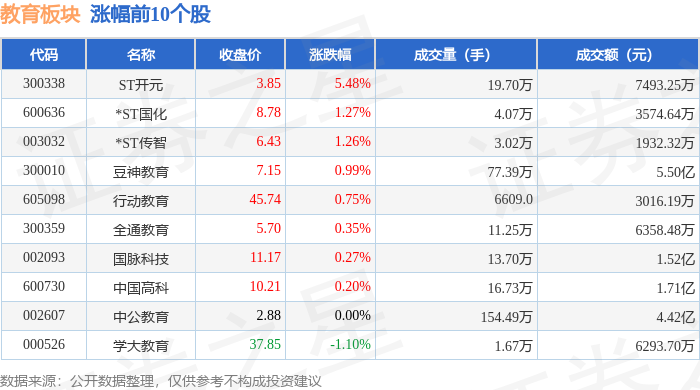
Market Overview - The education sector experienced a decline of 0.26% on February 4, with Chuangye Heima leading the drop [1] - The Shanghai Composite Index closed at 4102.2, up 0.85%, while the Shenzhen Component Index closed at 14156.27, up 0.21% [1] Individual Stock Performance - ST Kaiyuan (300338) saw a closing price of 3.85, with an increase of 5.48% and a trading volume of 197,000 shares, amounting to 74.93 million yuan [1] - ST Guohua (600636) closed at 8.78, up 1.27%, with a trading volume of 40,700 shares, totaling 35.74 million yuan [1] - Dongshen Education (603377) closed at 3.60, down 1.91%, with a trading volume of 84,100 shares, amounting to 30.50 million yuan [2] - Xueda Education (000526) closed at 37.85, down 1.10%, with a trading volume of 16,700 shares, totaling 6.29 million yuan [2] Capital Flow Analysis - The education sector saw a net outflow of 47.31 million yuan from institutional investors, while retail investors had a net inflow of 52.09 million yuan [2] - The main capital inflow was observed in Dou Shen Education (300010) with a net inflow of 50.51 million yuan, representing 9.19% of its trading volume [3] - ST Guohua (600636) experienced a net outflow of 2.00 million yuan, accounting for 5.60% of its trading volume [3]


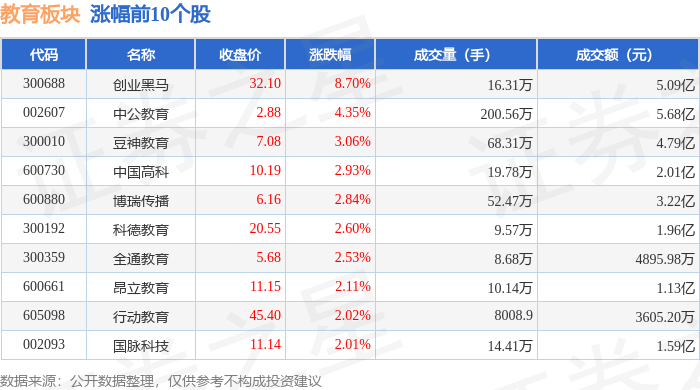
教育板块2月3日涨2.65%,创业黑马领涨,主力资金净流入9817.66万元
Zheng Xing Xing Ye Ri Bao· 2026-02-03 09:03
Market Overview - The education sector increased by 2.65% on February 3, with Chuangye Heima leading the gains [1] - The Shanghai Composite Index closed at 4067.74, up 1.29%, while the Shenzhen Component Index closed at 14127.1, up 2.19% [1] Individual Stock Performance - Chuangye Heima (300688) closed at 32.10, up 8.70%, with a trading volume of 163,100 shares and a turnover of 509 million yuan [1] - Zhonggong Education (002607) closed at 2.88, up 4.35%, with a trading volume of 2,005,600 shares and a turnover of 568 million yuan [1] - Dou Shen Education (300010) closed at 7.08, up 3.06%, with a trading volume of 683,100 shares and a turnover of 479 million yuan [1] - Other notable stocks include China High-Tech (600730) at 10.19 (+2.93%), and Bo Rui Communication (600880) at 6.16 (+2.84%) [1] Capital Flow Analysis - The education sector saw a net inflow of 98.18 million yuan from institutional investors, while retail investors contributed a net inflow of 7.31 million yuan [2] - However, speculative funds experienced a net outflow of 105 million yuan [2] Detailed Capital Flow for Selected Stocks - Zhonggong Education had a net inflow of 85.73 million yuan from institutional investors, but a net outflow of 46.19 million yuan from speculative funds [3] - Chuangye Heima experienced a net inflow of 24.26 million yuan from institutional investors, with a net outflow of 15.13 million yuan from speculative funds [3] - Guomai Technology (002093) had a net inflow of 7.92 million yuan from institutional investors, while speculative funds saw a net outflow of 4.36 million yuan [3]