XI'AN XICE TESTING TECHNOLOGY CO.(301306)

Search documents
西测测试(301306.SZ):主要为客户提供覆盖卫星产品全生命周期的可靠性验证服务
Ge Long Hui· 2026-01-21 07:16
Core Viewpoint - The detection costs for satellites are not fixed and depend on various factors such as the scope of the detection project, technical complexity, cycle requirements, and the novelty and reliability indicators of the satellite itself [1] Group 1: Company Overview - The company, Xicet Testing (301306.SZ), operates as an independent third-party inspection and testing service provider, offering reliability verification services throughout the entire lifecycle of satellite products [1] - The company aims to become a high-reliability manufacturing and verification service supplier within the aerospace industry chain, focusing on the trends of "low cost, high reliability, and rapid iteration" [1] Group 2: Strategic Focus - The company is implementing a "testing + manufacturing" dual-driven strategy, leveraging its established one-stop service capabilities and core qualifications [1] - There is an emphasis on increasing resource investment to align with the evolving demands of the aerospace sector [1]
中美竞逐万亿美元新赛道,五层解构下的投资蓝图
Tebon Securities· 2026-01-21 04:07
Investment Rating - The report maintains an "Outperform" rating for the commercial aerospace industry [1] Core Insights - The aerospace sector is transitioning from being viewed as a "cost center" driven by national will to a "growth engine" driven by commercial demand, with significant investments and strategic planning from both the US and China [6][9] - The global aerospace economy is projected to reach $613 billion in 2024, with commercial aerospace contributing 78%, and is expected to exceed $1 trillion by 2032 [6][9] - The value chain of commercial aerospace is divided into five core levels: "space, ground, terminal, rocket, and application," each presenting unique market opportunities and technical challenges from 2026 to 2030 [10][29] Summary by Sections 1. Space: Satellite Manufacturing - The satellite manufacturing market in China is expected to grow from approximately 7.1 billion yuan in 2025 to about 39.4 billion yuan by 2030, reflecting a shift from sporadic research models to continuous, batch engineering deliveries [16][18] 2. Ground: Ground Systems - The ground systems market is projected to increase from around 1.2 billion yuan in 2025 to approximately 39.1 billion yuan by 2030, evolving from a supporting role to a core infrastructure essential for stable satellite constellation operations [21][22] 3. Terminal: Key Variable for Commercial Aerospace - The terminal market is anticipated to grow from 500 million yuan in 2025 to about 141.9 billion yuan by 2030, driven by multiple vertical industries and potential consumer scenarios [23][24] 4. Rocket: Core Constraint - The cost of rocket launches is a critical constraint, with reusable technology expected to reduce costs by 80%-90% compared to traditional expendable rockets. The market for rocket launch services is projected to grow from approximately 10.7 billion yuan in 2025 to about 34.3 billion yuan by 2030 [25][26] 5. Application: Final Value Realization - The application market is expected to expand from 200 million yuan in 2025 to 525 billion yuan by 2030, with the revenue share from applications projected to rise from single digits to over 67% by around 2030 [27][28] 6. Investment Opportunities - Investment opportunities in commercial aerospace can be categorized into three main tracks: 1. Launch and manufacturing segments, which are expected to benefit directly from increased orders and visibility 2. Core components and systems, characterized by high technical barriers and critical for long-term competitiveness 3. Downstream applications and operational services, which, while currently limited in scale, hold the greatest long-term potential for value realization [29][30]


军工电子板块1月20日跌3.67%,西测测试领跌,主力资金净流出59.05亿元
Zheng Xing Xing Ye Ri Bao· 2026-01-20 09:00
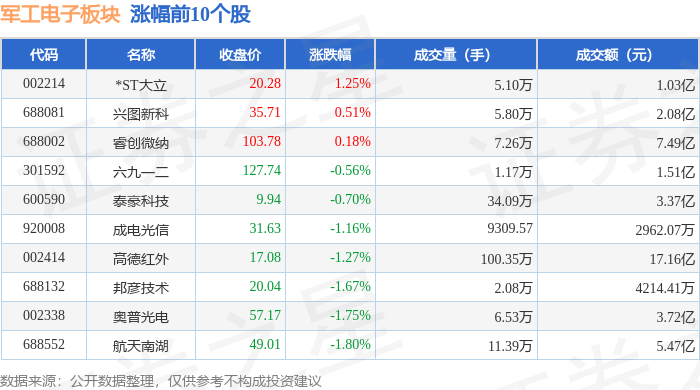
Market Overview - The military electronics sector experienced a decline of 3.67% on January 20, with Xicet Testing leading the drop [1] - The Shanghai Composite Index closed at 4113.65, down 0.01%, while the Shenzhen Component Index closed at 14155.63, down 0.97% [1] Stock Performance - Notable stock performances in the military electronics sector included: - *ST Dali (002214): Closed at 20.28, up 1.25% with a trading volume of 51,000 shares and a turnover of 103 million yuan - Xicet Testing (301306): Closed at 116.45, down 12.11% with a trading volume of 118,600 shares and a turnover of 1.463 billion yuan - Shenglu Communication (002446): Closed at 10.82, down 8.92% with a trading volume of 1.8396 million shares and a turnover of 2.039 billion yuan [1][2] Capital Flow - The military electronics sector saw a net outflow of 5.905 billion yuan from institutional investors, while retail investors had a net inflow of 5.209 billion yuan [2] - The capital flow for specific stocks included: - Aerospace South Lake (688552): Net inflow of 32.9088 million yuan from institutional investors - Xicet Testing (301306): Net outflow of 463.963 million yuan from retail investors [3]


商业航天上演过山车行情,板块加速“去伪存真”
Di Yi Cai Jing· 2026-01-20 08:48
Core Viewpoint - The commercial aerospace sector experienced a significant downturn on January 20, with many stocks hitting their daily limit down, marking the end of a month-long rally. The sector's volatility is attributed to a combination of policy changes, clarifications of business relevance, and recent launch failures [1][2][3]. Market Performance - As of January 20, the commercial aerospace sector index (BK0963) fell over 3.2%, with individual stocks like Xice Testing (301306.SZ) and Aerospace Hongtu (688066.SH) dropping more than 11%. A total of 11 stocks hit their daily limit down, while others like Aerospace Huanyu (688523.SH) and Shenglu Communication (002446.SZ) saw declines exceeding 8% [2][3]. - The index has decreased from above 3100 points on January 12 to around 2790 points, ending a rapid rise that began in late November 2025, during which at least 10 stocks doubled in price [2][3]. Factors Influencing Market Changes - The recent market cooling is attributed to multiple factors, including over 20 companies issuing risk warnings or clarifications about their lack of substantial involvement in commercial aerospace. For instance, Aerospace Hongtu stated that its strategic cooperation with a space technology company has not led to any significant business collaboration [3][6]. - The sector faced setbacks with launch failures, including the Long March 3B rocket and the private commercial rocket from Star River Power, which both experienced mission failures [3][4]. Policy and Industry Developments - The previous surge in the sector was driven by favorable policies, such as China's application for 203,000 new satellites, the largest in recent years, and the Shanghai Stock Exchange's announcement allowing commercial rocket companies to apply for IPOs under specific standards [4][5]. - Recent developments indicate that several companies with core technology capabilities are in the IPO preparation stage, although many have not yet gone public [6][7]. Financial Challenges - Financial data reveals significant challenges for companies in the sector. For example, Blue Arrow Aerospace reported net losses of 8.21 billion yuan in 2022, 12.16 billion yuan in 2023, and 9.16 billion yuan in 2024, with a total loss exceeding 35 billion yuan over three and a half years [7][8]. - The commercial viability of these companies is hindered by their early-stage development and the high costs associated with rocket technology, which still lag behind international competitors [8]. Future Outlook - Despite the recent downturn, long-term prospects for the commercial aerospace sector remain positive, with industry experts suggesting that the current market correction may help identify companies with genuine technological capabilities and commercial potential [9]. - Analysts believe that the sector may experience a recovery similar to the renewable energy market, driven by ongoing policy support and potential improvements in profitability [9].


西测测试:无人机等低空经济方面检测业务占比非常小
Jin Rong Jie· 2026-01-20 01:16
Core Viewpoint - The company is recognized as one of the leading third-party testing institutions in China, providing comprehensive testing services primarily focused on environmental reliability, electromagnetic compatibility, component testing, and electrical assembly services [1] Group 1 - The company offers specialized technical services for clients in the aerospace and aviation sectors [1] - Current testing services are mainly concentrated in environmental reliability testing, electromagnetic compatibility testing, component testing, and electrical assembly [1] - The share of testing services related to low-altitude economy, such as drones, is currently very small [1]
西测测试(301306.SZ):无人机等低空经济方面相关检测业务占比非常小
Ge Long Hui· 2026-01-20 01:04
Core Viewpoint - The company, Xicetest (301306.SZ), is recognized as one of the leading third-party testing institutions in China, providing comprehensive testing services primarily in the aerospace and aviation sectors [1] Group 1: Company Overview - The company specializes in environmental reliability testing, electromagnetic compatibility testing, component testing, and electrical assembly services [1] - The current focus remains on traditional testing services, with a minimal share of business related to low-altitude economy sectors such as drone testing [1]
商业航天 多地各显其能 产业布局“竞速赛”开启
Shang Hai Zheng Quan Bao· 2026-01-15 18:01
Core Insights - The commercial aerospace industry in China is experiencing significant growth, with an annual increase of over 20%, projected to reach between 7 trillion to 10 trillion yuan by 2030. The formal inclusion of commercial aerospace in the national space development plan by the end of 2025 highlights its strategic importance and potential [1]. Group 1: Industry Growth and Events - Major cities like Beijing, Shanghai, and Shenzhen are hosting commercial aerospace exhibitions, which serve as indicators of industry development and resource aggregation [1][2]. - The third Beijing Commercial Aerospace Industry High-Quality Development Conference and the 2026 Beijing International Commercial Aerospace Exhibition will take place from January 23 to 25, featuring over 300 global companies, including major domestic players [1][2]. Group 2: Regional Development and Policies - Beijing's Yizhuang area is a key hub for the commercial aerospace industry, housing over 180 companies, with a significant concentration of commercial rocket enterprises [2]. - Recent policies in Beijing and Shanghai aim to accelerate the development of the commercial aerospace sector, including action plans for innovation and advanced manufacturing clusters [3]. Group 3: Regional Strategies and Goals - Shaanxi and Sichuan provinces are leveraging their unique resources to develop differentiated paths in the commercial aerospace sector, with Shaanxi aiming to establish a 100 billion yuan industry by 2030 [4]. - Shaanxi's action plan includes the establishment of over 200 enterprises in the commercial aerospace sector by 2030, supported by a robust industrial ecosystem [4][5]. - Chengdu is also actively developing its commercial aerospace capabilities, with plans to reach a scale of 50 billion yuan by 2027, focusing on satellite applications and core electronic components [5][6].


西测测试与集智股份签署战略合作协议 共拓航空航天检测新空间
Zheng Quan Shi Bao Wang· 2026-01-12 14:25
Group 1 - West Test (301306) and Hangzhou Jizhi Electromechanical Co., Ltd. (300553) have signed a strategic cooperation agreement to deepen collaboration in the aerospace field and testing service market, aiming to explore new business growth points [1] - West Test has adopted a "4+1+1" strategy to enhance its layout in the aerospace sector, providing one-stop testing services and undertaking multiple product identification tests, including significant aerospace engineering projects [1] - West Test is recognized as a "super factory for commercial satellite payloads," leveraging a secure component supply chain, large-scale manufacturing capabilities, and comprehensive certification such as AS9100, SPCAP, and NadCAP to support the aerospace industry's development [1] Group 2 - The agreement focuses on deep cooperation in testing needs under extreme environments and complex scenarios, promoting the autonomy and standardization of related testing technologies [2] - The collaboration aims to accelerate the application of artificial intelligence technologies in the testing field, providing technical support to enhance the reliability and safety of China's aerospace equipment [2]

集智股份与西测测试签署战略合作协议
Zheng Quan Shi Bao Wang· 2026-01-12 13:24
Core Viewpoint - The strategic cooperation agreement between Jizhi Co., Ltd. and Xice Testing focuses on the aerospace sector, emphasizing high-end equipment demand and market promotion for testing services [1] Group 1: Strategic Cooperation - Jizhi Co., Ltd. and Xice Testing have signed a strategic cooperation agreement to collaborate on high-speed dynamic balancing equipment and testing services in the aerospace field [1] - The cooperation aims to address testing needs in extreme environments and scenarios through technical collaboration and resource sharing [1] Group 2: Technological Development - The partnership seeks to promote the autonomy and standardization of relevant testing technologies, as well as the application of artificial intelligence [1] - This initiative is intended to enhance the reliability and safety of China's aerospace industry [1]
招商证券:重视商业航天测试设备环节 有望率先放量
智通财经网· 2026-01-12 07:15
Group 1 - The core viewpoint is that China's commercial aerospace industry is experiencing significant growth, with the industry scale expected to reach 2.8 trillion yuan by 2025, representing a compound annual growth rate of over 26%, and a 180% increase compared to 2020 [1] - The upstream satellite manufacturing and rocket launch segments account for approximately 10% of the industry value, while the midstream ground equipment manufacturing and downstream satellite application services each account for about 45% [1] Group 2 - The commercial aerospace sector demands higher standards for testing equipment, covering all stages of satellite development, from design to mass production, with routine testing required even for individual satellites [2] - The testing dimensions have become comprehensive and specialized, including environmental adaptability, electromagnetic compatibility, communication performance, network collaboration, reliability, lifespan, and safety [2] Group 3 - Domestic companies are accelerating their catch-up with overseas counterparts, with significant potential for domestic substitution in the high-end scientific instrument sector, which has long R&D cycles and high technical barriers [3] - Major international players in the communication testing equipment industry include Keysight (USA), Rohde & Schwarz (Germany), and Anritsu (Japan), while domestic companies are making strides in closing the gap [3]