AGRICULTURAL BANK OF CHINA(ACGBY)

Search documents
迅速突破,双百亿银行ETF(512800)续涨逾1%,站上半年线!农业银行15连阳,累计涨幅近25%
Xin Lang Ji Jin· 2025-10-23 01:59
Core Viewpoint - The banking sector in A-shares has shown a strong upward trend, with Agricultural Bank of China experiencing a 15-day consecutive rise since September 25, accumulating a nearly 25% increase [1][4]. Group 1: Stock Performance - Agricultural Bank of China has risen over 1%, marking a 15-day consecutive increase with a total gain of nearly 25% since September 25 [1]. - Postal Savings Bank has increased by over 3%, while Nanjing Bank and six other banks have risen by over 1% [1]. - The banking ETF (512800) has also seen a rise of over 1%, achieving an 11-day consecutive increase and successfully breaking through the half-year line, with a total trading volume of 350 million yuan [2]. Group 2: Market Analysis - The banking sector experienced a significant pullback in July after a strong performance in the first half of the year, but has recently resumed an upward trend [4]. - The 11-day consecutive rise of the banking sector is seen as a strong signal, indicating a revaluation of the sector's value and a shift of funds towards certainty amid uncertainty [4]. - Morgan Stanley's research report suggests that after seasonal adjustments in the third quarter, bank stocks are entering a cyclical bottom, with expectations for good investment opportunities in the fourth quarter of this year and the first quarter of next year [4]. Group 3: Investment Tools - The banking ETF (512800) and its linked funds are efficient investment tools that passively track the CSI Bank Index, which includes 42 listed banks in A-shares [4]. - The latest scale of the banking ETF (512800) exceeds 20.7 billion yuan, with an average daily trading volume of over 700 million yuan, making it the largest and most liquid among the 10 banking ETFs in A-shares [4].





农业银行15连阳累计涨幅近25%,银行ETF天弘(515290)近5日吸金超3亿元,机构:Q4或为红利股布局关键时点之一
2 1 Shi Ji Jing Ji Bao Dao· 2025-10-23 01:59
Group 1 - The three major indices collectively declined, while the banking sector saw an increase, with the China Securities Banking Index rising by 0.85% [1] - Postal Savings Bank increased by over 2%, and nine other banks, including Qingdao Bank and Jiangyin Bank, rose by more than 1% [1] - Agricultural Bank continued to strengthen, rising nearly 1% and achieving a cumulative increase of nearly 25% since September 25, with a total market capitalization approaching 2.9 trillion yuan [1] Group 2 - The Tianhong Bank ETF (515290) rose by 0.67%, with a trading volume of 9.5731 million yuan, and a cumulative net inflow of 315 million yuan over the last five trading days [1] - As of October 22, the latest circulation size of the Tianhong Bank ETF was 7.128 billion yuan, with a circulation share of 4.798 billion [1] - The National Development and Reform Commission announced a new policy financial tool with a total scale of 500 billion yuan, aimed at supplementing project capital [2] Group 3 - The Tianhong Bank ETF closely tracks the China Securities Banking Index, which consists of up to 50 banking stocks to reflect the overall performance of the sector [2] - CITIC Securities indicated that the fourth quarter of 2025 may be a key time for bottom-fishing in dividend stocks, with current pessimistic expectations already reflected in the fundamentals [2] - The report highlighted the potential for a shift in investment style and opportunities arising from stable allocation needs of incremental capital as valuations stabilize [2]

AH股齐跌,创业板跌超1%,农业银行15连阳再创新高,AI硬件股调整,恒科指跌超1%,国债跌,商品涨
Hua Er Jie Jian Wen· 2025-10-23 01:53
Market Overview - A-shares experienced a decline with all three major indices falling, the ChiNext index dropping over 1% [1] - The Hang Seng Index also fell, with the Hang Seng Tech Index down 1.28% [2][3] - Domestic commodity futures showed strength, with fuel oil rising nearly 3% [4][5] A-shares Performance - As of the report, the Shanghai Composite Index decreased by 0.46% to 3895.79, the Shenzhen Component Index fell by 1.00% to 12867.09, and the ChiNext Index dropped by 1.11% to 3025.44 [1][14] - The banking sector showed resilience, with Agricultural Bank of China hitting a historical high and several other banks like Postal Savings Bank and Qingdao Bank also rising [8][9] Hong Kong Market - The Hang Seng Index was down 0.41% to 25677.26, while the Hang Seng Tech Index fell by 1.28% [2][3] - New consumption concept stocks in Hong Kong continued to weaken, with Pop Mart dropping over 6% [10] Commodity Market - Domestic commodity futures mostly rose, with notable increases in fuel oil (up 2.86%) and asphalt (up 2.37%) [5][17] - Other commodities like coking coal, soybean meal, and lithium carbonate also saw gains exceeding 1% [4][5] Banking Sector - The banking sector maintained strong performance, with multiple banks reporting gains, including Postal Savings Bank (up 3.14%) and Qingdao Bank (up 1.74%) [9][8] - Agricultural Bank of China continued its upward trend, marking 15 consecutive days of gains [8] Coal Sector - The coal sector remained strong, with stocks like Daya Energy and Zhengzhou Coal Electricity hitting the daily limit up [11] - Notable gains included Shaanxi Black Cat (up 10.12%) and Yunmei Energy (up 10.06%) [11] Shenzhen Local Stocks - Shenzhen local stocks opened strong, with several companies like Jian Kexuan and Guangtian Group hitting the daily limit up [12][13] - The Shenzhen government announced a plan to enhance the quality of listed companies, aiming for a total market value exceeding 20 trillion yuan by 2027 [13]
农业银行15连阳再创历史新高,年内累涨超60%
Xin Lang Cai Jing· 2025-10-23 01:47
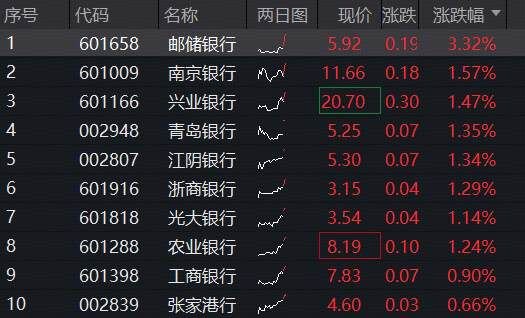
A股市场银行板块再度逆势上扬,其中,邮储银行涨超3%,青岛银行、江阴银行、农业银行、兴业银 行、光大银行、浙商银行、中信银行、交通银行、民生银行、南京银行、工商银行、中国银行、张家港 行、建设银行、北京银行涨超1%。值得注意的是,农业银行15连阳,再创历史新高,年内累涨超 60%。 ...
「焦点复盘」沪指低开回升3900点失而复得,成交额再创2个多月地量,农业银行年内涨近六成
Sou Hu Cai Jing· 2025-10-22 10:42
Market Overview - A total of 56 stocks hit the daily limit up, while 21 stocks faced limit down, resulting in a sealing rate of 73% [1] - The market experienced weak fluctuations, with the three major indices showing a rebound before retreating [1] - The total trading volume in the Shanghai and Shenzhen markets was 1.67 trillion yuan, a decrease of 206 billion yuan from the previous trading day, marking the first drop below 1.7 trillion since August 5 [1] - The Shanghai Composite Index fell by 0.07%, the Shenzhen Component Index dropped by 0.62%, and the ChiNext Index decreased by 0.79% [1] Stock Performance - Deyou Energy achieved 9 limit ups in 13 days, while other stocks like Shihua Machinery, CITIC Heavy Industries, and others also saw consecutive limit ups [1][3] - The highest limit-up stock, Deyou Energy, continued to advance with reduced trading volume [3] - High-dividend stocks like Agricultural Bank of China recorded a 14-day consecutive rise, increasing nearly 60% year-to-date [3] Sector Analysis - The oil and gas, engineering machinery, and wind power equipment sectors showed the highest gains, while precious metals, coal, and battery sectors faced the largest declines [1] - The deep earth economy concept continued to gain traction, with stocks like ShenKong Co., Shihua Machinery, and CITIC Heavy Industries achieving consecutive limit ups [5] - The market showed limited enthusiasm for high-priced stocks, with some experiencing significant pullbacks after hitting limit up [5] Investment Themes - The deep earth economy concept is expected to continue attracting investment, influenced by the upcoming 14th National Congress and the easing of the Russia-Ukraine situation [5] - The robotics sector saw renewed interest following the launch of new products by Yushu Technology, with stocks like Ruineng Technology and others performing well [7][16] - The Hubei state-owned assets concept remains active, with stocks like Guangji Pharmaceutical and others achieving consecutive limit ups [8][27] Conclusion - The market is currently characterized by a mix of high-dividend stocks and thematic investments in sectors like deep earth economy and robotics, while facing challenges in trading volume and overall market sentiment [1][5][7]

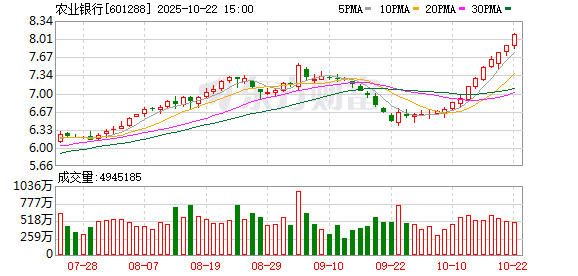
再度爆发!601288 14连阳!688256 突然拉升
Zheng Quan Shi Bao· 2025-10-22 09:36
Market Overview - The Shanghai Composite Index experienced weak fluctuations but managed to hold above 3900 points, closing at 3913.76, down 0.07% [2] - The Shenzhen Component Index fell by 0.62% to 12996.61, while the ChiNext Index decreased by 0.79% to 3059.32 [2] - The Northbound 50 Index rose by 0.87%, with total trading volume in the Shanghai and Shenzhen markets reaching 16905 billion, a decrease of over 2000 billion from the previous day [2] Sector Performance - The coal, non-ferrous metals, brokerage, and semiconductor sectors saw declines, while the oil sector showed strong gains [2] - Notable performers in the oil sector included Keli Co., which rose over 10%, and several others that hit the daily limit [10] - The banking sector also rebounded, with Agricultural Bank of China rising over 2%, marking its 14th consecutive trading day of gains [6][4] Noteworthy Stocks - Cambrian (688256) surged over 7% during the afternoon session, closing up 4.42% with a trading volume of nearly 200 billion, making it the top stock by trading volume in A-shares [14] - The stock price of Cambrian reached a peak of 1468 yuan, surpassing that of Kweichow Moutai during trading [14] - The newly listed Marco Polo on the Shenzhen main board saw a significant increase of 128.8%, closing at 31.46 yuan per share [2] Banking Sector Insights - Analysts from Guangda Securities noted that the banking sector currently offers good value after market adjustments, with stable earnings expected in the upcoming quarterly reports [8] - The sector is characterized by high dividends and low valuations, with a notable preference for Hong Kong-listed banks [8] - Citic Securities indicated that the banking sector is likely to see continued demand for stocks due to their defensive attributes amid rising risk aversion [8] Oil Sector Developments - The oil sector's rise is attributed to the U.S. Department of Energy's plan to purchase 1 million barrels of crude oil to replenish strategic reserves [12] - International agencies have adjusted their forecasts for oil production, indicating a potential oversupply situation in the near term [12] - Despite short-term price fluctuations, the long-term outlook for oil supply and demand remains optimistic, particularly for major oil companies and service providers [12] Cambrian's Financial Performance - Cambrian reported a significant revenue increase of 2386% year-on-year for the first three quarters, totaling 4.607 billion yuan [16] - The net profit attributable to shareholders reached 1.605 billion yuan, driven by the strong performance of its cloud products [16] - The company is positioned to benefit from the growing demand for domestic AI chip solutions amid increasing capital expenditures from major cloud providers [17]

再度爆发!601288,14连阳!688256,突然拉升
Zheng Quan Shi Bao· 2025-10-22 09:19
Market Overview - The Shanghai Composite Index experienced weak fluctuations but managed to hold above 3900 points, closing at 3913.76, down 0.07% [1] - The Shenzhen Component Index fell 0.62% to 12996.61, while the ChiNext Index decreased by 0.79% to 3059.32 [1] - The Northbound 50 Index rose by 0.87%, with total trading volume across the three markets reaching 169.05 billion yuan, a decrease of over 20 billion yuan from the previous day [1] Banking Sector Performance - The banking sector showed strength, with Agricultural Bank of China rising over 2%, marking its 14th consecutive trading day of gains [2][4] - Other banks such as Jiangyin Bank and Industrial and Commercial Bank of China also saw increases, with Jiangyin Bank up 3.56% [2][3] Oil Sector Activity - The oil sector saw significant gains, with Keli Co. rising over 12% and several other companies hitting the daily limit [7][8] - The U.S. Department of Energy announced plans to purchase 1 million barrels of crude oil to replenish strategic reserves, which may influence market dynamics [9] Company-Specific Highlights - Cambricon Technologies (688256) experienced a notable surge, with its stock price rising over 7% during the day, closing up 4.42% with a trading volume of 19.8 billion yuan [10] - The company reported a substantial increase in revenue for the first three quarters, achieving 4.607 billion yuan, a year-on-year growth of 2386% [11] - The growth was attributed to the strong performance of its cloud products, particularly the Siyuan 590, amid increasing domestic demand for AI-related technologies [11]

鑫闻界|农业银行股价14连阳“破8”,投资者目光投向其他大行
Qi Lu Wan Bao· 2025-10-22 09:17
齐鲁晚报·齐鲁壹点记者 黄寿赓 张雨鑫 10月22日收盘,农业银行(601288.SH)股价定格于8.09元/股,涨幅2.66%,走出"14连阳",总市值达到2.83万亿元,稳居A股首位。 同花顺数据显示,银行板块年内涨幅达12.46%,除农业银行,青岛银行、浦发银行、江阴银行、厦门银行、渝农商行涨幅超20%。10月份以来,银行板块累 计上涨6.94%,除农业银行,江阴银行、重庆银行、上海银行、中信银行涨超10%,建设银行涨8.94%,其他国有大行10月以来估值修复幅度有限。 从市净率来看,除农业银行外,招商银行刚刚"破1",成都银行达0.95。工商银行、建设银行、邮储银行分别为0.74、0.73、0.70,中国银行为0.67,交通银 行仅0.56。方正证券表示,银行板块经历回调后股息率提升,中长期配置性价比凸显,随着四季度险企"开门红"营销活动启动,险资资产配置需求也将提 升,有望持续加大对银行等高股息红利资产的配置。 农业银行此轮行情始于9月25日,当日收涨0.61%拉开"连阳"序幕,10月17日,农业银行首次突破7.65元/股的净资产线,打破了国有银行长期"破净"(即市净 率低于1倍)的局面,上次国有四 ...

农业银行走出14连阳,10月超90亿资金冲进银行ETF,华宝银行ETF、银行ETF易方达和银行ETF天弘“吸金”居前
Sou Hu Cai Jing· 2025-10-22 08:30
Core Insights - The A-share market is witnessing a rise in bank stocks, with notable increases in shares of banks such as Zhejiang Commercial Bank and Agricultural Bank, which has reached a historical high with a year-to-date increase of nearly 56% [1][5] - Hong Kong bank stocks are also on an upward trend, with Agricultural Bank achieving a 10-day consecutive rise and other banks like China Merchants Bank and Industrial and Commercial Bank of China showing gains [1] - Bank ETFs are experiencing positive performance, with various funds recording increases in value, indicating strong investor interest in the banking sector [1][3] Market Performance - A-share bank index has decreased by 4% since early July, underperforming the CSI 300 index by 19.3 percentage points, while the H-share bank index has slightly increased by 2.2%, lagging behind the Hang Seng index by 5.2 percentage points [5] - The average price-to-book (PB) ratio for A-share banks is 0.71, placing it in the 42.4% percentile over the past three months and 77.7% over the past year, while H-share banks have a PB ratio of 0.5, in the 46% and 73.6% percentiles respectively [5] Investment Trends - There is a growing preference for bank stocks due to their low valuations and high dividend yields, as investors seek safety and stable returns amid rising market risk aversion [5] - Since October 21, a total of 93.14 billion yuan has flowed into 10 bank-themed ETFs, with significant inflows into funds managed by Huabao and E Fund [6][8] - Morgan Stanley anticipates a favorable investment opportunity for domestic bank stocks in the fourth quarter and early next year, supported by upcoming dividend distributions and stable interest rates [10]
国有大型银行板块10月22日涨1.92%,农业银行领涨,主力资金净流入4.43亿元
Zheng Xing Xing Ye Ri Bao· 2025-10-22 08:19
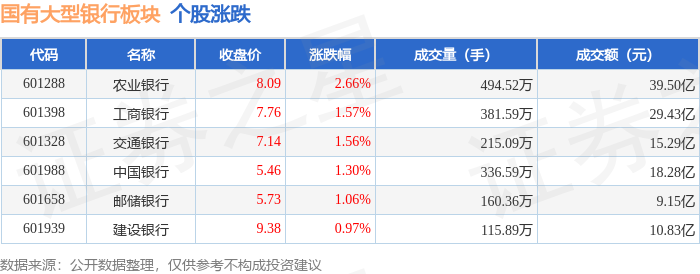
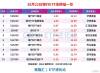
Core Insights - The state-owned large bank sector saw an increase of 1.92% on October 22, with Agricultural Bank leading the gains [1] - The Shanghai Composite Index closed at 3913.76, down 0.07%, while the Shenzhen Component Index closed at 12996.61, down 0.62% [1] Bank Performance - Agricultural Bank (601288) closed at 60.8, up 2.66% with a trading volume of 4.9452 million shares [1] - Industrial and Commercial Bank (601398) closed at 7.76, up 1.57% with a trading volume of 3.8159 million shares [1] - Bank of Communications (601328) closed at 7.14, up 1.56% with a trading volume of 2.1509 million shares [1] - Bank of China (601988) closed at 5.46, up 1.30% with a trading volume of 3.3659 million shares [1] - Postal Savings Bank (601658) closed at 5.73, up 1.06% with a trading volume of 1.6036 million shares [1] - China Construction Bank (601939) closed at 9.38, up 0.97% with a trading volume of 1.1589 million shares [1] Capital Flow - The state-owned large bank sector experienced a net inflow of 443 million yuan from institutional investors, while retail investors saw a net outflow of 315 million yuan [1] - Institutional capital flow details show that Industrial and Commercial Bank had a net inflow of 220 million yuan, while Bank of China had a net inflow of 134 million yuan [2] - Agricultural Bank had a net inflow of 87.35 million yuan from institutional investors, while it faced a net outflow of 38.26 million yuan from retail investors [2]