
Amazon(AMZN)

Search documents
2 AI Stocks Trading at Bargain Prices to Kick Off 2026
The Motley Fool· 2026-02-01 01:10
Core Viewpoint - Certain top-quality AI stocks are currently trading at reasonable prices, presenting investment opportunities as the market enters 2026 [2] Group 1: Meta Platforms - Meta Platforms reported double-digit revenue growth, reaching $59 billion, and anticipates significant advancements in AI [3] - The stock is trading at a valuation of 24 times forward earnings estimates, indicating it is undervalued [3] - Meta's market capitalization stands at $1.8 trillion, with a gross margin of 82% and a dividend yield of 0.29% [5] - The company is focusing on developing AI tools, including large language models, with plans to launch new products in the coming months [6] Group 2: Amazon - Amazon has established a strong presence in AI through its Amazon Web Services (AWS) unit, which has an annual revenue run rate of $132 billion [9] - The stock is trading at 30 times forward earnings estimates, suggesting it is also undervalued [10] - Amazon's market capitalization is $2.6 trillion, with a gross margin of 50.05% [8]



Is ‘AI-washing’ behind new wave of tech layoffs?
The Economic Times· 2026-01-31 18:33
Group 1 - Executives are anticipating significant changes due to AI technology, leading to job cuts, with over 50,000 layoffs expected in 2025 attributed to AI [1][3] - Amazon announced it would cut 16,000 corporate jobs, in addition to 14,000 previously announced layoffs, with the CEO indicating that generative AI will change work processes, although the company later clarified that the primary reason for cuts was to reduce bureaucracy [3] - Pinterest plans to cut about 15% of its workforce to reallocate resources towards AI-focused roles [3] Group 2 - HP Inc's CEO stated that embedding AI into the company could result in up to 6,000 job cuts in the coming years, which may be viewed positively by investors [3] - Some skeptics argue that companies are using AI as a pretext for layoffs, a phenomenon referred to as "AI-washing," where layoffs are attributed to future AI implementation despite a lack of mature AI applications [3]


亚马逊新一轮裁员波及西雅图,涉约1400个职位
Xin Lang Cai Jing· 2026-01-31 16:27
格隆汇1月31日|亚马逊本周公布的裁减约1.6万个职位中,约1400个位于西雅图,另约700个位于邻近 的Bellevue,相关资料已提交予州及地方政府。是次裁员延续去年10月行动,当时亚马逊已在该地区裁 减逾2000人。亚马逊管理层表示,裁员有助削减管理层级、简化官僚架构。连串裁员行动加深市场对西 雅图科技产业持续低迷的忧虑。数据显示,去年西雅图通勤范围内的四个市合共流失近1.3万个职位, 为2009年金融海啸以来首次出现年度就业负增长,数据不计及2020年疫情年份。 ...
Alphabet, Amazon, AMD Lead Earnings Wave; Jobs Data On Deck


Seeking Alpha· 2026-01-31 16:00
Core Viewpoint - Wall Street's main averages experienced a decline as investors assessed recent company earnings and focused on the implications of Kevin Warsh's selection as Federal Reserve chair [2]. Group 1: Company Earnings - Major S&P 500 companies, including Alphabet (GOOGL), Amazon (AMZN), AMD (AMD), Merck (MRK), and Pfizer (PFE), are set to release their quarterly financial results in the week ending February 6 [4]. - Earnings spotlight for Monday includes Palantir (PLTR) and Walt Disney (DIS) [5]. - Earnings spotlight for Tuesday features AMD, Merck, PepsiCo (PEP), Amgen (AMGN), and Pfizer [5]. - Earnings spotlight for Wednesday includes Alphabet and Eli Lilly [5]. Group 2: Economic Data Releases - Key economic data releases include S&P Global Manufacturing PMI, ISM Manufacturing Prices, and ISM Manufacturing PMI for January on Monday [3]. - JOLTS Job Openings data for December is scheduled for release on Tuesday [3]. - ADP Nonfarm Employment Change, S&P Global Services, and Composite PMI for January will be released on Wednesday [3]. - Initial Jobless Claims data is due on Thursday, while Nonfarm Payrolls and Unemployment Rate for January are set for release on Friday [3].

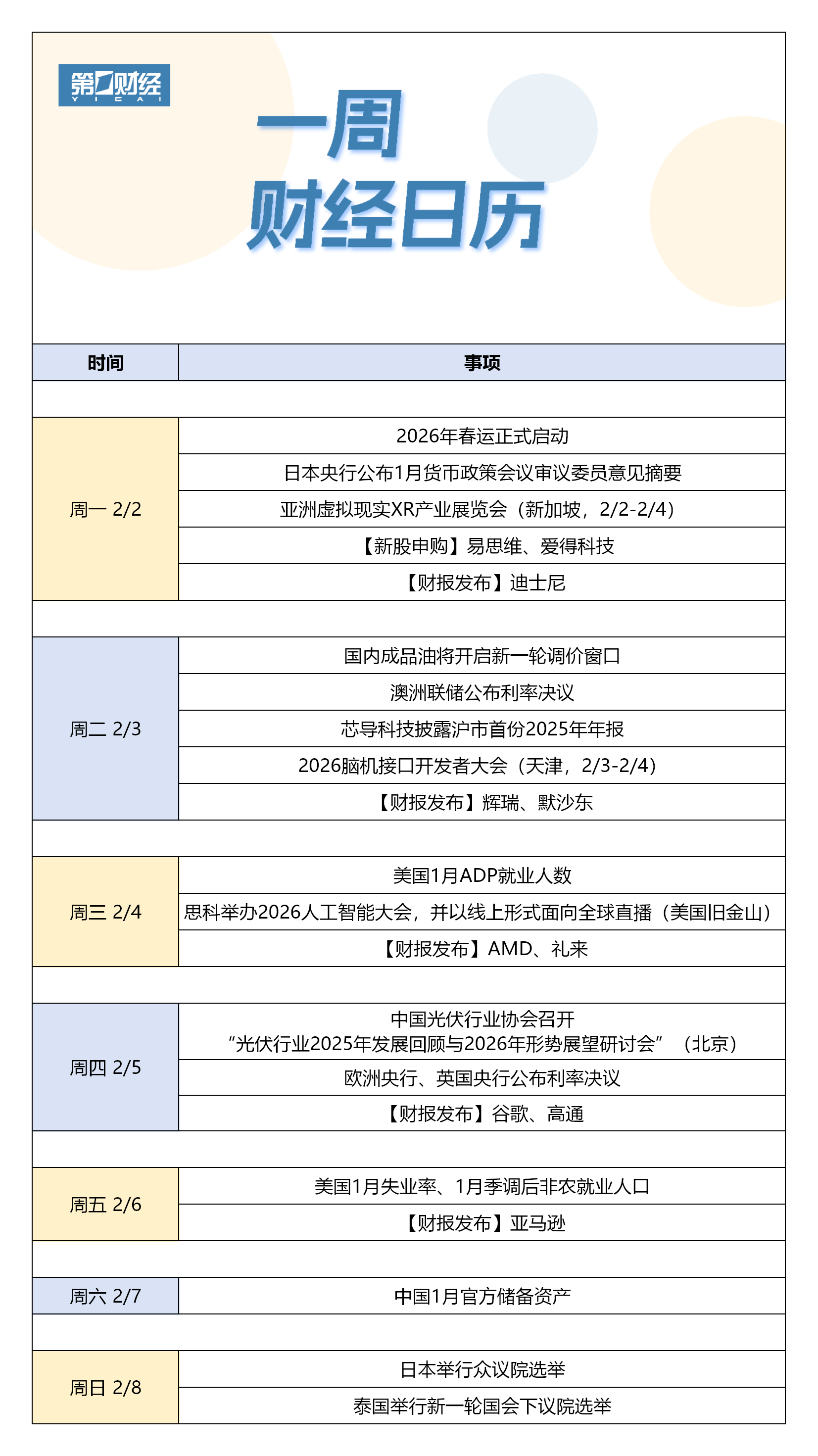
下周财经日历(2月2日-2月8日)
Di Yi Cai Jing· 2026-01-31 13:11
Group 1 - Pfizer and AMD are scheduled to release their financial reports [2] - Google and Amazon will also announce their earnings [2] - The European Central Bank and the Bank of England are set to publish important economic data [2] Group 2 - The U.S. ADP employment report for January will be released [2] - The U.S. unemployment rate and seasonally adjusted data for January will be published [2] - China's official reserve data for January will be announced [2]

Ring, Habitat for Humanity, and Paris Johnson Jr. Foundation Team Up to Bring Housing Support to Glendale Families
Businesswire· 2026-01-31 13:00
Core Insights - Ring has launched a joint initiative with Habitat for Humanity Central Arizona and the Paris Johnson Jr. Foundation to enhance community safety by donating and installing home security products for families in Glendale, Arizona [1][4] Group 1: Initiative Details - The initiative involves the donation and installation of four Ring devices per home, totaling 44 devices, at no cost to the families. The devices include the Ring Wired Doorbell Pro 4K, Ring Spotlight Cam Solar, Ring Outdoor Cam Plug-In, and Ring Chime Pro [3] - Ring will also provide a total of $40,000 in donations, with $20,000 going to Habitat for Humanity Central Arizona and $20,000 to the Paris Johnson Jr. Foundation [3] Group 2: Community Engagement - The event emphasizes community involvement, with volunteers, including Arizona Cardinals offensive lineman Paris Johnson Jr. and Ring founder Jamie Siminoff, participating in the installation and support for the families [2][4] - The partnership aims to strengthen neighborhoods by improving access to community safety and fostering engagement among local families [4] Group 3: Organizational Background - Ring, founded in 2013, focuses on making neighborhoods safer through affordable smart home security products and community engagement [5] - Habitat for Humanity Central Arizona has been active since 1985, dedicated to building safe and affordable homes and transforming communities through volunteer efforts and donations [6] - The Paris Johnson Jr. Foundation, established in 2018, aims to empower disabled veterans and disadvantaged student athletes by providing essential resources [8]


Dow Jones Futures Fall, Bitcoin Dives To Lowest Since 2024; Google, AMD, Amazon, Palantir Due
Investors· 2026-02-02 03:57
Core Viewpoint - The U.S. government has entered a shutdown, expected to end on Monday, while major companies like Google, Amazon, and AMD are set to report earnings this week [1]. Group 1: Market Overview - Dow Jones futures, along with S&P 500 and Nasdaq futures, will open on Sunday evening [1]. - The stock market, including the Dow Jones index, experienced a decline following President Trump's announcement regarding the Fed chair pick [1]. Group 2: Company Earnings - Google-parent Alphabet (GOOGL), Amazon.com (AMZN), Eli Lilly (LLY), Palantir Technologies (PLTR), and Advanced Micro Devices (AMD) are highlighted as key players in the upcoming earnings reports [1]. - Google is currently in a buy zone ahead of its earnings report scheduled for February 4 [1]. - Amazon is expected to announce significant job cuts, with 16,000 layoffs in its latest round [1].

AI革命和泡沫分析框架(一):AI的1998——科网泡沫再审视
Changjiang Securities· 2026-01-31 12:00
市场策略丨深度报告 [Table_Title] AI 革命和泡沫分析框架(一):AI 的 1998—— 科网泡沫再审视 %% %% %% %% research.95579.com 1 丨证券研究报告丨 报告要点 [Table_Summary] 本文对科网泡沫复盘,希望以史为鉴,对当下 AI 产业演进过程提出一些思考。衡量泡沫是否存 在主要有八大维度,可以分为三个层面。宏观:叙事催化剂和杠杆水平;产业:故事性、应用 场景、未来竞争格局、商业模式;市场:经验不足的投资者、纯粹可投资标的。从宏观环境整 体来讲,美国当前的经济环境不及科网泡沫时期,流动性相比当时更好。产业端来讲,商业模 式能否闭环,企业能否产生最终盈利是市场最为关注的问题。而市场端来看,当前估值水平和 市场构成相比科网泡沫时期更优。 分析师及联系人 [Table_Author] 戴清 SAC:S0490524010002 SFC:BTR264 请阅读最后评级说明和重要声明 2 / 26 %% %% %% %% research.95579.com 2 [Table_Title AI 革命和泡沫分析框架(一 2] ):AI 的 1998—— 科网泡沫 ...


开源项目Clawdbot爆火,开发者爆料开发内幕:100%AI开发;OpenAI计划四季度上市,已聘请新高管筹备IPO丨AI周报
创业邦· 2026-01-31 10:30
Core Insights - The article highlights significant developments in the AI industry, including funding rounds, product launches, and strategic partnerships, indicating a rapidly evolving market landscape [5][6]. Group 1: AI Product Developments - ClawdBot, an open-source AI assistant, has gained popularity, running on Mac mini and integrating with various tools, showcasing the trend of local AI applications [7][8]. - OpenAI plans to go public in Q4 2024, having hired new executives to prepare for the IPO, reflecting the growing interest in AI companies from investors [10]. - Xiaomi and Ant Group have launched a parking payment feature in Xiaomi smart glasses, marking a significant step in integrating AI into everyday tasks [17]. Group 2: Major Investments and Acquisitions - SoftBank is reportedly negotiating to invest up to $30 billion in OpenAI, which is seeking to raise up to $100 billion in new funding, potentially valuing the company at $830 billion [20][28]. - Apple has completed its acquisition of Israeli AI startup Q.ai for nearly $2 billion, emphasizing the tech giant's commitment to enhancing its AI capabilities [14]. - The AI startup Anthropic has raised over $10 billion in its latest funding round, indicating strong investor confidence in AI technologies [28]. Group 3: Industry Trends and Predictions - The AI industry is expected to see a significant increase in the number of intelligent agents, with predictions of at least 10 billion by 2026, suggesting a shift towards more integrated AI solutions across various sectors [17]. - Meta reported a 24% year-over-year revenue increase in Q4, driven by its advertising business, which is a key revenue stream for AI-driven platforms [26]. - The article notes a decrease in disclosed AI financing events, with 23 events reported this week, down from previous periods, indicating potential market consolidation [38]. Group 4: Regulatory and Ethical Considerations - A court ruling in China clarified that AI-generated content does not constitute a legal commitment, setting a precedent for future cases involving AI liability [28]. - The introduction of AI tools in education, as discussed by Jack Ma, emphasizes the need for teaching children how to effectively use AI rather than competing with it, highlighting a shift in educational paradigms [12]. Group 5: Regional Insights - The majority of disclosed AI funding events in China are concentrated in Guangdong and Jiangsu, indicating regional hubs for AI innovation and investment [41]. - The article mentions that early-stage funding remains dominant in the AI sector, with 15 early-stage investments reported this week, reflecting ongoing support for startups [42]. Group 6: Notable Company Announcements - WeRide has launched a universal simulation model to bridge physical and generative AI, which could accelerate the development of autonomous vehicles [20]. - Alibaba's Qwen has released a series of open-source speech recognition models, expanding its capabilities in AI-driven communication technologies [25]. - Tencent is testing a new social feature for its AI assistant, indicating a push towards enhancing user engagement through AI-driven social interactions [32].




2026年第4周计算机行业周报:涨价潮继续传导,看好AI基础资源产业链-20260131
Changjiang Securities· 2026-01-31 09:53
Investment Rating - The industry investment rating is "Positive" and maintained [9] Core Views - The report highlights a continued price increase trend in the AI infrastructure supply chain, suggesting that multiple segments such as CPU and cloud services may experience simultaneous volume and price growth, benefiting related industries [8][58] - The report recommends focusing on the domestic computing power supply chain, particularly leading companies in computing chips like Cambricon and Haiguang Information, as well as domestic CPU, cloud, and AI infrastructure suppliers [8][58] Summary by Sections Market Performance - Last week, the computer sector rebounded slightly, with an overall decline of 0.25%, ranking 27th among major industries in the Yangtze River region, and accounting for 7.08% of total market turnover [2][18] Key Recommendations - The report emphasizes the importance of the domestic basic resource supply chain, particularly in light of ongoing price increases that are expected to benefit various segments, including computing chips and cloud services [8][58] Notable Developments - Recent updates include the IPO progress of three companies in the commercial aerospace sector, and announcements from Elon Musk regarding the Optimus humanoid robot, which is expected to be available to the public by the end of 2027 [2][23][29] - The report also notes that the full version of Tesla's FSD (Full Self-Driving) may receive regulatory approval soon, which could accelerate investment opportunities in the smart driving industry [37][41]


