
Amazon(AMZN)

Search documents
两大科技巨头,蚕食英伟达
半导体芯闻· 2026-01-30 11:22
Core Insights - The rise of artificial intelligence has led to a consensus that Nvidia's chips are essential for large AI projects, but Amazon and Google have begun to challenge Nvidia's dominance by developing their own AI chips [1][2]. Group 1: Market Dynamics - Nvidia holds a commanding 92% market share in the AI chip sector, with projected revenues nearing $200 billion by 2025 [2]. - Amazon's self-developed AI chip, Trainium, is expected to generate "tens of billions" in revenue by 2025, while Google's Tensor Processing Unit (TPU) has already reached hundreds of billions in revenue [2]. - The competition from Amazon and Google is particularly significant as they are both expanding their chip businesses while still relying on Nvidia as a core supplier [2][3]. Group 2: Strategic Partnerships - Anthropic, a leading AI company, is reducing its reliance on Nvidia chips and has secured significant chip sales for Amazon and Google, totaling hundreds of billions [3][4]. - Google has allowed Anthropic to install its chips in non-Google data centers, marking a new collaborative model in the industry [3][4]. - Amazon's investment of $4 billion in Anthropic was motivated by the promise of using Amazon's chips for AI system development, aiming to create a competitive alternative to Nvidia [5][6]. Group 3: Industry Implications - The rapid growth of Amazon's chip business, driven by partnerships with companies like Anthropic, is expected to lead to significant industry changes, signaling that Nvidia chips are not the only option available [6][7]. - Other chip manufacturers, such as AMD and Cerebras, are also seeking partnerships with AI companies to expand their market presence [6][7]. - The increasing acceptance of non-Nvidia chips by companies like Anthropic and OpenAI is likely to encourage broader industry adoption of alternative chip solutions [7].





AI日报丨苹果第一财季营收高于预期,盘后一度涨超3%,黑石总裁:AI颠覆传统产业是当前最大的风险
美股研究社· 2026-01-30 11:13
Core Viewpoint - The article discusses the rapid development of artificial intelligence (AI) technology and its implications for various industries, highlighting both opportunities and risks associated with AI adoption. Group 1: AI Disruption and Risks - Jon Gray, President of Blackstone, emphasizes that the greatest risk posed by AI is the rapid disruption of specific industries, citing examples such as JPMorgan using AI to replace proxy advisory services [5] - Blackstone is actively assessing the risks associated with AI disruption, while also recognizing the potential for AI to drive significant productivity gains and enhance profit margins across many sectors [5] Group 2: Power Supply Risks - A report indicates that up to 151 million Americans face a high risk of power shortages or blackouts in the next five years due to extreme weather, fragile natural gas systems, and surging electricity demand [6] - The North American Electric Reliability Corporation (NERC) highlights that the threat level has significantly increased compared to the previous year, driven by aging infrastructure and the overload from expanding data centers [6] Group 3: Mergers and Acquisitions - SpaceX is reportedly considering a merger with Tesla or xAI, reflecting Elon Musk's strategy to integrate his business ventures [7][8] - Investors are pushing for the feasibility of a merger between SpaceX and Tesla, as well as a potential integration with xAI before an initial public offering (IPO) [8] Group 4: Software Sector Concerns - Concerns over AI disrupting traditional software licenses and workflows have led to a bear market for software stocks, with ServiceNow experiencing a 10% drop [9] - The North American Technology Software Index ETF (IGV) fell by 5.4%, marking its largest single-day decline since April 2025, and has dropped approximately 22% from recent highs, indicating a formal entry into bear market territory [9] Group 5: Major Corporate Developments - Amazon is reportedly in talks to invest up to $50 billion in OpenAI, with the latter's valuation potentially reaching $830 billion [12] - Apple reported first-quarter revenue of $143.76 billion, exceeding expectations with a 16% year-over-year growth, driven by strong iPhone sales [13][14]



2812 亿美元!「OpenAI 税」开始「拖累」微软
创业邦· 2026-01-30 10:18
Core Viewpoint - Microsoft's Q2 financial report shows significant revenue growth, but the market reacted negatively due to concerns over slowing cloud growth and weak profit margin guidance [6][8]. Financial Performance - Microsoft reported Q2 revenue of $81.3 billion, a 17% year-over-year increase, with net profit soaring 60% to $38.5 billion [6]. - Cloud revenue surpassed $50 billion for the first time, reaching $51.5 billion, reflecting a 26% year-over-year growth [6]. Cloud Business Insights - Azure cloud service revenue grew 39% year-over-year, slightly below the market expectation of 40% [6]. - The remaining performance obligation for Microsoft's cloud business surged 110% to $625 billion, indicating strong future revenue potential [6]. Strategic Partnership with OpenAI - Microsoft's relationship with OpenAI has evolved into a strategic symbiosis, with approximately 45% ($281.2 billion) of the cloud revenue backlog driven by OpenAI-related deals [7][9]. - This partnership has positioned Microsoft prominently in the AI infrastructure space, but it also ties Microsoft's growth narrative closely to OpenAI's performance and stability [9][11]. Risks of Dependency - The deep integration with OpenAI presents risks, as any fluctuations in OpenAI's development could directly impact Microsoft's stock price and valuation [11][12]. - Microsoft is also preparing a "Plan B" by establishing an independent AI department, indicating a desire to reduce reliance on OpenAI [12][15]. Competitive Landscape - Microsoft's approach contrasts with Amazon's strategy, which involves a more defensive investment in AI competitors like Anthropic, allowing for greater independence [16][18]. - While Microsoft's focused strategy may yield direct benefits, it also exposes the company to significant risks by heavily investing in a single partnership [18].


The Hidden AI Winner That Wall Street Analysts Love for 2026
The Motley Fool· 2026-01-30 10:10
Group 1 - The article highlights that Amazon is being recognized as a hidden winner in the AI space, with a majority of Wall Street analysts recommending it as a "buy" or "strong buy" for 2026, predicting a 21% increase in stock price over the next 12 months [2][3] - Amazon has established itself as a major player in e-commerce and cloud services through Amazon Web Services (AWS), generating significant revenue and earnings over the years [3][4] - The company is leveraging AI to enhance its operations, including streamlining processes in fulfillment centers and developing AI tools such as Trainium chips for AWS customers, which contributes to its growth strategy [6][7] Group 2 - AWS has achieved an annual revenue run rate of $132 billion in the latest quarter, indicating strong growth potential as AI demand continues to rise [7] - Amazon's e-commerce and non-AI-related AWS services are expected to maintain growth due to the company's leadership in these sectors, providing a balance of security and growth for investors [8]
Amazon Mulls $50 Billion Investment in OpenAI, Report Says. What's in it for Both.
Barrons· 2026-01-30 08:47
Core Insights - Amazon is negotiating to invest up to $50 billion in OpenAI as part of a larger fundraising effort to raise a total of $100 billion [1] Company Summary - Amazon's potential investment in OpenAI signifies a strong interest in artificial intelligence and its applications [1] - The overall fundraising round aims to secure significant capital, indicating a robust market interest in AI technologies [1] Industry Summary - The investment landscape for AI companies is becoming increasingly competitive, with major players like Amazon looking to secure substantial stakes [1] - The move reflects the growing importance of AI in various sectors and the potential for high returns on investment [1]
就业降温信号再现!美大型企业本周宣布裁员逾5.2万人
Jin Shi Shu Ju· 2026-01-30 08:15
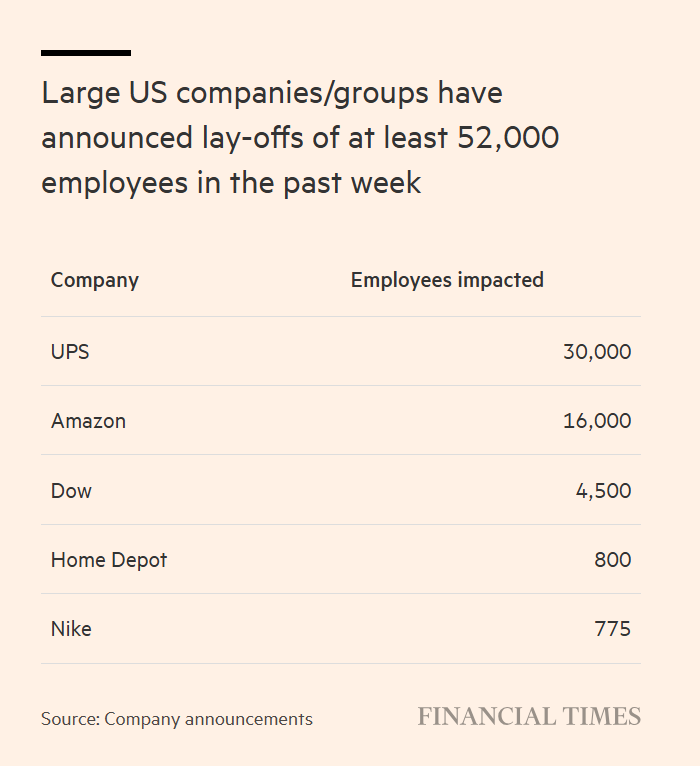
Group 1 - Major US companies, including Amazon, UPS, Dow, Nike, and Home Depot, announced layoffs totaling over 52,000 employees due to ongoing economic uncertainty and pressures from investments in artificial intelligence [1][2] - UPS is set to lay off 30,000 employees, while Amazon will cut 16,000 jobs, Dow will reduce its workforce by 4,500, Home Depot will let go of 800, and Nike will lay off 775 [2] - The frequency of discussions about layoffs among companies is increasing, with a clear urgency to utilize AI to reduce labor costs [3] Group 2 - The US labor market is showing signs of stagnation, with companies hesitant to hire new employees or make significant layoffs due to uncertainties from trade issues and AI developments [6] - In December, the US economy added only 50,000 jobs, marking a significant slowdown in hiring, with the average unemployment duration extending to 11.4 weeks, the longest since 2021 [9] - Despite the increase in layoffs among well-known companies, the overall scale of layoffs in the past year has not reached abnormal levels compared to pre-pandemic figures [6][9] Group 3 - Companies are primarily implementing layoffs to streamline operations and improve efficiency rather than responding to macroeconomic trends [12] - UPS CFO Brian Dykes indicated that the layoffs are part of a strategy to adjust to a reasonable scale due to reduced package volumes for Amazon [12] - Amazon's recent announcement of a second round of layoffs within three months aims to "streamline bureaucratic structures" [12]


亚马逊海外购李岩川:击穿同质引入高潜力小众品牌,跳出商品思维孵化新生活方式
Cai Jing Wang· 2026-01-30 08:07
穿越周期是零售商经久不衰的考题,尽管已知健康升级、情绪疗愈是拿分点,但在消费者趋于倦怠 的"阅卷"情景下,想要让每次作答保持有效,实属不易。 恰恰是这么一套小众但丰富、理想而切实的生活表达态度,正在得到更多共鸣——与热销品类更趋多 元、细分一样,亚马逊海外购在"小而美"的路上,乐此不疲。 "从小众潮玩、户外、个护,到家居、电子、健康品类,我们都发现了新的消费变化和趋势。" 亚马逊 海外购亚太区及中国业务负责人李岩川称,"我们不仅关注品牌的丰富性和多样性,也在积极引入更多 独特的、有全球趋势潜力的小众品牌,这会使我们的选品更具差异化,避免同质化。" 复古电子宠物Tamagotchi拓麻歌子销售额翻番提升、户外运动眼镜品牌Julbo销售额同比增超120%、口 腔个护品牌Oral-B销售额同比增长近三倍……来自全球的品牌轮番接力,正让亚马逊海外购这座"试炼 场",系统性完善听声辩位的方法进化论。 这源于亚马逊海外购的战略定位,正如李岩川强调,"相比于其他购物网站,亚马逊海外购的侧重点有 所不同,它更像是一个海外生活方式孵化器。" 对于这一孵化器的造景立体度,曾在海外留学多年的生活方式博主"特小小特"便深有体会,从 ...
5.2万人!美企巨头本周密集裁员,想用AI降本
Sou Hu Cai Jing· 2026-01-30 08:02
Group 1 - Major companies in the U.S. have announced large-scale layoffs, totaling over 52,000 job cuts [1] - Companies are increasingly discussing layoffs as a strategy to reduce labor costs, particularly through the use of artificial intelligence [1][6] - The layoffs are concentrated among a few large firms, raising concerns among Federal Reserve policymakers and economists about the weakening job market [1] Group 2 - In December, the U.S. added only 50,000 jobs, with the median duration of unemployment rising to 11.4 weeks, the longest since 2021 [2][4] - Companies like Amazon, UPS, Dow Chemical, Nike, and Home Depot have disclosed layoff plans aimed at streamlining operations and increasing efficiency [3] - UPS plans to cut up to 30,000 jobs, while Amazon announced a second round of layoffs affecting 16,000 employees, citing the need to eliminate bureaucracy [3] Group 3 - The labor market, which expanded rapidly after the pandemic, has stagnated due to uncertainties related to trade and artificial intelligence, leading employers to hesitate in hiring or laying off staff [4][5] - Although overall layoff data may not seem alarming, the experience of unemployment is becoming increasingly challenging for workers in a slowing hiring environment [5] - Recent announcements of layoffs indicate that companies are shifting towards proactive cost-cutting measures amid increasing pressure to invest in AI [6]
Amazon AI Cuts, Snap Spins Out AR, VR Content Studios Retreat
Forbes· 2026-01-30 07:35
Group 1: Amazon - Amazon announced another round of layoffs as part of a cultural reset, eliminating tens of thousands of roles over the past two years, primarily in white-collar developer positions [2] - The company is restructuring around cloud infrastructure, AI services, and operational efficiency [2] - Amazon will close its Amazon Go and Fresh stores, citing a failure to create a distinctive customer experience with the right economic model [2] Group 2: Snap Inc. - Snap is spinning out its Specs AR glasses business into a standalone entity, separating hardware development from its core social media operations [3] - The launch of Spectacles at $99/month for developers will soon be available to the public, but the effort is considered doomed to fail [3] - Snap has struggled against competitors like Google's Android XR, Meta's AI smartglasses, and Apple's upcoming wearable AI devices [3] Group 3: Apple - Apple is developing an AI wearable, a small pin-sized device comparable to an AirTag, designed to work with a future LLM-powered version of Siri [4] - The device is still considered experimental, with a possible launch window in 2027, and aims to be an ambient companion integrated into Apple's ecosystem [4] - Apple's approach reflects a strategy of entering categories only after they have proven successful, focusing on vertically integrated hardware, silicon, and software [4] Group 4: OpenAI - OpenAI is preparing to debut its own consumer AI hardware later this year, following the acquisition of former Apple design leader Jony Ive's company for $6 billion [5] - The effort aims to establish a new category of AI-native devices centered around conversation and perception [5] - The convergence of Apple, OpenAI, and Google around AI hardware suggests a new device cycle centered on continuous AI presence may begin in 2026 [5] Group 5: VR Industry - Mighty Coconut, developer of Walkabout Mini Golf, cut roughly a quarter of its staff despite having a successful title on Quest, raising prices on new content due to rising costs [7] - Atlas V raised $6 million to diversify from narrative VR toward free-to-play gaming and location-based experiences, acknowledging that premium narrative VR has failed to reach sufficient audience scale [8] - The studio plans to focus on experiences with clearer revenue models, including ticketed VR attractions and live installations [8]


英媒:随着就业市场降温,美国大型企业预计将裁员至少超5万人
Xin Lang Cai Jing· 2026-01-30 06:15
Core Insights - Major U.S. companies are announcing significant layoffs, with a total of over 52,000 employees expected to be cut, indicating a shift from years of strong hiring to workforce reductions [1] Group 1: Layoff Announcements - Companies such as Amazon, United Parcel Service, Dow Chemical, Nike, and Home Depot are among those planning to reduce their workforce [1] - The layoffs are attributed to ongoing economic uncertainty and increased pressure to streamline operations due to investments in artificial intelligence [1] Group 2: Economic Implications - The recent layoffs highlight concerns among Federal Reserve policymakers and private economists regarding the cooling of the previously hot job market [1] - David Mericle, Chief Economist at Goldman Sachs, noted that companies are increasingly discussing layoffs and are eager to leverage artificial intelligence to reduce labor costs [1]
