
Arm plc(ARM)

Search documents
电子掘金 GPT-5时代来临,算力依然硬通货
2025-08-11 01:21
Summary of Key Points from Conference Call Industry Overview - The conference call primarily discusses the AI computing power industry, focusing on advancements in AI models, particularly OpenAI's GPT-5, and the competitive landscape among major tech companies in North America such as Google and Meta [1][7][8]. Core Insights and Arguments - **GPT-5 Enhancements**: GPT-5 has not revolutionized application paradigms but has significantly improved efficiency, pricing, and context length. The API pricing is set at $1.25 per million tokens for input and $10 for output, making it cost-effective compared to other AI models [1][4]. - **Market Demand for Computing Power**: There is a strong and persistent demand for computing power in the market, with expectations of increased capital expenditures from major cloud providers. The total capital expenditure for North America's top four cloud companies is projected to reach $366.1 billion in 2025, a year-on-year increase of approximately 47% [3][23]. - **Domestic Market Trends**: Despite uncertainties in capital expenditures, domestic internet giants are expected to continue investing in computing power, with a notable increase in investments in the domestic patent industry chain anticipated in the second half of the year [8][10][9]. - **Technological Innovations**: Domestic computing power manufacturers are focusing on innovations in interconnect technology, superpoint architecture, and large-scale system solutions to support large models comprehensively [11]. - **Performance of U.S. Tech Hardware Companies**: U.S. tech hardware companies reported second-quarter results that generally met expectations, driven by surging demand for coding and agent-related inference and pre-training [12]. Additional Important Insights - **Competitive Landscape**: Major tech companies like Google and Meta are heavily investing in model updates and optimizations, with Google potentially leading in frontier models. Meta is also increasing its investments to enhance its capabilities [7]. - **Emerging Technologies**: The call highlights the competitive dynamics among interconnect technologies, including PCIe and Ethernet interconnects, with Broadcom's advancements in PCIe 6.0 and Ethernet Scale-Up technology being particularly noteworthy [2][13]. - **Future Projections**: The demand for AI GPUs and ASICs is expected to rise significantly in 2026 and 2027, with recommendations for core industry players that exhibit high elasticity and clear performance delivery [18]. - **Arista's Performance**: Arista's stock surged over 10% following its second-quarter earnings report, attributed to better-than-expected performance and an optimistic revenue outlook for AI [19][20]. Conclusion - The AI computing power industry is experiencing robust growth driven by advancements in AI models, significant investments from major tech companies, and a strong demand for computing power. The competitive landscape is evolving with new technologies and strategies, indicating a promising outlook for the sector.




🚨 All-In Summit Speaker Announcement: Rene Haas
All-In Podcast· 2025-08-05 16:28
Company Valuation & Market Position - ARM's IPO in September valued the company above $54 billion [1] - The IPO was the largest public offering in over 2 years [1] - The company's valuation has tripled [1] - ARM's circuits are present in nearly every smartphone [1] - ARM is considered the winner in the CPU side [2] Industry Trends & Opportunities - Software is advancing faster than hardware [2] - Increased investment in new hardware benefits ARM [2]



今夜!跳水!
中国基金报· 2025-08-05 16:12
Core Viewpoint - The article highlights a significant downturn in the U.S. stock market, driven by disappointing service sector data, raising concerns about the economic outlook and potential market corrections [2][5][10]. Group 1: Market Performance - U.S. stock indices experienced a decline, with the Dow Jones dropping approximately 100 points and both the Nasdaq and S&P 500 falling around 0.5% [2]. - Technology stocks collectively fell, with notable declines in companies such as ARM (-2.83%), TSMC (-2.78%), and Nvidia (-1.73%) [4]. Group 2: Service Sector Data - The ISM services index showed almost zero growth in July, indicating stagnation and raising concerns about stagflation, characterized by high inflation and low employment [5]. - The services sector, which constitutes about 70% of the U.S. economy, is showing signs of slowdown, with the services index dropping to 50.1, below economists' expectations [5]. - The employment index fell to 46.4, marking its fourth contraction in five months and reaching one of the lowest levels since the pandemic [5]. Group 3: Economic Concerns - Businesses are facing challenges from high tariffs, cautious consumer behavior, and uncertainties stemming from former President Trump's policies [6]. - The new orders index decreased to 50.3, nearing stagnation, while 11 service industries reported growth, and 7 experienced contraction, with the largest decline in accommodation and food services [7]. Group 4: Market Predictions - Major Wall Street firms, including Morgan Stanley and Deutsche Bank, are warning investors to prepare for potential market corrections, with predictions of a 10% to 15% decline in the S&P 500 in the coming weeks [10][11]. - The S&P 500's relative strength index (RSI) reached 76, indicating overbought conditions, and historical data suggests that August and September are typically weak months for the index [11].



Arm :投资阶段预示未来价值潜力-Arm Holdings plc_ Investment Phase Signals Future Value Potential
2025-08-05 03:15
Summary of Arm Holdings plc Conference Call Company Overview - **Company**: Arm Holdings plc (ARM.O) - **Industry**: Semiconductors - **Market Cap**: US$167.807 billion - **Current Stock Price**: US$163.33 - **Price Target**: Adjusted from US$194.00 to US$180.00 [1][9] Key Financial Metrics - **Q1 Sales**: US$1.05 billion, EPS of US$0.35, both in line with expectations [10] - **Q2 Guidance**: Sales range of US$1.01-1.11 billion, EPS guidance of US$0.29-0.37 [10] - **Opex**: Expected to increase to US$655 million in Q2, with a projected exit of US$700 million by year-end [8][10] - **R&D Spending**: Anticipated to rise by approximately 31% year-over-year for FY26 [8] Core Insights - **Investment Phase**: The company is in a heavy investment phase, which is impacting earnings but is seen as a necessary step for future growth [1][3] - **Diversification**: Arm is exploring opportunities beyond its traditional markets, including chiplets and full solutions [3][9] - **Licensing Growth**: Licensing revenue in Q1 was strong at US$468 million, with royalties increasing by 25% year-over-year to US$585 million [10] - **CSS Deals**: The company signed 16 CSS deals to date, indicating a shift towards next-generation designs and potentially higher royalty rates [10] Market Position and Future Outlook - **Market Dominance**: Arm holds over 60% of global semiconductor IP sales, particularly in smartphones [25] - **Growth Drivers**: Structural growth opportunities in edge AI, automotive, and potential chipmaking are expected to drive future revenue [25][30] - **Earnings Growth**: Projected earnings CAGR of approximately 33% from FY25 to FY28, with FY27 EPS estimate at US$2.68 [18][24] Risks and Challenges - **Geopolitical Risks**: Potential impacts from geopolitical issues and litigation could affect future growth [25][28] - **Market Competition**: Competition from emerging open-source ecosystems and established players poses a risk to market share [35] - **Revenue Uncertainty**: Uncertainty around revenues from Arm's China joint venture and smartphone royalties could impact overall performance [36] Conclusion - **Investment Rating**: The company maintains an Overweight rating, reflecting optimism about its long-term growth potential despite current challenges [9][18] - **Valuation**: The adjusted price target of US$180 is based on a PEG ratio of 2.0, reflecting a premium valuation justified by Arm's market position and growth prospects [18][24]
Undervalued and Profitable: 3 Artificial Intelligence (AI) Stocks for Buffett-Minded Investors
The Motley Fool· 2025-08-02 08:05
Group 1: AI Stocks and Investment Perspective - Contrary to common assumptions, owning AI stocks does not require taking excessive risks or tolerating high volatility [1] - Warren Buffett prefers predictable, profitable companies with simple business models, which often excludes many AI stocks from his investment strategy [1][2] - A few AI stocks may be justifiable additions to a portfolio based on their predictability, profitability, and potential upside [2] Group 2: Arm Holdings - Arm Holdings is categorized as a semiconductor stock, focusing on designing microchip architecture and licensing it to chipmakers [6] - The company generated $4 billion in sales last fiscal year, resulting in nearly $800 million in net income, indicating high-margin revenue due to no production costs [7] - Arm's patented technology and superior power efficiency make it a preferred choice for major companies, potentially controlling up to 50% of the data center processor market by the end of this year [9][10] Group 3: Taiwan Semiconductor Manufacturing Company (TSMC) - TSMC manufactures high-performance chips for major semiconductor companies, holding a market share of 80% to 90% in global production of high-performance processors [12] - The complexity and expense of manufacturing computer processors make outsourcing to TSMC a practical choice for many companies [13] - TSMC's established position and technological advancements align with Buffett's investment principles of proven, high-quality companies with a competitive moat [13][16] Group 4: DigitalOcean - DigitalOcean, with a market cap of less than $3 billion, provides cloud-based services, including AI solutions, and is considered a profitable AI stock [17][19] - The company has an annualized recurring revenue run rate of $843 million, reflecting a 14% increase from the previous year, with $84 million in net income [20] - As demand for cloud and AI solutions grows, DigitalOcean's revenue and earnings are expected to increase accordingly [21]
Why Arm Holdings Stock Sank by Over 15% This Week
The Motley Fool· 2025-08-01 22:37
Core Insights - Arm Holdings experienced a significant decline in share price, dropping over 15% due to disappointing earnings guidance and mixed analyst reactions [1][6]. Financial Performance - Arm reported a 12% year-over-year increase in total revenue, reaching slightly over $1.05 billion, driven by a 25% rise in royalty revenue to $585 million, despite a 1% decrease in licensing revenue to $468 million [2]. - Non-GAAP net income fell to $374 million, or $0.35 per share, compared to $419 million in the previous year, meeting analyst estimates for profitability but slightly missing revenue expectations of $1.06 billion [4]. Future Guidance - Management's guidance for the second quarter forecasts revenue between $1.01 billion and $1.11 billion, indicating a potential decline or flat performance compared to the first quarter, with adjusted earnings projected at $0.29 to $0.37 [5]. Analyst Reactions - Analysts reacted with mixed sentiments, with some reducing their price targets. UBS's Timothy Arcuri lowered his target from $185 to $175 while maintaining a buy recommendation, and Morgan Stanley's Lee Simpson cut his target from $194 to $180, also keeping an overweight rating [6].
前瞻全球产业早报:我国大模型应用个人用户注册超31亿
Qian Zhan Wang· 2025-08-01 12:23
Group 1: Manufacturing and Economic Indicators - In July, the manufacturing PMI was reported at 49.3%, a decrease of 0.4 percentage points from the previous month, indicating a decline in manufacturing activity [2] - Large enterprises had a PMI of 50.3, down 0.9 percentage points, while medium-sized enterprises saw an increase to 49.5, up 0.9 percentage points, and small enterprises dropped to 46.4, down 0.9 percentage points [2] - The production index and supplier delivery time index were above the critical point, while new orders, raw material inventory, and employment indices were below the critical point [2] Group 2: AI and Technology Developments - The number of registered personal users for large model applications in China has exceeded 3.1 billion, with API call users surpassing 159 million [3] - Huawei has officially open-sourced its self-developed programming language "Cangjie," which includes a compiler, runtime, and standard library, aimed at intelligent applications [7] - OpenAI's annualized revenue has reached $12 billion, with an adjusted cash burn forecast of approximately $8 billion for 2025 [15] Group 3: Corporate Actions and Market Developments - Nvidia was summoned by China's internet regulator to explain security risks related to its H20 computing chip sold in China [4] - Energy Capital Partners and KKR announced plans to build a 190 MW data center in Texas, with an investment close to $4 billion, marking the first investment of their $50 billion strategic partnership [11] - Chevron has received limited permission from the U.S. government to operate in Venezuela, contingent on ensuring oil revenues do not benefit the Maduro government [17] Group 4: Financial Market Updates - The A-share market saw all three major indices close lower, with the Shanghai Composite Index down 1.18% [18] - The Hong Kong GDP for Q2 2025 increased by 3.1% year-on-year, slightly up from a 3.0% increase in Q1 [4] - U.S. stock indices showed mixed results, with the Dow Jones down 0.38% and the Nasdaq up 0.15% [19]



赛道Hyper | Arm加入自研芯片战团
Hua Er Jie Jian Wen· 2025-08-01 11:45
Core Viewpoint - Arm's announcement of lower-than-expected revenue forecasts for the upcoming fiscal quarter and its plan to invest profits into developing its own chips marks a significant shift in its business model from licensing to direct chip production [1][9][12] Group 1: Financial Performance - Arm expects Q2 revenue to be between $1.01 billion and $1.11 billion, aligning with market expectations of $1.06 billion, but forecasts adjusted earnings per share between $0.29 and $0.37, with the midpoint below the market average of $0.36 [1] - The company's traditional licensing model has been highly successful, with Arm's architecture present in 99% of smartphones globally [5][6] Group 2: Business Model Transition - Arm has historically operated as a knowledge property supplier, licensing chip designs to semiconductor manufacturers rather than producing chips directly [3][4] - The licensing model includes various types of authorizations, with upfront fees ranging from $1 million to $10 million, and royalties typically between 1% to 2% of chip sales, with higher rates for new architectures [4] - The shift to self-developed chips indicates a major change in Arm's strategy, potentially transforming its relationships with existing clients into competitive dynamics [9][10] Group 3: Market Context and Challenges - Arm's core market, the smartphone sector, is experiencing stagnation, with IDC projecting only a 1% growth in global smartphone shipments for Q2 2025 [7] - The competitive landscape in the data center market is intense, with established players like Intel and NVIDIA dominating, making it challenging for Arm to gain market share solely through licensing [8] - Arm's move to develop its own chips could enhance its competitiveness and allow for better integration of its technologies, potentially reshaping the industry landscape [11][12] Group 4: Future Implications - If successful in chip development, Arm could disrupt the current market dynamics, particularly in the data center sector, and expand its presence in emerging fields like IoT [11][12] - The transition from a licensing model to direct chip production may require Arm to reassess its partnerships and find new ways to maintain relationships with existing clients while attracting new ones [11]
反转,Arm承认下场自研芯片
3 6 Ke· 2025-08-01 07:28
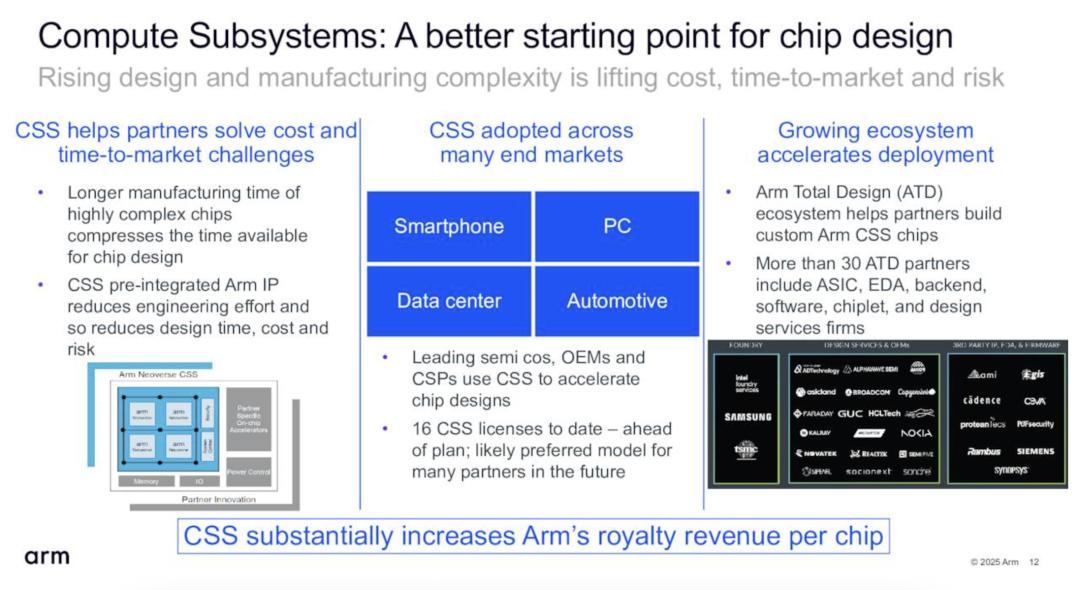
Core Insights - Arm has announced its strategic shift towards developing its own chips, moving away from its traditional model of licensing chip design blueprints to other companies [1][2][10] - The first self-developed chips are expected to be launched as early as summer 2023, with TSMC as the foundry partner and Meta potentially being one of the first customers [3][10] Group 1: Strategic Shift - Arm's CEO René Haas confirmed the company's decision to invest more in developing physical chips, which are seen as a tangible representation of their existing Compute Subsystem (CSS) products [2][3] - The move to self-developed chips is a response to the growing demand for high-performance chips in the data center market, which is projected to be a trillion-dollar industry [10][11] Group 2: Financial Performance - Arm's Q1 revenue was reported at $1.05 billion, slightly below market expectations of $1.06 billion, with adjusted earnings per share at $0.35, in line with expectations [3] - For Q2, Arm forecasts adjusted earnings per share between $0.29 and $0.37, with revenue expectations of $1.01 billion to $1.11 billion, aligning with market predictions [3] Group 3: Key Developments - Arm's collaboration with SoftBank on the "Stargate" project aims to support a broader AI vision, leveraging Arm's technology as the core CPU for various applications [4][5] - The company has seen a 40% year-over-year increase in enterprises running AI workloads on Arm Neoverse data center chips, with a 14-fold increase since 2021 [5] - Arm's CSS platform has signed 16 licenses with 10 companies, more than doubling from the previous year, indicating strong demand for its technology [6] Group 4: Chiplet Development - Arm is actively developing Chiplets, which allow for modular design and independent scaling of compute or memory, supported by over 70 partners [9] - The Chiplet architecture is seen as a way to diversify product offerings without requiring significant investment in single-chip SoC designs [9] Group 5: Market Impact - The introduction of self-developed chips may disrupt Arm's long-standing relationships with existing clients, as it transitions from a partner to a competitor [10] - This strategic move is viewed as a necessary step for Arm to achieve higher profit margins compared to its licensing model, especially in the booming AI-driven data center market [10][11]
大行评级|美银:上调ARM目标价至180美元 重申“买入”评级
Ge Long Hui· 2025-08-01 06:34
该行指,无论如何,ARM的销售额及每股盈余将会在未来十年之后保持15至20%的稳定增长,其大型 客户软银正处于全球人工智能部署的前沿。该行将其目标价由150美元上调至180美元,重申"买入"评 级。 美银发表研究报告指,ARM截至6月止季绩表现及截至9月底止季度前景并不乐观,该行相信,公司正 建立多个推动增长的长期助推器,其独特的专利费模式能够提供多年的经常性收入可见度。ARM的授 权模式逼使集团提前数年进行投资,但成果需3至4年才能显现,在近期或中期低迷环境下,对集团作出 估值判断变得更加困难。 ...