Broadcom(AVGO)

Search documents
AI Spending Is Shifting — And Broadcom, Marvell Are Positioned To Win
Benzinga· 2025-11-14 16:45
Core Insights - AI datacenters are entering a new phase focused on inference rather than training, which is expected to reshape the competitive landscape and spending patterns in the industry [1][2][8] Shift from Training to Inference - The focus is shifting from training large models to optimizing inference processes, with techniques like distillation and quantization making inference cheaper and more efficient [2][3] - By 2027, inference is expected to dominate incremental compute spending, with a notable shift already occurring in 2025-2026 [3] Beneficiaries of the Shift - Broadcom is highlighted as a key beneficiary due to its custom ASICs that support inference for major companies like Google, Amazon, and Meta [4] - Marvell Technology is also positioned to benefit as inference workloads increasingly rely on Ethernet and PCIe, moving away from expensive training-oriented technologies [5] Hardware and Networking Trends - Celestica is well-positioned as the industry moves towards standardized, cost-effective inference hardware, allowing operators to source from multiple vendors [6] - Arista Networks continues to support high-performance training networks, but the shift towards Ethernet in inference may create new opportunities for networking companies [6] Power Efficiency and Deployment - Inference is significantly less power-hungry than training, often requiring 5-10 times less power, making it easier to deploy in datacenters with limited grid capacity [7] - The trend towards making AI cheaper, faster, and easier to run is expected to drive spending towards companies like Broadcom and Marvell [8]



美股三大指数大幅低开,科技股普跌,特斯拉跌超4%
Xin Lang Cai Jing· 2025-11-14 15:16
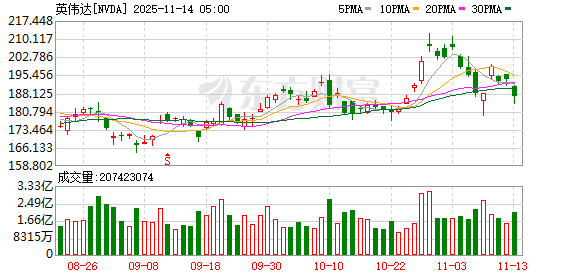
Market Overview - The U.S. stock market opened significantly lower, with the Dow Jones down 0.94%, Nasdaq down 1.40%, and S&P 500 down 1.02% [1] - The current values for the indices are as follows: Dow Jones Industrial Average at 47011.72 (-445.50), Nasdaq at 22549.33 (-321.03), and S&P 500 at 6668.69 (-68.80) [2] Sector Performance - Technology stocks experienced a broad decline, with Tesla dropping over 4%, and Nvidia, Google, and Broadcom each falling more than 2% [2] - Cryptocurrency-related stocks and gold mining stocks mostly weakened, with Coinbase down nearly 5% and Harmony Gold down over 4% [3] Chinese Concept Stocks - Most Chinese concept stocks declined, with Xiaoma Zhixing down over 6%, Canadian Solar down more than 5%, and JinkoSolar down over 3%. However, Bilibili saw an increase of over 2% [4]




Broadcom Rises 106% in a Year: Buy, Sell or Hold the AVGO Stock?
ZACKS· 2025-11-14 15:01
Core Insights - Broadcom (AVGO) shares have increased by 106.3% over the past 12 months, significantly outperforming the Zacks Electronics – Semiconductors industry's return of 71.4% and the broader Zacks Computer and Technology sector's growth of 30.7% [1][2] - The company is experiencing strong demand for XPUs, which are essential for training Generative AI models, leading to a substantial increase in AI revenues [1][6] Company Performance - In Q3 of fiscal 2025, Broadcom's AI revenues rose by 63% year over year to $5.2 billion, with XPUs contributing 65% of total AI revenues [6][10] - The consolidated backlog reached $110 billion, and the company secured over $10 billion in orders for AI racks driven by XPU demand [6][10] - Broadcom anticipates Q4 semiconductor sales to increase by 30% year over year, with software revenues expected to rise by 15% [7][10] Product Development - Broadcom launched the first Wi-Fi 8 silicon solutions for the broadband wireless edge ecosystem and began shipping the Tomahawk 6 - Davisson Ethernet switch, designed for AI networking demands [7][9] - The Jericho 4 Ethernet fabric router can interconnect over one million XPUs across multiple data centers, and the Thor Ultra is the first 800G AI Ethernet Network Interface Card [9][10] Market Position - Broadcom's partner base includes major companies like OpenAI, Walmart, and Meta Platforms, which is expected to drive top-line growth [10] - The company is outperforming competitors such as NVIDIA, Marvell Technology, and AMD in terms of stock performance [2][10] Financial Outlook - The Zacks Consensus Estimate for fiscal 2025 earnings is $6.72 per share, indicating a 38% growth from fiscal 2024, with revenues projected at $63.36 billion, suggesting a 22.9% increase [13] - However, a higher mix of lower-margin XPUs is expected to pressure gross margins, with a forecasted decline of 70 basis points sequentially [11][12] Valuation Concerns - Broadcom's stock is considered overvalued, trading at a forward price/sales ratio of 18.72X, significantly higher than the sector average of 6.85X and competitors like NVIDIA and AMD [14][17] - Despite strong growth potential, the declining gross margin and challenging macroeconomic conditions raise concerns about the premium valuation [17][18]

美股部分明星股盘前大幅走低
Ge Long Hui A P P· 2025-11-14 12:58
Group 1 - Major U.S. stocks experienced significant pre-market declines, with Nvidia down 3.3% [1] - Google saw a pre-market drop of 2.7% [1] - Broadcom's pre-market decline was 2.5% [1] - TSMC (Taiwan Semiconductor Manufacturing Company) fell by 3.4% in pre-market trading [1] - Tesla faced the largest pre-market drop at 5% [1]

美股部分明星股盘前大幅走低,英伟达盘前跌3.3%
Mei Ri Jing Ji Xin Wen· 2025-11-14 12:52
Core Viewpoint - U.S. stock market shows significant declines in pre-market trading for several major tech stocks, indicating potential market volatility and investor concerns [2] Group 1: Company Performance - Nvidia shares fell by 3.3% in pre-market trading [2] - Google experienced a decline of 2.7% [2] - Broadcom's stock decreased by 2.5% [2] - TSMC (Taiwan Semiconductor Manufacturing Company) saw a drop of 3.4% [2] - Tesla's stock plummeted by 5% [2]
Bitcoin's $100K Breakdown Is A Liquidity Alarm For The Whole Market
Benzinga· 2025-11-14 12:09
Group 1: Bitcoin and Market Liquidity - Bitcoin has dropped below the $100,000 mark, signaling a systemic liquidity warning that is affecting equity and credit markets [1][2][4] - The decline in Bitcoin is correlated with a broader liquidity squeeze, as evidenced by simultaneous declines in tech indices and other asset classes [4][12] - The recent drop is characterized as a deleveraging event rather than a gradual decline due to weak fundamentals, with key support levels identified between $100,000 and $101,000 [5][6] Group 2: Credit Market Issues - The U.S. has experienced credit market problems, including the bankruptcy of a major subprime auto lender and write-downs at large banks [8][10] - Regional banks are increasingly relying on the Federal Reserve's liquidity backstops, indicating stress in their balance sheets [9][10] - Credit rating agencies have noted that downgrades in private credit are outpacing upgrades, suggesting a tightening credit environment [10][12] Group 3: Coinbase and Crypto Infrastructure - Coinbase's significant drop in stock price reflects the stress in the crypto infrastructure, which remains sensitive to liquidity changes [13][15] - The correlation between Coinbase and Bitcoin is very high, indicating that the performance of crypto infrastructure is closely tied to Bitcoin's price movements [24] - The current market conditions suggest that the crypto ecosystem is not yet stable, as Coinbase's volatility highlights its dependence on retail and speculative flows [15][26] Group 4: Broader Market Implications - The liquidity squeeze is not limited to crypto but extends to high-beta tech stocks and other speculative assets, indicating a systemic issue [12][29] - The upcoming Nvidia earnings report is seen as a potential catalyst that could influence market sentiment amid the liquidity concerns [20][30] - The overall market is undergoing a layered reset in liquidity, with various sectors experiencing stress, including subprime auto loans and regional banks [29][30]

1 No-Brainer Artificial Intelligence (AI) ETF to Buy With $70 During the Nasdaq Bull Market
Yahoo Finance· 2025-11-14 09:47
Core Insights - The article discusses the significant growth and investment opportunities in the artificial intelligence (AI) sector, particularly through the Roundhill Generative AI and Technology ETF, which focuses on companies driving the AI boom [7][10][12]. Company Highlights - **Broadcom**: Supplies networking equipment for data centers, including Tomahawk switches and AI accelerators that are alternatives to traditional GPUs [1]. - **Microsoft**: Integrates its Copilot AI assistant into major software products and offers a robust Azure cloud platform for AI software development [2]. - **SK Hynix**: A leading supplier of memory and storage chips, providing high-bandwidth memory solutions critical for AI workloads [3]. - **Alphabet**: Owns Google Search and has developed the Gemini family of large language models, widely adopted in AI software [4]. - **Nvidia**: Supplies advanced GPUs, with its latest Blackwell Ultra variants being highly sought after for AI model development due to their processing power and energy efficiency [5]. - **Roundhill Generative AI and Technology ETF**: Focuses on companies developing AI infrastructure and has a concentrated portfolio with its top five holdings representing 25.1% of its total value [6][10][11]. Market Performance - The Roundhill ETF has delivered a remarkable 150% return since its inception in May 2023, outperforming the Nasdaq-100's 91% and the S&P 500's 66% during the same period [12]. - The Nasdaq-100 index has experienced a significant recovery, rising 50% from its April low, driven largely by AI stocks [9][10]. Investment Considerations - The Roundhill ETF has an expense ratio of 0.75%, which is higher than traditional passive index funds, reflecting its active management approach [13]. - Despite strong returns, the ETF's heavy focus on AI means that investors should consider it as part of a diversified portfolio to mitigate risks associated with the sector [14].

花旗预判到了AI泡沫恐慌! Q3猛砍科技巨头仓位 大举做空纳指与英伟达(NVDA.US) 押注...
Xin Lang Cai Jing· 2025-11-14 09:36
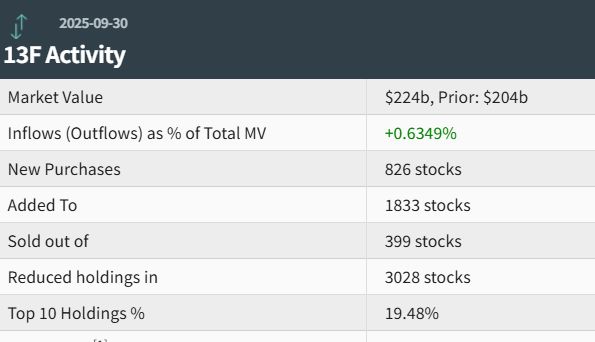
Core Viewpoint - Citigroup has significantly reduced its holdings in major AI-related technology stocks, reflecting concerns over the sustainability of the AI investment boom and the potential for a market correction in these high-valuation stocks [3][9]. Summary by Category Holdings Overview - As of September 30, 2025, Citigroup's total market value of holdings reached approximately $224 billion, up from $204 billion in the previous quarter, marking a 10% increase [1][2]. - The firm added 826 new stocks and increased holdings in 1,833 stocks, while reducing positions in 3,028 stocks and completely selling out of 399 stocks [1][2]. Major Stock Adjustments - Citigroup has notably reduced its positions in major tech giants such as Nvidia, Microsoft, Apple, and Amazon, aligning with the narrative of an "AI bubble" and the subsequent market correction [3][9]. - Despite the reductions in tech giants, Citigroup slightly increased its stake in Broadcom, indicating a positive outlook on its ASIC technology growth prospects [3][4]. Top Holdings - Nvidia remains Citigroup's largest holding with approximately 33.39 million shares valued at about $6.23 billion, although this represents a 28.22% decrease from the previous quarter [6]. - The second-largest holding is the Russell 2000 Index ETF put options, with around 23.99 million shares valued at approximately $5.81 billion, reflecting a 12.26% increase [4]. - Microsoft ranks third with about 9.56 million shares valued at approximately $4.95 billion, down 19.55% from the previous quarter [4]. Strategic Moves - Citigroup has increased its holdings in put options for the Nasdaq 100 Index ETF by 81%, indicating a preparation for potential declines in AI-related stocks [7][8]. - The top five purchases in the third quarter included high-yield corporate bond ETF put options and Nvidia put options, emphasizing a strategy to hedge against potential downturns in the AI sector [8]. Selling Trends - The top five sell-offs included Nvidia, Meta, Amazon, Microsoft, and Apple, further underscoring Citigroup's cautious stance on the AI investment landscape [9].


1 Artificial Intelligence (AI) Semiconductor Stock to Buy Hand Over Fist Before December (Hint: It's Not Nvidia)
Yahoo Finance· 2025-11-14 09:35
Core Viewpoint - The semiconductor sector, particularly companies like Broadcom, is experiencing significant growth driven by the increasing demand for AI infrastructure and custom silicon solutions [2][4]. Group 1: Company Performance - Broadcom has achieved a 55% gain in stock value this year, which is noteworthy compared to its peers in the semiconductor industry [3]. - The company is benefiting from the AI revolution, with strong demand for its custom application-specific integrated circuits (ASICs) [5][6]. Group 2: Strategic Partnerships - Broadcom has formed collaborations with major tech companies, including OpenAI, to deploy 10 gigawatts of custom AI accelerators over the next few years [7]. - The company is also working with Meta Platforms on custom chip designs, aligning with Meta's plans to increase capital expenditures [8]. - Additionally, Broadcom partners with Alphabet to develop custom tensor processing unit (TPU) hardware, further solidifying its position in the AI infrastructure market [8]. Group 3: Market Position - Broadcom holds an estimated 75% market share in the custom AI accelerator market, indicating its dominance in this growing segment [9].
CNBC Daily Open: A murky past and uncertain future trouble traders
CNBC· 2025-11-14 07:30
Market Performance - U.S. markets experienced their worst day since October 10, with the Dow Jones Industrial Average dropping 1.65% to settle at 47,457.22 after previously closing above 48,000 for the first time [1] - The S&P 500 and Nasdaq Composite also saw declines, losing 1.66% and 2.29% respectively [1] Sentiment on Technology Stocks - The decline in stock prices is partly attributed to a shift in sentiment regarding artificial intelligence, with major tech companies like Nvidia, Broadcom, and Oracle facing significant losses [2] - Oracle's stock has decreased by more than one-third in value since a 36% surge in September, raising concerns among investors about high valuations and substantial capital expenditures [2] Interest Rate Uncertainty - Uncertainty surrounding a potential interest rate cut in December is negatively impacting market sentiment, with the likelihood of a cut now seen as a "coin toss" compared to a 95.5% chance a month ago [3] - The lack of October's employment and inflation data further complicates the Federal Reserve's ability to assess the economy and make informed decisions regarding monetary policy [4]