Broadcom(AVGO)

Search documents
Prediction: Broadcom's $10 Billion Mystery Customer Could Be Anthropic. Here's Why.
The Motley Fool· 2025-11-09 10:15
Core Insights - Broadcom has secured a significant $10 billion chip deal with a new customer, which has generated considerable interest among investors [1] - Speculation suggests that the mystery customer could be Anthropic, a competitor to OpenAI, which aligns with Broadcom's strategic interests in the AI sector [2][4] Company Overview - Broadcom operates across more than two dozen business segments, with a notable revenue stream from custom application-specific integrated circuits (ASICs) driven by rising AI demand [3] - The company has established relationships with major hyperscalers, including Meta Platforms, Alphabet, and ByteDance, indicating its strong position in the AI hardware market [3] Potential Customer Analysis - Anthropic has gained traction in the AI landscape since the launch of ChatGPT, receiving substantial investments from Amazon and Alphabet [4][6] - The company has recently partnered with Google Cloud Platform and plans to utilize Alphabet's custom tensor processing units (TPUs), showcasing its diversified approach to chip platforms [7][8] Market Dynamics - Broadcom's existing supply relationship with Alphabet positions it favorably to support Anthropic's growing compute needs as AI workloads become more complex [9] - The overall investment in AI infrastructure is projected to reach $7 trillion through the decade, presenting a significant growth opportunity for Broadcom's custom silicon and networking solutions [14] Investment Perspective - Despite a recent contraction in Broadcom's stock valuation, the company remains well-positioned to attract new hyperscaler customers and deepen existing partnerships in the AI sector [13][15] - Broadcom is viewed as a compelling buy-and-hold opportunity as the demand for AI infrastructure continues to accelerate [15]

美股AI八巨头市值一周蒸发5.6万亿 高盛:未来1~2年市场或回撤20%
2 1 Shi Ji Jing Ji Bao Dao· 2025-11-09 09:37
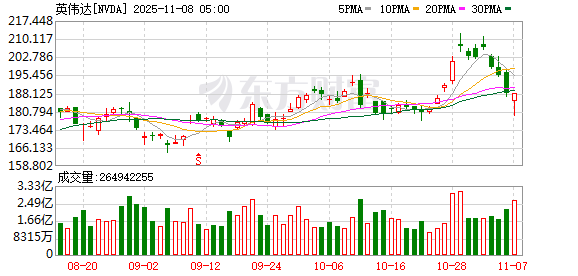
Group 1: Market Performance - The Nasdaq index, primarily composed of technology stocks, experienced a weekly decline of over 3%, marking its worst performance since April [2] - The S&P 500 index fell by 1.6% during the week, ending a three-week streak of gains [2] - Eight leading companies closely associated with AI saw a combined market value drop of approximately $800 billion, with U.S. companies linked to AI losing nearly $1 trillion in market capitalization [2] Group 2: Individual Company Performance - Nvidia, which recently became the world's most valuable company, saw its stock drop over 7%, resulting in a market value loss of about $350 billion [2] - Microsoft experienced a decline of more than 4%, with a market value reduction exceeding $150 billion [2] - Oracle's stock fell nearly 8%, leading to a loss of over $66 billion in market capitalization [2] - Other AI-related stocks, such as Duolingo and Palantir, also faced significant declines, with Duolingo dropping over 24% and Palantir over 11% [2] Group 3: AI Market Sentiment - There is a growing consensus in the U.S. that the AI "myth" is unsustainable, as companies heavily invest in uncertain paths towards general artificial intelligence (AGI) [3] - A survey indicated that 95% of companies using generative AI have not yet turned a profit from the technology, suggesting a bubble driven by narrative rather than fundamentals [3] - Concerns are rising that excessive spending on AI with low returns could lead to the collapse of many leading companies in the sector [3] Group 4: Competitive Landscape - The U.S. industry recognizes that nearly half of the global AI talent is based in China, which may leverage this advantage in the long-term competition [4] - Unlike the U.S. focus on uncertain AGI investments, China is pursuing a more pragmatic approach driven by industrial applications, providing it with cost and application advantages [4] - Analysts from Goldman Sachs and Morgan Stanley predict a potential 10% to 20% market correction in the U.S. stock market due to the tech bubble, while expressing optimism about the Chinese market, particularly in AI, electric vehicles, and biotechnology [4] Group 5: Cryptocurrency Market - The cryptocurrency market saw a significant downturn, erasing nearly all gains accumulated over the first ten months of the year within just over a month [5] - Major cryptocurrencies like Bitcoin and Ethereum continued to decline, with trading volumes dropping by 40% to 50% in a 24-hour period [6] - The market experienced a substantial liquidation event, leading to over 130,000 traders being liquidated, indicating a collapse in liquidity and confidence [6] Group 6: Institutional Demand - For the first time in seven months, institutional demand for Bitcoin has fallen below the rate of new coin mining, suggesting that large buyers may be retreating from the market [8]






利空突袭,全线大跌!5.7万亿,发生了什么?
Xin Lang Cai Jing· 2025-11-09 04:49
Core Viewpoint - The recent sell-off in the U.S. tech sector, particularly in AI-related stocks, has led to significant market declines, raising concerns about overvaluation and potential economic downturns [1][2][3] Group 1: Market Performance - The Nasdaq index, heavily weighted with tech stocks, experienced a weekly decline of over 3%, marking its worst performance since April [1][2] - Eight major AI-related companies saw a combined market value loss exceeding $800 billion in just one week, with the total market loss for AI-related U.S. companies nearing $1 trillion [1][2] - Nvidia alone lost approximately $348.5 billion in market value, while Microsoft and Oracle also faced significant declines [2][3] Group 2: Investor Sentiment - Concerns over high valuations in the AI sector have prompted investors to withdraw from the market, leading to the first weekly decline in three weeks for the broader U.S. market [2][3] - Retail investors, typically known for buying on dips, chose to remain cautious this week, reducing their holdings following Palantir's disappointing earnings report [3] Group 3: Economic Indicators - Signs of a weakening labor market and declining consumer confidence have emerged, with the Michigan Consumer Sentiment Index dropping to a three-year low [3] - The Chicago Fed reported a continuous decline in hiring rates for six consecutive months, further unsettling investors [3] Group 4: Company-Specific Issues - Palantir's recent earnings report triggered concerns about its high valuation, leading to a sharp decline in its stock price and affecting related companies [1][3] - Meta has been implicated in generating significant revenue from fraudulent advertisements, with internal documents revealing that about $16 billion, or 10% of its projected 2024 revenue, comes from such ads [5][6]


Prediction: This Supercharged Growth Stock Will Join Nvidia, Apple, Microsoft, and Alphabet in the $3 Trillion Club Before 2028
The Motley Fool· 2025-11-08 18:02
Core Insights - The semiconductor and infrastructure software specialist, Broadcom, is experiencing significant growth driven by artificial intelligence (AI) adoption, with expectations for further expansion in the future [1][6]. Company Overview - Broadcom currently has a market capitalization of approximately $1.7 trillion and is positioned to potentially join the $3 trillion market cap club due to its critical role in the AI ecosystem [4][10]. - The company offers a diverse product portfolio, including AI solutions, broadband networking, data center solutions, enterprise security, and mobile communication products, with 99% of all internet traffic passing through its technology [5]. Financial Performance - In the third quarter, Broadcom reported record revenue of $15.9 billion, a 22% year-over-year increase, with adjusted earnings per share (EPS) rising 36% to $1.69 [6]. - AI semiconductor revenue surged 63% to $5.2 billion, making up one-third of the total revenue, and the company anticipates AI-related revenue growth exceeding 60% by 2026 [6][11]. Market Opportunity - Broadcom estimates its AI opportunity to be between $60 billion and $90 billion by 2027 for its three current hyperscale customers, with AI revenue projected to grow from $12.2 billion in fiscal 2024, indicating a potential growth of 391% to 638% over three years [7][8]. - The addition of OpenAI to its customer list has further enhanced Broadcom's growth prospects, contributing to a record backlog of $110 billion [8]. Future Projections - Wall Street estimates suggest Broadcom could generate revenue of $63.3 billion in 2025, with a forward price-to-sales (P/S) ratio of approximately 27, necessitating around $111 billion in annual revenue to support a $3 trillion market cap [10]. - Expectations for revenue growth are bullish, with projections of 28% annual growth over the next five years, potentially allowing Broadcom to reach a $3 trillion market cap as early as 2028 [11]. Industry Context - The generative AI market is projected to be worth between $2.6 trillion and $4.4 trillion annually over the next decade, indicating a substantial opportunity for companies like Broadcom [12]. - Broadcom's stock has appreciated significantly, increasing 2,820% over the past decade, compared to a 225% gain for the S&P 500, justifying its premium valuation despite a current trading price of 30 times next year's expected earnings [13].


Is Broadcom (AVGO) The Best AI Chips Stock to Buy Now?
Yahoo Finance· 2025-11-08 15:43
Group 1 - Broadcom Inc (NASDAQ:AVGO) is highlighted as one of the best AI stocks to buy, with recent purchases by U.S. Congressman Cleo Fields and others indicating confidence in the stock [1] - Since the purchase by Congressman Cleo Fields on September 17, Broadcom's shares have increased by approximately 7%, and further transactions by other representatives have led to a total gain of 10% [1] - Polen Focus Growth Strategy initiated positions in Broadcom and NVIDIA in August 2025 after a hiatus of 2.5 years, citing concerns over the cyclical nature of their business models and the difficulty in forecasting future earnings growth [2] Group 2 - The investment community acknowledges the potential of Broadcom as an investment, but some analysts believe other AI stocks may offer higher returns with limited downside risk [3] - There is a mention of a report on a short-term AI stock that is considered extremely cheap and a beneficiary of Trump tariffs and onshoring, suggesting alternative investment opportunities within the AI sector [3]
Market momentum breaks: S&P 500 drops below 50-day average for first time since April – what does it mean?
The Economic Times· 2025-11-08 14:55
Market Overview - The S&P 500 fell below its 50-day moving average for the first time since April, indicating investor concerns over the U.S. government shutdown and weak economic data [1][11] - The Nasdaq Composite closed down 3% for the week, marking its worst performance since early April, while the S&P 500 and Dow each lost over 1% [8] Economic Indicators - A University of Michigan survey indicated consumer sentiment is nearing its lowest level ever, and October layoffs reached a 22-year high according to Challenger, Gray & Christmas [3] - Economists anticipated a loss of 60,000 jobs and an increase in unemployment to 4.5%, but the Bureau of Labor Statistics was unable to release the nonfarm payroll report due to the government shutdown [4] Government Shutdown Impact - Senate Minority Leader Chuck Schumer proposed a plan to end the government shutdown by providing short-term funding in exchange for a one-year extension of enhanced ACA tax credits [3] - The shutdown has led to significant disruptions, including a 10% cut in flights at 40 major airports, affecting 3,500 to 4,000 flights daily [5] AI and Tech Stocks Performance - Major AI stocks such as Oracle, AMD, and Nvidia experienced significant declines, contributing to the overall market downturn due to concerns over high valuations and slowing demand [8][12] - Oracle dropped nearly 2% on Friday, resulting in a weekly loss of 9%, while AMD fell almost 9% [8] Investor Behavior - Some investors are shifting towards value stocks amidst the sell-off in tech and AI stocks, with the sentiment that AI spending remains robust [9] - Leah Bennett, Chief Investment Strategist at Concurrent Asset Management, expressed optimism that the AI rally will continue despite current market challenges [9]

Better Artificial Intelligence ETF: iShares Semiconductor vs. the Fidelity MSCI Information Technology Index
The Motley Fool· 2025-11-08 14:30
Core Viewpoint - The Fidelity MSCI Information Technology Index ETF (FTEC) and the iShares Semiconductor ETF (SOXX) offer different investment strategies within the technology sector, with FTEC providing broader diversification and lower costs compared to the more concentrated SOXX [1][10]. Cost & Size Comparison - SOXX has an expense ratio of 0.34%, while FTEC has a lower expense ratio of 0.08% [2] - As of October 31, 2025, SOXX has a 1-year return of 28.64% compared to FTEC's 26.99% [2] - SOXX has a dividend yield of 0.5%, slightly higher than FTEC's 0.4% [2] - Assets Under Management (AUM) for SOXX is $16.8 billion, while FTEC has $17.5 billion [2] Performance & Risk Comparison - The maximum drawdown over five years for SOXX is (45.75%), significantly higher than FTEC's (34.95%) [4] - An investment of $1,000 would grow to $2,842 in SOXX over five years, compared to $2,568 in FTEC [4] Portfolio Composition - FTEC holds 288 stocks, providing nearly complete coverage of the U.S. tech sector, with 98% in technology and 1% in communication services [5] - Top holdings in FTEC include Nvidia, Microsoft, and Apple [5] - SOXX is concentrated with only 35 stocks, all in technology, featuring top positions in Advanced Micro Devices (AMD), Broadcom, and Nvidia [6] Sector Exposure - Both ETFs provide exposure to the artificial intelligence sector, with SOXX focusing on semiconductor stocks essential for AI systems [7] - FTEC includes semiconductor stocks like Nvidia and AMD, but also encompasses non-semiconductor companies that have experienced significant gains, such as Palantir, which saw a 200% increase in shares over the past year [8] Market Outlook - SOXX is positioned to benefit from the anticipated growth in semiconductor stocks as governments and businesses upgrade to specialized AI chips [9] - FTEC offers exposure to both semiconductor and major tech players like Microsoft, which are also expected to grow due to AI advancements, providing a more diversified investment opportunity [10]

5 Top Artificial Intelligence Stocks to Buy in November
The Motley Fool· 2025-11-08 11:30
Group 1: AI Investment Opportunities - Artificial intelligence (AI) investing remains a top priority for investors, with significant capital being allocated to support the AI revolution [1][2] - Several compelling stocks are highlighted for potential growth as investors adjust their portfolios for expected success in 2026 [2] Group 2: Nvidia - Nvidia is recognized as a leading player in AI investing, with its GPUs serving as the backbone for current AI technology [3] - The company has secured orders worth $500 billion for advanced data center chips over the next five quarters, indicating strong future growth potential [3] - Nvidia's market cap is reported at $4,572 billion, with a gross margin of 69.85% and $165 billion in revenue over the past 12 months [4][5] Group 3: Broadcom - Broadcom is competing in the AI sector by partnering with hyperscalers to create custom chips tailored for specific workloads, which may enhance performance while reducing costs [6][7] - Although Broadcom's custom AI accelerators may not directly compete with Nvidia's GPUs, they could capture a significant market share as clients seek to optimize data center expenditures [7] Group 4: Taiwan Semiconductor Manufacturing (TSMC) - TSMC is the leading semiconductor manufacturer for AI chips, producing components for major tech companies, including Nvidia and Broadcom [8] - The company's market cap stands at $1,486 billion, with a gross margin of 58.06%, making it a strong investment as demand for AI computing power continues to rise [10] Group 5: Alphabet - Alphabet's Google Search revenue continues to grow, countering earlier concerns about being replaced by generative AI [11] - The Google Cloud business is also generating revenue by running AI workloads for various clients, positioning Alphabet as a valuable investment opportunity [12] Group 6: Meta Platforms - Meta Platforms has substantial cash reserves for AI investments, but market concerns about its spending have led to a decline in stock price [13] - The stock is currently trading at 21 times forward earnings, which is considered low given its growth potential, suggesting it may yield impressive returns in the future [15]
美股AI科技股遭遇重挫 八巨头一周蒸发近万亿美元
Sou Hu Cai Jing· 2025-11-08 02:46
Core Insights - The recent week saw a significant adjustment in U.S. AI-related tech stocks, with a total market value loss of approximately $800 billion (around 5.7 trillion RMB) among eight major companies closely tied to the AI boom [1] - The broader AI concept stocks have experienced nearly a $1 trillion loss in market value, marking the worst weekly decline of the year [1][3] Group 1: Market Performance - The Nasdaq Composite Index, primarily composed of tech stocks, fell by 3% this week, ending a three-week streak of gains and recording its worst performance in five trading days since April [3] - The decline is attributed to multiple factors, including ongoing concerns about high valuations, weak macroeconomic data, and skepticism regarding the sustainability of massive capital expenditures in the AI sector [3] Group 2: Economic Indicators - Recent economic indicators have shown caution, with the University of Michigan's November consumer confidence index dropping to a three-year low and a decline in hiring activity, as indicated by the Chicago Fed's data showing a six-month drop in hiring rates [3] - Major companies like Amazon and Target have announced layoffs, further intensifying market concerns about the economic outlook [3] Group 3: Capital Expenditure in AI - Investment in the AI sector is expanding rapidly, with Microsoft, Amazon, Meta, and Alphabet collectively spending $112 billion on capital expenditures in the last quarter [4] - The industry is increasingly relying on debt financing for AI infrastructure development, raising concerns reminiscent of the blind investment frenzy during the 2000 tech bubble, as noted by Lombard Odier Investment Managers [4]


Broadcom Inc. (NASDAQ:AVGO) - A Tech Giant with Steady Growth and Strong Financial Health
Financial Modeling Prep· 2025-11-08 02:00
Core Viewpoint - Broadcom Inc. (NASDAQ:AVGO) is a significant player in the technology sector, providing a wide range of semiconductor and infrastructure software solutions, and competing with major companies like Intel, Qualcomm, and Texas Instruments [1] Financial Performance - AVGO has experienced a modest monthly gain of 0.36%, indicating stability and investor confidence, despite a recent 4.36% decline over the past 10 days, which may present a buying opportunity for investors [2][5] - The stock has a robust growth potential estimated at 15.49%, suggesting that AVGO is currently undervalued, with a target price of $399.9 indicating significant upside from current trading levels [3][5] Financial Health - AVGO's strong Piotroski Score of 8 highlights its solid financial health, indicating strong profitability, liquidity, and operational efficiency, which are essential for sustaining long-term growth [4][5]