Broadcom(AVGO)

Search documents
Tech Sell-Off Drags Wall Street Lower Amid AI Valuation Fears and Government Shutdown Woes
Stock Market News· 2025-11-07 22:07
Market Performance - U.S. equity markets ended in negative territory on November 7, 2025, with the Dow Jones Industrial Average (DJIA) falling 0.8% to 46,912.30, the S&P 500 (SPX) down 1.1% to 6,720.32, and the Nasdaq Composite (IXIC) dropping 1.9% to 23,053.99 [1][2] - This marked the first weekly loss for the S&P 500 and DJIA in a month, while the Nasdaq recorded its worst weekly performance since March [3] - The CBOE Volatility Index (VIX) rose 8.3% to 19.50, indicating increased market uncertainty [3] Key Market Drivers - Concerns over AI stock valuations led to profit-taking among investors, particularly affecting major technology companies [4] - The ongoing U.S. government shutdown, now in its 38th day, has diminished market confidence and resulted in a lack of critical economic data [5] - Weak labor market data revealed 153,074 job cuts in October, a 183% increase from the previous month, contributing to declining consumer sentiment [6] Major Stock News and Movements - Nvidia (NVDA) saw a decline of 2.2% to 3.8% due to AI valuation concerns, while Broadcom (AVGO) fell 4.2% to 4.6% [8] - Salesforce Inc. (CRM) dropped 5.3%, and Microsoft (MSFT) and Amazon (AMZN) fell 2% and 2.9% respectively [8] - Expedia Group (EXPE) surged over 17% after exceeding profit expectations and raising annual revenue guidance [8] Upcoming Market Events - Key economic releases and Federal Reserve activities are anticipated next week, including U.S. inflation data and initial jobless claims [9] - Several Federal Reserve governors are scheduled to speak, which may provide insights into the Fed's economic outlook [9] - Notable companies set to report earnings next week include Tyson Foods (TSN), Beyond Meat (BYND), and Walt Disney (DIS) [9]






Wall Street Retreats as Tech Sell-Off Intensifies Amid Valuation Concerns and Government Shutdown Woes
Stock Market News· 2025-11-07 19:07
Market Overview - U.S. equity markets faced a broad retreat on November 7, 2025, primarily due to a sell-off in technology stocks, driven by concerns over inflated valuations in the AI sector and a prolonged government shutdown [1][10] - All three major indexes are on track for their steepest weekly losses in months, with the Nasdaq Composite poised for its worst weekly performance since March [1][2] Major Index Performance - The Nasdaq Composite (IXIC) declined approximately 1.5% to 2% in afternoon trading, following a 1.9% drop on Thursday [2] - The S&P 500 (SPX) fell between 0.9% and 1.2% by mid-afternoon, after a 1.1% decline on Thursday [2] - The Dow Jones Industrial Average (DJI) was down around 0.5% to 0.8% in afternoon trading, closing 0.8% lower on Thursday [2] Volatility and Investor Sentiment - The CBOE Volatility Index (VIX) surged by 8.3%, reaching its highest level in over two weeks, indicating increased investor nervousness [3] - The current market unease is exacerbated by the ongoing government shutdown, which has led to a "data blackout" affecting crucial economic releases [6] Sector Performance - There is a notable rotation out of high-growth technology stocks, with the Technology Select Sector SPDR Fund (XLK) and Consumer Discretionary Select Sector SPDR Fund (XLY) slipping 2% and 2.3% respectively [4] - The Energy Select Sector SPDR Fund (XLE) advanced by 1%, indicating a defensive shift in investor portfolios towards traditional and value-oriented sectors [5] Corporate Developments - Tesla (TSLA) shares fell 3.3% to 4% despite shareholder approval of CEO Elon Musk's $1 trillion compensation package [13] - Chipmakers like Nvidia (NVDA) and Broadcom (AVGO) faced significant pressure, with declines of 3.8% and 4.6% respectively, reflecting caution regarding high valuations in AI-related stocks [13] - Payments company Block (SQ) slumped 9.8% to 10.5% after disappointing third-quarter earnings [13] - Conversely, Peloton (PTON) and Expedia Group (EXPE) saw significant gains of 3.4% to 6.1% and 16.6% to 17.3% respectively, following better-than-expected earnings [13]


今夜!大跳水!
Sou Hu Cai Jing· 2025-11-07 16:24
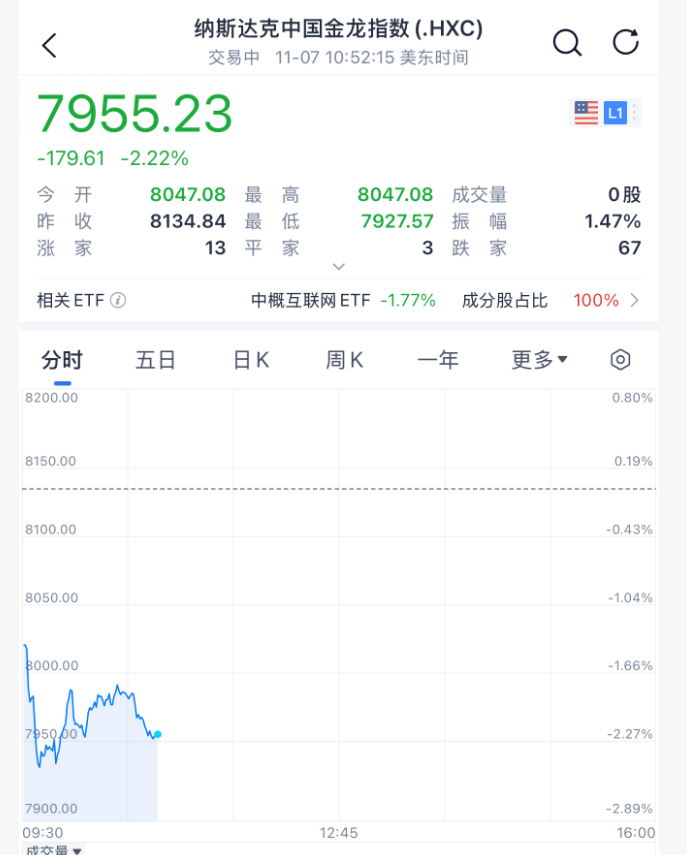
Core Viewpoint - The U.S. stock market is experiencing significant declines, particularly in technology stocks, amid growing concerns over AI valuations and a potential market bubble [2][6]. Market Performance - On November 7, major U.S. indices fell, with the Dow Jones down approximately 200 points, the Nasdaq down over 1.6%, and the S&P 500 down about 1% [2]. - The Nasdaq is heading towards its worst week since April, when a sell-off triggered by tariffs occurred [2]. - The Nasdaq China Golden Dragon Index dropped over 2% [3]. Technology Stock Declines - Popular AI technology stocks collectively fell, with notable declines including ARM down 6.06%, Applovin down 5.38%, AMD down 4.48%, and Nvidia down 3.80% [5]. - Concerns have emerged regarding whether the valuations of AI stocks have reached unsustainable levels following a strong rebound earlier in the year [5]. Economic Indicators - The consumer confidence index in the U.S. fell to its lowest level in over three years, dropping from 53.6 to 50.3 [10]. - The decline in consumer confidence is attributed to worries about the government shutdown and high inflation impacting personal financial expectations [10]. - A significant portion of respondents, 71%, expect unemployment rates to rise in the coming year, more than double the proportion from the previous year [10]. Employment Data - The ADP report indicated a modest increase of 42,000 jobs in the private sector for October, marking the first increase in three months [11]. - The ongoing government shutdown has delayed the release of key federal employment data, complicating economic assessments [11].



今夜!大跳水!
中国基金报· 2025-11-07 16:14
Core Viewpoint - The U.S. stock market is experiencing significant declines, particularly in technology stocks, amid growing concerns over AI valuations and economic outlook due to government shutdowns and high inflation [1][11]. Group 1: Market Performance - On November 7, major U.S. indices fell, with the Dow down approximately 200 points, the Nasdaq down over 1.6%, and the S&P 500 down about 1% [1]. - The Nasdaq is heading towards its worst week since the "tariff-induced sell-off" in April, with Chinese concept stocks also dropping over 2% [2]. - AI technology stocks collectively declined, reflecting investor concerns about unsustainable valuations after a strong rebound earlier in the year [4][5]. Group 2: Economic Indicators - The Michigan Consumer Sentiment Index dropped from 53.6 to 50.3, marking the lowest level since June 2022, driven by fears related to the government shutdown and high prices [11][12]. - A significant decline in the index reflecting current economic conditions fell by 6.3 points to 52.3, indicating widespread pessimism across various demographics [12]. - Concerns about rising unemployment are prevalent, with 71% of respondents expecting an increase in the unemployment rate over the next year, more than double the proportion from the previous year [13]. Group 3: Future Outlook - Analysts suggest that the current market downturn may present opportunities for investors to seek better risk-reward scenarios, potentially waiting for a healthy market correction before taking action [6]. - The upcoming Nvidia earnings report is seen as a potential catalyst for reaffirming the AI narrative, with hopes that the end of the government shutdown and possible Fed rate cuts in December could alleviate market pressures [9].

深夜美股集体下挫,小马智行、文远知行跌超9%,加密货币超24万人爆仓
2 1 Shi Ji Jing Ji Bao Dao· 2025-11-07 15:44
Market Overview - On November 7, U.S. stock indices opened lower, with the Dow Jones down 0.36%, S&P 500 down 0.85%, and Nasdaq down 1.46% [1] - Major technology stocks experienced significant declines, with Nvidia, Tesla, Oracle, and AMD dropping over 3%, while TSMC ADR fell over 2% [2] Sector Performance - The semiconductor sector faced a sharp decline, with the Philadelphia Semiconductor Index dropping 2.8%, reaching a two-week low [3] - Notable declines included Microchip Technology down over 8%, Marvell Technology down over 4%, and Advanced Micro Devices down over 2% [3] Chinese Stocks - The Nasdaq China Golden Dragon Index opened lower and saw its decline expand to 2.19%, with major Chinese stocks like Xiaopeng Motors down over 6% and Bilibili down over 3% [3] Precious Metals - Gold prices showed a slight increase, with spot gold at $3988.97 per ounce, up 0.3%, and COMEX gold at $4004.2 per ounce, up 0.33% [4] Cryptocurrency Market - The cryptocurrency market faced heavy selling, with Bitcoin dropping over 2% and Ethereum down nearly 4% [4] - Over the last 24 hours, more than 240,000 traders were liquidated, with a total liquidation amount of $772 million [4][5] Economic Indicators - The U.S. economic outlook is under pressure, with the White House economic advisor stating that the government shutdown's impact on the economy is greater than expected, potentially slowing GDP growth in Q4 [5] - The Michigan Consumer Sentiment Index for November reported a low of 50.3, the lowest since June 2022 [5] - Concerns regarding an "AI bubble" have intensified, raising worries about the overvaluation of related stocks [5]


深夜美股集体下挫,小马智行、文远知行跌超9%,加密货币超24万人爆仓
21世纪经济报道· 2025-11-07 15:43
Market Overview - The U.S. stock market opened lower on November 7, with the Dow Jones down 0.36%, S&P 500 down 0.85%, and Nasdaq down 1.46% [1] - Major technology stocks experienced significant declines, with Nvidia, Tesla, Oracle, and AMD dropping over 3%, while TSMC's ADR fell over 2% [2] Sector Performance - The semiconductor sector faced a sharp decline, with the Philadelphia Semiconductor Index dropping 2.8%, reaching a two-week low [3] - Notable declines in individual stocks included Microchip Technology down over 8%, Marvell Technology down over 4%, and Advanced Micro Devices down over 2% [3] Chinese Stocks - The Nasdaq Golden Dragon China Index opened lower and expanded its losses to 2.19%, with significant drops in popular Chinese stocks such as Xiaopeng Motors down over 6% and Bilibili down over 3% [3] Precious Metals - Gold prices showed a slight increase, with spot gold at $3988.97 per ounce, up 0.3%, and COMEX gold at $4004.2 per ounce, up 0.33% [4] Cryptocurrency Market - The cryptocurrency market faced heavy selling, with Bitcoin dropping over 2% and Ethereum down nearly 4% [4] - Over the last 24 hours, more than 240,000 traders were liquidated, with a total liquidation amount of $772 million [5] Economic Indicators - The U.S. economic advisor Hassett indicated that the government shutdown's impact on the economy is more severe than expected, potentially leading to a slowdown in Q4 GDP growth [5] - The University of Michigan's consumer confidence index for November reported a low of 50.3, the lowest since June 2022 [5] - Concerns regarding an "AI bubble" have intensified, contributing to investor anxiety over high valuations in related stocks [5]


11份料单更新!出售安世、TI、ON等芯片
芯世相· 2025-11-07 09:14
Core Viewpoint - The article discusses the challenges and opportunities in managing excess inventory of electronic components, highlighting the need for effective promotion and sales strategies to mitigate financial losses from storage and capital costs [1][10]. Group 1: Inventory Management - The company faces significant costs associated with excess inventory, including at least 5,000 in monthly storage and capital costs, leading to potential losses of 30,000 if held for six months [1]. - The company has a substantial inventory, with over 50 million electronic components valued at over 100 million, stored in a 1,600 square meter smart warehouse [9]. Group 2: Sales and Promotion Strategies - The company has served 21,000 users and offers discounts to clear inventory, with transactions completed in as little as half a day [10]. - The company encourages potential buyers to explore their inventory through a dedicated mini-program and website, aiming to improve sales of hard-to-sell items [11][12]. Group 3: Product Listings - A detailed list of available electronic components is provided, including various brands and models, with quantities ranging from hundreds to hundreds of thousands [4][5][7][8]. - The company is also actively seeking specific components, indicating a proactive approach to inventory management and customer needs [7][8].



Here's How Nvidia, AMD, and Broadcom Could Help This Super Semiconductor ETF Turn $500 Per Month Into $1 Million
The Motley Fool· 2025-11-07 09:14
Core Insights - The demand for AI hardware is expected to drive significant infrastructure spending, with estimates ranging from $3 trillion to $4 trillion by 2030 [2][14] - The iShares Semiconductor ETF focuses on companies that are poised to benefit from this AI infrastructure spending, holding a concentrated portfolio of 30 semiconductor stocks [3][4] - Nvidia, AMD, and Broadcom are the top three holdings in the ETF, collectively accounting for 25% of its value and have shown substantial returns since the AI boom began in early 2023 [4][5] Industry Trends - AI models require increasingly more computing power, with the latest models using up to 1,000 times more tokens than previous generations, leading to higher demand for data center capacity [1] - Nvidia leads the AI data center GPU market, with its latest chips offering up to 50 times the performance of earlier models, indicating strong revenue growth potential [7] - AMD has secured a significant deal with OpenAI, potentially worth $90 billion by 2030, which will enhance its position in the AI hardware market [8] ETF Performance - The iShares Semiconductor ETF has delivered a compound annual return of 11.9% since its inception, with an accelerated return of 27.2% over the past decade due to increased demand for advanced chips [11][12] - Consistent investments in the ETF could yield substantial returns, with projections showing that investing $500 monthly could grow to $1 million in under 30 years, even at a conservative return rate [12][16] - The ETF's top three holdings have achieved a median return of 529% since the start of the AI boom, significantly outperforming the S&P 500 index [4][12] Company Insights - Broadcom provides essential networking equipment that enhances data processing speeds, crucial for AI workloads [9] - Micron Technology supplies high-bandwidth memory solutions used in GPUs from Nvidia and AMD, indicating its importance in the AI hardware ecosystem [10] - Qualcomm is entering the AI data center market, expanding competition among major players like Nvidia and AMD [10]


CNBC Daily Open: It's a bad time to be a tech investor — or employee
CNBC· 2025-11-07 07:30
Group 1 - October's job losses in the U.S. were nearly twice as high as in September, marking the steepest decline for any October since 2003, with the technology sector experiencing the most significant impact, resulting in 33,281 layoffs, almost six times the previous month's total [1] - Tesla CEO Elon Musk received approval for a nearly $1 trillion pay package, contingent on meeting performance targets, including achieving an $8.5 trillion valuation for Tesla [2] - Tesla's current market capitalization stands at $1.54 trillion, while Nvidia recently reached a valuation of $5 trillion before dropping to $4.57 trillion following a decline in tech stocks, which also affected other companies like Microsoft, Broadcom, and Palantir Technologies, contributing to a 1.9% drop in the Nasdaq Composite [3] Group 2 - The volatility in the tech sector serves as a reminder of the challenges faced by tech workers and investors, contrasting sharply with Elon Musk's continued ascent in wealth and company valuation [4]

刚刚,全线重挫!美联储降息分歧加剧,美股科技股遭猛烈抛售
Sou Hu Cai Jing· 2025-11-07 02:47
Market Overview - The U.S. stock market experienced a significant downturn on November 6, with all three major indices declining sharply. The Nasdaq fell by 1.9% to close at 23053.99, with an intraday drop exceeding 2%. The S&P 500 index decreased by 1.12%, while the Dow Jones Industrial Average saw a smaller decline of 0.84. The VIX fear index surged over 8%, indicating rising market anxiety [1][2]. Technology Sector Impact - The technology sector was notably affected, with major tech stocks facing substantial losses. AMD dropped over 7%, while Nvidia, Tesla, and Qualcomm fell by more than 3%. Amazon, Meta, and Oracle saw declines exceeding 2%, and Microsoft and TSMC ADRs decreased by over 1%. Apple and Broadcom also experienced slight declines. The AI sector was particularly hard hit, with related stocks generally declining, reflecting concerns over high valuations in the tech space. Duolingo's stock plummeted over 25%, marking its largest single-day drop ever, primarily due to disappointing earnings guidance and a focus on "user growth" rather than short-term monetization. This turmoil in the AI sector was exacerbated by misinterpretations of comments made by OpenAI executives regarding support for chip investments [4]. Employment Market Concerns - The deterioration of the U.S. employment market has further dampened market sentiment. In October, U.S. companies laid off a total of 153,074 employees, driven mainly by the tech and warehousing sectors, marking an increase of 183% from September and nearly three times the number from the same month last year, reaching the highest level for October since 2022. Additionally, October saw a decrease of 9,100 in non-farm employment, contrasting with a gain of 33,000 in September, raising widespread concerns about the labor market's weakness [5][6]. Federal Reserve Divergence - Uncertainty regarding the Federal Reserve's interest rate cut outlook is a core reason for the recent stock market decline. Several officials have expressed significant divergence on the path to rate cuts. Chicago Fed President Goolsbee, who previously advocated for gradual cuts, has recently adopted a cautious stance due to missing key inflation data and a recent uptick in overall inflation. Cleveland Fed President Mester has taken a more hawkish view, emphasizing that inflation is a more pressing concern than labor market weakness and suggesting that current rates are "almost non-restrictive." New York Fed President Williams indicated that the low-rate environment persists, with neutral rates estimated around 1%. The differing views among Fed officials add considerable uncertainty to the December FOMC meeting regarding the continuation of rate cuts [7][8].