Bank of America(BAC)

Search documents
美国银行:计划将季度股息提高8%,至每股0.28美元。
news flash· 2025-07-01 20:32
Core Viewpoint - The company plans to increase its quarterly dividend by 8%, raising it to $0.28 per share [1] Group 1 - The increase in the dividend reflects the company's strong financial performance and commitment to returning value to shareholders [1]

Bank of America Comments on Stress Test Results; Plans to Increase Quarterly Dividend 8% to $0.28 Per Share
Prnewswire· 2025-07-01 20:30
Core Viewpoint - Bank of America announced plans to increase its quarterly common stock dividend to $0.28 per share starting in Q3 2025, following positive results from the Federal Reserve's 2025 Comprehensive Capital Analysis and Review (CCAR) [1][4]. Group 1: Capital Analysis and Stress Test Results - The 2025 stress test results showed an improvement in Bank of America's modeled capital depletion by 100 basis points (bps) to 170 bps, indicating stronger capital resilience [2]. - As a result of the stress test, Bank of America's preliminary stress capital buffer (SCB) would improve by 70 bps to 2.5%, with a CET1 minimum requirement of 10.0%, effective October 1, 2025 [2]. - If proposed modifications to the SCB calculation are adopted, the SCB would increase to 2.7%, raising the CET1 minimum ratio to 10.2%, effective January 1, 2026 [3]. Group 2: Financial Position - As of March 31, 2025, Bank of America reported $201 billion in regulatory CET1 capital and a CET1 ratio of 11.8%, which exceeds the current minimum requirement [3]. Group 3: Company Overview - Bank of America is a leading financial institution, serving approximately 69 million consumer and small business clients through around 3,700 retail financial centers and approximately 15,000 ATMs [7]. - The company is recognized for its digital banking services, with approximately 59 million verified digital users, and provides a full range of banking, investing, asset management, and risk management products [7]. - Bank of America operates globally, serving clients in the U.S., its territories, and over 35 countries, and is listed on the New York Stock Exchange (NYSE: BAC) [7].


金十图示:2025年07月01日(周二)美股热门股票行情一览(美股收盘)





news flash· 2025-07-01 20:10
Market Capitalization Summary - Oracle has a market capitalization of 806.88 billion, while Visa stands at 655.99 billion [2] - Procter & Gamble has a market capitalization of 378.02 billion, and ExxonMobil is at 512.70 billion [2] - Mastercard's market capitalization is 470.87 billion, and Bank of America is at 375.11 billion [2] - UnitedHealth has a market capitalization of 308.53 billion, while ASML is at 310.77 billion [2] - Coca-Cola's market capitalization is 295.75 billion, and T-Mobile US Inc is at 273.60 billion [2] Stock Performance - Oracle's stock increased by 0.46 (+0.47%), while Visa's rose by 0.47 (+0.13%) [2] - Procter & Gamble's stock saw a slight increase of 2.68 (+0.48%), while ExxonMobil's stock increased by 1.92 (+1.20%) [2] - Mastercard's stock increased by 1.46 (+1.35%), and Bank of America's stock rose by 3.15 (+2.06%) [2] - UnitedHealth's stock decreased by 11.21 (-1.40%), while ASML's stock increased by 0.93 (+1.31%) [2] - Coca-Cola's stock increased by 14.05 (+4.50%), and T-Mobile US Inc's stock rose by 3.31 (+1.39%) [2] Additional Company Insights - McDonald's has a market capitalization of 212.78 billion, while AT&T is at 207.73 billion [3] - Uber's market capitalization is 192.79 billion, and Verizon's is at 184.08 billion [3] - Caterpillar's market capitalization is 183.87 billion, while Qualcomm is at 174.99 billion [3] - BlackRock has a market capitalization of 163.25 billion, and Citigroup is at 161.13 billion [3] - Boeing's market capitalization is 158.16 billion, while Pfizer is at 142.36 billion [3] Recent Market Movements - Intel's stock increased by 0.45 (+1.99%), while Dell Technologies rose by 0.82 (+0.16%) [4] - Rio Tinto's market capitalization is 746.07 billion, and Newmont is at 654.78 billion [4] - General Motors has a market capitalization of 494.87 billion, while Target is at 472.00 billion [4] - Ford's market capitalization is 451.14 billion, and Valero Energy is at 432.26 billion [4] - Vodafone's market capitalization is 241.45 billion, while Pinterest is at 270.30 billion [5]

Stock Of The Day: Bank Of America Breaks Out
Benzinga· 2025-07-01 18:16
Group 1 - Bank of America Corporation (BAC) is experiencing a bullish trend, with shares trading higher and potentially breaking out, indicating a continued upward movement in stock price [1] - The current market conditions, with many stocks reaching all-time highs, contribute to the breakout of Bank of America shares [1] - A stock in an uptrend suggests an imbalance in the market, where demand exceeds supply, leading to increased competition among buyers and driving prices up [2] Group 2 - Resistance levels in stock trading represent price points where selling interest is strong enough to meet buying demand, often causing price rallies to pause or reverse [4] - Anxious sellers may lower their asking prices to avoid being undercut, which can create a downward price spiral if many sellers act similarly [5] - Breakouts occur when buyers overpower sellers at resistance levels, leading to a potential new uptrend as supply diminishes and demand remains strong [6]
X @Bloomberg
Bloomberg· 2025-07-01 17:45
Market Trends - Bank of America's clients reduced exposure to US equities [1] - Clients withdrew money from US equities at the fastest pace in 10 weeks [1] - The S&P 500 capped its best quarter since 2023 to end June at a record [1]
美国银行股涨势剑指2022年高点!对冲基金疯狂“抢筹”
智通财经网· 2025-07-01 11:20
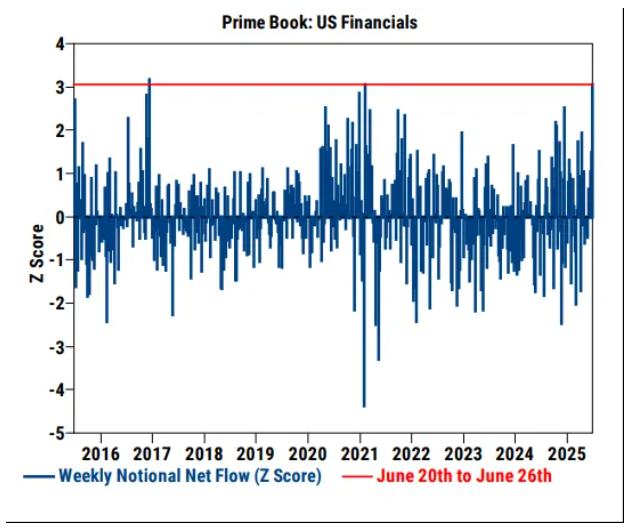
Group 1 - The core viewpoint is that U.S. bank stocks are experiencing a significant rally, with hedge funds aggressively purchasing shares, indicating Wall Street's confidence in further upward potential [1] - Goldman Sachs reported that net buying of short-term funds reached a nearly ten-year high, reflecting optimistic sentiment in the market [1] - The S&P 500 financial sector reached a historic high, driven by expectations of economic growth and interest rate cuts, alongside the Federal Reserve's announcement that all major banks passed the annual stress tests [1] Group 2 - Analysts and traders tracking financial stocks are highly enthusiastic, with UBS favoring large bank stocks as a preferred tool for participating in the current market rally [3] - Bank of America analysts believe that the Federal Reserve's stress test results will provide a significant boost to the entire industry, which investors have been anticipating since the Trump administration's pro-business policies [3] - The KBW Bank Index has rebounded over 30% from its April lows, although it remains 5.4% below its peak in 2022 [3] Group 3 - Future positive factors include potential regulatory reforms that may ease capital and leverage requirements for banks, which could enhance loan profitability and encourage more aggressive lending [4] - RBC Capital Markets anticipates new policies by the second half of 2025 that will allow banks to manage their loan portfolios more aggressively [5] - The expected shift towards a more accommodative Federal Reserve policy could stimulate economic activity and activate banks' trading businesses [5] Group 4 - Despite the positive outlook, the financial sector is projected to show zero growth in earnings this quarter after nine consecutive quarters of growth, with major banks set to report earnings soon [6] - Options traders are betting on continued stock price increases, with the call/put ratio for the Financial Select Sector SPDR Fund (XLF) hovering near a four-month high [6] - Regulatory easing and low implied volatility in the industry are fueling strong market interest in bank stock rallies [6]

Billionaire Warren Buffett Sold 39% of Berkshire's Stake in Bank of America and Is Piling Into a Historically Cheap Legal Monopoly
The Motley Fool· 2025-07-01 07:06
Group 1: Bank of America (BofA) Activity - Warren Buffett has sold over 401 million shares of Bank of America since mid-July 2024, representing a reduction of approximately 39% of his stake [8][12] - The selling activity has occurred over three consecutive quarters, indicating a persistent trend in divesting from BofA [6][8] - Factors influencing this decision may include profit-taking and concerns over declining interest income due to the Federal Reserve's rate-easing cycle [9][11] Group 2: Berkshire Hathaway's Investment Strategy - Berkshire Hathaway's investment strategy remains focused on valuation, with Buffett unwilling to pursue companies that do not offer perceived value [12] - Despite being a net seller of stocks for 10 consecutive quarters, Buffett has identified attractive investment opportunities, such as Sirius XM Holdings [15] Group 3: Sirius XM Holdings Investment - Sirius XM operates as a legal monopoly in satellite radio, providing it with unique pricing power compared to traditional and online radio competitors [17] - The company generates a significant portion of its revenue from subscriptions (77.5%), which offers more consistent cash flow during economic downturns compared to advertising-dependent models [19] - Sirius XM stock is currently valued at less than 8 times forecast earnings for 2025 and 2026, representing a 60% discount to its average trailing-12-month earnings multiple over the last five years [21]


Major Banks Pass 2025 Stress Test: Bigger Payouts in the Cards?
ZACKS· 2025-06-30 16:11
Core Insights - The annual stress test results indicate that all 22 tested banks passed, demonstrating strong capital levels under a less severe scenario compared to the previous year [1][7] - The Federal Reserve's vice chair for supervision confirmed that large banks are well-capitalized and resilient to severe economic outcomes [1] Group 1: Stress Test Overview - The Federal Reserve conducts annual stress tests to assess the largest U.S. banks' ability to withstand significant economic downturns, determining minimum capital requirements and influencing share repurchases and dividends [2] - The stress test evaluates banks' financial resilience by estimating losses, revenues, expenses, and resulting capital levels under hypothetical economic conditions, including baseline and severely adverse scenarios [3] Group 2: Details of This Year's Test - This year's severely adverse scenario included a smaller increase in the unemployment rate and a less severe decline in house prices compared to the previous year [4] - All 22 banks maintained capital levels above the required threshold in a scenario where GDP contracts by 8%, commercial real estate prices decline by 30%, house prices drop by 33%, and the unemployment rate rises to 10% [5] Group 3: Capital Ratios and Loss Projections - The minimum common equity tier 1 capital ratio required to pass the test is 4.5%, while the banks collectively had a ratio of 11.6% during the stress scenario, absorbing projected hypothetical losses exceeding $550 billion [6] - Projected losses included approximately $158 billion in credit card losses, $124 billion from commercial and industrial loans, and $52 billion from commercial real estate [6] Group 4: Regulatory Implications - With all banks passing the stress test, they are positioned to issue dividends and buy back shares, returning capital to investors [7] - The Federal Reserve proposed easing capital rules, potentially freeing up $213 billion for bank subsidiaries and enhancing profitability [7][11] Group 5: Proposed Regulatory Changes - The Fed's proposal aims to reduce capital requirements for Global Systemically Important Banks (GSIBs) by 1.4% or $13 billion, and for depository institution subsidiaries by 27% or $213 billion [11] - The proposed changes would replace current enhanced Supplementary Leverage Ratio (SLR) buffers with a new structure based on each bank's GSIB surcharge, allowing banks more flexibility in managing low-risk assets [12]



美银:The Flow -A Game of Two HalvesShow
美银· 2025-06-30 01:02
Investment Rating - The report maintains an "Overweight" position on "BIG" (Bonds, International, Gold) and suggests cyclical buying of Treasuries [19] Core Insights - The S&P 500 is on the verge of its 7th major breakout since 1990, with only 22 stocks at all-time highs, indicating a narrow market participation [3][21] - The BofA Bull & Bear Indicator has risen to 5.8, reflecting a neutral sentiment but indicating potential for profit-taking as inflows to equities and high-yield bonds approach 1.0% of AUM [13][56] - The report highlights significant inflows across various asset classes, with $427 billion to cash, $325 billion to stocks, and record inflows of $40 billion to gold in H1 2025 [12][34] Summary by Sections Market Performance - Year-to-date performance shows gold at 26.2%, stocks at 8.4%, and commodities at 0.4%, while oil and crypto have declined by 7.8% and 14.1% respectively [1][2] Economic Indicators - The report notes that the US dollar has decreased by 10.4% year-to-date, while the 12-month forward EPS expectations are 11% in the US, 8% in China, and 6% in Europe [18] Investment Flows - Weekly flows indicate $26.1 billion to cash, $12.1 billion to bonds, and $3.5 billion to equities, with a notable outflow of $4.4 billion from US small-cap stocks [11][16] Policy Outlook - The report anticipates potential Fed rate cuts and a shift in fiscal policy under Trump, which could support equity markets and lead to a US dollar bear market [19][20] Sector Analysis - The report suggests long positions in airlines and small-cap value stocks while shorting defense and momentum stocks, reflecting a tactical approach to sector allocation [17][20]
惊曝金价将破4000!美银说:别盯着打仗,政府欠债多才是主因!
Sou Hu Cai Jing· 2025-06-29 00:06
Group 1 - The core viewpoint of the article is that the future of gold is being driven by a restructuring of the global monetary system due to significant U.S. fiscal deficits, with predictions of gold prices soaring to $4,000 per ounce within a year [1] - The U.S. fiscal deficit is identified as a key driver behind the bullish outlook for gold, with projections of trillions in new deficits due to government spending plans, leading to increased issuance of U.S. Treasury bonds [1][3] - Central banks, particularly in emerging economies, are shifting their reserve strategies by selling U.S. Treasuries and increasing their gold holdings, reflecting a decline in trust in the dollar [3] Group 2 - Geopolitical tensions, such as the ongoing conflict in the Middle East, are causing short-term fluctuations in gold prices driven by investor sentiment, rather than being a long-term price driver [5] - Historical patterns show that gold prices often rise temporarily during the onset of conflicts but tend to revert to economic fundamentals as the situation stabilizes [5] - The long-term potential of gold is seen as undervalued, with current market allocations to gold at only 3.5%, indicating a lack of recognition of its value among investors [7] Group 3 - The persistent U.S. fiscal deficit is expected to lead to a series of repercussions, including increased Treasury yields to attract investors, which could further worsen the deficit and weaken the dollar, thereby benefiting gold [9] - The demand for gold as an alternative asset is anticipated to grow as central banks reduce their dollar reserves, with gold being viewed as a hedge against inflation due to potential quantitative easing measures by the Federal Reserve [10] - The article concludes that the true long-term trajectory of gold will be shaped by the restructuring of the global monetary system in response to U.S. fiscal challenges, marking the beginning of a new era for gold [11]