
Bank of America(BAC)

Search documents
Fed Votes to Advance Proposal to Ease Banks' Capital Requirements
PYMNTS.com· 2025-06-25 21:59
Core Viewpoint - The Federal Reserve has voted to advance a proposal that would ease the "enhanced supplementary leverage ratio," impacting the capital banks must hold against low-risk assets [1][2]. Group 1: Proposal Details - The Fed board voted 5-2 to advance the proposal, which will now be open for public comment for 60 days [2]. - Under the proposed reform, the capital banks must set aside will depend on their role in the global financial system, equaling half of their "GSIB surcharge" [3]. - Currently, banks are required to hold a flat percentage of capital against all assets, treating lower-risk assets similarly to high-yield ones, which penalizes banks for holding Treasuries [4]. Group 2: Background and Rationale - The current requirement was established after the 2008 financial crisis and has been increased over the years, with banks arguing it restricts their ability to trade in lower-risk assets like Treasury bonds [5]. - Fed officials supporting the change believe the current requirement discourages large banks from facilitating trading in the Treasury market [5]. - Fed Chairman Jerome Powell stated it was "prudent" to reconsider the rule, while some governors oppose the changes, citing concerns over the size of the capital requirement decrease [6]. Group 3: Industry Response - The banking industry has lobbied for reform, claiming the current rule limits their ability to extend credit and participate in the government debt market [7]. - Critics argue that recent market volatility makes it an inappropriate time to roll back capital requirements [7].



美银:今年美国利率政策或面临两种走向 关键看关税与就业
智通财经网· 2025-06-24 22:31
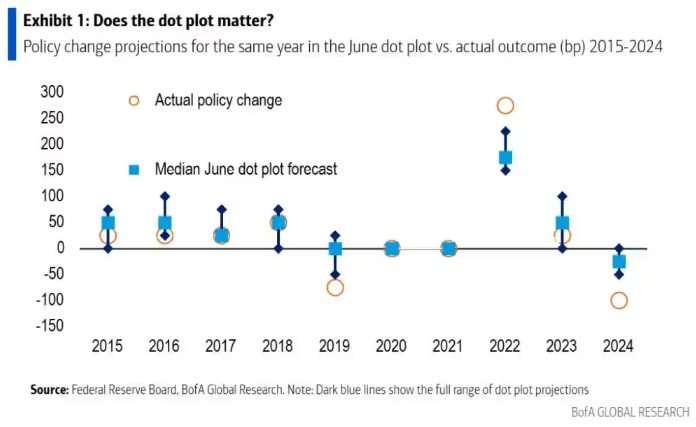
Group 1 - The core viewpoint of the articles indicates that U.S. monetary policy may face two distinct paths in 2025, heavily influenced by the tariffs reimposed by the Trump administration, which could affect the Federal Reserve's interest rate decisions [1][2] - Bank of America economists predict that if the job market remains resilient, inflationary pressures from tariffs may prevent the Fed from lowering rates throughout 2025, which is their baseline scenario [1] - Conversely, if the economy experiences a "breakdown," significant easing measures may be implemented by the Fed as early as September, with a potential rate cut of 75 basis points [1] Group 2 - There is a notable divergence between Bank of America's predictions and the Federal Reserve's internal outlook, with about half of the FOMC members expecting to maintain rates until 2025, while the other half anticipates at least two rate cuts [2] - The "dot plot" from the Fed indicates a split in expectations, with some members suggesting a rate cut as early as July, while Bank of America economists argue that the median forecast is unrealistic due to its reliance on an ideal economic environment [2] - Historical accuracy of the Fed's dot plot predictions has been poor, particularly during periods of high economic uncertainty, making future forecasts challenging [2] Group 3 - Fed Chairman Jerome Powell emphasized a cautious approach in light of the unclear impact of Trump tariffs on inflation, suggesting the Fed will remain observant [5] - Concerns have been raised by economists regarding the potential negative impact on the overall economy if the Fed delays rate cuts, with some arguing that the labor market risks should be prioritized over inflation concerns [5] - Despite signs of a softening labor market, U.S. stock markets, including the S&P 500, Nasdaq, and Dow Jones, have shown resilience, with significant gains reported [5]
Brokers Suggest Investing in Bank of America (BAC): Read This Before Placing a Bet
ZACKS· 2025-06-24 14:31
Core Viewpoint - Analyst recommendations play a significant role in influencing stock prices, but their reliability is questionable due to potential biases from brokerage firms [1][5][10]. Group 1: Bank of America (BAC) Recommendations - Bank of America has an average brokerage recommendation (ABR) of 1.26, indicating a consensus between Strong Buy and Buy, with 76% of recommendations being Strong Buy and 20% being Buy [2]. - The ABR is based on recommendations from 25 brokerage firms, with 19 Strong Buy and 5 Buy recommendations [2]. Group 2: Limitations of Brokerage Recommendations - Studies indicate that brokerage recommendations have limited success in guiding investors towards stocks with the highest price increase potential [5]. - Brokerage analysts often exhibit a strong positive bias due to vested interests, leading to a disproportionate number of Strong Buy recommendations compared to Strong Sell [6][10]. - The best use of brokerage recommendations is to validate independent research rather than solely rely on them for investment decisions [7]. Group 3: Zacks Rank as an Alternative - The Zacks Rank is a proprietary stock rating tool that classifies stocks into five groups based on earnings estimate revisions, providing a more reliable indicator of near-term price performance [8][11]. - Unlike the ABR, the Zacks Rank is updated frequently to reflect changes in earnings estimates, making it a timely indicator of future price movements [13]. - Bank of America currently holds a Zacks Rank of 3 (Hold), with an unchanged consensus estimate of $3.68 for the current year, suggesting cautious investment consideration [14][15].

美联储将推动2008年以来最猛资本松绑令 华尔街大型银行或迎重大利好
智通财经网· 2025-06-24 02:04
Core Viewpoint - The U.S. banking industry is set to experience the most significant regulatory easing since the 2008 financial crisis, with proposals to relax the Enhanced Supplementary Leverage Ratio (eSLR) requirements being reviewed by regulators [1][2] Group 1: Regulatory Changes - The Federal Reserve will review the long-awaited reform proposal on eSLR this Wednesday, followed by discussions from the FDIC on Thursday [1] - The proposed adjustment aims to lower the eSLR capital requirement from 5% to 3.5%, potentially benefiting major financial institutions like JPMorgan Chase, Bank of America, Goldman Sachs, and Morgan Stanley by significantly expanding their capital release capacity [1] - This regulatory change is intended to enhance the credit deployment capability of the banking system, injecting more liquidity into the real economy and strengthening the capacity to purchase U.S. Treasury securities [1] Group 2: Market Implications - Market analysts have noted positive signals from the policy shift, indicating that institutions with a higher proportion of traditional investment banking activities will gain greater benefits [2] - The new head of bank regulation at the Federal Reserve, Michelle Bowman, stated that the eSLR reform is just the starting point for a broader restructuring of capital regulations, which will include reassessing additional fees for globally systemically important banks and regulatory thresholds [2] - The regulatory easing is seen as a response to the tight capital constraints exposed during the market turmoil at the onset of the COVID-19 pandemic, with Bowman emphasizing the need for a return to traditional leverage ratios as a capital buffer [2] Group 3: Industry Sentiment - The timing of this regulatory change is favorable for banking executives like JPMorgan's Jamie Dimon, as the financial world anticipates whether this capital easing will mark a paradigm shift in post-crisis banking regulation [3]


每日投行/机构观点梳理(2025-06-23)
Jin Shi Shu Ju· 2025-06-24 01:58
Group 1: Oil Market Insights - Goldman Sachs indicates that if Iran disrupts the Strait of Hormuz, Brent crude oil prices could spike to $110 per barrel, with a potential increase to $90 per barrel if Iranian oil supply decreases by 1.75 million barrels per day [1] - The report from Mitsubishi UFJ highlights that the Philippine peso, South Korean won, and Thai baht are more susceptible to rising oil prices, with a $10 per barrel increase potentially reducing Asia's current account positions by 0.2% to 0.9% of GDP [3] - Panmure Liberum warns that if the Strait of Hormuz is closed, stock markets could face a decline of 10% to 20%, with significant inflationary impacts similar to those seen in 2022 [4] Group 2: Currency and Economic Outlook - HSBC analysts express concerns over the uncertainty of U.S. policies, suggesting that the dollar may face further depreciation, with the euro expected to rise to 1.20 against the dollar by Q4 [2] - The report from Saxo Bank notes that countries heavily reliant on oil imports, such as India and Thailand, will face multiple challenges including rising energy costs and currency depreciation [2] Group 3: Investment Trends - Bank of America reports a growing interest in Japanese stocks as investors seek diversification due to high valuations in U.S. equities, despite ongoing trade uncertainties between the U.S. and Japan [2] - Citic Securities highlights the transformation of traditional cross-border payment systems, suggesting potential growth for participating banks amid a reshaping of the payment landscape [5]



Bank of America (BAC) Surpasses Market Returns: Some Facts Worth Knowing
ZACKS· 2025-06-23 22:51
Company Performance - Bank of America (BAC) closed at $46.30, with a daily increase of +1.76%, outperforming the S&P 500's gain of 0.96% [1] - Over the past month, BAC shares have increased by 5.32%, while the Finance sector has seen a loss of 1.18% and the S&P 500 has gained 0.5% [1] Upcoming Earnings - The company is set to release its earnings report on July 14, 2025, with projected EPS of $0.89, reflecting a 7.23% increase year-over-year [2] - Revenue is expected to reach $26.71 billion, indicating a 5.23% increase compared to the same quarter of the previous year [2] Full Year Projections - For the full year, earnings are projected at $3.68 per share and revenue at $108.14 billion, representing increases of +12.2% and +6.13% respectively from the prior year [3] Analyst Estimates - Recent changes in analyst estimates for Bank of America suggest a favorable outlook on the company's business health and profitability [4] - The Zacks Consensus EPS estimate has increased by 0.07% over the past month, and Bank of America currently holds a Zacks Rank of 3 (Hold) [6] Valuation Metrics - Bank of America is trading at a Forward P/E ratio of 12.36, which is below the industry average Forward P/E of 14.87 [7] - The company has a PEG ratio of 1.23, aligning with the average PEG ratio for Financial - Investment Bank stocks [7] Industry Context - The Financial - Investment Bank industry is ranked 141 in the Zacks Industry Rank, placing it in the bottom 43% of over 250 industries [8] - Research indicates that the top 50% rated industries outperform the bottom half by a factor of 2 to 1 [8]
Special Olympics Celebrates One Year Countdown to 2026 Special Olympics USA Games, Announces Three-Year BofA Grant and Platinum Partnership
Prnewswire· 2025-06-23 12:02
The funding will specifically enable Special Olympics to grow and scale the delivery of their workforce readiness trainings, Athlete Leadership programming, and Unified Leadership, a training co-developed and facilitated by people with IDD that is designed to develop inclusive mindsets to facilitate a more accepting and inclusive workplace for people of all abilities. To date, the training has been offered to more than 2,000 businesses, schools, and community organizations around the world. "Bank of America ...

美国银行:投资者对日股投资兴趣上升 因美股估值过高
news flash· 2025-06-23 06:23
Core Viewpoint - Investors are increasingly interested in Japanese stocks due to high valuations in the US stock market, prompting a search for diversification [1] Group 1: Investor Sentiment - There is a noticeable rise in investor interest in Japanese equities as a response to elevated US stock valuations [1] - The need for diversification beyond US markets is a significant driver for this shift towards Japanese stocks [1] Group 2: Economic Factors - Signs of accelerated corporate reform in Japan are attracting global investors [1] - Japan's transition towards an "inflationary economy" is also a factor drawing investor attention [1] Group 3: Trade Concerns - Despite the growing interest, concerns remain regarding the trade outlook between the US and Japan [1] - The expiration of the US's suspension of "reciprocal" tariffs on several countries, including Japan, is approaching, adding uncertainty [1] - Ongoing discussions about a new trade agreement between the US and Japan are characterized by high uncertainty [1]
美银建议买入美元/日元 对冲中东紧张局势风险
news flash· 2025-06-23 06:12
Core Viewpoint - Bank of America recommends investors to buy USD/JPY to hedge against escalating geopolitical tensions in the Middle East, citing Japan's heavy reliance on oil imports from the region [1] Group 1 - The recommendation is driven by the increasing geopolitical risks associated with the Middle East [1] - Japan's significant dependence on oil imports from the Middle East makes it vulnerable to regional instability [1]
以金融创新引擎驱动文旅产业高质量发展
Zheng Quan Ri Bao· 2025-06-22 15:11
Group 1 - The article emphasizes the importance of financial innovation by banks to support the high-quality development of the cultural and tourism industry in China, driven by favorable government policies [1][3] - Banks are encouraged to actively participate in local cultural and tourism consumption promotion activities, collaborating with government departments and enterprises to offer consumer vouchers and diverse credit support [1][2] - The need for banks to tailor financial services to different age groups, such as family-oriented services for parents, educational travel financing for students, and user-friendly banking for the elderly, is highlighted [2][3] Group 2 - Banks are urged to provide financial support for cultural entertainment projects and large-scale performances, helping enterprises enhance content quality and expand their offerings [2][3] - The article discusses the role of banks in fostering new cultural consumption scenarios, including financing for immersive tourism projects and digital upgrades for cultural spaces [3] - It stresses the importance of improving the consumer environment by enhancing service levels, optimizing ticketing systems, and providing convenient financial services for inbound tourists [3]