Citi(C)

Search documents
Fed Cuts Rates, Signals Caution Ahead: 5 Bank Stocks Set to Benefit
ZACKS· 2025-12-11 18:01
Federal Reserve Interest Rate Cut - The Federal Reserve announced its third interest rate cut of 25 basis points, lowering the Fed funds rates to the 3.5%-3.75% range amid persistent inflation and a softening job market [1] - The Fed signaled one additional cut in 2026, projecting rates to be close to 3.4% by the end of that year, and a terminal rate of 3.1% in 2027 [4] Impact on Financial Services Sector - Rate-sensitive sectors, including Financial Services, were top performers in the S&P 500 Index following the rate cut [2] - Major banks saw notable stock price increases, with the KBW Nasdaq Regional Banking Index and the S&P Banks Select Industry Index both rising by 3.3% [3] Bank Performance and Projections - Citigroup's net interest income (NII) is projected to rise 5.5% year over year in 2025, with total revenues expected to exceed $84 billion [12][13] - Bank of America anticipates NII to be $15.6-$15.7 billion in Q4 2025, up 8% year over year, with a CAGR of 9.3% over the last three years [15][17] - KeyCorp expects adjusted total revenues to increase by 15% in 2025, supported by decent loan demand and fee income [19][20] - Wells Fargo aims to stabilize funding costs and grow both consumer and corporate loan assets, with NII expected to remain stable year over year [21][22] - Citizens Financial anticipates NII growth of 3-5% and non-interest income growth of 8-10% in 2025, driven by loan growth and fee income [23][24]


降息,突发大消息!黄金直拉!美股、中概股,突变!
Sou Hu Cai Jing· 2025-12-11 15:24
Economic Data - Initial jobless claims in the U.S. increased by 44,000 to 236,000, marking the largest increase since March 2020 [4] - U.S. imports in September were $342.1 billion, up from $340.4 billion, while exports were $289.3 billion, up from $280.8 billion, resulting in a trade deficit that narrowed to the lowest level since 2020 [4] Federal Reserve Outlook - Major banks including JPMorgan, Morgan Stanley, and Citigroup predict that the Federal Reserve will cut interest rates again in January [5] - The Federal Reserve recently lowered the federal funds rate target range by 25 basis points to between 3.50% and 3.75% [4] Market Reactions - The Nasdaq China Golden Dragon Index fell by 0.9%, with notable declines in stocks such as Bilibili and Alibaba [3] - Oracle's stock dropped over 15% after the company announced a $15 billion increase in its FY2026 capital expenditure forecast [2]


Lock In World Cup 2026 Travel With Points and Miles Now
UpgradedPoints.com· 2025-12-11 14:30
Core Insights - The 2026 FIFA World Cup will be the largest ever, hosted jointly by the U.S., Canada, and Mexico across 16 cities, featuring 104 matches [1][67] - Fans can start planning their trips now that the match schedule is released, with various strategies to utilize points and miles for travel [2][67] Travel Planning - Transferable points from programs like Amex Membership Rewards, Chase Ultimate Rewards, and others provide flexibility for booking flights to World Cup matches [3][4] - Utilizing international airline programs can often yield cheaper flight options within North America compared to domestic programs [5][6] - Credit card and loyalty programs can also be leveraged to purchase World Cup match tickets, with specific offers available for cardholders [7] Host Cities - The 16 host cities for the World Cup include major urban centers such as Atlanta, Boston, Dallas, Houston, Los Angeles, Miami, New York/New Jersey, Philadelphia, San Francisco Bay Area, Seattle, Toronto, Vancouver, Guadalajara, Mexico City, and Monterrey [9][65] Booking Strategies - Early booking of hotels with points is recommended to avoid price surges as the event approaches, with many hotel programs allowing free cancellations [64][68] - Major hotel programs like Marriott Bonvoy, Hilton Honors, World of Hyatt, and IHG One Rewards offer various advantages for booking during the World Cup [68][69] - Fans are encouraged to secure refundable hotel stays now, even if match tickets are not yet purchased, to alleviate stress and ensure accommodation [67][68]



Piper Sandler上调花旗集团目标价至120美元
Ge Long Hui· 2025-12-11 07:58
Piper Sandler将花旗集团的目标价从110美元上调至120美元,维持"买入"评级。(格隆汇) ...
US bank regulator says large banks engaged in 'debanking' of disfavored industries
Yahoo Finance· 2025-12-10 19:03
Core Viewpoint - The nine largest U.S. banks have been found to have policies that restrict financial services to certain controversial industries, a practice referred to as "debanking," according to a report from the Office of the Comptroller of the Currency (OCC) [1][3]. Group 1: Regulatory Review - The OCC initiated a review following an executive order from President Donald Trump aimed at investigating banks for practices that may bar customers based on political or religious beliefs [2]. - The review revealed that from 2020 to 2023, the banks had policies that either denied services to specific industries or imposed excessive scrutiny beyond actual financial risks [3]. Group 2: Accountability and Future Actions - Comptroller of the Currency Jonathan Gould criticized the banks for their debanking policies and stated that the OCC will hold them accountable to prevent unlawful debanking practices in the future [4][5]. - The OCC is currently reviewing thousands of complaints related to debanking based on political or religious beliefs and may refer cases to the Justice Department [5]. Group 3: Industry Response - The banks involved, including JPMorgan Chase, Bank of America, Citigroup, Wells Fargo, U.S. Bank, Capital One, PNC, TD Bank, and BMO Bank, either declined to comment or did not respond to inquiries regarding the report [6]. - The Bank Policy Institute, representing larger banks, expressed that banks aim to serve as many customers as possible and supports regulatory clarity [6][7]. - The industry advocates for fair access to banking and is collaborating with Congress and the administration to ensure compliance with sound risk management while serving law-abiding customers [7].

华尔街五大投行共识:油价“至暗时刻”未过,2026年或下探59美元
Zhi Tong Cai Jing· 2025-12-10 13:48
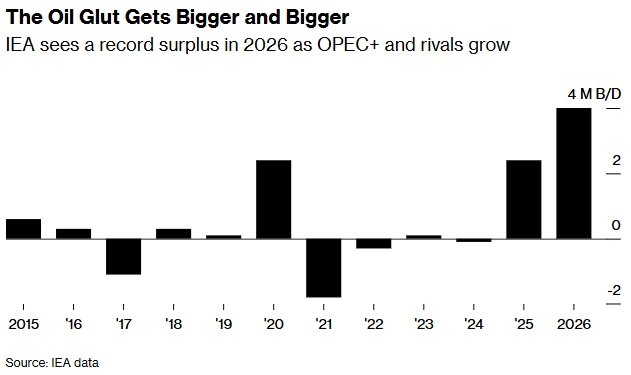
Group 1 - Oil prices have experienced their worst year since the pandemic, with Wall Street predicting that the decline is not over yet [1] - The average forecast from major banks indicates that Brent crude oil futures, currently trading around $62 per barrel, will further decline to approximately $59 by 2026, reflecting a 17% drop this year [1] - The five banks predict a surplus of about 2.2 million barrels per day in the global oil market next year due to production exceeding demand growth [1] Group 2 - Goldman Sachs holds the most pessimistic forecast among the five banks, with an annual average price of $56 per barrel, while Citigroup is the most optimistic at $62 per barrel [4] - Goldman Sachs believes that delayed oil projects during the pandemic will come online, increasing supply in the market [4] - JPMorgan expects the oil surplus to be less than the reported figures, as the OPEC+ alliance, led by Saudi Arabia, may reverse its strategy and significantly cut production by mid-next year [4][5]


花旗CFO:预计第四季度投行业务费用将同比增长20%左右
Ge Long Hui A P P· 2025-12-10 02:08
Core Viewpoint - Citigroup's CFO Mark Mason indicated a sustained growth momentum in investment banking, particularly in the mergers and acquisitions sector, with an expected year-over-year increase of approximately 20% in investment banking fees for the fourth quarter [1] Group 1: Investment Banking Performance - The investment banking business is experiencing continuous growth, especially in the M&A area [1] - Citigroup is benefiting from a recovery in capital markets, similar to its competitors [1] - There has been an increase in large transactions this year as corporate boards adapt to President Trump's tariff policies [1] Group 2: Market Activity - The capital markets are described as being largely open, with a significant amount of investment-grade transaction activity observed [1] - Despite the impact of the pandemic, stock trading volumes and IPO activity remain stable [1] - The bank anticipates a single-digit percentage decline in market revenues compared to the same period last year [1]
Forget The Fed and Buy This Dividend Stock for 2026
Yahoo Finance· 2025-12-10 00:30
Group 1: Federal Reserve Policy - The Federal Reserve is expected to cut rates by 25 basis points in December, marking its third consecutive cut, despite inflation remaining above the 2% target [1][2] - A cooling labor market and leading indicators suggest a slowdown in the U.S. economy, supporting the case for a rate cut [1] Group 2: Impact on Banking Sector - Banks are significantly affected by the Fed's policies, particularly regarding their net interest margin (NIM) and overall business performance [3] - Citigroup (C) stock is identified as a strong buy for 2026, having increased nearly 53% this year, outperforming the KBW Bank Invesco ETF (KBWB) [3] Group 3: Citigroup's Performance and Strategy - Citigroup's dividend yield stands at 2.1%, which is higher than most large-cap banking peers, despite a narrowing gap due to the stock's outperformance [4] - Citigroup has undergone a significant turnaround under CEO Jane Fraser, focusing on reducing complexity and improving efficiency by flattening its organizational structure and exiting consumer banking in several international markets [6]
Citigroup Inc. (C) Presents at Goldman Sachs 2025 U.S. Financial Services Conference Transcript
Seeking Alpha· 2025-12-09 21:57
PresentationRichard RamsdenGoldman Sachs Group, Inc., Research Division All right. If everybody could take their seats, we're going to get started with the next presentation. I am delighted to welcome Citigroup to the stage. Mark needs no introduction. He has been CFO of Citigroup since 2019 and has attended this conference every year as CFO, and we greatly appreciate your support. As many of you know, this is Mark's last time presenting as Citigroup's CFO. Mark has been a tremendous CFO at Citigroup. But ...