
Deutsche Bank AG(DB)

Search documents
德银和高盛认为:美联储降息将再次引发美元下跌
Sou Hu Cai Jing· 2025-12-12 15:45
Core Viewpoint - Wall Street banks, including Deutsche Bank and Goldman Sachs, predict that the US dollar will continue to weaken as the Federal Reserve lowers interest rates next year, with further depreciation expected by 2026 due to policy easing in the US compared to stable or tightening policies in other countries [1] Group 1 - Strategists anticipate that the interest rate differential will encourage investors to shift funds to higher-yielding non-US markets [1] - Bloomberg consensus estimates indicate that the index measuring the value of the dollar is expected to decline by approximately 3% by the end of 2026 [1] - Institutions like Morgan Stanley believe there is still room for the market to price in larger rate cuts, which could lead to further dollar weakness [1]

华尔街齐唱空:高盛、德银押注美联储降息,2026年美元跌势难挡
Sou Hu Cai Jing· 2025-12-12 11:44
德意志银行、高盛集团等华尔街投行预测,随着美联储在明年延续降息路径,美元或将继续走低。多家机构分析指出,美国与其他主要经济体货 币政策的分化,预计将为美元带来持续的贬值压力。 据彭博报道,德银全球外汇研究主管George Saravelos和Tim Baker在最新展望报告中表示,美元当前被高估,预计明年将对主要货币走弱。高盛分 析师Kamakshya Trivedi团队也指出,市场正将非美经济体更为乐观的增长前景,逐步反映在相关货币的汇率定价中。当全球其他主要经济体增长 动能增强时,美元往往呈现相对贬值态势。 美元指数在今年上半年经历显著回调后,过去六个月逐步企稳盘整。展望2026年,超过六家大型投银的预测专家普遍认为,美元将对日元、欧元 及英镑等主要货币延续弱势。彭博社汇总的共识预测显示,到2026年底,美元指数将下跌约3%。 据,欧洲央行近期表态进一步强化了这一趋势。多位官员强调,其货币政策不会简单跟随美联储。法国央行行长维勒鲁瓦·德加豪明确指出,"欧 洲的货币政策立场已较美国更为宽松",暗示欧央行更可能维持现有利率水平。欧洲央行执行委员会委员伊莎贝尔·施纳贝尔指出,欧洲央行的下 一步行动存在加息可能性 ...

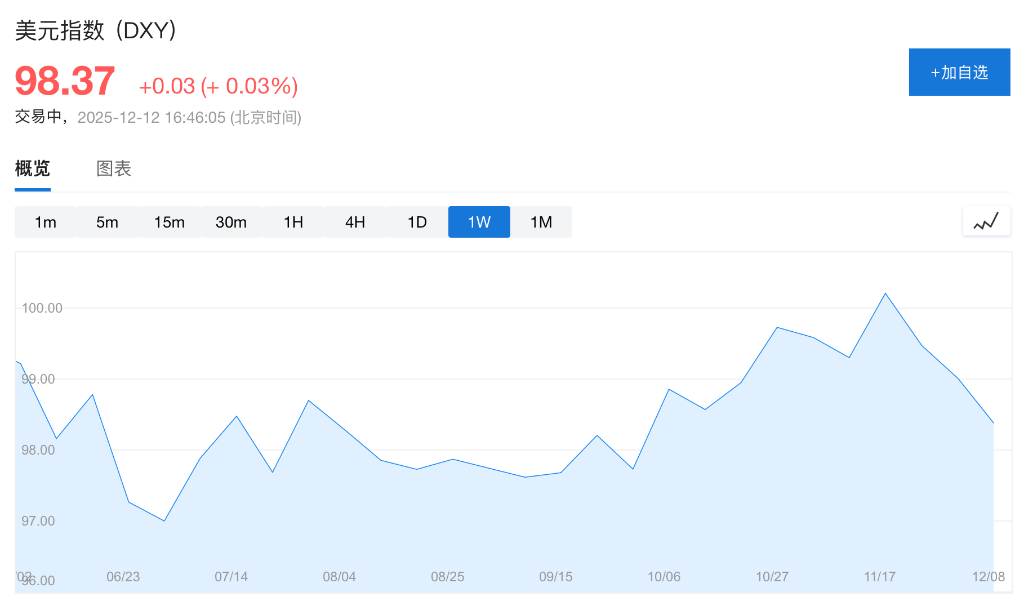
德意志银行、高盛认为美联储降息将重启美元跌势
Xin Lang Cai Jing· 2025-12-12 10:31
Core Viewpoint - Major Wall Street investment banks, including Deutsche Bank and Goldman Sachs, predict that the US dollar will resume its downward trend next year as the Federal Reserve continues to lower interest rates [1][5]. Group 1: Dollar Weakness Predictions - The dollar experienced its largest decline since the early 1970s in the first half of this year due to market turmoil caused by President Trump's trade war, but has stabilized over the past six months [1]. - Strategists expect the dollar to weaken again by 2026, driven by the Fed's continued implementation of loose monetary policy while other major central banks maintain or gradually increase interest rates [1][6]. - A consensus forecast compiled by Bloomberg predicts that a widely tracked dollar index will depreciate by approximately 3% by the end of 2026 [1]. Group 2: Economic Implications - The anticipated decline in the dollar is expected to have a chain reaction on the overall economy, leading to increased import costs, higher value of overseas profits for companies, and a boost in exports [6]. - The weakening dollar may be welcomed by the Trump administration, which has consistently complained about the US trade deficit [6]. Group 3: Emerging Markets and Currency Trends - The flow of funds into emerging markets for higher yields has led to the largest returns from carry trades since 2009, with JPMorgan and Bank of America optimistic about further appreciation of emerging market currencies [7]. - Analysts from Goldman Sachs noted that as economic data from multiple countries improves, market expectations for currencies like the Canadian dollar and Australian dollar are being revised upward [7]. Group 4: Diverging Economic Outlooks - Some contrarian investors believe the dollar may appreciate against certain major currencies, citing the strong performance of the US economy, particularly driven by the AI boom [7]. - Citigroup and Standard Chartered analysts suggest that the growth in the US economy will attract significant investment inflows, potentially boosting the dollar's value [7]. Group 5: Federal Reserve's Policy Impact - The Federal Reserve has raised its economic growth forecast for 2026, indicating a potentially better-than-expected economic outlook, despite announcing a 25 basis point rate cut and plans for another cut next year [8]. - Fed Chair Jerome Powell alleviated market concerns about a shift towards tightening monetary policy, emphasizing the focus on the weak labor market and inflation above target levels [8].
X @Bloomberg
Bloomberg· 2025-12-11 16:34
Deutsche Bank has the largest exposure among European lenders to non-bank financial institutions, according to research from UBS https://t.co/ogNu3IWs3G ...
Deutsche Bank Decreases Prime Lending Rate to 6.75%
Businesswire· 2025-12-10 23:18
Group 1 - Deutsche Bank has announced a decrease in its prime lending rate from 7.00% to 6.75%, effective December 11, 2025 [1] - Deutsche Bank is recognized as Germany's leading bank, providing a wide range of financial services including commercial and investment banking, retail banking, transaction banking, and asset and wealth management [2] Group 2 - The bank has a strong position in Europe and a significant presence in the Americas and Asia Pacific [2]

European banks now in 'significant excess capital territory' - Deutsche Bank
Youtube· 2025-12-10 10:02
Core Insights - The banking sector has experienced a strong decade driven by profitability uplift post-COVID, sustainable profitability at a 14% return on tangible equity, and ongoing earnings revisions [1][2][3] - Loan growth has shown consistent improvement over the past 18 months, with expectations of continued growth aiding valuations into 2026 [4] - The sector is currently valued slightly above the long-term average, with expectations for progress towards double-digit valuations due to ongoing earnings growth [6] Profitability and Rerating - Profitability in the banking sector has increased significantly, leading to a rerating that began in 2024 and has intensified in the current year [2][3] - The expectation of ongoing earnings revisions supports a bullish outlook for the sector [3] Growth Trends - Loan growth is highlighted as a key comeback story, with a current growth rate of 3% expected to positively impact valuations [4] - The sector is perceived as having previously low growth, but recent trends indicate a shift towards more robust growth opportunities [3] Valuation and Market Position - Current valuations are at 9.5 times, slightly above the long-term average, with historical peaks around 12.5 times [6] - Continued earnings growth and upgrades are anticipated to drive valuations higher [6] M&A Activity - European banks are well-capitalized, presenting opportunities for management teams to consider various growth strategies, including M&A [7][8] - There is a growing confidence among management teams regarding M&A, with investor support increasing for deals that are typically earnings accretive [8]


Volkswagen to decide on 160 bln euro investment budget, Handelsblatt reports
Reuters· 2025-12-10 10:02
Core Insights - Volkswagen's supervisory board is scheduled to make a decision on the allocation of a five-year investment budget amounting to approximately 160 billion euros ($186 billion) [1] Investment Allocation - The investment budget is aimed at enhancing Volkswagen's competitiveness and innovation in the automotive industry [1] - The decision will likely focus on areas such as electric vehicle development, digitalization, and sustainability initiatives [1]

美股异动丨德意志银行盘前涨超2%,获标普上调评级展望至“正面”
Ge Long Hui· 2025-12-09 09:21
德意志银行(DB.US)盘前涨超2%,报37.41美元。消息面上,标普全球评级将德意志银行的评级展望 从"稳定"上调至"正面",同时确认A/A-1长期和短期发行人信用评级。标普指,德意志银行稳健的盈利 势头和不断增强的业务实力是此次展望调整的关键因素。标普认为,该银行修订后的战略议程有利于其 信誉,重点是利用多元化的业务模式,同时避免大规模并购活动。(格隆汇) ...
DWS Group Americas' David Bianco: Markets expect the Fed to cut rates this week
Youtube· 2025-12-08 17:06
Let's bring in David Biano, DWS Group, America's CIO. David, good to see you. >> Morning, Mike.>> Uh market seems to have been expressing a lot of confidence that we'll get the Fed rate cut. It's also going to be kind of an insurance cut. The overall economy may be looking to pick up early next year.Uh we're kind of priced for that. How you see things. >> Beware what you wish for during the holiday season because we expect markets to expect the Fed to cut this week.They certainly have not pushed back agains ...

德银下调PayPal目标价至65美元

Ge Long Hui· 2025-12-08 08:54
Group 1 - Deutsche Bank has lowered PayPal's target price from $75 to $65 while maintaining a "hold" rating [1]