
Deutsche Bank AG(DB)

Search documents
德意志银行(DB.US)因违反监管规定遭香港证监会谴责及罚款2380万港元
智通财经网· 2025-08-28 09:21
Core Points - The Hong Kong Securities and Futures Commission (SFC) has reprimanded Deutsche Bank Aktiengesellschaft (DB) and imposed a fine of HKD 23.8 million due to multiple regulatory violations, including overcharging management fees, misallocating product risk ratings, and failing to disclose investment banking relationships in research reports [1][6] Group 1: Overcharging Fees - From November 2015 to November 2023, DB overcharged management fees due to process flaws and execution errors, affecting 39 discretionary investment portfolio management accounts [2] - DB incorrectly valued 392 floating-rate debt instruments using a "fixed" rate, leading to overcharges for 92 clients based on inaccurate portfolio valuations [2] - Due to negligence from external vendors and lack of proper monitoring, DB overestimated or underestimated the value of 16 private equity funds and three real estate funds, resulting in overcharges for 32 clients [2][3] Group 2: Disclosure Failures - Between September 2014 and September 2021, DB failed to disclose its investment banking relationships in 261 individual company reports and 1,590 industry reports due to shortcomings in its research disclosure system [4] Group 3: Misallocation of Risk Ratings - From August 2012 to December 2020, DB assigned lower product risk ratings to 40 exchange-traded funds (ETFs), impacting 93 clients and 265 transactions, with ten transactions identified as having risk mismatches [5] - The SFC concluded that DB did not act with appropriate skill, care, and diligence to protect clients' best interests and ensure market integrity [5]

香港证监会:Deutsche Bank Aktiengesellschaft因违反监管规定遭谴责及罚款2380万港元
Di Yi Cai Jing· 2025-08-28 09:09
Core Viewpoint - The Hong Kong Securities and Futures Commission has reprimanded Deutsche Bank Aktiengesellschaft and imposed a fine of HKD 23.8 million due to multiple regulatory violations, including overcharging management fees, misallocating product risk ratings, and failing to disclose investment banking relationships in several research reports [1] Regulatory Violations - Deutsche Bank was found to have violated several regulatory requirements, which led to the imposition of the fine [1] - Specific violations included overcharging clients on management fees and incorrectly assigning risk ratings to products [1] - The bank also failed to disclose its investment banking relationships in various research reports, which is a significant compliance issue [1]
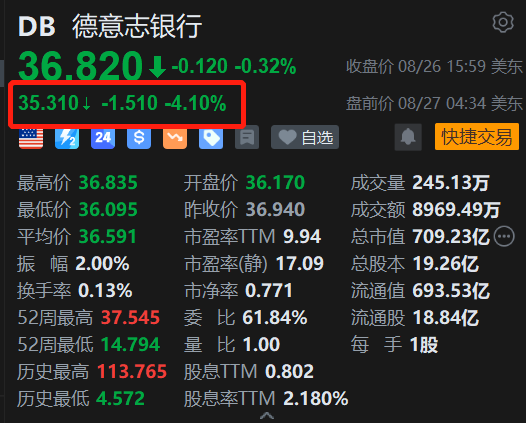
美股异动丨德意志银行盘前跌超4% 高盛下调其评级
Ge Long Hui· 2025-08-27 08:57
Group 1 - Deutsche Bank (DB.US) shares fell over 4% in pre-market trading after reaching a new high yesterday [1] - Goldman Sachs downgraded Deutsche Bank's rating from "Buy" to "Neutral" due to its stock performance being better than the market year-to-date [1] - Goldman Sachs also downgraded Commerzbank's rating from "Neutral" to "Sell" [1] Group 2 - As of August 26, Deutsche Bank's closing price was $36.820, with a pre-market price of $35.310, reflecting a 4.10% decrease [2] - The stock's highest price was $36.835, and the lowest was $36.095, with a trading volume of 2.4513 million shares [2] - Deutsche Bank's total market capitalization is approximately $70.923 billion, with a price-to-earnings ratio of 17.09 and a price-to-book ratio of 0.771 [2]

X @Bloomberg
Bloomberg· 2025-08-27 08:32
Shares in Deutsche Bank and Commerzbank dropped after they were downgraded by Goldman analysts https://t.co/ydD1cty4ZM ...
高盛:德银(DB.US)今年迄今已跑赢大盘 下调评级至“中性”
Zhi Tong Cai Jing· 2025-08-27 02:21
Core Viewpoint - Goldman Sachs downgraded Deutsche Bank's rating from "Buy" to "Neutral" and Deutsche Commercial Bank's rating from "Neutral" to "Sell" due to their stock performance exceeding the market since the beginning of the year [1] Group 1: Market Performance - The European banking sector has risen nearly 50% year-to-date, significantly outperforming the overall European stock market [1] - Factors contributing to this growth include strong growth momentum, a more stable and steeper interest rate trajectory, and ongoing performance growth and rating upgrades [1] Group 2: Analyst Outlook - Goldman Sachs maintains an optimistic outlook for European banks, projecting an average potential stock price increase of about 10% over the next 12 months, with some stocks rated "Buy" expected to rise by approximately 20% [1] - Stocks rated "Buy" include UBS Group, ING Group, Lloyds Banking Group, BNP Paribas, National Westminster Group, Santander Bank, and HSBC [1] Group 3: Interest Rate Environment - The interest rate curve has steepened this year, with expectations for final rates trending towards a range-bound movement, enhancing investor confidence in the medium-term outlook for net interest income [1]




别被美股夏季涨势迷惑!德银预警:关税与移民政策冲击远未结束
智通财经网· 2025-08-26 14:19
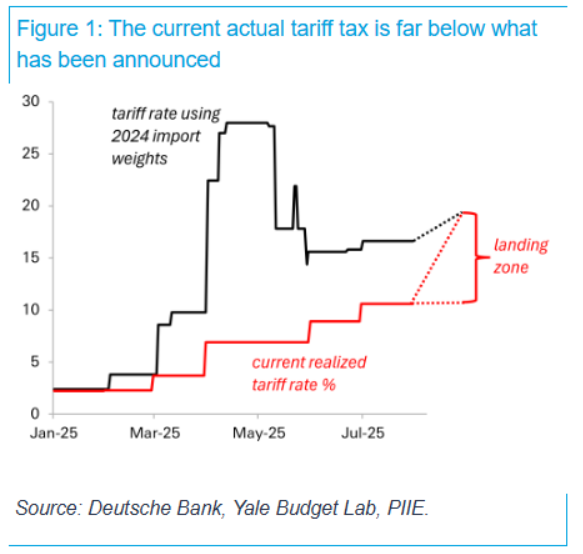
Group 1 - The US stock market showed strong performance this summer, with the S&P 500 index rising nearly 9% from the spring low [1] - Deutsche Bank warns that the impacts of tariffs and immigration policies will continue to affect the labor market and economy [1][3] - Current tariff revenue is approximately 10% of the value of imported goods, but actual rates may stabilize between 15%-20% depending on final tariffs on chips and automobiles [1][3] Group 2 - The low current tariff revenue is attributed to transshipment trade effects and the advance declaration of duty-free imports of pharmaceuticals and electronics [3] - An increase in actual tariff rates by 15% on a $3 trillion import scale could generate an additional $450 billion in tax revenue, tightening fiscal policy by 1.5% of GDP [3] - The shortage of immigrant labor is expected to significantly impact non-farm employment growth, with current growth rates indicating potential economic recession [3][5] Group 3 - The termination of several Biden-era work visa programs will further strain the labor market, affecting over 700,000 individuals from specific programs [5]
德意志银行:英国零售股下半年处境艰难
Ge Long Hui A P P· 2025-08-26 07:57
Core Viewpoint - UK retail stocks are expected to face a more challenging environment in the second half of the year due to weakening fundamental drivers such as wage growth and consumer spending [1] Group 1: Economic Indicators - Wage growth is anticipated to slow down despite a strong increase expected at the end of 2024 and early 2025 [1] - Concerns regarding unemployment and job security are rising among consumers [1] Group 2: Consumer Sentiment - Consumer confidence surveys remain low, indicating a potential worsening of the situation [1]
日本经济展望:关税、货币政策、政治格局(1)
2025-08-25 02:03
Summary of Deutsche Bank Group Research on Japan Economic Perspectives Industry/Company Involved - **Industry**: Japanese Economy - **Company**: Deutsche Bank Group Key Points and Arguments Economic Growth Forecasts - The growth forecast for fiscal 2025 has been revised upward from 0.6% to 1.0% based on 2Q 2025 GDP figures, which showed a real GDP growth rate of 1.0% saar, exceeding market consensus of 0.3% [4][5] - The forecast for fiscal 2026 has been revised downward from 1.1% to 0.9% [4][5] - Growth forecasts continue to exceed consensus estimates [5] Tariff Negotiations and Economic Impact - Reciprocal tariffs with the US will be raised to 15%, while tariffs on automobiles will be lowered [4][9] - The impact of the US tariff increase on the real economy has been limited so far, with no significant change in export volumes to the US [10] - The expected impact on growth rates due to tariff changes is -0.1% for fiscal 2025 and 2026 [9] Inflation and Consumption Trends - Despite high inflation, real private consumption is on a moderate upward trend, primarily due to increases in real employee compensation [15] - Real employee compensation remains below pre-pandemic levels, with a significant negative real wage gap of about -4% in 2Q 2025 [15][23] - Inflation is expected to decelerate moderately but is unlikely to fall significantly below 2% [23] Monetary Policy Outlook - No significant changes in the Bank of Japan's (BoJ) stance on interest rate hikes are expected unless Takaichi becomes prime minister [4][46] - An interest rate hike is anticipated in October, influenced by the political calendar and economic measures [46][47] Political Landscape and Future Cooperation - The political situation will be influenced by the outcome of the Liberal Democratic Party (LDP) presidential election, with potential cooperation with opposition parties depending on the outcome [38][42] - If Prime Minister Ishiba remains in office, cooperation with the Japan Innovation Party (Ishin) or the Constitutional Democratic Party (CDP) is likely [38][42] Fiscal Policy Uncertainty - High uncertainty exists regarding future economic measures, with a placeholder assumption of a supplementary budget of about 15 trillion yen [34] - Further increases in defense spending sought by the US government are not reflected in the current economic outlook [34] Employment and Wage Dynamics - The number of employees has increased at an annual rate of about 0.7-0.8%, contributing to the rise in real employee compensation [15] - Nominal wage increases of at least 3% are deemed necessary to address the negative real wage gap [15] Long-term Economic Policy Trends - The long-term trend in economic policy is shifting from monetary policy to fiscal policy, focusing more on household-oriented policies rather than corporate-oriented ones [45][42] Other Important Content - The presence of a Liberal Democratic Party presidential election will significantly influence future political cooperation and economic policy direction [38][42] - The economic measures and their scale will be critical in shaping the economic outlook, with potential implications for fiscal policy and public sentiment regarding inflation and consumption [34][23]
日本经济展望:关税、货币政策、政治格局
2025-08-25 01:38
Summary of Deutsche Bank Group Research on Japan Economic Perspectives Industry/Company Involved - **Industry**: Japanese Economy - **Company**: Deutsche Bank Group Key Points and Arguments Economic Growth Forecasts - The growth forecast for fiscal 2025 has been revised upward from 0.6% to 1.0% due to improved GDP figures for 2Q 2025, which recorded a real GDP growth rate of 1.0% saar, surpassing the market consensus of 0.3% [4][5] - The forecast for fiscal 2026 has been revised downward from 1.1% to 0.9% [4][5] - Growth forecasts continue to exceed consensus estimates [5] Tariff Negotiations and Economic Impact - Reciprocal tariffs with the US will be raised to 15%, while tariffs on automobiles will be lowered [4][9] - The impact of the US tariff increase on the real economy has been limited so far, with no significant change in export volumes to the US despite a 25% tariff on automobiles [10] - The expected impact on growth rates from the tariff changes is a reduction of -0.1% for fiscal 2025 and 2026 [9] Inflation and Consumption Trends - Despite high inflation exceeding 3%, real private consumption is on a moderate upward trend, primarily due to increases in real employee compensation [15] - Real employee compensation remains below pre-pandemic levels, with a significant negative real wage gap of about -4% in 2Q 2025 [15][23] - Inflation is expected to decelerate moderately but is unlikely to fall significantly below 2% [23] Political Landscape and Monetary Policy - The political situation, particularly regarding the Liberal Democratic Party (LDP) presidential election, will influence future economic measures and monetary policy [34][38] - An interest rate hike by the Bank of Japan (BoJ) is expected in October, contingent on the political landscape [46][47] - The BoJ's stance on interest rate hikes is not expected to change significantly unless Takaichi becomes prime minister [46] Fiscal Policy Uncertainty - There is high uncertainty regarding future economic measures, with assumptions of a supplementary budget similar to last year (approximately 15 trillion yen) [34] - The potential for increased defense spending sought by the US government is not reflected in the current economic outlook [34] Employment and Wage Dynamics - The number of employees has increased at an annual rate of about 0.7-0.8%, contributing to the rise in real employee compensation [15] - The recovery in real employee compensation in Japan is notably weaker compared to other major countries [15][24] Long-term Economic Policy Trends - Regardless of political outcomes, long-term trends in economic policy are expected to continue, focusing on a shift from monetary policy to fiscal policy and from corporate-oriented to household-oriented policies [42][45] Other Important Content - The presence or absence of a change in the LDP president will affect cooperation with opposition parties, which is essential given the lack of a majority in both houses [42] - The upcoming political events and economic data releases are likely to influence the BoJ's policy stance [48]
德银经济学家预计鲍威尔将修正美联储框架 呼吁恢复预防性政策优先地位
Xin Hua Cai Jing· 2025-08-22 06:27
Core Viewpoint - Deutsche Bank's Chief Economist Matthew Luzetti indicates that the new monetary policy framework adopted in 2020 is not the primary cause of the Federal Reserve's delayed response and inflation overshoot, but it has objectively contributed to these outcomes [1] Group 1 - Luzetti expects Fed Chair Jerome Powell to emphasize the revision of the Fed's long-term goal statement to align more closely with reality during his key speech on Friday [1] - Potential revisions may include the removal of the 2020 reform content and the re-establishment of the priority for preventive policies [1] - The upcoming speech coincides with a policy turning point, and Luzetti anticipates Powell will also adjust his statements regarding the labor market [1]