Alphabet(GOOG)

Search documents
软件股遭遇2010年来最大做空潮,高盛惊呼:市场“无处可藏”!
Hua Er Jie Jian Wen· 2026-02-13 06:51
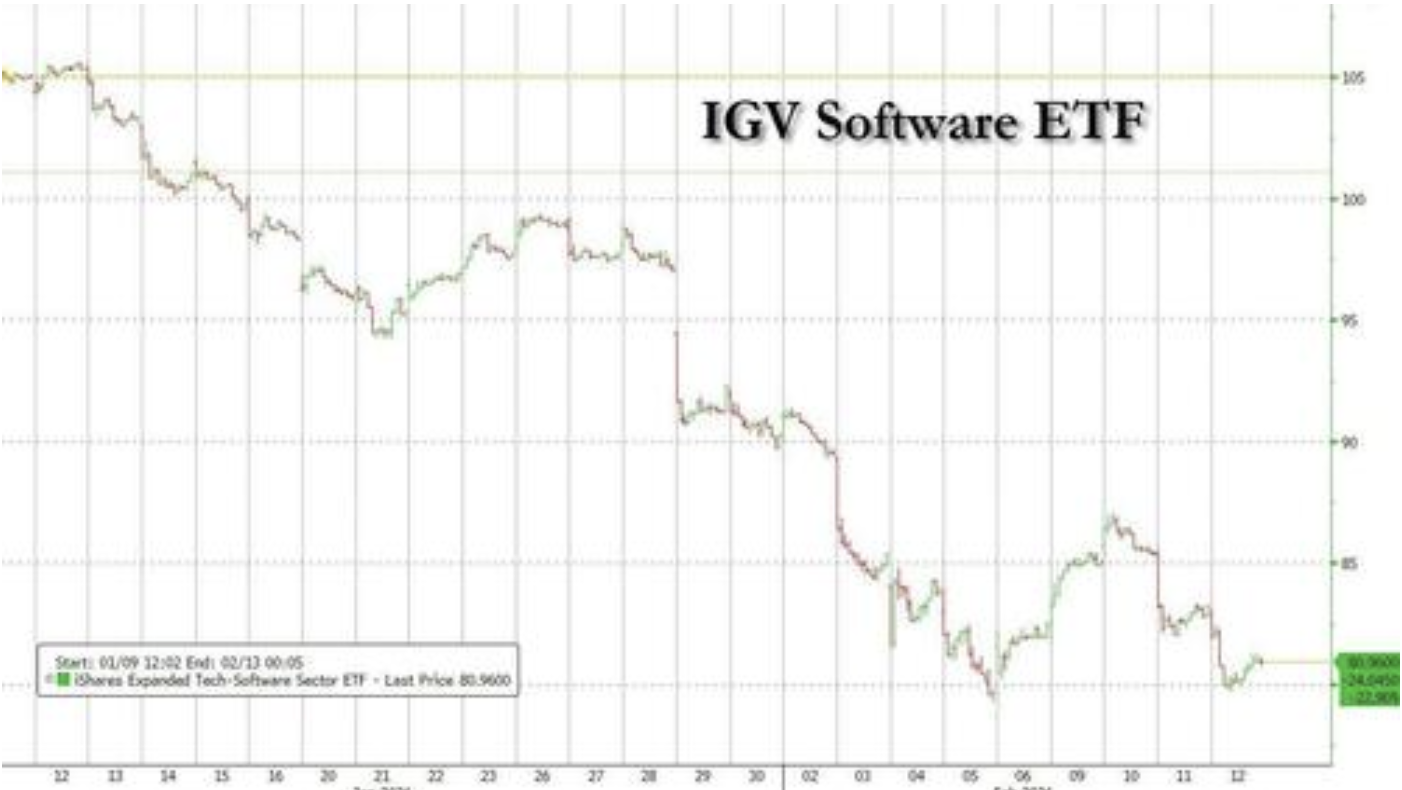
Group 1 - The software sector is experiencing the most intense short-selling attack in over a decade, with Morgan Stanley reporting that the short-selling volume in the software and SaaS sectors reached one of the highest levels since 2010 [1][7] - Hedge funds have quickly resumed short-selling strategies after a brief period of covering, with new short positions in the software sector exceeding levels seen at the end of January [2][7] - Concerns about AI replacing human jobs are spreading across more sub-industries, significantly impacting market sentiment, as evidenced by a notable drop in the stock price of CH Robinson [4][8] Group 2 - Defensive sectors are outperforming cyclical stocks, with Goldman Sachs noting the worst two-day performance for cyclical stocks since the "Liberation Day," with a cumulative drop of over 350 basis points [6][8] - The 10-year U.S. Treasury yield has fallen to around a three-month low of 4.08%, indicating increased market risk aversion, while the VIX index closed above 20 [6][8] - The market is becoming increasingly sensitive to the potential disruptive impacts of AI, with major tech companies experiencing valuation declines [9] Group 3 - Goldman Sachs described the current trading environment as one of the most volatile seen, with many tech and growth stocks appearing oversold as the Russell Tech Index falls to its 200-day moving average [6][10] - There is a discussion on whether the valuation adjustments in the market have been excessive, with some companies not returning to pre-earnings release levels despite the rapid pricing in of perceived technological changes [10] - The large tech stocks, referred to as "Mag 7," have underperformed the market by approximately 7.5 percentage points over the past few months, indicating a significant pullback [11]





姚顺宇谷歌首秀,Gemini新模型刷爆SOTA:人类仅剩7人捍卫碳基编程
量子位· 2026-02-13 05:42
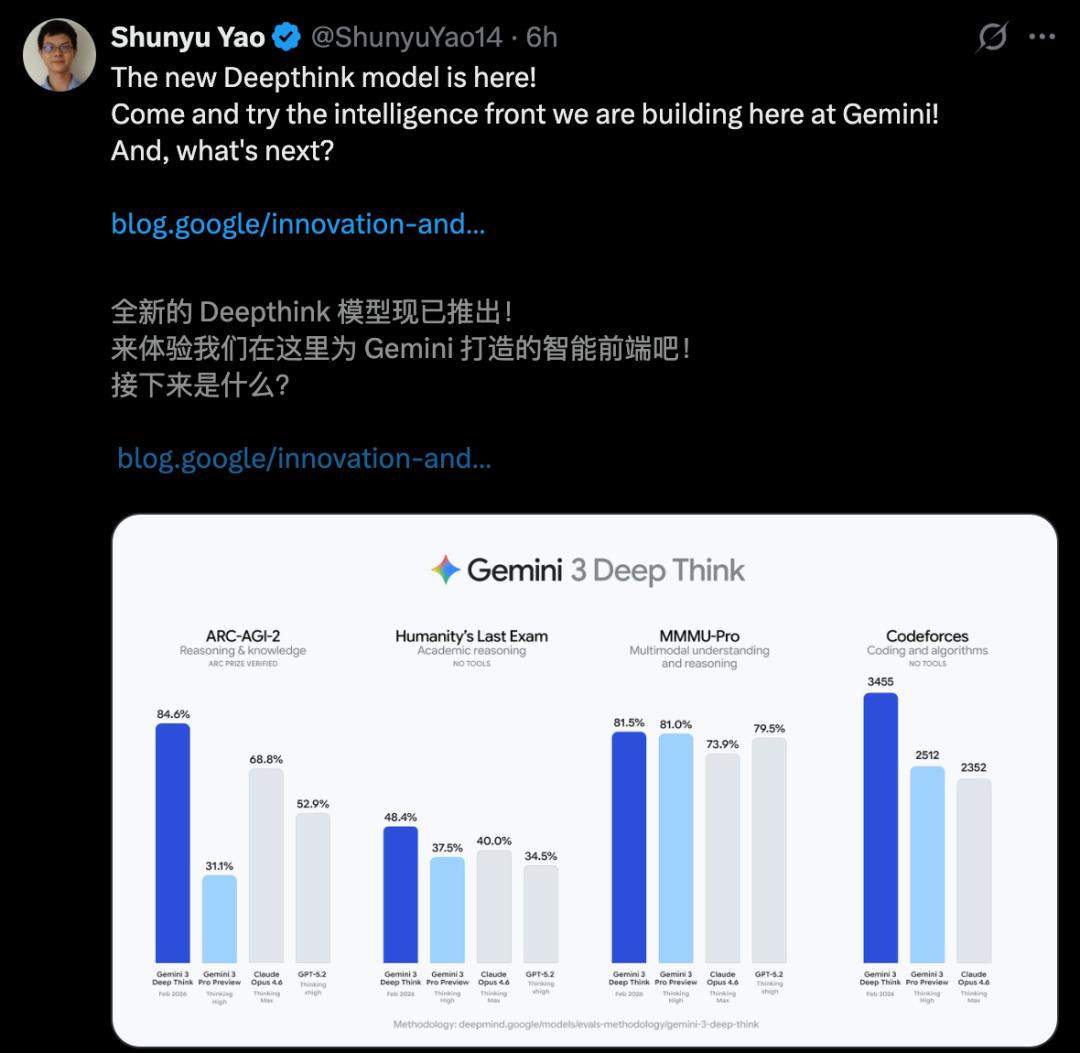
Core Insights - Google has significantly upgraded its AI model, Gemini 3 Deep Think, in response to competition from Claude Opus 4.6 and GPT Codex 5.3 [1] Performance Metrics - Gemini 3 Deep Think achieved an unprecedented score of 84.6% on the ARC-AGI-2 benchmark, surpassing previous models that scored between 60%-70% [3][26] - In the Humanity's Last Exam (HLE), it scored 48.4%, setting a new state-of-the-art (SOTA) [4][22] - The model also scored 3455 Elo points on Codeforces, ranking it as the 8th in the world [2] - In the International Math Olympiad 2025, it reached gold medal level with a score of 81.5% [5][33] Cost Efficiency - The upgrade has reduced the reasoning cost by 82%, from $77.16 to $13.62 per task [29] Applications and Capabilities - Gemini 3 Deep Think can analyze sketches, model complex shapes, and generate files for 3D printing [8] - It successfully identified a subtle logical flaw in a complex mathematical paper that was missed during human peer review [10][11] - The model optimized a method for growing complex crystals, achieving a thickness greater than 100 microns, which was previously difficult [14] Research and Development Team - The development team includes notable Chinese scientists, such as Yi Tay and Shunyu Yao, who have significant backgrounds in AI and physics [36][41] - Yi Tay has previously worked on early large language models and returned to Google DeepMind after a stint in a startup [38] - Shunyu Yao has a strong academic background, having published in top journals and worked on advanced topics in quantum physics [41][42]
谷歌DeepMind CEO:今年开启AI抗癌药物临床试验,未来18个月迎来机器人突破
Hua Er Jie Jian Wen· 2026-02-13 05:38
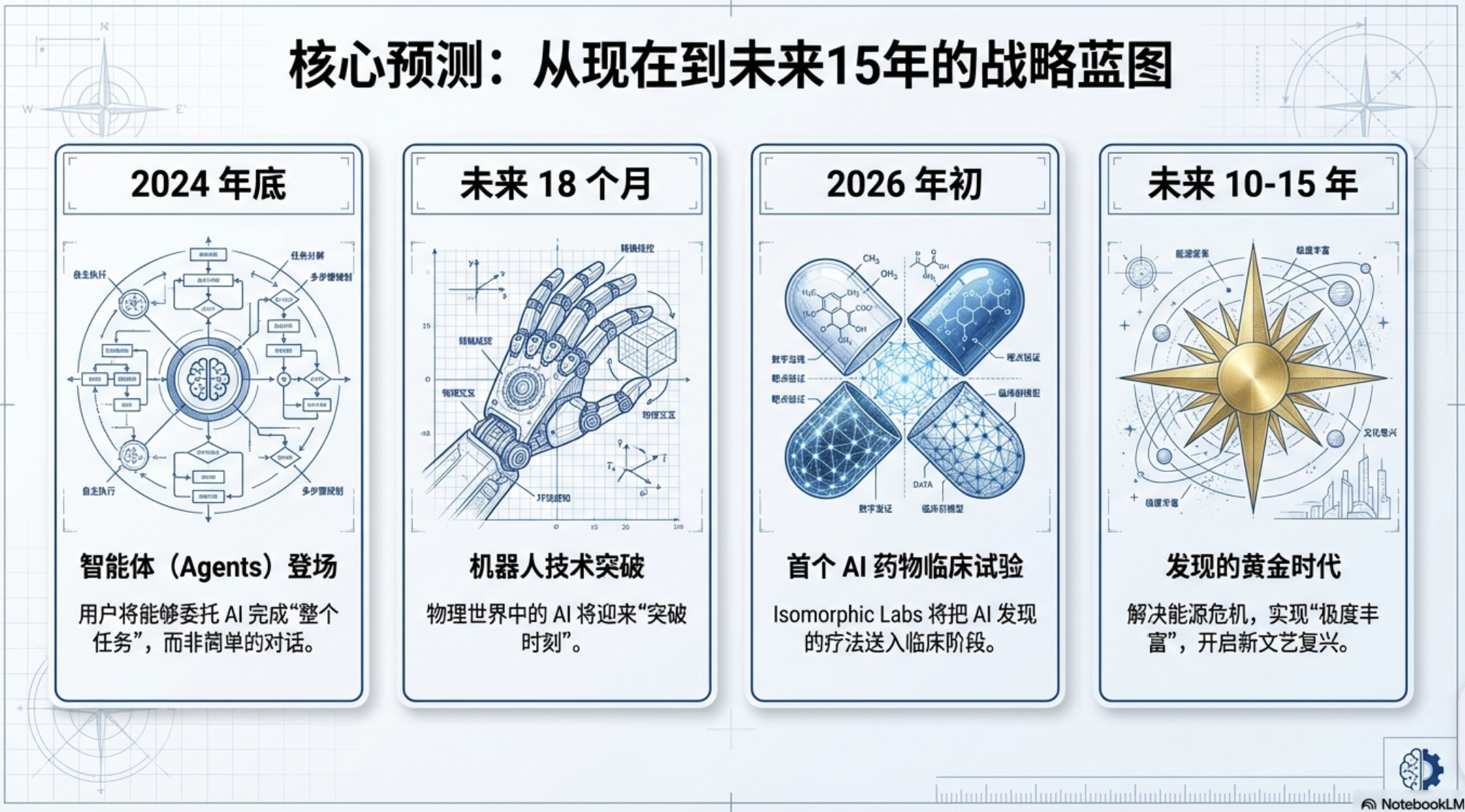
Core Insights - Google DeepMind's CEO Demis Hassabis envisions a transformative future for AI, predicting that AI-designed drugs will enter clinical trials by 2026 and heralding a "golden age of discovery" in the next 10 to 15 years [2][4][58] Group 1: AI in Pharmaceuticals - Hassabis aims to leverage AI through his startup Isomorphic Labs to revolutionize drug development, targeting the initiation of clinical trials for the first AI-designed drug by early 2026 [4][30] - The company is currently working on 17 drug projects across various fields, including cancer and cardiovascular diseases, with plans to expand to hundreds of projects [4][28] - Traditional drug development is costly and time-consuming, averaging 10 years and billions of dollars with a success rate of only 10%, while AI could enhance efficiency by "hundreds of thousands of times" [4][28] Group 2: AI Model Developments - Hassabis confirmed that Google’s Gemini 3 has reached a "watershed moment," indicating significant advancements in its capabilities [5] - Google is restructuring its infrastructure to rapidly integrate the latest AI models into its products, aiming to revive the innovative spirit of its earlier years [5][44] Group 3: Future Applications of AI - Hassabis predicts that AI agents and more autonomous systems will start to emerge by the end of this year, allowing users to delegate entire tasks to them [6][52] - He highlighted the potential of smart glasses as a "killer app" for AI technology, envisioning a universal assistant that operates across various devices [6][55] - Optimism surrounds breakthroughs in robotics within the next 18 months, suggesting significant advancements in this field [7][53] Group 4: Vision for Humanity - Hassabis foresees a new "golden age" where human health will be transformed, with personalized medicine becoming a reality and AI addressing major challenges like the energy crisis [7][58] - He believes that advancements in AI could lead to a world rich in resources, enabling humanity to explore the galaxy [7][58] Group 5: Company Management and Strategy - Google DeepMind is merging its AI teams to enhance collaboration and efficiency, focusing on leveraging top talent for projects like Gemini [35][36] - The company is fostering a culture of rapid delivery and innovation, reminiscent of its earlier "golden age," to maintain a competitive edge in the AI landscape [38][44]

清华传奇姚顺宇立功,全新Gemini一夜血洗编程,全球仅7人能赢它
3 6 Ke· 2026-02-13 04:29
刚刚,谷歌Gemini 3 Deep Think原地进化!在Codeforces比赛中拿下全球第七,击败了人类选手。短短三个月,全方位刷爆SOTA。 猝不及防,谷歌DeepMind深夜又放大招了! 今天,Gemini 3 Deep Think重磅升级,几乎刷爆全领域的SOTA,标志着AI推理能力进入了全新维度。 离职Anthropic入职谷歌的华人学者姚顺宇参与了Gemini 3 Deep Think 这一次,在科学研究和硬核工程领域,Deep Think堪称一个「最强大脑」。 它可以将草图渲染成一个高保真、实用的3D笔记本电脑支架图,并直接将其打印出来。 谷歌VP晒出这个副项目,最终的成品是这样子的。 9 ll l 6 | > Top rated | | | | --- | --- | --- | | # | User | Rating | | 1 | Benq | 3792 | | 2 | ecnerwala | 3715 | | 3 | jiangly | 3664 | | 4 | VivaciousAubergine | 3646 | | 5 | Kevin114514 | 3604 | | 6 | ...
一天两枚“代码核弹”:OpenAI 祭出首个“主打实时协作”的 Codex 模型,谷歌放出 Gemini Deep Think,码力冲到世界前8
3 6 Ke· 2026-02-13 03:39
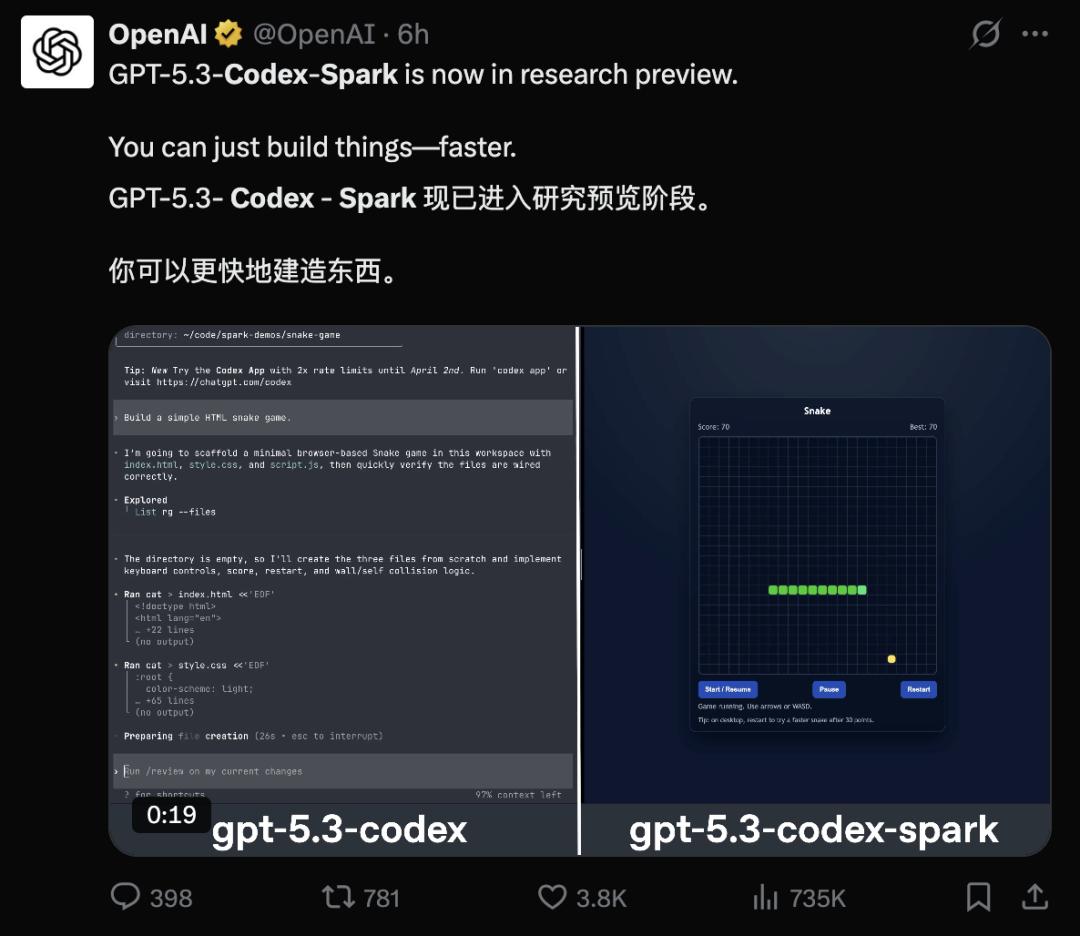
从定位上看,Codex-Spark 并不是为了替代现有的 Codex,而是补齐其在"即时交互"场景中的短板:在过去,Codex 更擅长长时间运行的复杂任务,而 Codex-Spark 的目标则非常明确——把人与模型之间的交互延迟压缩到接近"无感"的程度。 这一发布同时也是 OpenAI 与 芯片初创企业 Cerebras 合作的重要阶段性成果。为了减少对英伟达芯片的依赖,上个月 OpenAI 签署了一项金额超过 100 亿 美元的协议,使用 Cerebras 的硬件以提升其模型的响应速度,而 Codex-Spark 被视为这项合作落地的第一个技术里程碑。 为实时而生:Codex-Spark 的核心是"速度" OpenAI 发布新模型,专为实时编码而生 昨晚,OpenAI正式发布了GPT-5.3-Codex-Spark的研究预览版本。这是一款从 GPT-5.3-Codex 主模型中"裁剪"而来的精简版本,同时也是 OpenAI 首个专 门围绕实时编码(real-time coding)场景设计的模型。 在官方定义中,Codex-Spark 是一个"专为实时使用 Codex 而设计的模型",它支持进行针对性编辑、 ...
8连跌!“资本开支最高”的亚马逊跌入熊市,投资者对Mag 7“用脚投票”
美股IPO· 2026-02-13 03:27
Core Viewpoint - Amazon has officially entered a technical bear market after its stock price dropped 21.4% from recent highs, while Microsoft became the first member of the Mag7 to enter a bear market. Investor confidence in the return on investment from AI spending by these companies is low, with Amazon planning capital expenditures of up to $200 billion by 2026 [1][3]. Group 1: Amazon and Microsoft Performance - Amazon's stock closed at $199.60 after eight consecutive days of decline, marking its entry into a technical bear market as the second company in the Mag7 to do so [3]. - Microsoft’s stock price fell 25.9% from recent highs after its Azure cloud business growth failed to meet investor expectations, leading to its entry into a bear market on January 29 [3]. Group 2: AI Spending and Investor Sentiment - The total projected capital expenditure for AI by Amazon, Microsoft, Meta, and Alphabet is expected to reach $650 billion by 2026, with Amazon having the highest planned expenditure [3]. - Meta's stock is close to entering a bear market, just 2.3% away from the threshold, despite exceeding Wall Street expectations for Q4 revenue and earnings, as increased AI spending and profit margin pressures have affected investor confidence [3]. Group 3: Market Dynamics and Cash Flow Concerns - There is a noticeable rotation among Mag7 members, with investors moving away from Microsoft, Nvidia, and Oracle-related OpenAI trades towards Alphabet and Broadcom ecosystems [5]. - Alphabet's vertically integrated technology stack has somewhat mitigated concerns over excessive spending, allowing it to avoid the worst impacts of the tech stock sell-off, with its stock down 9.2% from recent highs [5]. - Increased capital expenditure levels for Amazon may lead to negative free cash flow this year, prompting the company to seek additional capital through debt markets [5].

未知机构:①李强要合理开发稀土资源努力打造稀土科技创新高地②2月10-20260213
未知机构· 2026-02-13 02:50
Summary of Key Points from Conference Call Records Industry and Company Involvement - **Rare Earth Industry**: Emphasis on the rational development of rare earth resources and innovation in rare earth technology [1] - **Tungsten Industry**: Significant price increase in tungsten raw materials, with current prices reaching five times the level at the beginning of 2025 [2] - **Nickel Mining**: Indonesia's substantial reduction in nickel mining output, with expected production between 260 million to 270 million tons, down from 379 million tons in 2025 [3][4] - **Glass Fiber Industry**: Taiwanese manufacturers shifting production from E-glass to low-DK glass fabric due to increased demand [5] - **Cloud Computing and AI**: Meta's investment in a data center and predictions of massive growth in AI token consumption in China [6][7] - **Chemical Industry**: Price adjustments in the pesticide sector and incidents of illegal chemical production leading to regulatory actions [8] - **Dye Industry**: Price increases in disperse dyes due to low inventory levels and market consolidation [9] - **Battery Technology**: Development of solid-state battery standards and strategic partnerships for next-generation battery materials [10] Core Insights and Arguments - **Rare Earth Development**: The need for innovation in rare earth technology to enhance resource utilization [1] - **Tungsten Price Surge**: A 50% increase in tungsten prices within a month, indicating strong demand and potential supply constraints [2] - **Nickel Production Cuts**: Indonesia's drastic cuts in nickel production quotas, with a 70% reduction in the largest nickel mine's output [3][4] - **Shift in Glass Fabric Production**: Taiwanese companies adjusting production lines to meet the rising demand for low-DK glass fabric [5] - **AI and Cloud Market Growth**: Significant investments in AI infrastructure and predictions of a 370-fold increase in AI token consumption by 2030 [6][7] - **Chemical Pricing and Regulation**: The average cost of chlorantraniliprole and regulatory measures against illegal chemical production [8] - **Dye Price Increases**: Anticipated further price hikes in disperse dyes due to low inventory and market dynamics [9] - **Solid-State Battery Development**: Collaboration between companies to innovate in solid-state battery technology [10] Other Important but Potentially Overlooked Content - **Meta's Data Center Investment**: A $10 billion investment in a new data center in Indiana, expected to be operational by late 2027 or early 2028 [6] - **AI Model Developments**: The launch of new AI models and tools aimed at enhancing programming capabilities [7] - **Regulatory Actions in Chemical Sector**: Increased scrutiny and actions against illegal chemical production following a fatal incident [8] - **Market Dynamics in Dye Industry**: The consolidation of the dye industry leading to fewer manufacturers and potential for price increases [9] - **Battery Technology Partnerships**: Strategic collaborations aimed at advancing solid-state battery technology [10]


谷歌加码逐鹿AI霸权!阿里巴巴/字节跳动/微美全息建生态抢未来战略高地!
Sou Hu Cai Jing· 2026-02-13 02:43
Group 1 - Alphabet plans to issue a rare century bond, marking the first such issuance by a tech company since the late 1990s [1] - The company has raised $20 billion for its ambitious AI spending plans, exceeding the initial target of $15 billion [2] - Major tech companies, including Meta and Amazon, are expected to increase their spending to approximately $660 billion by 2026 for AI initiatives, with a significant portion being raised through the bond market [4] Group 2 - Morgan Stanley estimates that large corporations will borrow $400 billion this year, up from $165 billion in 2025, indicating a surge in capital expenditure related to AI, cloud infrastructure, and data centers, projected to reach $3 trillion by 2029 [6] - In the domestic market, Alibaba is aggressively pursuing AI infrastructure through its Qianwen app, which has seen user growth driven by a $3 billion promotional campaign [7] - ByteDance views AI as a transformative opportunity, with its Doubao product expected to reach over 100 million daily active users by the end of 2025, and plans for global expansion in AI business [9] - WIMI has established a full-stack AI ecosystem, focusing on self-developed strategies and creating a comprehensive ecosystem from foundational technology to industrial applications [11]

AI热潮再遇“当头棒喝”,纳指重挫逾2%
2 1 Shi Ji Jing Ji Bao Dao· 2026-02-13 02:38
Group 1: Market Trends - The recent AI hype has led to a three-year bull market in US stocks, but this trend is now facing challenges, with major indices like the Dow Jones, S&P 500, and Nasdaq experiencing declines of 1.34%, 1.57%, and 2.03% respectively [1] - Concerns over the disruptive potential of AI have shifted market sentiment, impacting various sectors including software, legal services, and wealth management, as investors reassess company valuations [1] Group 2: Capital Expenditure Concerns - Major tech companies including Google, Meta, Microsoft, and Amazon are projected to spend a total of $650 billion on capital expenditures this year, primarily for AI infrastructure expansion [2] - There are worries that these tech giants may not achieve sufficient returns from their high capital expenditures, leading to significant stock price declines for Microsoft and Amazon post-earnings reports [2] - UBS has downgraded the US information technology sector to a "neutral" rating, citing soaring capital expenditures and increasing uncertainty in the software industry, with expectations that capital spending by large US firms could reach $700 billion this year, quadrupling from three years ago [2] Group 3: Sector Rotation - A noticeable trend of sector rotation is occurring in the US stock market, with funds moving from AI-related stocks to value stocks as concerns about tech giants' capital expenditures grow [3] - Bank of America suggests that the leadership of tech giants in the stock market is facing significant threats, especially with the upcoming midterm elections, prompting a shift towards small-cap stocks [3] - Despite the challenges, some analysts remain optimistic about the tech sector's future, citing strong revenue prospects supported by the AI boom and attractive buying opportunities in stocks like Microsoft and Intuit following recent declines [3][4] Group 4: Future Outlook - Analysts believe that the fundamental benefits of AI-enabled sectors remain positive, and companies applying AI to core business operations, rather than just developing technology and infrastructure, present more investment opportunities [4]
AI投资人:1-5年内AI将消灭 50%入门级白领岗位
阿尔法工场研究院· 2026-02-13 02:33
Core Viewpoint - The article emphasizes that the release of GPT-5.3 Codex and Claude Opus 4.6 on February 5, 2026, marks a critical turning point in AI capabilities, impacting knowledge workers sooner and more broadly than anticipated [2]. Group 1: AI's Rapid Advancement - The author compares the current perception of AI to the early days of the COVID-19 pandemic, suggesting that many are underestimating the scale and speed of AI advancements [3]. - The pace of AI improvements has accelerated significantly, with new models showing substantial enhancements in capabilities and shorter intervals between releases [4]. - The author describes a personal experience where AI independently completed tasks with high quality, indicating a shift in how AI can be utilized in various fields [4]. Group 2: Implications for Knowledge Work - AI's ability to write code is seen as a strategic advantage, enabling the development of more advanced AI systems, which could eventually impact all knowledge work sectors, including law, finance, and healthcare [5]. - The article discusses the ongoing debate about AI's progress, asserting that those who claim AI has hit a wall are likely using outdated models or have a vested interest in downplaying its capabilities [7]. - A timeline of AI advancements is provided, illustrating rapid progress from basic arithmetic capabilities in 2022 to the potential for AI to handle significant coding tasks by 2025 [7][8]. Group 3: Future Workforce Changes - Predictions suggest that AI could eliminate 50% of entry-level white-collar jobs within 1-5 years, with the author noting that this is a conservative estimate [11]. - The article highlights that AI is a general substitute for cognitive work, making it challenging for workers to transition to new roles as AI continues to improve across various domains [11]. - The author emphasizes that the latest AI models exhibit decision-making capabilities that resemble human judgment, raising concerns about job security for many roles that involve computer-based tasks [11]. Group 4: Practical Recommendations - The article provides actionable advice, urging individuals to subscribe to paid versions of AI tools and actively integrate them into their work processes [13][15]. - It encourages users to experiment with AI daily, suggesting that hands-on experience will enhance understanding and adaptability to ongoing changes in the industry [15]. - The author warns that many professionals are currently ignoring AI's potential, and those who leverage it effectively will gain a competitive advantage [14]. Group 5: Broader Implications of AI - The article concludes with a discussion on the potential societal impacts of AI, including both positive advancements in fields like medicine and negative consequences such as increased surveillance and security threats [17]. - The author presents a thought experiment about a hypothetical nation with super-intelligent citizens, highlighting the dual-edged nature of AI advancements [17].