Alphabet(GOOG)

Search documents
股价大涨7.87%!巨头砸钱6500亿加剧担忧,黄仁勋“灭火”:AI需求火爆,庞大支出合理、可持续
美股IPO· 2026-02-07 00:35
Core Viewpoint - The CEO of Nvidia, Jensen Huang, emphasized that the current surge in AI infrastructure spending is driven by extremely high computational demands, marking it as the largest infrastructure build-out in human history. He believes that as long as people continue to pay for AI, companies will profit from it [1][3]. Group 1: AI Infrastructure Spending - Huang stated that the capital expenditure in AI infrastructure is reasonable, appropriate, and sustainable, with a projected total of approximately $650 billion from major clients like Meta, Amazon, Google, and Microsoft by 2026, representing a 60% increase from 2025 [5][8]. - The spending from these four companies is expected to surpass the GDP of many medium-sized economies, with Meta's capital expenditure potentially rising by 87% to $135 billion [5][8]. - Nvidia's stock rebounded significantly after Huang's comments, with a daily increase of over 7.7%, reversing a five-day decline [3]. Group 2: Profitability and Demand for AI - Huang indicated that AI companies are starting to become profitable, and the demand for AI infrastructure will continue for the next seven to eight years. He noted that AI has become "very useful and very powerful" with a high adoption rate [6][7]. - Specific examples were provided, such as Meta transitioning its recommendation systems to generative AI, and Amazon's AWS utilizing Nvidia chips to enhance product recommendations [7]. - Huang highlighted that Nvidia's GPUs, including older models, are still in demand, reflecting ongoing needs for AI computational power [7]. Group 3: Market Reactions and Concerns - Despite the optimism from Huang, there are significant concerns among investors regarding the efficiency of AI investments and potential overcapacity, leading to a market sell-off that resulted in a loss of approximately $1.35 trillion in market capitalization for major tech companies [5][10]. - Analysts have drawn parallels between the current software industry and the newspaper industry during the internet boom, suggesting that the software sector may face similar disruptions [5]. - The market sentiment is influenced by fears surrounding the massive capital expenditures required for AI development and the uncertainty of returns, with some analysts questioning the economic viability of these investments [10][11].



3 Unstoppable Artificial Intelligence (AI) Stocks to Buy Right Now for Less Than $1,000
The Motley Fool· 2026-02-07 00:30
Core Insights - The article emphasizes the potential of investing in artificial intelligence (AI) stocks, highlighting that even a small investment can grow significantly over time with patience and consistent contributions. Company Summaries Palantir Technologies - Palantir Technologies reported fourth-quarter revenue of $1.41 billion, marking a 70% increase year-over-year, with a net income of $609 million and earnings per share of $0.24, resulting in a profit margin of 43% [4][5] - The company closed 180 deals valued at over $1 million in the fourth quarter, achieving a record total contract value of $4.26 billion, which is up 138% from the previous year [5] Nvidia - Nvidia's market capitalization reached $4.2 trillion, driven by high demand for its graphics processing units (GPUs), which are essential for AI and other high-performance computing tasks [9][10] - The company reported that its cloud GPUs were "sold out" ahead of the release of its next-generation Rubin chips, indicating strong market demand [8] - Nvidia is expected to report another strong quarter for its fiscal fourth quarter of 2026 on February 25 [11] Alphabet - Alphabet's Google Cloud division generated $15.15 billion in revenue in the third quarter, reflecting a 33% increase year-over-year, driven by the growing adoption of AI in cloud computing [12] - The company also reported $74.18 billion in revenue from internet advertising, benefiting from its dominant position with the Chrome browser and Google search engine [13] - Alphabet is expanding its Tensor Processing Units (TPUs) market, including a deal with Anthropic and discussions with Meta Platforms, indicating strategic growth in AI capabilities [14]

50000点,大涨!见证历史
Zhong Guo Ji Jin Bao· 2026-02-07 00:10
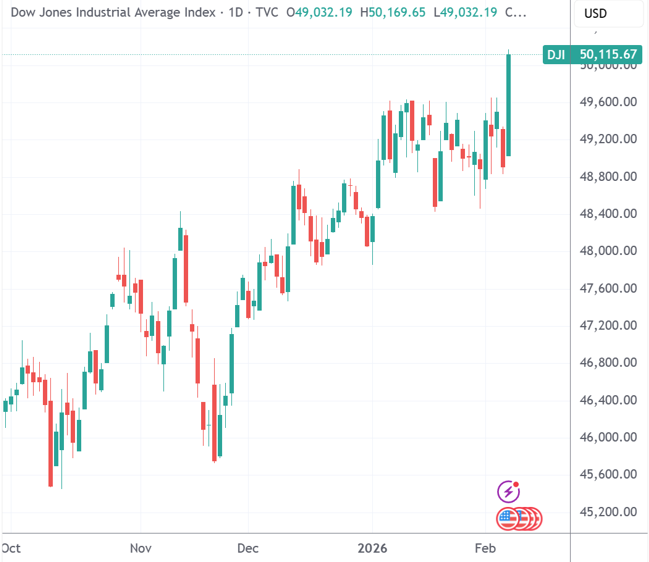
Market Overview - The US stock market experienced significant gains, with the Dow Jones Industrial Average surpassing the 50,000 points mark for the first time in history, closing at 50,115.67 points, up 2.47% [1] - The S&P 500 index rose by 1.97% to 6,932.3 points, while the Nasdaq Composite increased by 2.18% to 23,031.21 points [1] - Weekly performance showed mixed results, with the Nasdaq down 1.84%, the Dow up 2.5%, and the S&P 500 down 0.1% [1] Sector Performance - Major technology stocks saw a rally, with the US Technology Seven Index rising by 1.02% [1] - Semiconductor stocks performed well, with the Philadelphia Semiconductor Index surging, AMD rising over 11%, and Broadcom increasing by over 7% [5] - Other sectors such as coal, electrical equipment, and non-ferrous metals also showed positive performance, with increases of 5.04% to 6.46% [6] Individual Stock Highlights - Nvidia's stock surged by 7.81%, closing at $185.41 per share, with a total market capitalization of $450.55 billion [5] - Tesla's shares rose by 3.48%, while Microsoft and Apple also saw increases [4] - In contrast, Amazon, Google, and Meta experienced declines of 5.62%, 2.5%, and 1.31% respectively [4] Chinese Stocks - Chinese stocks listed in the US saw a collective increase, with the Nasdaq China Golden Dragon Index rising by 3.71% [7] - Notable gains included Alibaba up over 3%, Baidu up over 5%, and Li Auto up over 6% [7][8] Economic Indicators - The Federal Reserve's Vice Chairman Jefferson indicated that the current interest rate stance is appropriate for the economy, despite inflation being above the 2% target [12] - Jefferson noted signs of stabilization in the labor market and anticipated a return to the 2% inflation target later in the year [12] - Fed official Daly highlighted the importance of balancing price stability and full employment, acknowledging concerns about rising unemployment expectations among Americans [12]



50000点,大涨!见证历史!
Zhong Guo Ji Jin Bao· 2026-02-06 23:58
Market Performance - The US stock market saw a significant rise, with the Dow Jones Industrial Average historically surpassing the 50,000 points mark, closing at 50,115.67 points, up 2.47% [1] - The S&P 500 index rose by 1.97% to 6,932.3 points, while the Nasdaq Composite increased by 2.18% to 23,031.21 points [1] - Weekly performance showed mixed results, with the Nasdaq down 1.84%, the Dow up 2.5%, and the S&P 500 down 0.1% [2] Sector Performance - Major technology stocks experienced a rally, with the US Technology Seven Index rising by 1.02% [3] - The Philadelphia Semiconductor Index saw a significant increase, with AMD rising over 11% and Broadcom up over 7% [7] Individual Stock Highlights - Nvidia shares surged by 7.81%, closing at $185.41 per share, with a total market capitalization of $450.55 billion [7] - Tesla shares increased by 3.48%, while Microsoft and Apple also saw gains; however, Amazon, Google, and Meta experienced declines [6][7] - Chinese stocks listed in the US showed strong performance, with the Nasdaq Golden Dragon China Index rising by 3.71%, and notable increases in Alibaba, Baidu, and Li Auto [9] Commodity Market - Spot gold prices surged nearly 4%, reaching a high of $4,971.39 per ounce before closing at $4,966.61 per ounce [10] - Spot silver prices also saw a significant increase, breaking through $78 per ounce with a daily rise of 9.7% [12] Federal Reserve Commentary - Federal Reserve Vice Chairman Jefferson indicated that the current interest rate stance is appropriate for the economy, despite inflation being above the 2% target, with expectations of a downward trend later in the year [14] - Fed official Daly noted that economic growth remains strong, with stable consumer spending and ample job supply, although there are concerns about future job opportunities and rising unemployment [15]

景林资产四季度减持英伟达,重仓谷歌、Meta和拼多多



Hua Er Jie Jian Wen· 2026-02-06 23:52
减持新思科技、谷歌C、Spotify、联合健康、台积电、Sea、优步(Uber)、Weride Inc.,减持Meta Platforms 22.906万股,减持英伟达154万股,减持贝壳188万股。 市场有风险,投资需谨慎。本文不构成个人投资建议,也未考虑到个别用户特殊的投资目标、财务状况或需要。用户应考虑本文中的任何 意见、观点或结论是否符合其特定状况。据此投资,责任自负。 风险提示及免责条款 据景林资产13F披露文件,景林资产管理香港有限公司四季度增持谷歌母公司Alphabet(谷歌A)92.968 万股,增持英特尔69.436万股,增持拼多多61.131万股,并增持博通和富途控股。 在其投资组合中,重仓谷歌A、Meta、拼多多、网易、满帮,英伟达配置占比第七,阿里巴巴、英特尔 紧随其后。 ...
深夜,中国资产大涨
财联社· 2026-02-06 23:44
Market Overview - After three days of selling pressure, the US stock market experienced a significant rebound, with the S&P 500 index recording its largest single-day gain since May of the previous year, and the Dow Jones Industrial Average surpassing the 50,000 points mark for the first time in history [1] - The S&P 500 index rose by 1.97% to close at 6,932.3 points, the Nasdaq Composite increased by 2.18% to 23,031.21 points, and the Dow Jones Industrial Average climbed by 2.47% to 50,115.67 points [1] Key Stock Performances - Nvidia saw a single-day increase of over 7%, adding more than $320 billion to its market capitalization, while other cyclical/value stocks like Caterpillar, Goldman Sachs, and JPMorgan also attracted significant capital inflows [1] - Despite the overall market rally, Amazon's stock fell over 5% after announcing a capital expenditure of up to $200 billion for 2026, indicating skepticism about AI spending [4] - Major tech stocks showed mixed results, with Nvidia up 7.87%, Apple up 0.8%, Google-A down 2.53%, and Microsoft up 1.9% [6] Sector Movements - The precious metals sector, represented by silver, rebounded nearly 10%, while Bitcoin surged close to 12%, reflecting a risk-on sentiment in the market [3] - The semiconductor sector performed well, with AMD rising 8.28%, and companies supporting Amazon's chip production, such as Marvell Technology, increasing by 8.18% [6] Chinese Stocks Performance - Chinese stocks continued their strong performance, with the Nasdaq Golden Dragon China Index rising by 3.71%. Notable gains included Alibaba up 3.01%, JD.com up 2.75%, and NIO up 7.23% [7] Company-Specific News - Tesla is reportedly evaluating options to increase its solar production capacity, including expanding its Buffalo, New York plant to 10 gigawatts and potentially building additional factories in New York, Arizona, or Idaho [8] - The FDA announced plans to crack down on illegal GLP-1 drugs, impacting companies like Hims & Hers Health, which saw a post-market drop of over 13% [9] - Stellantis faced a significant decline of 23.69% after announcing a restructuring plan that would lead to a €22.2 billion loss due to a reduction in its electric vehicle business [10]


Google World Model AI Accelerates Waymo Robotaxi Expansion
PYMNTS.com· 2026-02-06 23:32
Core Insights - Waymo is enhancing its self-driving technology through the development of the Waymo World Model, which is based on Google DeepMind's Genie 3, aimed at improving real-world service scalability [1][2] Group 1: Waymo World Model - The Waymo World Model utilizes Genie 3's extensive world knowledge to simulate various scenarios, including extreme weather and safety-critical events [3][4] - This model allows engineers to modify simulations using simple language prompts and driving inputs, enhancing the controllability of the simulations [3][4] Group 2: Impact of Genie 3 - Genie 3 is designed to create 3D environments governed by physics, enabling AI agents to learn through exploration of virtual worlds rather than relying on static datasets [5] - Google DeepMind launched an experimental prototype, Project Genie, which allows users to interact with world-generation features [6] Group 3: Market Reaction and Investment - Following the announcement of Genie 3, the video game industry experienced a significant market value loss due to concerns over AI's capability to generate video games [7] - Waymo successfully raised $16 billion in a funding round, resulting in a post-money valuation of $126 billion, with Alphabet remaining its majority investor [7]

美股集体大涨,道指首次站上5万点,中概股指数涨超3%
Feng Huang Wang· 2026-02-06 23:09
Market Performance - The US stock market experienced a significant rebound, with the S&P 500 index recording its largest single-day gain since May 2022, rising by 1.97% to close at 6932.3 points. The Dow Jones Industrial Average also reached a historic milestone, surpassing the 50,000 points mark, closing up 2.47% at 50115.67 points [1] - Notable stock performances included Nvidia, which surged over 7%, adding more than $320 billion to its market capitalization. Other cyclical/value stocks like Caterpillar, Goldman Sachs, and JPMorgan also saw increased capital inflow, contributing to the Dow's record high [1] Technology Sector - Amazon's announcement of a capital expenditure plan of up to $200 billion for 2026 led to a decline of over 5% in its stock price, highlighting skepticism regarding AI spending in the market. Google, which previously disclosed a capital expenditure of $185 billion, also saw its stock drop by over 2% [5] - Nvidia's CEO reiterated the sustainability of large AI investments, stating that companies will continue to invest heavily in AI as long as they can achieve profitability from these investments [6] Cryptocurrency and Commodities - The market saw a rebound in risk assets, with silver prices rising nearly 10% and Bitcoin increasing by almost 12% [3] - The rebound in commodities also positively impacted the materials sector, with Century Aluminum rising by 11.80% and Hilltop Holdings increasing by 8.82% [6] Chinese Stocks - Chinese stocks continued to perform strongly, with the Nasdaq Golden Dragon China Index rising by 3.71%. Key performers included Alibaba (+3.01%), JD.com (+2.75%), and NIO (+7.23%) [7] Tesla and Renewable Energy - Tesla is reportedly evaluating options to increase its solar production capacity, including expanding its Buffalo, New York factory to 10 gigawatts and potentially building additional factories in New York, Arizona, or Idaho [8] FDA and Pharmaceutical Sector - The FDA announced plans to crack down on illegal GLP-1 drugs, which negatively impacted Hims & Hers Health, causing its stock to drop over 13% after the launch of its oral medication [9] Automotive Industry - Stellantis faced a significant decline of 23.69% in its stock price after announcing a restructuring plan that would lead to a reduction in its electric vehicle business, resulting in a loss of €22.2 billion [10]
Stock Market Today, Feb. 6: Nvidia Leads Rally After AI Hardware Rebounds
The Motley Fool· 2026-02-06 22:21
Market Overview - The Dow Jones Industrial Average closed above 50,000 for the first time, rising about 2.5% to 50,115.66, while the S&P 500 and Nasdaq Composite also saw significant gains of 1.97% and 2.18% respectively [1][3] Key Market Movers - Semiconductor companies, particularly Nvidia, led a strong rebound in AI hardware, with Nvidia's stock increasing by 8.01% [2] - MicroStrategy, which is heavily exposed to cryptocurrency, surged approximately 26.11% as Bitcoin rebounded to over $70,000 [2][5] - In contrast, Amazon's stock fell by 5.49% due to a substantial capital expenditure plan for 2026, and Micron Technology's stock decreased by 3.08% due to lowered expectations for HBM4 memory chips [2][4] Investor Sentiment - The overall market rally has reinforced confidence in the ongoing bull market, suggesting that it may not be nearing an end [3] - Despite the positive momentum, a prior sell-off earlier in the week resulted in a loss of $1.5 trillion from high-performing tech stocks, indicating mixed sentiment among investors [4]


Earnings live: Amazon, Reddit stocks sink to cap jam-packed earnings week
Yahoo Finance· 2026-02-06 21:31
Group 1 - The fourth quarter earnings season is ongoing, with significant results from major companies like Alphabet, Amazon, AMD, Qualcomm, and Palantir [1] - As of February 6, 59% of S&P 500 companies have reported their fourth quarter results, with analysts estimating a 13% increase in earnings per share, marking the 10th consecutive quarter of annual earnings growth for the index [2][4] - Analysts initially expected an 8.3% increase in earnings per share for the fourth quarter, a decrease from the previous quarter's 13.6% growth rate, but have since raised expectations, particularly for tech companies [4] Group 2 - Major capital expenditures by Big Tech are influencing the AI trade, with ongoing themes from 2025, such as artificial intelligence and economic policies, continuing to impact investor sentiment [5] - Upcoming earnings reports are anticipated from companies including Coca-Cola, Spotify, Robinhood, Lyft, Ford, Rivian, Moderna, Airbnb, and Coinbase [6]