Alphabet(GOOG)

Search documents
Musk's Tesla Robotaxi Is Cheaper Than Waymo, But Longer Waiting Times And More Human Drivers Are A Drag, Analysts Say - Tesla (NASDAQ:TSLA)
Benzinga· 2026-02-26 11:54
Core Insights - Tesla's Robotaxi service in Austin is reported to be significantly cheaper than Alphabet's Waymo, with a price advantage of 2x [2] - Tesla's performance in key performance indicators (KPIs) is generally lower compared to Waymo, with issues such as suboptimal routing and longer trip times [3] - Tesla's Robotaxi service has faced scrutiny due to an increase in reported crashes, totaling 14 incidents since its launch in mid-2025 [3] Tesla's Performance - Analysts from Jeffries conducted a study involving 15 rides in Tesla and 19 rides in Waymo, revealing that Tesla offered only 2 rides without a safety driver and had a ride unavailability rate exceeding 25% [2] - The research indicates that Tesla's rides were heavily discounted compared to Waymo's, suggesting a reliance on price reductions to attract customers [3] Waymo's Situation - Waymo is also under investigation by the NHTSA for over 3,000 of its autonomous vehicles following multiple accidents [4] - The scrutiny on both companies highlights the challenges faced in the autonomous vehicle (AV) sector, with analysts suggesting that AVs have relied on hype for adoption without a clear cost advantage over traditional rideshare services [5] Market Reaction - Tesla's stock experienced a rise of 1.96% to $417.40 at market close, but saw a slight decline of 0.63% to $414.75 in pre-market trading [5]



谷歌连夜封禁,全行业集体堵截,OpenClaw 到底动了谁的蛋糕?
凤凰网财经· 2026-02-26 11:54
Core Viewpoint - The article discusses the controversy surrounding OpenClaw, an AI tool that has faced backlash from Google and other AI companies due to its perceived misuse of their services and the potential security risks it poses [2][11]. Group 1: Incident Overview - Google has initiated a ban on users of OpenClaw who were using its Antigravity service to access the Gemini model, citing "massive malicious usage" that degraded service quality for legitimate users [4][5]. - The ban peaked around February 23, with hundreds of accounts being banned overnight, leading to significant user complaints about lack of warnings and continued billing despite account suspension [8][13]. - OpenClaw's founder, Peter Steinberger, criticized Google's approach and indicated he might remove support for Google services in OpenClaw [9][10]. Group 2: Technical Aspects - OpenClaw utilizes OAuth for access, which is compliant with standard protocols, but Google’s service terms did not explicitly prohibit such integrations, leading to confusion among users [14][15]. - The "heartbeat" mechanism of OpenClaw, which checks for tasks at regular intervals, significantly increases token consumption, leading to excessive costs for users [16][20]. - Users reported that the high frequency of API calls, driven by the growing context size, resulted in costs that could reach between $1,000 to $3,600 monthly for average users [24]. Group 3: Industry Response - The actions taken by Google are part of a broader industry trend, with Anthropic also updating its terms to prohibit the use of its services through third-party tools like OpenClaw [26][32]. - Other tech companies have expressed concerns about OpenClaw, with some banning its use on company devices due to security risks associated with its high system permissions [34][36]. - The article highlights a shift in the AI industry where companies are tightening control over their services to protect their business models from tools like OpenClaw that exploit subscription pricing [39][40]. Group 4: Security Concerns - Gartner's report criticized OpenClaw for presenting unacceptable cybersecurity risks, urging companies to block its use and manage credentials carefully [46]. - Research indicated that over 42,000 instances of OpenClaw were exposed online, with many lacking proper security measures, making them vulnerable to attacks [47]. - The article emphasizes that the security issues are symptomatic of deeper conflicts regarding the business models of AI companies, as OpenClaw threatens the balance of subscription and token-based revenue [51][53]. Group 5: Future Implications - The article suggests that OpenClaw represents a pivotal moment in the AI industry, raising questions about the future of open versus closed ecosystems in AI development [60]. - The contrasting approaches of companies like OpenAI, which supports OpenClaw, versus those like Google and Anthropic, which seek to restrict it, highlight the ongoing battle for control in the AI landscape [43][58].


GenAI 系列报告之 69 暨 AI 应用深度之四:Seedance2.0 突破,AI 视频竞争格局及产业链机遇
Shenwan Hongyuan Securities· 2026-02-26 11:10
Investment Rating - The report indicates a positive investment outlook for the AI video generation industry, particularly highlighting the advancements of ByteDance's Seedance2.0 and its competitive positioning against other major players like Kuaishou and Alibaba [5][6]. Core Insights - Seedance2.0 has achieved significant technological and industrial breakthroughs, establishing a closed-loop system from creation to distribution and monetization [5][6]. - The AI video generation market is still in its early stages, with leading companies exhibiting differentiated competitive strategies, allowing multiple major players to coexist [5][6]. - The content production function is shifting towards a new paradigm that emphasizes foundational creativity, prompt engineering, AI computing power, data fuel, and distribution algorithms [7][8]. Summary by Sections 1. Seedance2.0: Technological and Industrial Breakthroughs - Seedance2.0 utilizes a unified multi-modal audio-video generation architecture, significantly improving controllability and consistency in content production [11]. - The model supports various input modalities, enhancing creative freedom and allowing for a more comprehensive content generation process [11][12]. 2. Competition Analysis - The AI video generation market is characterized by rapid iteration and differentiation among major models, with domestic models generally priced lower than their international counterparts [13][16]. - The demand for AI video generation comes from various sectors, including individual content creators, professional media companies, and the entertainment industry [13][16]. 3. Impact of AI on Content Production - The introduction of AI models is transforming the content production function, leading to lower marginal costs and a shift in value towards scarce IP and efficient distribution platforms [37]. - The report highlights that while there may be an oversupply of lower-tier content, the value of high-quality IP is expected to increase, benefiting from enhanced operational efficiencies through AI [37][38]. 4. AI Manhua and Realistic Short Dramas - AI-generated manhua and realistic short dramas are identified as the first large-scale commercial applications of AI video technology, with significant growth potential [6][7]. - The core user demographic for AI manhua is primarily young males under 40, indicating a new market segment beyond traditional live-action short dramas [6][7]. 5. Importance of Copyright Services in the AIGC Era - The report emphasizes the growing importance of copyright services in the AI-generated content landscape, with a shift from adversarial relationships between copyright holders and AI companies to collaborative models [8][9]. - Establishing a robust rights attribution and revenue-sharing system is crucial for maximizing the value of IP in the AIGC era [8][9]. 6. Multi-modal Computing Power Requirements - The report notes that video models require significantly more computing power compared to language models, with the generation of a 5-second 4K video demanding computational resources equivalent to processing 100,000 instances of a language model prompt [7][8].





华为、字节、Meta同台竞技,AI眼镜势必记住2026这一年
3 6 Ke· 2026-02-26 11:06
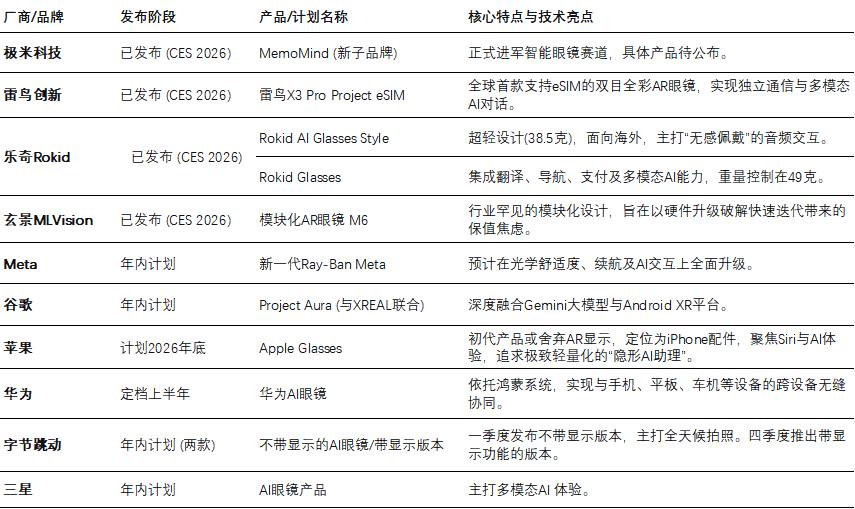
Core Insights - The AI glasses market in 2026 is characterized by intense competition, with numerous companies, including major tech giants and startups, launching new products and strategies, marking a shift from niche gadgets to essential tools for various applications [1][2][4] Group 1: Market Dynamics - The AI glasses market is witnessing a "full-scale war" with major players like Meta, Google, Apple, and domestic companies like Huawei and ByteDance all actively participating [1][2] - The CES 2026 event served as a platform for companies to showcase their innovations, with significant product announcements from various manufacturers [2][4] - The trend of "lightweight" and "independence" is evident, as companies prioritize user comfort and reduce reliance on smartphones through features like eSIM and independent processing capabilities [9][10] Group 2: Product Launches and Innovations - Key product launches include: - XGIMI's MemoMind brand entering the smart glasses market [8] - Thunderbird's X3 Pro Project eSIM, the first dual-lens AR glasses with independent connectivity [8] - Rokid's ultra-light AI glasses weighing only 38.5 grams, emphasizing comfort and audio interaction [8] - Modular AR glasses M6 from Xuanjing, designed for hardware upgrades [3][8] - Meta plans to enhance its Ray-Ban Meta glasses, aiming for improved optical comfort and AI interaction [4][8] - Google's three-step strategy includes launching audio smart glasses and collaborating on Project Aura with XREAL [4][8] - Apple is expected to release Apple Glasses by the end of 2026, focusing on a lightweight design and AI integration [4][8] Group 3: Industry Trends and Drivers - The industry is driven by three main factors: cost reduction in the supply chain, advancements in AI interaction, and growing market demand [10][11] - The rapid decrease in component costs, particularly in chips and optical displays, has made AI glasses more affordable for consumers, with prices now in the 2000-3000 yuan range [11] - The introduction of national subsidies for smart glasses is expected to boost market penetration and consumer adoption [14][15] Group 4: Future Competition Landscape - The competition is shifting from hardware specifications to user experience, ecosystem integration, and technological innovation [16][17] - Companies are focusing on creating compelling reasons for daily use, with examples like Rokid's integration of AI glasses into automotive systems and educational tools [17][18] - The future of the industry will depend on ecosystem development, with companies like Google and Huawei aiming to create comprehensive platforms that integrate AI capabilities and user data [20][21]


News rivals join forces to resist AI freeloading
Yahoo Finance· 2026-02-26 11:00
Core Viewpoint - A coalition of major media outlets has formed to protect publishers from copyright abuses by tech firms, particularly in the context of AI training data usage [2][3]. Group 1: Coalition Formation - Major media outlets including The Telegraph, BBC, Sky News, The Guardian, and The Financial Times have united to advocate for compensation from AI companies like OpenAI and Google for using their content as training data [2][3]. - The coalition is named Spur, which stands for Standards for Publisher Usage Rights, and aims to establish technical and licensing standards for interactions between news publishers and AI developers [7]. Group 2: Economic Impact on Journalism - The coalition highlights that original journalism has been used as foundational training material for AI systems without proper compensation, undermining the economic model that supports journalism [3][4]. - There has been a significant drop in traffic from Google to publishers, with global traffic decreasing by one-third last year, which threatens the digital business models of news publishers [5]. Group 3: Regulatory Response - The Competition and Markets Authority has mandated that Google must allow companies to choose whether to appear in AI overviews and has prohibited the manipulation of search results, responding to concerns from the publishing industry [6]. Group 4: Legal Challenges in the AI Industry - The AI industry is facing potential legal challenges, with The New York Times suing OpenAI and Perplexity for alleged copyright infringement, and another AI developer, Anthropic, having paid a $1.5 billion settlement for similar issues [9].
比互联网泡沫还猛!科技巨头2万亿美元豪赌AI,资本强度前所未见
Hua Er Jie Jian Wen· 2026-02-26 10:36
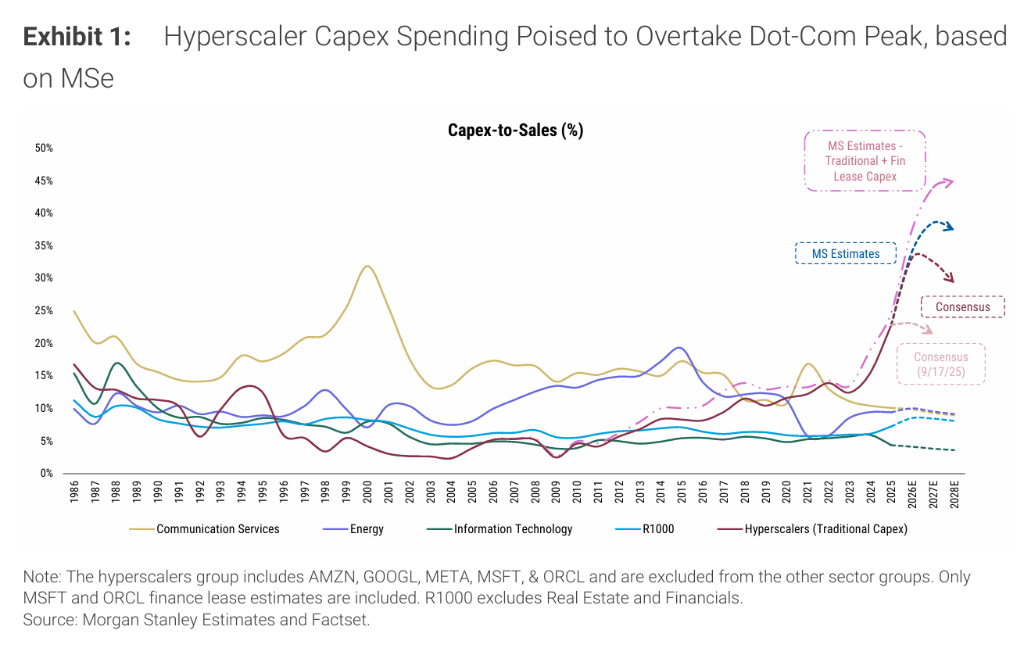
Core Insights - The investment wave in AI infrastructure is pushing tech giants into an unprecedented capital-intensive cycle, with hyperscalers like Amazon, Google, Meta, Microsoft, and Oracle expected to exceed historical capital expenditure peaks from the internet bubble era [1][4]. Capital Expenditure Trends - Morgan Stanley forecasts that the capital expenditure to sales ratio for these hyperscalers will reach 34%, 39%, and 37% from 2026 to 2028, surpassing the internet bubble peak of approximately 32% [1][4]. - Including financing leases, this ratio could rise to 38%, 44%, and 45% during the same period [1][7]. - The total capital expenditure for these companies is projected to exceed $2 trillion over the next three years, accounting for about 40% of the total capital expenditure of Russell 1000 index constituents [1]. Revenue Adjustments - Despite the significant increase in capital expenditure, revenue forecasts have not seen a corresponding rise, leading to a decline in free cash flow (FCF) expectations for hyperscalers [3][10]. - Over the past six months, capital expenditure expectations for 2026 and 2027 have been raised by over $630 billion, while revenue expectations have only seen limited adjustments [3][10]. Financing Leases Impact - The use of financing leases has significantly inflated the actual investment scale, with total commitments for future leases exceeding $660 billion among the five companies [13]. - For instance, Oracle's capital expenditure to sales ratio could rise dramatically from 75% to over 100% when including financing leases [15]. Sector Performance Disparity - Semiconductor companies have emerged as the biggest beneficiaries of the current investment cycle, with their revenue expectations rising by approximately 60%, compared to only 8% for hyperscalers [3][17]. - The market has shown a preference for semiconductor firms, with stock prices increasing significantly more than those of hyperscalers since December 2023 [17]. Future Outlook - Analysts believe that while companies like Meta, Google, and Amazon are leveraging AI investments to enhance user engagement and monetization, the substantial capital expenditures will lead to increased depreciation costs, putting pressure on profit margins if sales do not keep pace [18].



The "Magnificent Seven" Are Sending Shockwaves Through Wall Street With This $8.4 Billion Warning
The Motley Fool· 2026-02-26 10:06
Core Insights - The "Magnificent Seven" companies, including Nvidia, Apple, Alphabet, Microsoft, Amazon, Meta Platforms, and Tesla, have been pivotal in driving the stock market higher, particularly due to advancements in artificial intelligence [1][4] - However, these companies are collectively signaling a concerning trend with over $8.4 billion in net stock sales by insiders over the past year [4][10] Insider Trading Activity - Insiders at the Magnificent Seven have been significant net sellers of their company's shares, with the exception of Tesla, where CEO Elon Musk purchased approximately $1 billion in shares [5][10] - The total net selling across these companies amounts to $8,414,225,611, with Nvidia leading at $2,249,988,017 and Amazon following with $5,724,146,695 [10] - Notably, there has been a lack of insider buying in major companies like Nvidia, Apple, Amazon, and Meta Platforms, raising potential concerns for investors [12][13] Market Context - The insider trading data indicates that while selling may not always be negative, the absence of insider buying amidst a historically expensive stock market could be a red flag [9][12] - Insiders at Microsoft and Alphabet have made minimal purchases, totaling $3.4 million and $5 million respectively, which is relatively low compared to the selling activity [13]


Wall Street Says the Stock Market's Return in 2026 Will Crush the 30-Year Average
Yahoo Finance· 2026-02-26 09:32
About 5,500 companies were listed across U.S. stock exchanges last year, according to the Securities Industry and Financial Markets Association (SIFMA). Many of those companies are included in stock indexes, which measure various aspects of the domestic market. While hundreds of indexes exist, the S&P 500 (SNPINDEX: ^GSPC) is synonymous with the U.S. stock market due to its scope. Here's how the S&P 500 performed during the last 30 years and what Wall Street expects in the remaining months of 2026. Will A ...
超30GWh!海博思创等签储能重要合作
行家说储能· 2026-02-26 08:46
Core Viewpoint - The global energy storage industry is experiencing significant developments, with multiple companies forming strategic partnerships and expanding into new markets, highlighting the trend towards globalization and scalability in the sector [2]. Group 1: Strategic Partnerships - Haibo Sichuang has established a strategic partnership with Evervolt Green Energy to distribute energy storage solutions in India and Sri Lanka, focusing on commercial and industrial applications [3]. - JinkoSolar has signed a strategic cooperation agreement with Tongliao Energy Investment Group and China Water Resources and Hydropower Sixth Engineering Bureau to promote comprehensive energy projects and new energy storage initiatives in Tongliao City [7]. Group 2: Market Expansion and Technology - Evervolt is recognized as a leading supplier in the renewable energy sector, covering various fields including solar PV modules, inverters, and energy storage systems (ESS) [5]. - JinkoSolar aims to leverage this partnership to introduce advanced technologies and create a benchmark project centered on new energy storage in the Inner Mongolia region, with ongoing and planned projects exceeding 10GWh in scale [9]. Group 3: Major Projects and Investments - Google plans to build a data center in Minnesota, deploying a 30GWh iron-air energy storage system in collaboration with Xcel Energy, which is expected to be the largest battery system by energy capacity globally [6]. - The energy storage system will be integrated with 1400MW of wind and 200MW of solar power, ensuring competitive costs with traditional power plants while maintaining stable electricity prices for residents [6].


谷歌版“豆包手机”发布,GUI操作实现跨 App代办
Huan Qiu Wang· 2026-02-26 08:10
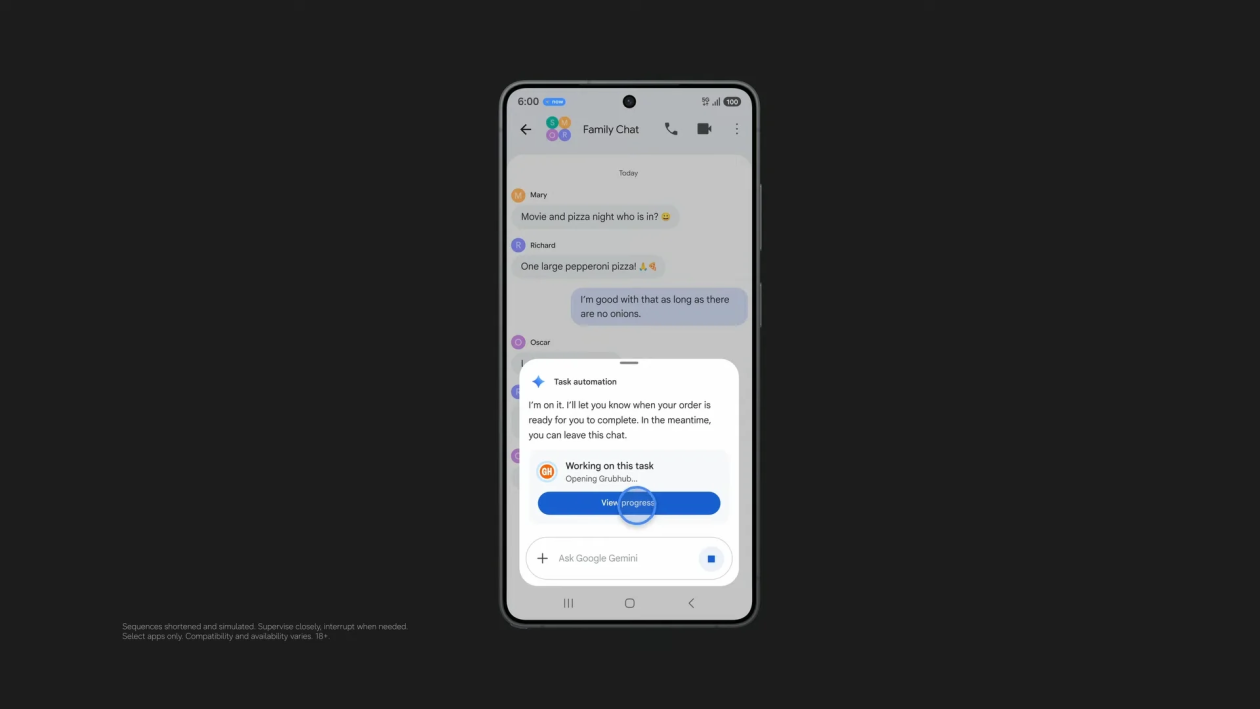
Group 1 - Samsung's latest Galaxy S26 series enhances integration with Gemini, introducing the Gemini smartphone assistant to automate tasks for users, similar to domestic "Doubao phone assistant" [1] - Users can activate Gemini by long-pressing the side button, allowing it to serve as a "to-do task" entry point, executing multi-step operations while users continue to use their phones and monitor progress via the notification bar [1] - Some task execution capabilities of the Gemini assistant are realized through GUI solutions [1] Group 2 - Google’s Android ecosystem president, Sameer Samat, stated that Android is evolving from a traditional operating system to a "truly understanding and serving intelligent system" [3] - He referred to the Gemini smartphone assistant as "agentic AI," emphasizing its ability to "get things done" by reducing app switching and manual coordination, thus streamlining processes while maintaining user visibility and control [3] - Samat highlighted the emerging nature of this technology and the importance of embracing it [3]