HP(HPQ)

Search documents
Why HP (HPQ) Dipped More Than Broader Market Today
ZACKS· 2025-11-18 00:01
Company Performance - HP's stock price decreased by 6.77% to $22.87, underperforming the S&P 500's daily loss of 0.92% [1] - Over the past month, HP's stock has fallen by 10.38%, while the Computer and Technology sector gained 1.64% and the S&P 500 gained 1.48% [1] Upcoming Earnings - HP is set to release its earnings report on November 25, 2025, with projected EPS of $0.92, indicating a 1.08% decline from the same quarter last year [2] - The consensus estimate for quarterly revenue is $14.79 billion, reflecting a 5.23% increase from the previous year [2] Full Year Projections - For the full year, earnings are projected at $3.11 per share, showing a decrease of 7.99%, while revenue is expected to remain flat at $55.2 billion [3] - Recent revisions to analyst forecasts for HP are important as they indicate the evolving short-term business trends [3] Valuation Metrics - HP has a Forward P/E ratio of 7.4, which is lower than the industry average Forward P/E of 12.58, indicating a valuation discount [5] - The company has a PEG ratio of 1.85, compared to the industry average PEG ratio of 1.34 [6] Industry Context - The Computer - Micro Computers industry, part of the Computer and Technology sector, holds a Zacks Industry Rank of 49, placing it in the top 20% of over 250 industries [6] - The Zacks Industry Rank measures the strength of industry groups based on the average Zacks Rank of individual stocks, with the top 50% rated industries outperforming the bottom half by a factor of 2 to 1 [7]


The memory boom has been great for Micron — but could hurt these other tech stocks
MarketWatch· 2025-11-17 20:45
Core Insights - Morgan Stanley analysts express concerns regarding potential profit pressure on Dell and HP due to rising memory prices [1] Company Analysis - Dell and HP are identified as companies facing challenges from increasing memory costs, which could impact their profitability [1] Industry Trends - The memory market is experiencing a surge in prices, which is likely to affect the broader PC and technology sectors, particularly companies reliant on memory components [1]


内存“超级周期”推高成本 摩根士丹利下调多家科技硬件巨头评级
智通财经网· 2025-11-17 15:06
Core Viewpoint - Morgan Stanley has significantly downgraded the ratings of major hardware manufacturers including Dell Technologies, HP, and HPE, citing increasing pressure on profit margins due to soaring memory prices and weakening non-AI hardware demand [1] Group 1: Memory Price Impact - The industry is currently experiencing a "memory supercycle," with NAND and DRAM spot prices rising approximately 50% to 300% over the past six months [1] - Historical data indicates that hardware OEM gross margins typically decline 60 basis points within 6 to 12 months after memory costs begin to rise, contrary to market expectations of slight expansion [1] Group 2: Dell Technologies - Morgan Stanley downgraded Dell's rating from "Overweight" to "Underweight," lowering the target price from $144 to $110, due to the impact of rising memory costs and structurally low profit margins in AI servers [2] - The forecast for Dell's fiscal year 2027 gross margin has been significantly reduced to 18.2%, down 220 basis points from previous estimates, with a 12% decrease in earnings per share (EPS) projections [2] Group 3: HP Inc. - HP's rating has been downgraded from "Equal Weight" to "Underweight," with the target price reduced from $26 to $24, as rising DRAM and NAND prices are expected to squeeze profit margins in its personal systems business [3] - The forecast for HP's fiscal year 2026 gross margin has been lowered by 90 basis points to 19.7%, which is 130 basis points below market consensus, despite an increase in revenue expectations to $56.5 billion [3] Group 4: HPE (Hewlett Packard Enterprise) - HPE's rating has been downgraded from "Overweight" to "Equal Weight," with the target price decreased from $28 to $25, as the integration of Juniper Networks is expected to limit overall profitability amid rising component costs [4] - The forecast for HPE's fiscal year 2026 gross margin has been cut by 260 basis points to 32.9%, with EPS revised down from $2.52 to $2.18 [4] Group 5: Industry Outlook - Dell and HP are identified as the most vulnerable U.S. hardware companies to the impact of rising memory prices, appearing at the top of Morgan Stanley's "most vulnerable list" [5] - The firm emphasizes a preference for technology companies with higher diversification or software revenue, warning that tight memory supply and high prices will pose greater downside risks for the industry until 2026 [5]

戴尔科技跌7.7%,惠普跌4.2%
Mei Ri Jing Ji Xin Wen· 2025-11-17 15:00
Group 1 - Dell Technologies experienced a decline of 7.7% [1] - HP Inc. saw a drop of 4.2% [1] - Morgan Stanley downgraded the ratings for both companies [1]
5 Stock Picks Last Week From Wall Street's Most Accurate Analysts - Circle Internet Group (NYSE:CRCL), Advanced Micro Devices (NASDAQ:AMD)
Benzinga· 2025-11-17 11:36
Market Overview - U.S. stocks closed mostly lower on Friday, with the Dow Jones index dropping over 300 points during the session [1] - The Nasdaq fell by 0.5% last week, while the S&P 500 and Dow increased by 0.1% and 0.3%, respectively [1] Analyst Insights - Wall Street analysts frequently update stock picks, but their track records in predicting market movements can be inconsistent, leading to confusion among investors [2] - Benzinga's Analyst Ratings API compiles high-quality stock ratings through partnerships with major sell-side banks, providing insights that can serve as effective trading indicators [3] Top Analyst Picks - Benzinga offers access to the latest analyst ratings, allowing traders to sort by analyst accuracy [4] - Notable analysts and their recent ratings include: - John Todaro from Citigroup maintained a Neutral rating on HP Inc. (NYSE:HPQ) and reduced the price target from $29 to $27, indicating a potential upside of around 13% [5] - An analyst from Citizens maintained a Market Outperform rating on SoundThinking, Inc. (NASDAQ:SSTI) and cut the price target from $19 to $16, suggesting a potential upside of approximately 125% [5] - An analyst from Needham maintained a Buy rating on Circle Internet Group (NASDAQ:CRCL) and lowered the price target from $250 to $190, expecting a surge of around 129% [5] - An analyst from Wedbush reiterated an Outperform rating on Advanced Micro Devices, Inc. (NASDAQ:AMD) with a price target of $290, anticipating a gain of about 17% [5] - An analyst from Wells Fargo maintained an Overweight rating on NVIDIA Corporation (NASDAQ:NVDA) and raised the price target from $220 to $265, expecting a 40% gain [7]



存储芯片疯狂涨价,PC与服务器厂商受伤!大摩:每涨10%,OEM毛利率就下降45-150个基点
美股IPO· 2025-11-17 09:54
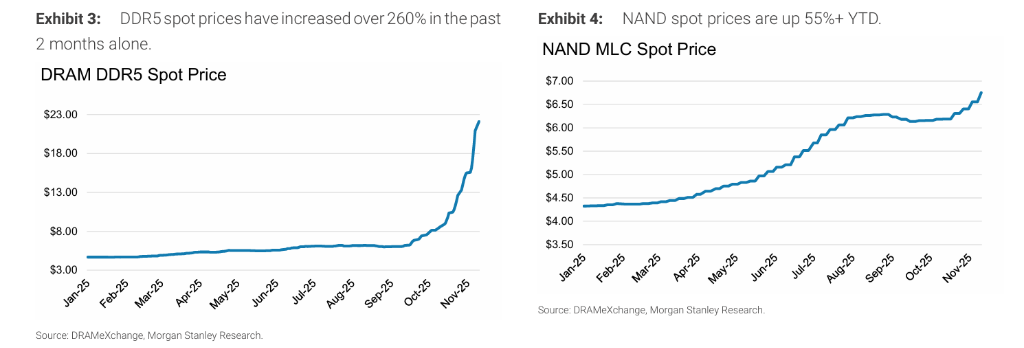
Core Viewpoint - The storage chip market is experiencing an unprecedented "super cycle" driven by AI demand and supply shortages, significantly impacting the profit outlook for PC and server manufacturers [1][3][4]. Group 1: Price Surge and Impact - Morgan Stanley warns that storage chip prices are skyrocketing due to AI demand and supply constraints, with DRAM spot prices soaring over 260% in just two months [1][5]. - The report indicates that the cost of storage chips (NAND and DRAM) constitutes 10%-70% of the BOM for high-end products, leading to a potential decline in hardware OEM gross margins by 45 to 150 basis points for every 10% increase in storage chip prices [3][6]. - The current price surge is unprecedented, with NAND flash prices rising over 50% since the beginning of the year [5][6]. Group 2: Drivers of Price Increase - The price surge is primarily driven by accelerated procurement from large cloud service providers for AI infrastructure, a spike in demand for high-bandwidth memory (HBM) for AI accelerators, and insufficient investment in NAND capacity over the past few years [6][10]. - Morgan Stanley predicts that contract prices for both NAND and DRAM could see double-digit percentage increases each quarter until 2026, far exceeding the previous cycle from 2016-2018 [6][10]. Group 3: Historical Context and Comparison - The previous storage super cycle from 2016 to 2018 serves as a reference point, where OEM margins and stock valuations began to decline 6 to 12 months after prices started to rise [8][10]. - Key differences in the current cycle include a more rapid price increase and a weaker demand environment for non-AI hardware compared to the previous cycle [10][11]. Group 4: Company Ratings and Vulnerabilities - Morgan Stanley has downgraded ratings for several major hardware companies, citing dual pressures on profits and valuations [12][13][14]. - Dell Technologies was downgraded from "Overweight" to "Underweight," with a target price cut from $144 to $110, due to significant impacts from rising storage costs [13]. - HP's rating was lowered from "Market Perform" to "Underweight," with a target price adjustment from $26 to $24, as profit margin pressures overshadow market recovery [14]. - Lenovo's rating was adjusted from "Overweight" to "Market Perform," as over 60% of its PC business targets the enterprise market, which is better positioned to pass on cost increases [17]. Group 5: Market Segmentation and Resilience - Different hardware manufacturers face varying levels of risk, with PC and server manufacturers more exposed due to their reliance on DRAM [18][20]. - Companies like Apple and Pure Storage are viewed as more resilient due to strong supply chain negotiation power and better pricing capabilities [20]. - Memory chip manufacturers such as Micron Technology, SK Hynix, and Samsung Electronics are expected to be direct beneficiaries of this super cycle [20].


存储芯片疯狂涨价,PC与服务器厂商受伤!大摩:每涨10%,OEM毛利率就下降45-150个基点
Hua Er Jie Jian Wen· 2025-11-17 09:01
Core Insights - A significant "super cycle" in storage chips is impacting the profit outlook for PC and server manufacturers, with Morgan Stanley warning of severe profit margin erosion due to skyrocketing storage chip prices [1][2][3] Price Surge and Market Dynamics - The current price surge in storage chips is driven by increased demand from AI infrastructure, a shift towards high bandwidth memory (HBM), and insufficient investment in NAND flash memory [2][7] - DRAM spot prices have surged over 260% in the past two months, while NAND flash prices have increased by over 50% since the beginning of the year [3][7] Historical Context and Comparison - The previous storage super cycle from 2016 to 2018 serves as a reference point, where OEM profit margins and stock valuations faced pressure after a similar price increase [9][11] - Key differences in the current cycle include a more rapid price increase and a weaker demand environment for non-AI hardware compared to the previous cycle [11][13] Impact on Hardware Manufacturers - Morgan Stanley has downgraded ratings for several global hardware giants, predicting dual pressure on profits and valuations [14] - PC and server manufacturers, particularly those heavily reliant on DRAM, are identified as the most vulnerable, with Dell, HP, Asus, and Acer being the most affected [15][17] Company-Specific Ratings Changes - Dell Technologies: Downgraded from "Overweight" to "Underweight," target price reduced from $144 to $110 due to severe impact from rising storage costs [17] - HP Inc.: Downgraded from "Market Perform" to "Underweight," target price lowered from $26 to $24 as profit margin pressures offset market recovery [17] - Asus: Downgraded from "Market Perform" to "Underweight," target price cut from NT$625 to NT$500 due to reliance on price-sensitive consumer markets [17] - Lenovo Group: Downgraded from "Overweight" to "Market Perform," with over 60% of its PC business targeting the enterprise market, which is better positioned to absorb cost increases [17]
Morgan Stanley slashes ratings on Dell, HP and HPE amid memory spike
Yahoo Finance· 2025-11-17 07:14
Core Viewpoint - Rising memory costs and weakening non-AI hardware demand have led Morgan Stanley to downgrade ratings for major technology hardware manufacturers, indicating increasing margin pressure across the sector [1] Group 1: Memory Cost Impact - Analysts describe the current situation as a "memory supercycle," with NAND and DRAM spot prices increasing between 50% and 300% over the past six months, which is expected to negatively impact earnings until 2026 [2] - Historical trends show that hardware OEMs typically experience gross-margin compression 6-12 months after memory costs rise, with a projected median decline of 60 basis points in global OEM margins by 2026, contrary to Wall Street's expectations of slight margin expansion [2] Group 2: Company-Specific Downgrades - Dell Technologies has been double-downgraded to "underweight" from "overweight" due to its high dependence on memory-intensive products and a shift towards AI servers with lower margins [3] - Morgan Stanley has reduced Dell's price target from $144 to $110 and lowered its fiscal 2027 gross-margin forecast to 18.2%, a decrease of 220 basis points from previous estimates, alongside a 12% reduction in EPS estimates [4] - HP Inc. has also been downgraded to "underweight" from "equal-weight," with its price target cut from $26 to $24, as higher DRAM and NAND prices are expected to pressure its Personal Systems margins [4][5] - The fiscal 2026 gross-margin outlook for HP has been reduced by 90 basis points to 19.7%, leaving it 130 basis points below consensus, with a projected 9% decline in EPS despite an increase in revenue estimates to $56.5 billion [5] Group 3: Hewlett Packard Enterprise Adjustments - Hewlett Packard Enterprise's rating has been lowered to "equal-weight" from "overweight," with a price target reduction from $28 to $25, as integration challenges and rising component costs are anticipated to limit profitability [6] - The fiscal 2026 gross-margin forecast for HPE has been cut by 260 basis points to 32.9%, balancing expected benefits from networking with the negative impact of higher memory prices, and EPS estimates have been lowered to $2.18 from $2.52 [7]
全球科技领域 - 存储芯片挤压硬件利润率-Global Technology Hardware-Memory Takes A Bite Out of Hardware Margins
2025-11-17 02:42
Summary of Key Points from the Conference Call Industry Overview - The report focuses on the **Global Technology Hardware** industry, specifically the **Hardware OEM/ODMs** sector, which is facing increasing margin pressure due to a **memory supercycle** amidst weak hardware demand [1][8][9]. Core Insights and Arguments - **Memory Pricing Surge**: Memory prices (NAND and DRAM) have surged by **50-300%** in the last six months, driven by demand from hyperscalers and underinvestment in NAND [9][11]. - **Earnings Risk**: The memory supercycle poses a downside risk to Hardware OEM earnings heading into **2026**, with memory costs accounting for **10-70%** of product costs [9][12]. - **Historical Context**: The last memory cycle (2016-2018) saw a **median gross margin compression of 70bps** year-over-year, indicating potential future earnings pressure for OEMs with high memory exposure [10][11]. - **Current Demand Trends**: The current demand for non-AI hardware is tepid, with enterprise hardware budget growth projected at only **1.6%** year-over-year in **2026**, which is below historical averages [12][15]. - **Downgrades**: Several companies, including **DELL**, **HPQ**, **Asustek**, and **Pegatron**, have been downgraded to **Underweight** due to expected margin pressures and negative EPS revisions [21][22]. Company-Specific Changes - **Dell Technologies (DELL)**: Downgraded to **Underweight** with a new price target of **$110**, down from **$144** [21]. - **HP Inc. (HPQ)**: Downgraded to **Underweight** with a new price target of **$24**, down from **$26** [21]. - **Asustek**: Downgraded to **Underweight** with a new price target of **NT$500**, down from **NT$625** [21]. - **Pegatron**: Downgraded to **Underweight** with a new price target of **NT$58**, down from **NT$73** [21]. - **Hewlett Packard Enterprise (HPE)**: Downgraded to **Equal-weight** with a new price target of **$25**, down from **$28** [21]. - **Lenovo**: Downgraded to **Equal-weight** with a new price target of **HK$10.20**, down from **HK$13.00** [21]. - **Giga-Byte**: Downgraded to **Equal-weight** with a new price target of **$290**, down from **$370** [21]. Additional Important Insights - **Mitigation Strategies**: OEMs are expected to respond to rising memory costs through pricing increases and cost management strategies, but even with these efforts, gross margins are projected to compress by **60bps** year-over-year in **2026** [12][19]. - **Risk Factors**: Potential risks include being too early in the call regarding margin pressures, successful mitigation actions, and strong demand for AI infrastructure that could overshadow margin concerns [17][18]. - **Investment Opportunities**: Companies like **Apple**, **Micron**, and **SK Hynix** are highlighted as potential beneficiaries of the memory cycle due to their strong demand trends and margin resilience [18][58]. Conclusion - The hardware OEM/ODM sector is facing significant challenges due to rising memory costs and weak demand, leading to downgrades for several key players. The historical context of memory cycles suggests that margin pressures could persist, making it crucial for investors to monitor these developments closely.
Independent Analysis Confirms HPQ Fumed Silica Reactor Produces Commercial-Grade Material at Pilot Scale
Globenewswire· 2025-11-12 12:00
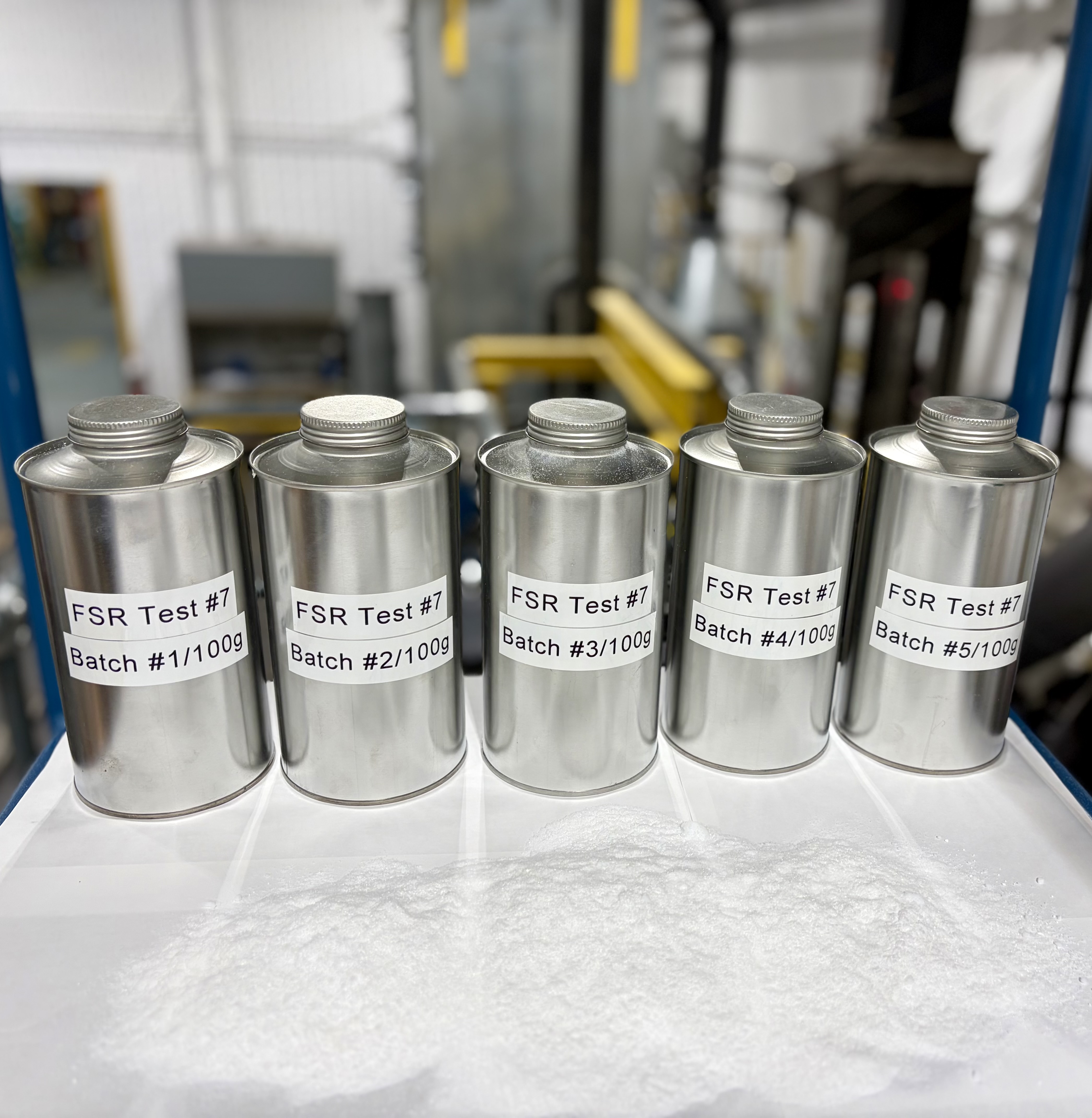
Core Insights - HPQ Silicon Inc. has achieved a significant milestone by producing commercial-grade fumed silica with superior surface area and purity at pilot scale, confirming the scalability and performance of its proprietary Fumed Silica Reactor (FSR) technology [1][2][3] Production and Quality Achievements - Independent laboratory analysis confirmed that the latest pilot-scale run produced fumed silica with a specific surface area ranging from 168.44 to 191.17 m²/g, representing a 20% to 40% improvement from the previous test [9] - The purity of the produced material reached 99.74% to 99.83%, surpassing the 99% commercial baseline [9] - The results validate HPQ's ability to replicate and exceed lab-scale data, achieving up to 191 m²/g and 99.8% purity, positioning the material within the upper end of commercial specifications [3][4] Technological Advancements - The FSR technology allows for the production of hydrophilic fumed silica directly from quartz without the use of chlorosilanes or hazardous by-products, distinguishing it from conventional manufacturing processes [2][12] - The process consumes up to 87% less energy than traditional methods and reduces CO₂-equivalent emissions by 84%, offering significant environmental and financial advantages [19] Future Plans and Market Positioning - Following the successful completion of Test 7, HPQ and its partner PyroGenesis plan to optimize production to maintain consistent output near 200 m²/g and aim for a full design capacity of 50 tonnes per year [13] - HPQ intends to distribute sample batches to potential partners in various sectors, including coatings and advanced materials, which rely on high-surface-area fumed silica [14] - The global fumed-silica market is projected to exceed US$2.57 billion by 2034, and HPQ's technology positions it as a potential new entrant capable of capturing market share from established chemical giants [15]