JP MORGAN CHASE(JPM)

Search documents
摩通:美股牛市格局未改 标普500指数近期料突破7000点
Ge Long Hui A P P· 2025-11-07 03:57
Core Viewpoint - JPMorgan analysts believe that any pullback in the US stock market before 2026 will present a buying opportunity, with the S&P 500 index expected to break the 7000-point mark, indicating approximately a 3% upside from current levels [1] Group 1: Reasons for Bullish Outlook - Strong economic growth persists despite government shutdown causing data gaps [1] - Robust corporate earnings performance, with 83% of S&P 500 companies exceeding earnings expectations as of October, marking the best record since 2021 [1] - Macroeconomic headwinds are gradually dissipating, with a Supreme Court ruling on Trump tariffs likely to reduce policy uncertainty [1] Group 2: Market Dynamics - Several agreements have been reached, enhancing policy visibility [1] - Government reopening may release liquidity, boosting risk asset prices and potentially triggering a short squeeze in recently underperforming sectors [1] - Overall bull market structure remains solid, supported by earnings momentum and macro resilience, despite concerns over AI-driven valuations [1]
小摩下调Doordash目标价至300美元

Ge Long Hui A P P· 2025-11-07 03:23
Core Viewpoint - Morgan Stanley has lowered the target price for DoorDash from $325 to $300 while maintaining an "Overweight" rating [1] Group 1 - The target price adjustment reflects a strategic reassessment of DoorDash's market position and growth potential [1] - The decision to maintain the "Overweight" rating indicates continued confidence in DoorDash's long-term prospects despite the price reduction [1]
全球液化天然气分析 2035_液化天然气供应增长凸显需求侧基础设施必要性-Global LNG Analyzer 2035_ Rising LNG supply underscores need for demand-side infrastructure
2025-11-07 01:28
Summary of Global LNG Market Analysis Industry Overview - The global LNG market is entering a multi-year period of unprecedented supply expansion, with approximately **400 Bcm/year** of new projects under construction and scheduled to come online between **2025 and 2035** [6][21][50] - The US leads the export project pipeline, accounting for **51%** of total capacity under construction, followed by Qatar (**17%**), Canada/Mexico (**10%**), and the UAE (**3%**) [6][21][26] Demand Dynamics - Demand growth in key established LNG markets—China, Japan/South Korea, and Europe—is slowing [6][21] - China is expected to see LNG imports peak at **120 Bcm** in **2032** [6][21] - Japan and South Korea are increasingly prioritizing nuclear and renewables, reducing reliance on imported LNG and coal, with projected growth of **15 Bcm** in LNG imports between **2025 and 2035** [6][21] - European LNG imports are projected to grow moderately by **26 Bcm** over the next decade [6][21] Emerging Markets - The onus to accommodate new LNG supply is shifting to emerging LNG markets in APAC (Taiwan, India, Thailand, Pakistan, Bangladesh, Indonesia), where demand is expected to more than double from **127 Bcm** in **2025** to **280 Bcm** by **2035** [6][21] - However, the APAC gas market faces significant challenges, including tightening regasification capacity and limited gas storage infrastructure [6][21] Infrastructure Needs - Upgrading demand-side infrastructure will be critical for global LNG demand growth to keep pace with the anticipated supply expansion [6][21] - The spread between US and global natural gas prices is expected to narrow, with the US emerging as the marginal supplier [6][21] Regional Insights North America - The US is projected to add approximately **26 Bcm/year** of liquefaction capacity in **2026**, with significant growth expected in **2028 and 2029** [31] - Canada is also expanding its LNG export capacity, with projects like LNG Canada and Coastal GasLink pipeline [32][33] Middle East - Qatar's LNG capacity increases represent the second-largest source of new supply after the US, with significant projects like North Field East and North Field South [34][38] Africa - Africa is the third-largest region for new LNG export capacity additions, led by Mozambique LNG and Nigeria [75][76] - Security concerns in Mozambique and operational challenges in Nigeria may hinder capacity utilization [80] Australia and the Pacific - Australia's LNG exports are expected to marginally increase in the near term but face long-term challenges due to resource constraints and regulatory risks [56][60] - Indonesia is undergoing a transformation in its natural gas sector, with new offshore discoveries expected to boost production [68] Conclusion - The global LNG market is poised for significant changes driven by supply expansions, shifting demand dynamics, and the need for infrastructure upgrades. Emerging markets in APAC will play a crucial role in absorbing new supply, while established markets face challenges in growth. The interplay between supply and demand will shape pricing and operational strategies in the coming years [6][21][50]
全球宏观展望策略报告_ 全球利率、大宗商品、货币与新兴市场-Global Macro Outlook Strategy presentation_ Global Rates, Commodities, Currencies and Emerging Markets
2025-11-07 01:28
Summary of Key Points from the Conference Call Industry Overview - **Global Macro Outlook**: The conference call discusses the macroeconomic outlook, focusing on US rates, international rates, commodities, currencies, and emerging markets [3][4][5][6][7]. Core Insights and Arguments US Rates - **Yield Trends**: Yields have increased following a hawkish FOMC meeting and positive labor market signs. However, significant yield increases are unlikely without confirmation from key labor market data [3][20]. - **Market Positioning**: The market is pricing in a more dovish Fed than expected, leading to a bearish bias on duration. Recommendations include 50:50 weighted 5s/10s/30s belly-cheapening butterflies as a low-beta bearish trade [3][20][15]. - **Treasury Financing**: A smaller financing gap is anticipated, with Treasury expected to maintain coupon auction sizes until November 2026, after which increases will focus on the front end and belly of the curve [21][24]. International Rates - **Eurozone and UK**: A neutral stance on Euro duration is maintained in the near term, with a medium-term bullish bias. In the UK, a tactical position on 1Yx1Y SONIA is recommended due to market pricing being below terminal rate forecasts [4][36][38]. Commodities - **Oil Supply Dynamics**: The risk of supply disruptions has increased, but declines in physical exports are expected to be temporary. Russia's shadow fleet has grown significantly, now representing nearly 20% of the global oil tanker fleet [78]. - **LNG Market Expansion**: The global LNG market is entering a period of unprecedented supply expansion, with approximately 400 Bcm/year of new projects expected to come online between 2025 and 2035 [83]. Currencies - **Dollar Outlook**: The near-term outlook for the dollar is uncertain due to a shift in Fed tone and rising real yields. A tactical truce between the US and China is expected to have limited near-term FX impacts [59][63]. - **Emerging Market Currencies**: The recommendation is to stay overweight on EM FX while cutting EM rates overweight size in half, reflecting a more optimistic growth outlook [7][8]. Emerging Markets - **Investor Positioning**: Aggregate investor positioning increased by 2% week-over-week, with significant increases in grains and oilseeds markets, offset by a decline in livestock positioning [87][97]. Other Important Insights - **China's Property Market**: Monthly property completions in China turned positive for the first time in 20 months, with a 0.3% year-over-year increase in September [87]. - **NEV Production**: Record production of new energy vehicles (NEVs) in China reached 1.5 million in September, marking a 33% year-to-date growth [87]. - **Gold Market**: Gold prices are projected to reach an average of $5,055/oz by 4Q26, driven by strong demand from investors and central banks [92]. This summary encapsulates the key points discussed in the conference call, providing insights into the macroeconomic landscape, market positioning, and sector-specific developments.
“获利了结”的机构正评估“重新入场黄金”时机:短期焦点是“黄金ETF”的粘性
Hua Er Jie Jian Wen· 2025-11-07 00:43
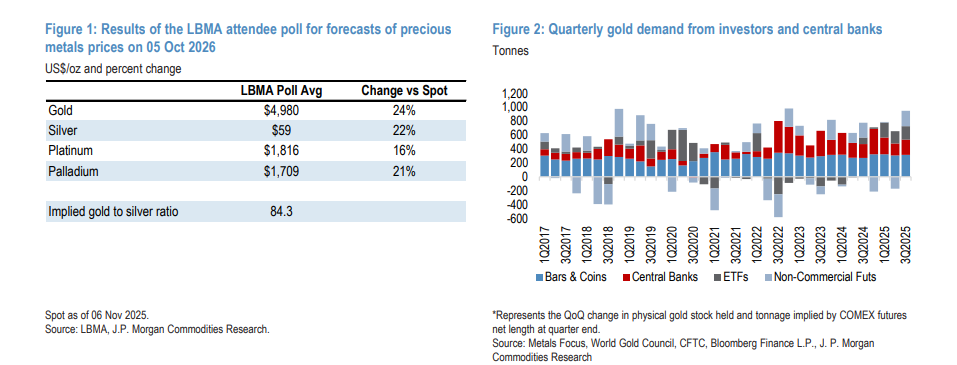
Core Viewpoint - The market is currently in a critical phase following a significant rise and subsequent pullback in gold prices, with institutional investors maintaining a positive medium-term outlook despite short-term profit-taking [1] Group 1: Market Sentiment and Price Predictions - Morgan Stanley's report indicates that despite recent price corrections, institutional investors remain optimistic about gold's long-term prospects, predicting an average price of $4,980 per ounce by the next LBMA meeting in October 2026 [1][2] - The report highlights a remarkable demand surge in Q3 2025, with total demand from investors and central banks reaching approximately 950 tons, equivalent to about $106 billion, which is nearly 50% higher than the average of the previous four quarters [1] Group 2: Short-term Focus and ETF Flows - Many institutional investors have taken profits during the recent price surge and are now assessing the timing and price for re-entry, with a focus on the "stickiness" of recent ETF flows [3] - Data shows a net outflow of about 35 tons from global gold ETFs over the past two weeks, which is only half of the record inflow of 62 tons recorded in the week ending October 17 [3] Group 3: Central Bank Purchases - The report emphasizes that ongoing, price-insensitive purchases by global central banks are a cornerstone supporting the long-term bull market for gold [7] - In Q3 2025, global central bank net gold purchases reached 220 tons, a 30% increase quarter-on-quarter, with an annualized purchase rate of 880 tons [7][10] Group 4: Demand Dynamics - There is a noticeable divergence in physical demand, with gold jewelry demand declining by 19% year-on-year in Q3 2025, particularly in India where it fell by 31% [11] - Conversely, retail demand for gold bars and coins has remained robust, growing by 17% year-on-year, partially offsetting the decline in jewelry demand [12][15] Group 5: Potential Risks and Market Dynamics - The report warns of potential risks related to gold recycling supply, which has seen only moderate growth despite high prices, with a 1% quarter-on-quarter decline in Q3 2025 [16] - A market dynamic to watch is the potential for panic selling if market sentiment reverses, which could lead to a surge in recycled gold supply and exacerbate downward price pressure [17]

OpenAI高管言论引发风暴,AI板块再遭抛售!纳指跌近2%
Xin Lang Cai Jing· 2025-11-07 00:16
Core Viewpoint - The recent comments from OpenAI executives regarding seeking government backing for their investments have sparked significant market reactions, leading to declines in major tech stocks and raising concerns about an "AI bubble" [1][3][6]. Market Reaction - The S&P 500 index fell by 1.12% to 6720.32 points, the Nasdaq Composite dropped by 1.9% to 23053.99 points, and the Dow Jones Industrial Average decreased by 0.84% to 46912.3 points [2]. - Major tech stocks led the decline, with Nvidia down 3.65%, Tesla down 3.5%, and Microsoft experiencing a seven-day losing streak [2][8]. OpenAI's Clarification - OpenAI's CFO Sarah Friar initially suggested the need for a financial ecosystem involving banks, private equity, and federal government support for their chip investments, which was misinterpreted as seeking government guarantees [2][4]. - Following the backlash, both Friar and CEO Sam Altman clarified that OpenAI does not intend to seek government backing for its infrastructure investments and emphasized that if the company fails, it should be allowed to fail [6][7]. Future Projections - Altman projected that OpenAI's annual revenue is expected to exceed $20 billion, potentially reaching "hundreds of billions" by 2030, with plans to launch enterprise-level products and expand into consumer electronics and robotics [6]. - Altman also suggested that the government should establish a "national strategic computing reserve" to sign power procurement agreements for public benefit, rather than to support private companies [6]. Employment Impact - The Challenger report indicated that U.S. employers cut over 150,000 jobs in October, the highest number in over two decades, influenced by cost-cutting measures and the adoption of AI [8].


英伟达↓3.65%、特斯拉↓3.5%、苹果↓0.1%、微软↓1.98%、谷歌↑0.2%、亚马逊↓2.86%、Meta↓2.67%
财联社· 2025-11-06 23:45
Core Viewpoint - The article discusses the recent decline in major tech stocks due to concerns over the U.S. job market and misinterpretations of OpenAI executives' statements regarding government backing for AI investments [1][3]. Group 1: OpenAI's Financial Strategy - OpenAI's CFO, Sarah Friar, indicated the company is seeking a financial ecosystem involving banks, private equity, and federal government guarantees to support its substantial chip investments [2]. - Following public backlash, Friar clarified that OpenAI is not seeking government guarantees for its infrastructure investments, and the term "backstop" was misinterpreted [3][6]. - CEO Sam Altman emphasized that OpenAI does not intend to seek government backing and is prepared to face failure without federal support, while projecting annual revenues to exceed $20 billion and potentially reach "hundreds of billions" by 2030 [6]. Group 2: Market Reactions and Employment Trends - The Challenger report revealed that U.S. employers cut over 150,000 jobs in October, marking the highest number of layoffs in that month in over two decades, influenced by cost-cutting and AI adoption [8]. - The tech sector is experiencing greater labor market risks compared to 2022, as layoffs are not being absorbed by other industries as quickly as before [8]. Group 3: Stock Performance - Major tech stocks saw declines, with Nvidia down 3.65%, Apple down 0.14%, and Microsoft down 1.98%, among others, reflecting the overall market sentiment [9]. - Duolingo, a language learning platform, experienced a significant drop of 25% due to disappointing earnings guidance, while an unnamed food delivery platform fell 17.45% for similar reasons [11]. - Chinese stocks showed mixed performance, with Alibaba up 1.69% and JD down 0.28%, indicating varied investor sentiment in the Chinese market [12].

X @Bloomberg
Bloomberg· 2025-11-06 19:18
JPMorgan bought Argentine pesos last month on behalf of the US Treasury as Secretary Scott Bessent tried to shore up the country’s libertarian leader before a pivotal election, according correspondence released by Senator Elizabeth Warren. https://t.co/0BV6uBxGnd ...
JEPI vs JEPQ vs QQQI: Which One Should You Buy in November 2025?
Yahoo Finance· 2025-11-06 19:11
Core Insights - A new type of exchange-traded fund (ETF) is gaining traction, particularly among retail investors interested in options trading, with ETFs like JPMorgan Equity Premium Income ETF (JEPI), JPMorgan Nasdaq Equity Premium Income ETF (JEPQ), and NEOS Nasdaq-100 High Income ETF (QQQI) offering attractive yields and index exposure [1][2] ETF Overview - The ETFs mentioned provide monthly income through a strategy that involves systematic call writing, appealing to retirees and income-focused investors [2] - JEPI primarily invests in U.S. large-cap stocks from the S&P 500 Index and employs an options overlay strategy by selling out-of-the-money call options [3][4] - JEPQ follows a similar strategy but focuses on Nasdaq-100 stocks, offering a yield of 10.17% [6][8] - QQQI provides the highest yield at 13.29% but has a higher expense ratio of 0.68% [7] Performance Metrics - JEPI has an 8.35% dividend yield and a 0.35% expense ratio, while it is down 2% year-to-date, excluding dividends [5] - The combination of these ETFs has attracted billions in investments during 2024 and early 2025, indicating strong market interest [2]
JPMorgan Chase & Co. (JPM) Presents at The BancAnalysts Association of Boston Conference Transcript
Seeking Alpha· 2025-11-06 19:06
Group 1 - The consumer health appears to be in good shape despite some signs of softening in the labor markets [1] - Recent data points indicate resilience in consumer spending across different income segments [1]