
Luckin Coffee(LKNCY)

Search documents
瑞幸CEO郭谨一:外卖补贴推动订单量爆发式增长 但咖啡业务将回归自提为主常态
Mei Ri Jing Ji Xin Wen· 2025-11-17 15:00
Core Insights - Luckin Coffee reported a net revenue of 15.29 billion RMB for Q3 2025, representing a year-on-year growth of 50% [2] - The company achieved a net profit of 1.28 billion RMB, which is a slight decline of 1.9% year-on-year [2] Revenue and Profit Analysis - The significant increase in net revenue indicates strong demand and effective business strategies [2] - The slight decrease in net profit suggests potential cost pressures or changes in operational efficiency [2] Market Dynamics - CEO Guo Jinyi highlighted that the subsidies in the delivery channel have led to explosive growth in order volume and customer numbers [2] - As subsidies shift towards a more refined approach, the company anticipates challenges and pressures for same-store growth in 2026 [2] - Guo also stated that the delivery model may not be the optimal solution for coffee, indicating a potential shift back to a self-pickup model [2] Strategic Focus - The company is currently focused on executing its business strategy and does not have a clear timeline for returning to the main board of the U.S. capital market [2]


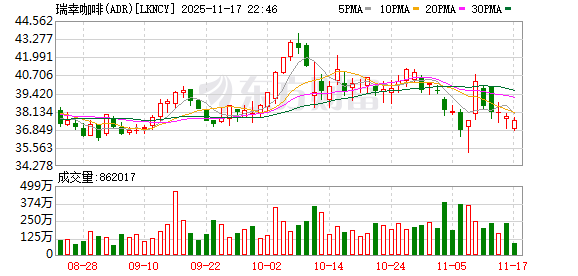
瑞幸CEO郭谨一:外卖补贴推动订单量爆发式增长,但咖啡业务将回归自提为主常态
Mei Ri Jing Ji Xin Wen· 2025-11-17 15:00
Core Insights - Luckin Coffee reported a net revenue of 15.29 billion RMB for Q3 2025, representing a year-on-year growth of 50% [1] - The company achieved a net profit of 1.28 billion RMB, which is a decline of 1.9% compared to the previous year [1] Revenue and Profit Analysis - The significant increase in net revenue indicates strong demand and effective business strategies [1] - The slight decrease in net profit suggests potential cost pressures or changes in operational efficiency [1] Market Dynamics - CEO Guo Jinyi highlighted that the subsidies in the delivery channel have led to explosive growth in order volume and customer numbers [1] - As subsidies shift towards a more refined approach, the company anticipates challenges and pressures for same-store growth in 2026 [1] - Guo emphasized that the delivery model may not be the optimal solution for coffee, indicating a potential shift back to a self-pickup model [1] Strategic Focus - The company is currently focused on executing its business strategy and does not have a clear timeline for returning to the main board of the U.S. capital market [1] - Continuous monitoring of the U.S. capital market remains a priority for the company [1]
零售周报|LVMH旗下多店亮相北京;汉堡王中国83%股权花落CPE源峰
Sou Hu Cai Jing· 2025-11-17 14:45
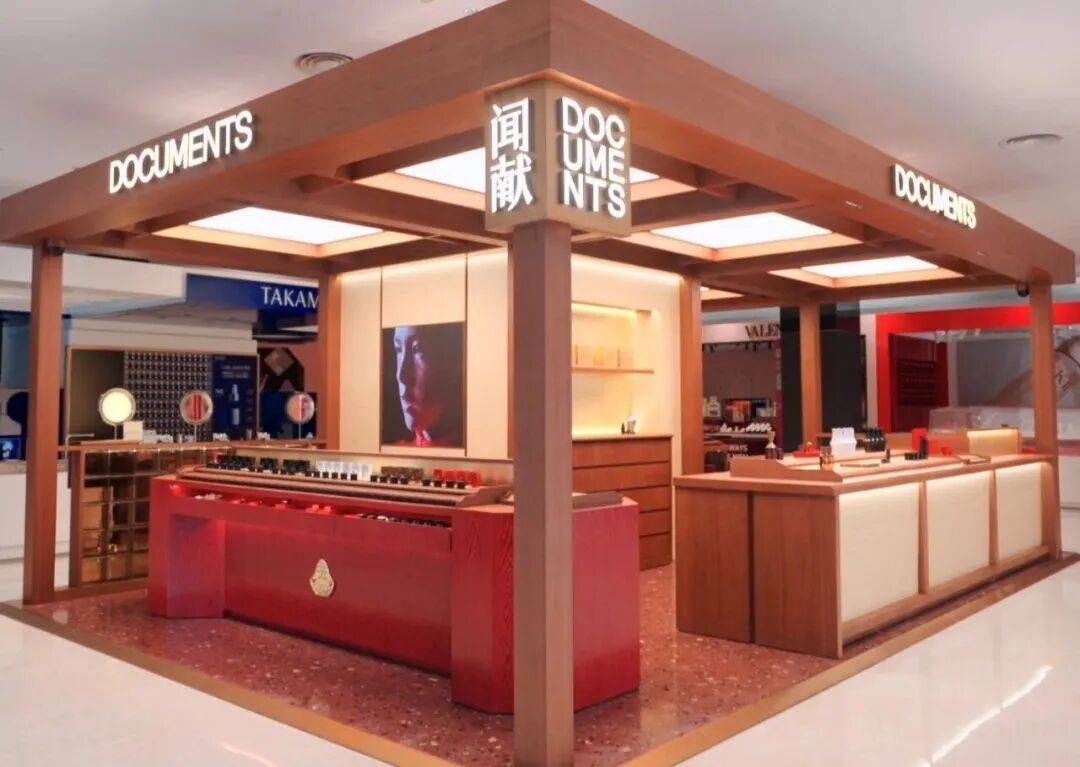
Group 1 - Hainan's new duty-free policy generated over 500 million yuan in sales during its first week, with a year-on-year increase of 34.86% in shopping amount and 3.37% in visitor numbers [1] - The first store of the high-end fragrance brand "Wenxian" opened in Wuxi, featuring a design that integrates local culture and aesthetics [3] - Shanghai Tang opened its first store in South China, showcasing a blend of innovative design and traditional Eastern aesthetics [5] Group 2 - The world's first humanoid robot-themed retail flagship store opened in Shenzhen, featuring interactive robots and a futuristic design [7] - SHEIN opened its first physical store in Paris, with plans to expand to six more locations in France by the end of November [10] - LVMH plans to open several new flagship stores in Beijing in December, marking a significant expansion in the Chinese market [12][13] Group 3 - CPE Yuanfeng acquired an 83% stake in Burger King China, with plans to expand the number of stores from approximately 1,250 to over 4,000 by 2035 [14] - Luckin Coffee's major shareholder is considering a bid for Costa Coffee, which is currently valued at around 1 billion pounds [17] - Haidilao's pizza brand "Xiao Hai Ai Zha" opened its first store in Xi'an, with plans for further expansion [21] Group 4 - Pet food brand "Pet & Fresh" is closing all its stores, with several already marked as closed or paused [22][24] - Sam's Club opened its 60th store in China, located in Yangzhou [26] - Walmart announced a leadership change, appointing John Furner as the new CEO effective February 2026 [27][29] Group 5 - Chaohe Suan NB is expanding nationwide, recruiting for various positions across multiple provinces [31] - JD.com is set to open its first discount supermarket in Beijing, with an area of approximately 5,000 square meters [32] - Richemont reported a 5% increase in total sales, with a significant 17% growth in sales from its four major jewelry brands in the second quarter [33][34] Group 6 - Gao Xin Retail reported a revenue of 30.502 billion yuan for the first half of the fiscal year, with plans to renovate over 200 stores before the next fiscal year [35]
瑞幸咖啡三季度总净收入超150亿元,同比增长50%
Xin Lang Cai Jing· 2025-11-17 14:40
Core Insights - Luckin Coffee reported a total net revenue of 15.287 billion yuan for Q3 2025, marking a year-on-year increase of 50.2% [1] - The company achieved an operating profit of 1.777 billion yuan, with an operating profit margin of 11.6% [1] - The total number of stores reached 29,214, with a net increase of over 3,000 stores in the quarter [1] Financial Performance - Q3 total net revenue was 15.287 billion yuan, a 50.2% increase year-on-year [1] - Operating profit for the quarter was 1.777 billion yuan, with a profit margin of 11.6% [1] - Self-operated store revenue was 11.08 billion yuan, up 47.7% year-on-year, while operating profit from these stores was 1.941 billion yuan, a 10.2% increase [1] Store Expansion - The total number of stores reached 29,214, with a net increase of 3,000 stores in Q3 [1] - In China, the company added 2,979 stores, bringing the total to 29,096, with franchise stores exceeding 10,000 for the first time at 10,287 [1] - Internationally, the company added 29 stores, reaching a total of 118 stores across Singapore, the United States, and Malaysia [1] Customer Growth - The company added over 42 million new transaction customers in Q3, with an average monthly transaction customer count of 112 million, a 40.6% year-on-year increase [2] - Cumulative transaction customer count surpassed 420 million by the end of Q3 [2] Market Challenges - The company faces significant market challenges from traditional competitors employing low-price strategies [2] - New entrants like JD.com with its "Seven Fresh Coffee" plan are intensifying competition in the coffee market [2] - Industry analysis suggests that the company must maintain price competitiveness while innovating products and exploring overseas markets for growth [2]
瑞幸咖啡Q3营收猛增50%,利润却降了!开店狂潮仍在继续
Sou Hu Cai Jing· 2025-11-17 14:13
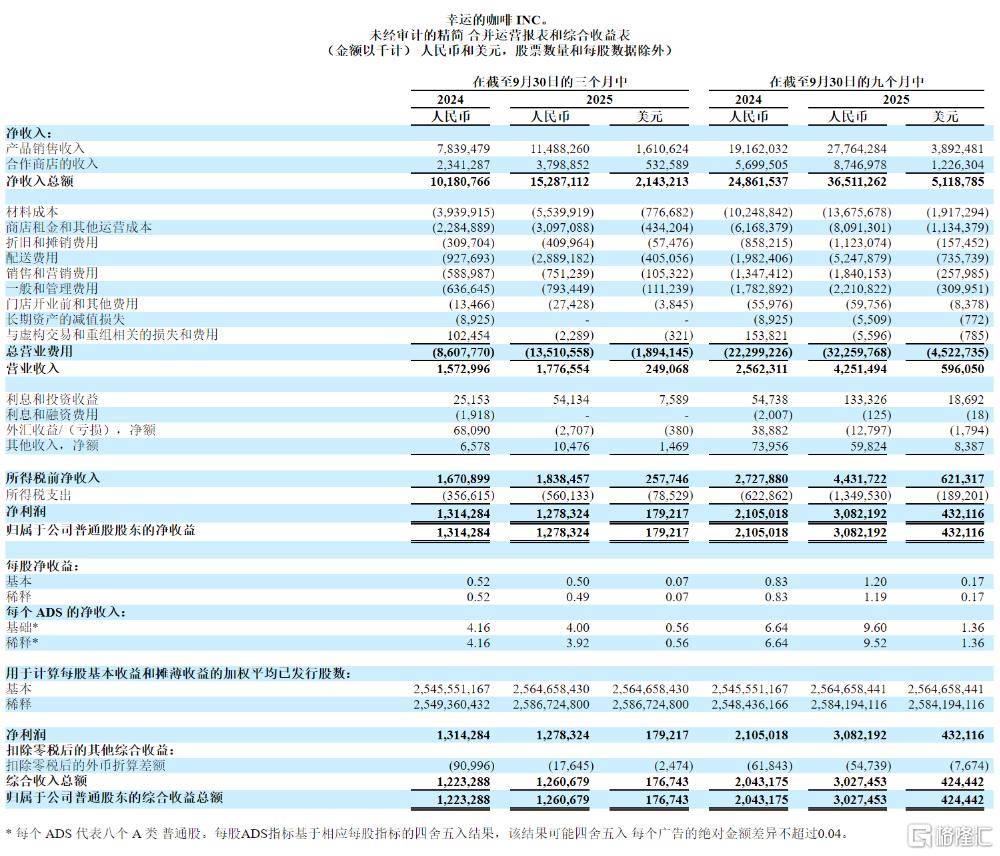
Core Insights - The company reported a net revenue of 15.29 billion RMB for Q3 2025, representing a year-on-year growth of 50.2%, while net profit decreased by 1.9% to 1.28 billion RMB [1][2] - Adjusted earnings per ADS for Q3 2025 were 4.4 RMB, with GAAP operating profit at 1.777 billion RMB, up 12.9%, and Non-GAAP operating profit at 1.926 billion RMB, up 15.2% [1][2] Financial Performance - Total revenue for Q3 2025 was 15.29 billion RMB, with product sales contributing 11.49 billion RMB and partner store revenue at 3.80 billion RMB [2] - Total operating expenses for Q3 2025 reached 13.51 billion RMB, a 57.0% increase year-on-year, driven by business expansion [4] - The company reported a gross profit of 1.78 billion RMB for Q3 2025, with a gross margin decline from 15.5% to 11.6% [1][4] Store Operations - Self-operated store revenue for Q3 2025 was 11.08 billion RMB, a 47.7% increase, with same-store sales growth at 14.4% [4] - The total number of stores reached 29,214 by the end of Q3 2025, with 18,882 self-operated and 10,332 partner stores, marking an 11.5% increase from Q2 2025 [4] - The company opened 3,008 new stores in Q3 2025, including 2,979 in China [4] Customer Metrics - The company added over 42 million new transaction customers in Q3 2025, with a monthly average customer count of 112 million, a 40.6% year-on-year increase [4] - Cumulative transaction customers surpassed 420 million by the end of Q3 2025 [4] Management Commentary - The CEO emphasized the company's scale-oriented strategy, highlighting strong revenue growth and double-digit same-store sales increases [5] - The company aims to continue product innovation and enhance brand value to sustain long-term growth [5]
瑞幸咖啡三季度总净收入152.87亿元 净增门店数3008家
Zheng Quan Shi Bao Wang· 2025-11-17 13:29
在国际市场,瑞幸咖啡保持稳健发展节奏,第三季度净增29家门店,总门店数达到118家,其中包括: 新加坡自营门店68家,美国自营门店5家,马来西亚加盟门店45家。 "展望未来,我们仍将继续致力于产品创新与品牌价值提升,不断为客户提供高品质、高性价比、高便 利性的产品与服务,这是我们持续扩大用户规模的基石,也是瑞幸实现长期可持续增长的关键驱动 力。"郭谨一表示。 在门店方面,瑞幸咖啡保持较快的开店速度,第三季度净新开门店3008家,全球门店总数截至第三季度 末达29214家。在中国市场,第三季度净增门店2979家,门店总数达29096家,含自营门店18809家,联 营门店正式破万,达10287家。 在客户方面,瑞幸咖啡三季度新增交易客户超4200万,月均交易客户数同比增长40.6%达1.12亿,以上 两个指标均创历史新高。截至三季度末,瑞幸咖啡的累计交易客户数突破4.2亿。 11月17日,瑞幸咖啡(OTC:LKNCY)公布2025年第三季度财报,2025年第三季度,瑞幸咖啡总净收 入为152.87亿元人民币,同比增长50.2%;GAAP营业利润17.77亿元人民币,营业利润率11.6%。月均交 易客户数达1.12 ...
瑞幸咖啡2025年第三季度新增交易客户超4200万 月均交易客户数达1.12亿
2 1 Shi Ji Jing Ji Bao Dao· 2025-11-17 13:24
第三季度,自营门店收入为110.80亿元人民币,同比增长47.7%。自营门店门店层面营业利润为19.41亿 元人民币,同比增长10.2%,自营门店同店销售增长率提升至14.4%。与此同时,联营门店收入同比增 长62.3%,至37.99亿元人民币。 在门店方面,瑞幸咖啡保持行业领先的开店速度,第三季度净新开门店3,008家,全球门店总数截至第 三季度末达29,214家。在中国市场,第三季度净增门店2,979家,门店总数达29,096家,含自营门店 18,809家,联营门店正式破万,达10,287家。在国际市场,瑞幸咖啡保持稳健发展节奏,第三季度净增 29家门店,总门店数达到118家,其中包括:新加坡自营门店68家,美国自营门店5家,马来西亚加盟门 店45家。 11月17日,瑞幸咖啡(OTC:LKNCY)公布2025年第三季度财报,围绕规模增长的核心战略,公司业 绩继续取得稳健发展。数据显示,2025年第三季度,瑞幸咖啡总净收入为152.87亿元人民币,同比增长 50.2%,GAAP营业利润17.77亿元人民币,营业利润率11.6%。月均交易客户数达1.12亿;门店总数增加 至29,214家。三季度GMV约为17 ...
瑞幸咖啡公布2025年第三季度财报,总净收入152.87亿元
Xin Lang Cai Jing· 2025-11-17 13:17
Core Insights - Luckin Coffee reported a total net revenue of 15.287 billion yuan for Q3 2025, representing a year-on-year growth of 50.2% [1] - The company achieved a GAAP operating profit of 1.777 billion yuan, with an operating profit margin of 11.6% [1] - The average monthly transacting customer count reached 112 million, with a total of over 420 million cumulative transacting customers by the end of Q3 [1] Financial Performance - Self-operated store revenue was 11.08 billion yuan, up 47.7% year-on-year, with an operating profit of 1.941 billion yuan, reflecting a 10.2% increase [1] - Same-store sales growth rate improved to 14.4% [1] - The total GMV for Q3 was approximately 17.32 billion yuan [1] Store Expansion - Luckin Coffee opened a net of 3,008 new stores in Q3, bringing the total number of stores to 29,214 [1] - In the Chinese market, 2,979 new stores were added, totaling 29,096 stores, including 18,809 self-operated and 10,287 partner stores [1] - Internationally, the company added 29 new stores, reaching a total of 118, including 68 self-operated stores in Singapore and 5 in the U.S. [1] Customer Growth - The company added over 42 million new transacting customers in Q3, with a year-on-year growth of 40.6% in average monthly transacting customers [1] - Cumulative transacting customers surpassed 420 million by the end of Q3 [1] Strategic Focus - The CEO emphasized a core strategy focused on scale growth, product innovation, and brand value enhancement as key drivers for sustainable long-term growth [2]
瑞幸咖啡第三季度营收153亿元 经调净利润14亿元
Xin Lang Cai Jing· 2025-11-17 12:51
来源:新浪科技 新浪科技讯 11月17日晚间消息,瑞幸咖啡(OTC:LKNCY)今日公布了截至9月30日的2025年第三季 度财报:总净营收为152.871亿元,同比增长50.2%。净利润为12.783亿元,而2024年同期净利润13.143 亿元。不按美国通用会计准则,净利润为14.214亿元,而2024年同期净利润14.125亿元。 第三季度,瑞幸咖啡平均每月交易客户为1.123亿,创历史新高,同比增长40.6%。 第三季度,瑞幸咖啡自营门店营收为110.803亿元(约合15.534亿美元),同比增长47.7%。 第三季度,瑞幸咖啡自营门店的同店销售额涨幅为14.4%,明显优于2024年同期的-13.1%。 门店级运营利润——自营门店运营利润为19.412亿元(约合2.721亿美元),同比增长10.2%。门店级运 营利润为17.5%,而2024年同期为23.5%。 不按美国通用会计准则(Non-GAAP),运营利润为19.257亿元(约合2.700亿美元),同比增长 15.2%。不按美国通用会计准则,运营利润率为12.6%,而2024年同期运营利润率为16.4%。 第三季度,瑞幸咖啡联营店营收为37.98 ...
瑞幸咖啡:第三季度净营收152.9亿元,同比增长50.2%
Di Yi Cai Jing· 2025-11-17 12:27
瑞幸咖啡晚间公告,第三季度净营收152.9亿元人民币,同比增长50.2%;第三季度净利润12.8亿元人民 币,同比下降1.9%。 (文章来源:第一财经) ...
