Luckin Coffee(LKNCY)

Search documents
瑞幸咖啡第三季度净营收152.9亿元人民币,同比增长50%
Mei Ri Jing Ji Xin Wen· 2025-11-17 12:15
每经AI快讯,11月17日,瑞幸咖啡第三季度净营收152.9亿元人民币,同比增长50%;第三季度净利润 12.8亿元人民币,同比下降1.9%。 (文章来源:每日经济新闻) ...


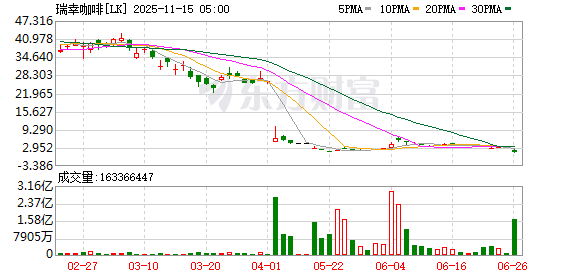
瑞幸咖啡:Q3净营收152.9亿元 同比增50%
Xin Lang Cai Jing· 2025-11-17 12:13
格隆汇11月17日丨瑞幸咖啡第三季度净营收152.9亿元人民币,同比增长50%;第三季度净利润12.8亿元 人民币,同比下降1.9%;第三季度经调整每股ADS净收益4.4元。 来源:格隆汇APP ...
瑞幸咖啡第三季度营收153亿元 净调净利润14亿元
Xin Lang Ke Ji· 2025-11-17 12:06
Core Viewpoint - Luckin Coffee reported significant growth in its third-quarter financial results for 2025, showcasing a strong recovery and profitability compared to the previous year [1] Financial Performance - Total net revenue reached 15.2871 billion yuan, representing a year-over-year increase of 50.2% [1] - The company achieved a net profit of 1.2783 billion yuan, a turnaround from a net loss of 1.3143 billion yuan in the same quarter of 2024 [1] - On a non-GAAP basis, net profit was 1.4214 billion yuan, compared to a net loss of 1.4125 billion yuan in the prior year [1]
瑞幸咖啡第三季度净营收152.9亿元人民币,同比增长50%;第三季度净利润12.8亿元人民币,同比下降1.9%
Hua Er Jie Jian Wen· 2025-11-17 12:01
Core Insights - Luckin Coffee reported a net revenue of 15.29 billion RMB for the third quarter, representing a year-on-year growth of 50% [1] - The company achieved a net profit of 1.28 billion RMB in the third quarter, which is a year-on-year decrease of 1.9% [1]
Luckin Coffee Announces Third Quarter 2025 Financial Results
Globenewswire· 2025-11-17 12:00
Core Insights - Luckin Coffee reported a significant increase in net revenues, which rose by 50.2% year-over-year to RMB 15.3 billion (approximately US$2.14 billion) for the third quarter of 2025 [1][5][6] - The company achieved a record high of 112.3 million average monthly transacting customers, reflecting a 40.6% year-over-year increase [1][5][6] - The total number of stores increased to 29,214, with 3,008 net new store openings during the quarter [1][5][6] Financial Performance - Revenues from self-operated stores reached RMB 11,080.3 million (US$1,553.4 million), marking a 47.7% year-over-year increase [5][8] - Same-store sales growth for self-operated stores was 14.4%, a significant improvement from negative 13.1% in the same quarter of 2024 [5][8] - GAAP operating income was RMB 1,776.6 million (US$249.1 million), representing a 12.9% year-over-year increase [11][12] Cost and Expenses - Total operating expenses increased by 57.0% year-over-year to RMB 13,510.6 million (US$1,894.1 million) [7][11] - Delivery expenses surged by 211.4% year-over-year to RMB 2,889.2 million (US$405.1 million), driven by increased delivery volumes [9][11] - General and administrative expenses rose by 24.6% year-over-year to RMB 793.4 million (US$111.2 million) [17] Revenue Breakdown - Revenues from product sales were RMB 11,488.3 million (US$1,610.6 million), a 46.5% increase from the same quarter of 2024 [8][36] - Revenues from partnership stores increased by 62.3% year-over-year to RMB 3,798.9 million (US$532.6 million) [8][36] - Freshly brewed drinks accounted for 69.6% of total net revenues, slightly down from 70.8% in the same quarter of 2024 [8] Customer Metrics - The average monthly transacting customers reached 112.3 million, up from 79.8 million in the same quarter of 2024 [5][18] - The total number of stores increased from 21,343 at the end of Q3 2024 to 29,214 by the end of Q3 2025 [18] Strategic Outlook - The company aims to continue its scale-driven strategy, focusing on product innovation and enhancing brand equity [3] - Luckin Coffee's value propositions of high quality, affordability, and convenience are seen as key drivers for long-term sustainable growth [3]
瑞幸拟赴美上市!CFO安静履历亮眼
Sou Hu Cai Jing· 2025-11-17 10:19
Core Viewpoint - Luckin Coffee, after overcoming a significant financial scandal, is planning to return to the U.S. capital market with a strong operational performance and a large number of stores [3][4][6]. Group 1: Company Background - Luckin Coffee was founded in 2017 and quickly reached a valuation of $4 billion within two years through aggressive subsidies and rapid store openings [3]. - The company went public on NASDAQ in May 2019, achieving the fastest IPO record globally [3]. - In 2020, Luckin faced a financial scandal, admitting to fabricating transactions and inflating sales figures, leading to an 80% drop in stock price and eventual delisting from NASDAQ [4]. Group 2: Financial Performance - As of Q2 2025, Luckin reported total net revenue of 12.359 billion yuan, a year-on-year increase of 47.1%, and a net profit of 1.251 billion yuan, up 43.6% [6]. - The company has expanded internationally, entering markets in Singapore, Malaysia, and the U.S., with a total of 89 overseas stores and 26,206 global stores as of the end of Q2 [6]. - Luckin aims for annual revenue exceeding 50 billion yuan in 2025 [6]. Group 3: Market Position - Luckin Coffee has become a leading player in the Chinese coffee market, holding approximately 35% market share, significantly ahead of Starbucks at 14% and Luckin's competitor, Kudi Coffee, at 18% [7]. - The rise of local coffee brands, such as Manner and Lucky Coffee, poses competitive pressure on Luckin, particularly in urban areas and lower-tier markets [8]. Group 4: Management and Governance - The company appointed a new CFO, Ms. An Jing, who has over 17 years of experience in finance and management, particularly in technology companies [9][11]. - To successfully return to the U.S. market, Luckin must meet stringent auditing and internal control requirements set by the PCAOB, which will be crucial for rebuilding investor confidence [11].

盘点最年轻金鸡奖影帝商业价值
第一财经· 2025-11-17 07:35
Core Viewpoint - The article highlights the recent achievement of Yi Yang Qianxi, who won the Best Actor award at the 38th China Golden Rooster Awards for his role in "Little Me," making him the youngest recipient of this award at the age of 24 [1][3]. Group 1: Awards and Recognition - Yi Yang Qianxi has been nominated four times for the Best Actor award at the Golden Rooster Awards, with this win marking a significant milestone in his career [1][3]. - The Central Academy of Drama congratulated Yi Yang Qianxi on his achievement, emphasizing his status as the youngest Golden Rooster Best Actor [1][3]. Group 2: Box Office Performance - The total box office revenue for films starring Yi Yang Qianxi has reached 19.7 billion [5]. Group 3: Business Associations - Yi Yang Qianxi is directly associated with two companies: Beijing Jiumude Cultural Development Co., Ltd. and Beijing Jiumude Cultural Media Center, the latter of which has been deregistered [6]. - Beijing Jiumude Cultural Development Co., Ltd. was established in December 2018, with Yi Yang Qianxi and Yi Shangjie each holding a 50% stake; Yi Shangjie is identified as Yi Yang Qianxi's father [6]. - Yi Yang Qianxi's associated company, Beijing Yangzhizhu Cultural Media Co., Ltd., has registered multiple trademarks and websites, although he does not hold direct shares in this company [6]. Group 4: Endorsements - Yi Yang Qianxi endorses over ten brands, including Li Xiang Automobile, Proya, Luckin Coffee, Huawei Nova, and Fila [6].



瑞幸咖啡时隔五年欲重返美股主板 全球门店数2.62万家半年赚近18亿
Chang Jiang Shang Bao· 2025-11-16 23:37
Core Viewpoint - Luckin Coffee is actively pursuing a return to the U.S. capital market after five years since its delisting due to a financial fraud scandal, with a focus on rebuilding credibility and expanding globally [1][3][6]. Group 1: Company Background and History - Luckin Coffee was founded in 2017 and went public on NASDAQ in May 2019 [3]. - The company faced a major financial scandal in 2020, admitting to fraudulent transactions amounting to 2.2 billion yuan, leading to an 80% drop in stock price and subsequent delisting from the U.S. stock market [4][10]. - After the scandal, a new management team led by Guo Jinyi took over, and the company underwent significant restructuring and debt resolution [4][7]. Group 2: Financial Performance - In 2020, Luckin Coffee reported a revenue of 4.033 billion yuan with a net loss of 5.589 billion yuan [10]. - From 2021 to 2024, the company’s revenues increased from 7.965 billion yuan to 34.475 billion yuan, with net profits rising from 686 million yuan to 2.932 billion yuan [10]. - In the first half of 2025, the company achieved revenues of 21.224 billion yuan and a net profit of 1.776 billion yuan, marking a year-on-year growth of 44.57% and 125.35% respectively [10][11]. Group 3: Market Position and Expansion - As of June 2025, Luckin Coffee operated approximately 26,200 stores globally, with a net increase of 2,109 stores in the second quarter alone [11]. - The company has become a leading player in the Chinese coffee market, with more stores than Starbucks, which has about half the revenue of Luckin Coffee in China [11][12]. - Luckin Coffee aims to leverage its return to the U.S. market to enhance its global expansion efforts, currently having 89 overseas stores, primarily in Singapore and Malaysia [6][11]. Group 4: Strategic Considerations for U.S. Market Return - Analysts suggest three main reasons for Luckin Coffee's desire to return to the U.S. market: capital needs due to low liquidity and valuation in the OTC market, the need to rebuild credibility, and the necessity for global expansion [6][13]. - The company is currently focused on executing its business strategy and development, with no specific timeline for its return to the main board of the U.S. market [3][6].
传媒互联网产业行业周报:继续寻找确定性板块的机会-20251116
SINOLINK SECURITIES· 2025-11-16 13:04
Investment Rating - The report maintains a positive outlook on cloud vendors and internet healthcare platforms, suggesting they are key areas for investment focus [3][5]. Core Insights - The report highlights ongoing discussions about the AI bubble, with short-term volatility expected. However, leading tech companies like Microsoft, Google, and Meta continue to show strong free cash flow, indicating no immediate pressure on static valuations and cash flows [3]. - The report emphasizes the growth potential in the internet healthcare sector due to low penetration rates and favorable market dynamics [3]. - The report remains bullish on trading platforms and cryptocurrency assets, noting that while short-term price increases may be challenging due to global liquidity pressures, there are significant long-term support factors [3]. Industry Situation Tracking Education - The education index fell by 2.90%, underperforming compared to major indices. Notable declines were observed in companies like Gaotu and NetEase Youdao, which dropped 8.49% and 11.12% respectively [11][21]. Luxury Goods & Gambling - The luxury goods index rose by 0.52%, with significant gains in companies like Galaxy Entertainment, which increased by 6.24%. The report notes a recovery in the Chinese market, contributing positively to luxury brand performance [23][29]. Coffee & Tea - The coffee sector remains robust, with over 250,000 related enterprises in China and a significant increase in registrations this year. The tea sector, however, is facing challenges due to reduced subsidies from delivery platforms [31][33]. E-commerce - The e-commerce sector showed slight pressure, with a 6.3% increase in online retail sales for the first ten months of the year. The report notes a subdued performance during the recent Double Eleven shopping festival [34][39]. Streaming Platforms - The streaming sector experienced a decline, with Tencent Music's stock dropping significantly despite a 20.6% year-on-year revenue increase [38][43]. Virtual Assets & Trading Platforms - The global cryptocurrency market capitalization decreased by 0.75%, with Bitcoin and Ethereum prices falling by 8.6% and 9.5% respectively. The report highlights ongoing challenges in the crypto market but notes potential long-term opportunities [44][48]. Automotive Services - The automotive service sector is expanding, with JD Auto surpassing 100 operational stores in Shenzhen. The report emphasizes the growth potential in the automotive aftermarket [51][55].




汉堡王中国业务易主;瑞幸回应重回美国上市;Burberry中国市场复苏丨品牌周报
36氪未来消费· 2025-11-16 11:38
Group 1: Burger King China Business Acquisition - CPE Yuanfeng announced a strategic partnership with Burger King to establish a joint venture named "Burger King China" [4] - CPE Yuanfeng will inject $350 million into the joint venture for restaurant expansion, marketing, menu innovation, and operational improvements [4] - Post-transaction, CPE Yuanfeng will hold approximately 83% equity, while RBI will retain about 17% [4] - The plan aims to expand Burger King's store count in China from around 1,250 to over 4,000 by 2035 [4] Group 2: Luckin Coffee's Plans for US Re-Listing - Luckin Coffee is actively pursuing a return to the US stock market, with no confirmed timeline yet [5] - The company reported a 44.57% year-on-year revenue increase to 21.224 billion yuan in the first half of the year, with a net profit rise of 125.41% to 1.776 billion yuan [5] - As of June 30, 2023, Luckin had 26,206 stores, with a net increase of 2,109 stores in Q2 [5] - The company forecasts a revenue of 34.475 billion yuan for 2024, representing a year-on-year growth of approximately 44.93% [5] Group 3: Burberry's Market Recovery - Burberry reported a revenue of £1.032 billion for the first half of the 2026 fiscal year, a 3% decline year-on-year at constant exchange rates [7] - The company narrowed its operating loss to £18 million, significantly improved from a £53 million loss in the previous year [7] - Sales in the Chinese market grew by 3% in the last three months, reversing a previous decline of 5% [7] - Burberry's new CEO has refocused the brand on its classic products, which has received a positive market response [7] Group 4: LABUBU Movie Development - Sony Pictures has signed an agreement to develop a movie based on the LABUBU IP from Pop Mart [9] - LABUBU has gained significant popularity globally, with the IP generating revenue of 4.81 billion yuan, a 668% increase year-on-year [9] - Pop Mart aims to become a global leader in cultural products, similar to Disney, and is considering collaboration with Hollywood for the movie [10] Group 5: INTO YOU's New Product Launch - INTO YOU launched the "Colorist Series" panda Menglan limited products, inspired by the giant panda [12] - The brand aims to enhance its influence in the Asia-Pacific region through global product releases [12] Group 6: Tea Yan Yue Se's Entry into Coffee Market - Tea Yan Yue Se plans to launch a new sub-brand, Tea Yan Coffee, with a new coffee menu featuring nine unique drinks [14] Group 7: Canada Goose's Financial Performance - Canada Goose reported a 1.8% year-on-year revenue growth for Q2 of the 2026 fiscal year, with a 20% increase in the Asia-Pacific market [17]