
Micron Technology(MU)

Search documents
Micron's HBM-Driven DRAM Demand Rises: Can AI Keep Lifting the Growth?
ZACKS· 2025-12-03 14:51
Core Insights - Micron Technology, Inc. is experiencing significant growth driven by increased demand for high-bandwidth memory (HBM), particularly due to the expansion of artificial intelligence (AI) workloads across data centers [2][12] Financial Performance - In the fourth quarter of fiscal 2025, Micron's DRAM revenues increased by 68.7% year over year and 27% sequentially, reaching $8.98 billion [3] - DRAM bit shipments rose in the low-teens percentage range sequentially, while average selling prices increased in the low-double-digit percentage range during the same period [3] Product Development and Market Position - The growth in DRAM revenues is supported by the adoption of Micron's HBM3E and high-capacity DIMMs, with expectations for continued momentum in fiscal 2026 as AI workloads grow [4] - Micron is advancing its HBM business, preparing for a transition to HBM4, with early samples demonstrating industry-leading bandwidth and power efficiency [5] - The company has secured pricing agreements for most of its 2026 HBM3E supply, indicating strong revenue growth visibility [5] Supply Dynamics - Tight DRAM supply due to limited industry capacity additions and slowing node transitions is expected to enhance Micron's pricing power [6] - Broader demand from AI personal computers, smartphones, and automobiles is further supporting DRAM consumption [6] Market Outlook - Analysts project Micron's fiscal 2026 DRAM revenues to reach $45.49 billion, reflecting a year-over-year increase of 59% [7] - The Zacks Consensus Estimate for Micron's fiscal 2026 and 2027 earnings suggests year-over-year increases of 109.4% and 23.5%, respectively, with upward revisions in estimates over the past 30 days [17] Competitive Landscape - While there are no direct U.S. competitors listed on stock exchanges, Intel and Broadcom play significant roles in the HBM supply chain and AI hardware ecosystem [8] - Intel is integrating HBM into its AI memory chip portfolio, while Broadcom is developing custom AI accelerators for major tech companies [9][10] Stock Performance and Valuation - Micron's shares have surged approximately 184.6% year to date, outperforming the Zacks Computer – Integrated Systems industry's gain of 78.9% [11] - The company trades at a forward price-to-earnings ratio of 13.01, significantly lower than the industry's average of 23.01 [14]


Micron Technology (NASDAQ:MU): A Strong Buy Amidst AI Transformation and Memory Demand Surge
Financial Modeling Prep· 2025-12-03 13:06
Core Viewpoint - Micron Technology is positioned for significant growth due to high demand for its high-bandwidth memory products, particularly in the AI sector, with strong revenue projections for fiscal 2026 [3][6]. Group 1: Company Overview - Micron Technology specializes in memory and storage solutions, catering to data centers, mobile devices, and automotive markets [1]. - The company faces competition from major players like Samsung and SK Hynix in the memory technology sector [1]. Group 2: Stock Performance - Goldman Sachs reaffirmed a "Buy" rating for Micron, with the stock currently priced at $239.49, reflecting a slight decrease of 0.40% [2][5][6]. - The stock has shown a history of rapid increases, surging over 50% in less than two months during key years like 2013 and 2020 [2]. Group 3: Demand and Production - The recent rise in Micron's stock is attributed to the fully booked production of high-bandwidth memory for 2025, indicating strong demand from the AI sector [3][6]. - Micron's HBM3E product is sold out until 2026, and the company is advancing its technology with 12-stack HBM and HBM4 developments [4][6]. Group 4: Market Position - The tightening memory market and robust revenue projections suggest further growth potential for Micron [3][6]. - Micron's leadership in AI high-bandwidth memory positions it well to capitalize on ongoing technological advancements, presenting significant investment opportunities [4][6].

Best Growth Stocks to Buy for Dec.3
ZACKS· 2025-12-03 11:01
Core Insights - Three stocks with strong growth characteristics and buy ranks are highlighted for investors to consider on December 3 Group 1: Micron Technology, Inc. (MU) - Micron Technology is a semiconductor company with a Zacks Rank 1 [1] - The Zacks Consensus Estimate for its current year earnings has increased by 7% over the last 60 days [1] - The company has a PEG ratio of 0.49, significantly lower than the industry average of 1.41 [1] - Micron Technology possesses a Growth Score of A [1] Group 2: Great Lakes Dredge & Dock Corporation (GLDD) - Great Lakes Dredge & Dock Corporation is a dredging services provider with a Zacks Rank 1 [2] - The Zacks Consensus Estimate for its current year earnings has increased by 7.8% over the last 60 days [2] - The company has a PEG ratio of 0.97, compared to the industry average of 2.91 [2] - Great Lakes Dredge & Dock Corporation possesses a Growth Score of A [2] Group 3: Universal Health Services, Inc. (UHS) - Universal Health Services is a healthcare services company with a Zacks Rank 1 [3] - The Zacks Consensus Estimate for its current year earnings has increased by 6.8% over the last 60 days [3] - The company has a PEG ratio of 0.81, which is lower than the industry average of 0.96 [3] - Universal Health Services possesses a Growth Score of B [3]



美光科技取得在接合堆叠微电子组件时的温度改变及相关衬底和组合件专利
Jin Rong Jie· 2025-12-03 10:19
Group 1 - Micron Technology has been granted a patent titled "Temperature Change and Related Substrates and Assemblies When Joining Stacked Microelectronic Components" [1] - The patent authorization announcement number is CN 113410147 B, with an application date of March 2021 [1]
美光科技取得用于低摆幅数据总线的数据电路专利
Jin Rong Jie· 2025-12-03 10:13
Core Viewpoint - Micron Technology has been granted a patent for a "data circuit for low-swing data buses," with the announcement number CN 115132249 B, and the application date was March 2022 [1] Group 1 - The patent indicates Micron's ongoing innovation in data circuit technology, which may enhance the performance of low-swing data buses [1] - The granted patent reflects Micron's commitment to advancing its intellectual property portfolio in the semiconductor industry [1]
集邦:五大NAND原厂Q3营收环比增长16.5%,铠侠大涨33.1%
Sou Hu Cai Jing· 2025-12-03 10:05
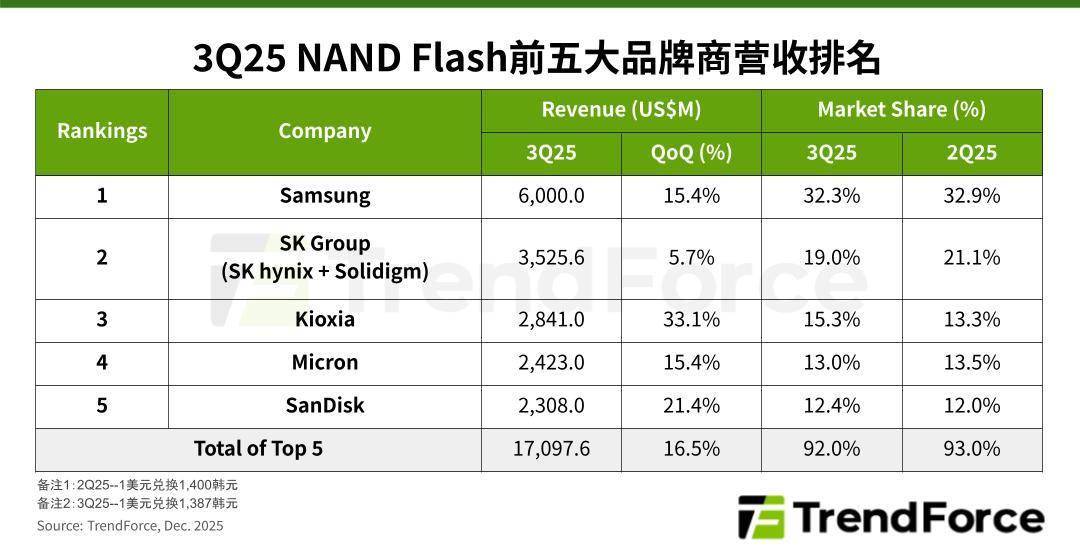
IT之家 12 月 3 日消息,研调机构 TrendForce 集邦咨询今日表示,五大 NAND 原厂今年三季度相关业务营收实现 16.5% 环比增长,总额接近 171 亿美元 (IT之家注:现汇率约合 1210.36 亿元人民币),其中 KIOXIA 铠侠营收相较二季度大幅扩张 33.1%。 | Rankings | Company | Revenue (US$M) | | | Market Share (%) | | --- | --- | --- | --- | --- | --- | | | | 3Q25 | QoQ (%) | 3Q25 | 2Q25 | | 1 | Samsung | 6,000.0 | 15.4% | 32.3% | 32.9% | | 2 | SK Group (SK hynix + Solidigm) | 3,525.6 | 5.7% | 19.0% | 21.1% | | 3 | Kioxia | 2,841.0 | 33.1% | 15.3% | 13.3% | | 4 | Micron | 2,423.0 | 15.4% | 13.0% | 13.5% | | 5 | ...
集邦咨询:AI基础建设助力NAND Flash产业 2025年第三季度铠侠营收季增33.1%
Zhi Tong Cai Jing· 2025-12-03 09:24
Core Insights - The demand for Enterprise SSDs is expected to remain strong due to ongoing expansions in AI infrastructure by Cloud Service Providers (CSPs), leading to a projected revenue increase of 16.5% for the top five NAND Flash brands in Q3 2025, nearing $17.1 billion [1] Group 1: Company Performance - Samsung reported a revenue of $6 billion in Q3 2025, reflecting a quarter-over-quarter increase of 15.4%, maintaining a market share of 32.3% [2][4] - SK Group, which includes SK hynix and Solidigm, achieved revenues of approximately $3.53 billion, with a quarterly growth of 5.7%, benefiting from Solidigm's focus on QLC Enterprise SSDs [2][4] - Kioxia experienced significant growth, with a revenue increase of 33.1% to over $2.84 billion, driven by AI Server demand and seasonal smartphone factors, raising its market share by 2 percentage points [2][4] - Micron's revenue reached $2.42 billion, up 15.4% quarter-over-quarter, primarily due to record shipments of data center SSDs [2][4] - SanDisk's revenue grew to nearly $2.31 billion, a 21.4% increase, supported by applications in the cloud and edge markets [2][4] Group 2: Market Trends - The overall NAND Flash price is expected to continue rising in Q4 2025, with price increases projected between 20-25% across various products, driven by sustained demand from AI applications and a return to normal inventory levels [1] - The shift towards higher performance TLC and QLC Enterprise SSDs is anticipated to further boost CSP demand in the upcoming quarter [1]

研报 | AI基础建设助力NAND Flash产业,2025年第三季度铠侠营收季增33.1%
TrendForce集邦· 2025-12-03 09:02
Core Insights - The article highlights the strong demand for Enterprise SSDs driven by cloud service providers (CSPs) expanding their AI infrastructure, leading to a 16.5% quarter-over-quarter revenue increase for the top five NAND Flash brands, approaching $17.1 billion [2][3]. Group 1: Market Performance - The top five NAND Flash manufacturers collectively generated revenues of $17.1 billion in Q3 2025, with a market share of 92% [3]. - Samsung led the market with $6 billion in revenue, a 15.4% increase from the previous quarter, maintaining a market share of 32.3% [5]. - SK Group, including SK hynix and Solidigm, reported revenues of $3.53 billion, up 5.7%, capturing 19% of the market [7]. - Kioxia's revenue surged by 33.1% to $2.84 billion, benefiting from AI server demand and seasonal smartphone factors, increasing its market share to 15.3% [7]. - Micron achieved $2.42 billion in revenue, a 15.4% increase, primarily due to record shipments of data center SSDs, holding a 13% market share [7]. - SanDisk's revenue rose to $2.31 billion, a 21.4% increase, driven by applications in cloud and edge markets, with a market share of 12.4% [7]. Group 2: Future Outlook - The demand for high-performance TLC and QLC Enterprise SSDs is expected to continue due to AI applications, although inventory normalization and production transitions may limit shipment growth [2]. - NAND Flash prices are projected to rise by 20-25% in Q4 2025, supported by ongoing supply shortages in HDDs [2].

AI与手机电脑“抢”芯片:手机厂商警告价格或上涨30%,存储短缺将持续至2027
Hua Er Jie Jian Wen· 2025-12-03 08:15
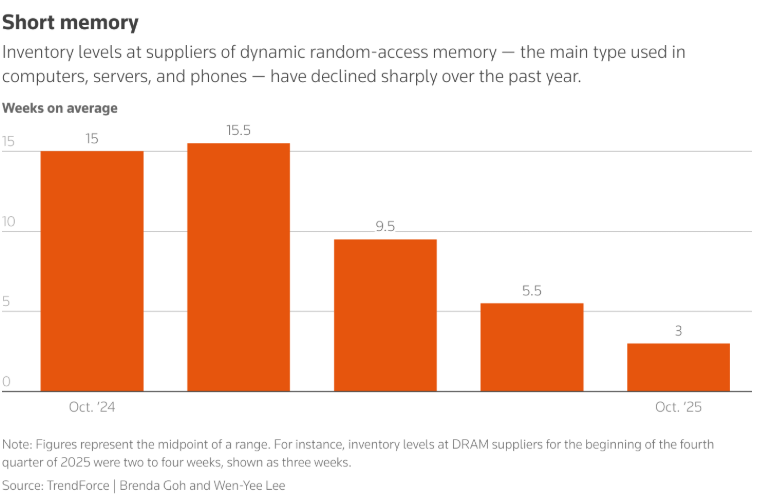
Core Viewpoint - The global storage chip market is facing a supply crisis, driven by competition between AI data centers and consumer electronics manufacturers, leading to skyrocketing prices and potential macroeconomic risks [1] Group 1: Supply Crisis Overview - The shortage affects nearly all types of storage chips, from USB flash drives to high-end HBM chips, threatening to increase consumer product prices and impact AI infrastructure investment returns [1] - SK Hynix predicts that the storage shortage will last until the end of 2027, with major tech companies like Microsoft and Google vying for supplies from manufacturers like Micron, Samsung, and SK Hynix [1][4] - TrendForce reports that some storage chip prices have more than doubled since February, with average inventory levels for DRAM suppliers dropping significantly [1] Group 2: Market Dynamics - The crisis stems from a mismatch between chip manufacturers' strategic shifts and market demand, particularly following the AI boom initiated by the release of ChatGPT in November 2022 [5] - Samsung and Micron have announced plans to halt production of older DDR4 chips, reallocating capacity to high-bandwidth memory for AI processors [5][8] - Major tech companies are placing open orders with Micron, indicating they will accept any available capacity regardless of price [9] Group 3: Consumer Impact - The rising storage costs are expected to lead to price increases for smartphones, with Realme indicating potential hikes of 20% to 30% [4][11] - Retailers in Japan are limiting the quantity of storage products consumers can purchase to prevent hoarding, with prices for certain memory products having surged dramatically [11] - Companies like Xiaomi are planning to offset higher storage costs through price increases and a shift towards selling more high-end devices [11] Group 4: Secondary Market and Economic Implications - The price surge is driving customers to the secondary market, with increased sales of used components and a rapid change in pricing dynamics among distributors [12] - The storage shortage is evolving into a macroeconomic risk, potentially delaying significant digital infrastructure investments and exacerbating inflationary pressures in various economies [12]
AI趋势下洁净室产业链梳理
2025-12-03 02:12
Summary of Cleanroom Industry Conference Call Industry Overview - The cleanroom industry is experiencing significant growth driven by the expansion of the semiconductor sector, particularly led by TSMC and followed by companies like Micron. The demand for high-end cleanroom engineering services is surging, resulting in equipment shortages and presenting opportunities within the cleanroom supply chain [1][2]. Key Points and Arguments - **Cleanroom Engineering Services**: These services are akin to industrial construction, designed to meet strict cleanliness and air composition requirements across sectors such as semiconductors, renewable energy, and biomedicine. Cleanroom classifications range from level 1 to 9, with semiconductor applications typically requiring levels 1 to 5 [1][4]. - **Capital Expenditure Trends**: Domestic capital expenditure in semiconductor cleanrooms increased to 20-30 billion yuan in 2022, with a structural rise in advanced process investments due to AI demand, benefiting engineering service providers with advanced process experience [1][10]. - **Market Dynamics**: The cleanroom industry is currently witnessing a strong stock performance, with a new round of capital expenditure in the semiconductor supply chain across domestic and Southeast Asian markets. Companies are beginning to see fundamental improvements [2][6]. - **Core Players**: Major players in the cleanroom engineering services include M+W Group from Germany and Taiwanese firms like HanTang and AsiaXiang, which are securing significant projects from TSMC and other major clients [8][9]. Additional Insights - **Operational Complexity**: Cleanroom engineering involves two core components: design and installation by engineering service providers, and the supply of fans and filters. The highest difficulty level is in wafer manufacturing, with fewer players in this space [5]. - **Investment Opportunities**: In the current market, it is recommended to focus on cleanroom companies with solid fundamentals and low valuations, as high-end engineering service providers are experiencing supply shortages and strong equipment demand [6]. - **Future Projections for AsiaXiang**: AsiaXiang is expected to secure new orders exceeding 10 billion yuan in Singapore by 2025, with profit margins potentially exceeding 30% as management experience improves [13]. - **Impact of TSMC's Expansion**: TSMC's global expansion plans are driving investment enthusiasm throughout the supply chain, with significant capital expenditures announced by companies like Micron in North America and Japan [14]. Company-Specific Highlights - **Mei Ai Technology**: As a leading domestic cleanroom equipment manufacturer, Mei Ai holds a 30% market share in China's semiconductor cleanroom sector. The company benefits from both domestic and international capital expenditure trends and is expanding its overseas market presence through acquisitions [15][16][17]. - **Competitive Advantages**: Mei Ai's cost control capabilities and alignment with domestic localization needs position it favorably against international competitors. The company aims for significant revenue growth, targeting 7 billion yuan in revenue by 2026 [17]. Conclusion - The cleanroom industry is poised for continued growth, driven by robust capital expenditures in the semiconductor sector and increasing demand for advanced manufacturing processes. Companies with strong fundamentals and strategic positioning are likely to benefit significantly in the coming years [18].


