Nintendo(NTDOY)

Search documents
任天堂股价暴跌,全怪芯片?
半导体芯闻· 2025-12-10 10:38
Core Insights - Nintendo's stock price dropped 4.7%, reaching its lowest level since May, due to concerns over rising storage chip prices impacting profit margins [3] - The cost of 12GB RAM modules for the Switch 2 has surged by 41%, while NAND flash memory prices have increased by nearly 8%, affecting the pricing of related storage products [3] - The market sentiment towards the Switch 2 is cooling as the supply crisis for storage chips worsens, with Nintendo's market value declining by approximately $14 billion over eight trading days [3] Group 1 - The rising costs of storage components are expected to compress the profit margins of Nintendo's new Switch 2 gaming console, potentially suppressing market demand [3] - The price of a 256GB high-speed SD card on Amazon has reached $89.99, with costs being passed on to consumers, particularly affecting players due to the limited internal storage of the Switch 2 [4] - The unexpected early price drop of the Switch 2, including a $50 discount during Black Friday, raises concerns about its ability to maintain high sales momentum beyond its initial launch [4]



Nintendo shares fall as global memory squeeze raises risks for Switch 2
Invezz· 2025-12-10 07:03
Core Insights - Nintendo's shares have experienced a decline of up to 2.6%, highlighting a broader trend in the tech supply chain related to increasing memory costs affecting gaming hardware [1] Industry Impact - The rising memory costs are causing significant ripples throughout the gaming hardware sector, indicating potential challenges for companies reliant on these components [1]

Switch 2面临内存成本飙升挑战,任天堂股价大跌
Sou Hu Cai Jing· 2025-12-10 06:36
Group 1 - Nintendo's stock price dropped by 4.7%, reaching its lowest level since May, due to concerns over rising component prices, including memory chips, which may erode profit margins [1] - The cost of 12GB RAM modules for the Switch 2 has increased by 41% this quarter, while NAND flash storage costs have risen by nearly 8%, impacting the prices of external storage cards [1] - Over the past eight trading days, Nintendo's stock has declined in seven, resulting in a market value loss of approximately $14 billion [1] Group 2 - The rising NAND flash prices are significantly increasing the costs of high-speed SD cards, which are essential for players due to the limited internal storage of the Switch 2 [3] - There are concerns about the sustainability of the Switch 2's initial sales momentum, as it has started to see early price promotions, including a $50 discount on bundles during the Black Friday period [3] - The unexpected discounts during the holiday shopping season indicate potential challenges in maintaining demand for the Switch 2 beyond its core fanbase [3]

芯片涨价担忧加剧 任天堂市值缩水140亿美元
Ge Long Hui· 2025-12-10 06:12
Core Viewpoint - Nintendo's stock experienced a significant decline due to concerns over rising component prices, particularly memory chips, which may erode profit margins for the upcoming Switch 2 console [1] Group 1: Stock Performance - On December 10, Nintendo's stock fell by 4.7%, reaching its lowest level since May of this year [1] - The stock has seen a downward trend, with seven out of eight trading days in December resulting in losses, leading to a market capitalization loss of approximately $14 billion [1] Group 2: Component Cost Increases - The price of the 12GB RAM modules used in the Switch 2 increased by 41% in the current quarter, according to market research firm TrendForce [1] - Additionally, the price of NAND storage, which is also utilized in the new console, rose by nearly 8%, impacting the cost of supplementary storage cards [1] Group 3: Market Sentiment - The escalating memory supply crisis has dampened investor optimism regarding the Switch 2, contributing to the stock's decline [1]
Nintendo’s 98% staff retention rate means the average employee has been there 15 years
Fortune· 2025-12-05 09:47
Company Retention and Knowledge Transfer - Nintendo has an impressive employee retention rate of 98%, with Japanese employees averaging 15 years at the company, significantly higher than the average tenure in Japan (11 years) and the U.S. (4 years) [1] - The long tenure of employees allows for the transfer of institutional knowledge, with key figures like Shuntaro Furakawa and Shigeru Miyamoto having decades of experience at Nintendo [2] Innovation and Adaptability - Despite the risk of becoming stagnant due to reliance on institutional knowledge, Nintendo successfully combines this knowledge with fresh ideas, allowing for a continuous pipeline of innovative games [3] - The company has faced its share of failures but maintains a competitive position in the video game industry against larger rivals like Sony and Microsoft [3] Positive Employee Sentiment - Former employees of Nintendo express positive sentiments about their experiences, highlighting the opportunity to work with talented designers and learn valuable lessons in game design [4] - This goodwill may stem from Nintendo's stable work environment, which contrasts with the industry's typical volatility [4] Unique Business Approach - Nintendo continues to create games in a manner distinct from its competitors, emphasizing its unique approach to game development [5]


任天堂股价跌超2%
Mei Ri Jing Ji Xin Wen· 2025-12-05 00:16
Core Viewpoint - The Nikkei 225 index opened lower on December 5, with notable declines in major companies such as Nintendo, Honda, and Toyota, while SoftBank Group experienced an increase [1] Company Summaries - Nintendo's stock decreased by 2.49% [1] - Honda's stock fell by 1.71% [1] - Toyota's stock declined by 1.64% [1] - SoftBank Group's stock rose by 2.03% [1]
TrendForce集邦咨询:存储器价格飙升冲击消费市场 2026年游戏主机出货量预估将下调至年减4.4%
智通财经网· 2025-12-02 05:50
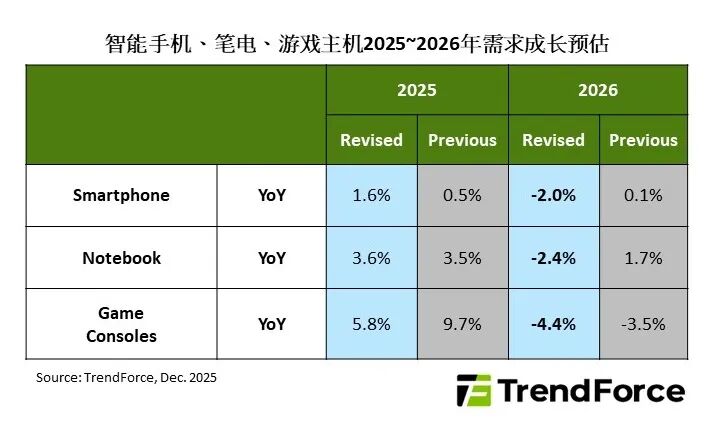
Core Viewpoint - The surge in memory prices is significantly increasing the cost of consumer electronics, leading to higher retail prices and impacting the consumer market. Consequently, TrendForce has revised its 2026 global gaming console shipment forecast down from a year-over-year decline of 3.5% to a decline of 4.4% [1][5]. Group 1: Impact on Gaming Consoles - The gaming console market is affected by rising memory prices, which are compressing hardware margins and limiting promotional pricing strategies. For instance, the Nintendo Switch 2 is priced at $450, higher than its predecessor, due to increased memory capacity and costs [2][5]. - The cost of memory modules is projected to account for 21-23% of the total cost of gaming consoles by 2026, indicating a significant impact on profitability for manufacturers like Nintendo [2][4]. - Sony and Microsoft are also facing similar challenges, with memory costs expected to exceed 35% of their bill of materials (BOM) by 2026, which may force them to raise prices instead of following traditional price reduction strategies [4][5]. Group 2: Market Dynamics and Forecast - The inability to lower retail prices in line with product lifecycle may adversely affect promotional strategies in 2026, particularly for mature products like the PS5 and Xbox Series, which may see reduced consumer demand [5][6]. - The gaming console market's shipment forecast has been revised down to a year-over-year decline of 4.4%, reflecting the challenges posed by supply chain issues and rising component costs [5][6]. - Historical precedents show that supply chain disruptions, such as semiconductor shortages, have previously led to significant reductions in production targets for major gaming consoles [5][6].

美国“黑五”战报:线上消费狂飙118亿美元创新高 AI导购成新潮流
智通财经网· 2025-12-01 00:11
Group 1 - The core point of the articles highlights that U.S. consumers achieved a record online spending of $11.8 billion on Black Friday, marking a 9.1% year-over-year increase, surpassing most industry expectations [1][2] - Strong sales were reported in the gaming console category, with top-selling products including Nintendo Switch 2, Microsoft Xbox Series X, Sony PlayStation 5, PlayStation Portal, and Meta Quest 3 [1] - Significant sales growth was observed in electronics, toys, and home appliances, driven by increased discounting, with online sales for popular gaming consoles surging by 1900% [1] Group 2 - The peak consumption period on Black Friday saw online spending reach $12.5 million per minute between 10 AM and 2 PM [2] - Mobile devices remained the primary channel for purchases, accounting for 55.2% of online sales [2] - There was a notable increase in AI-related traffic on retail websites, which surged by 805% year-over-year, as consumers utilized generative AI chat services and browsers to find deals and product information [2] - Looking ahead, Cyber Monday is expected to become the largest online shopping day of the season, with a projected 6.3% year-over-year increase in online sales, reaching $14.2 billion [2]

任天堂收购万代南梦宫新加坡工作室;字节跳动旗下沐瞳科技或被沙特游戏巨头收购|游戏早参
Mei Ri Jing Ji Xin Wen· 2025-11-27 23:11
Group 1 - Nintendo has signed a share transfer agreement to acquire Bandai Namco's Singapore studio, which will be renamed "Nintendo Studios Singapore" and focus on game development [1] - The acquisition will enhance Nintendo's first-party game development capabilities and secure future content for its consoles, supporting the company's long-term value [1] - This move highlights the competition among gaming giants for quality development resources, potentially leading to a reevaluation of talent and studio value in the industry [1] Group 2 - Savvy Games Group from Saudi Arabia is in talks to acquire ByteDance's subsidiary, Shanghai Mutong Technology, indicating a potential restart of ByteDance's sale plans [2] - If the acquisition is successful, it could provide ByteDance with significant cash flow and optimize its asset structure, positively impacting its stock price [2] - Savvy's interest in acquiring Mutong reflects its ambition to expand its global gaming footprint, which may intensify capital consolidation in the gaming industry and boost valuations for companies with strong IP and development capabilities [2] Group 3 - CD Projekt Red (CDPR) reported that global sales of "Cyberpunk 2077" have surpassed 35 million copies, showcasing the strong IP vitality and long-tail effect [3] - The company announced that "Cyberpunk 2" will not be released before 2028, with 135 full-time employees currently working on its development [3] - The positive sales figures and the development of "Cyberpunk 2" stabilize market expectations for CDPR's long-term product line, reinforcing confidence in the value of AAA game IPs and supporting the trend towards high-quality game development in the industry [3]
刚刚,日本股汇“双杀”!
Shang Hai Zheng Quan Bao· 2025-11-18 04:26
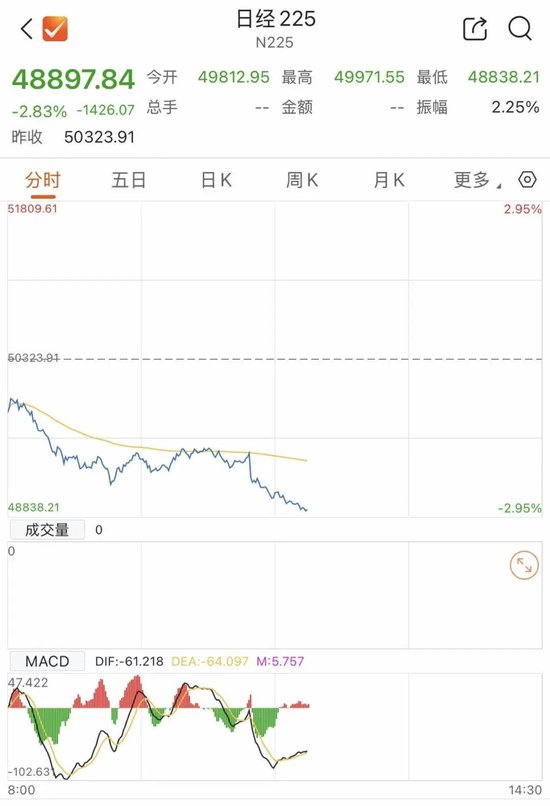
Group 1 - The Japanese stock market experienced a significant decline, with the Nikkei 225 index falling below 49,000 points, down over 1,400 points, representing a drop of 2.83% [1] - The Japanese yen continued its weakening trend, with the euro to yen exchange rate surpassing 180 for the first time since 1999, driven by concerns over Japan's deteriorating fiscal situation [3] - Political tensions arising from provocative statements by Japanese Prime Minister Suga Yoshihide regarding Taiwan have negatively impacted consumer sentiment, leading to declines in major companies such as SoftBank Group, Tokyo Electron, and Nintendo [5] Group 2 - Analysts express concerns that deteriorating Japan-China relations could further impact Japan's economy, which is already facing downward pressure, potentially leading to negative growth in the fourth quarter [7] - The South Korean stock market also saw a significant drop, with the KOSPI index declining over 3% [7]