
Oracle(ORCL)

Search documents
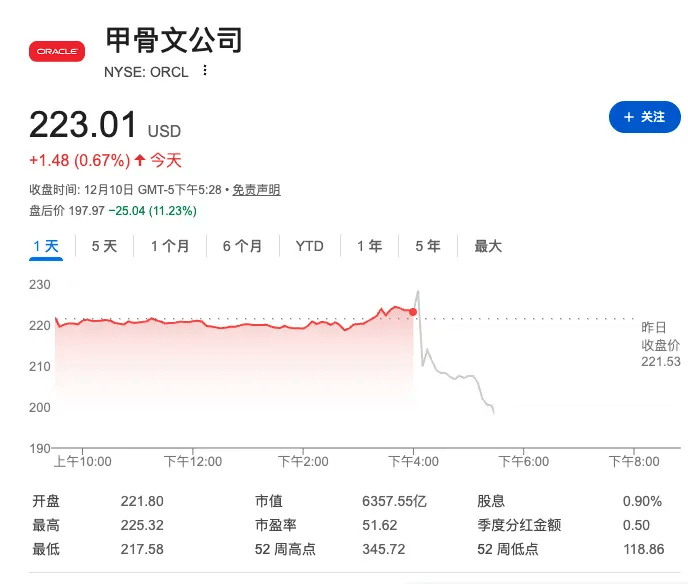
甲骨文业绩不及预期,资本开支比预期多约150亿美元,盘后重挫超10%
Sou Hu Cai Jing· 2025-12-11 06:36
甲骨文周三盘后公布第二财季业绩显示,该公司营收、云业务均不及分析师预期,季度自由现金流 (FCF)为-100亿美元,预计年度资本开支将比原来预料的多出大约150亿美元,导致该公司股价盘后 大跌超过10%。 以下是甲骨文第二财季财报要点: 每股收益:甲骨文第二财季GAAP每股收益为2.10美元,以美元计同比增长91%,以固定汇率计同比增 长86%。非GAAP每股收益为2.26美元,以美元计同比增长54%,以固定汇率计同比增长51%。 云业务数据: 云业务:甲骨文第二财季云业务营收(IaaS加SaaS)为80亿美元,以美元计同比增长34%,以固定汇率 计同比增长33% 云基础设施:第二财季云基础设施(IaaS)营收为41亿美元,以美元计同比增长68%,以固定汇率计同 比增长66% 云应用:第二财季云应用(SaaS)营收为39亿美元,以美元计同比增长11%,以固定汇率计同比增长 11%;Fusion Cloud ERP(SaaS)营收为11亿美元,以美元计同比增长18%,以固定汇率计同比增长 17%;NetSuite Cloud ERP(SaaS)营收为10亿美元,以美元计同比增长13%,以固定汇率计同比增长 13 ...


Buy The Dip In ORCL Stock?
Forbes· 2025-12-11 06:25
Core Insights - Oracle's stock has recently declined despite exceeding earnings expectations, primarily due to missing revenue targets and raising capital expenditure guidance to $50 billion for fiscal year 2026, up from $21 billion in fiscal 2025, focusing on AI infrastructure [2][3][15] Financial Performance - Oracle reported a 10.2% average annual revenue growth over the past three years, compared to 5.5% for the S&P 500 [12] - The company achieved a 14.2% revenue growth over the last twelve months, increasing from $51.2 billion to $58.3 billion [12] - In the most recent quarter, Oracle experienced a 14% year-over-year growth, reaching $16.1 billion [12] Profitability Metrics - Oracle generated $19 billion in operating income and $15 billion in net income over the previous four quarters, showcasing strong profitability [7] - The company's margins are significantly higher than those of most firms, indicating effective revenue conversion into profits [7] Valuation Concerns - Oracle's price-to-sales (P/S) ratio is 9.3x, compared to 3.2x for the S&P 500, and its price-to-earnings (P/E) ratio stands at 36.7x against the market's 23.4x, suggesting a premium valuation [5][15] - The high valuation raises concerns about the sustainability of growth, as it assumes significant future performance [15] Capital Structure - Oracle has $106 billion in debt against a market capitalization of $570 billion, resulting in a debt-to-equity ratio of 19%, which is slightly better than the S&P 500's 20.4% [8] - The company retains $19 billion in cash against total assets of $180 billion, giving it an 11% cash-to-assets ratio, which is higher than the market average of 7% [8] Market Resilience - Oracle has shown resilience during market stress, with historical performance indicating it typically recovers faster than the broader market after downturns [10][13] - The company experienced declines during past crises but managed to bounce back to pre-crisis levels, demonstrating its ability to withstand economic challenges [13] Investment Outlook - Despite strong growth and profitability metrics, the current high valuation limits potential upside in the near-to-mid term, making it a challenging investment at present prices [14][15] - For investors seeking exposure to strong companies without the risks associated with high valuations, diversified portfolios targeting quality at reasonable prices may offer a more favorable risk-reward scenario [16]

黑天鹅突袭!刚刚,全线杀跌!
券商中国· 2025-12-11 06:14
Core Viewpoint - The recent interest rate cut by the Federal Reserve, which was expected to be a positive factor, has instead led to market declines, raising concerns about potential AI bubbles and future monetary policy directions [1][5]. Group 1: Federal Reserve Actions - The Federal Reserve cut interest rates but maintained a forecast of only one rate cut by 2026, indicating a hawkish stance [5]. - The Fed's decision to expand its balance sheet by purchasing $40 billion in the first month is seen as a move to enhance market liquidity [5]. - Fed Chairman Jerome Powell suggested that current interest rates are at a "neutral level," which may limit future rate cuts [5]. Group 2: Oracle's Earnings Report - Oracle's stock plummeted by 11.55% after disappointing earnings, with concerns that AI orders may take longer to fulfill [3]. - The company's cloud business revenue grew by 34% to $7.98 billion, while infrastructure revenue increased by 68% to $4.08 billion, both slightly below analyst expectations [3]. - Oracle reported a free cash flow of -$10 billion for the second fiscal quarter, with capital expenditures reaching $12 billion, raising concerns about cash flow management [3]. Group 3: Japanese Monetary Policy - The Bank of Japan's potential for up to four interest rate hikes by 2027 has been highlighted, with expectations of a rate increase next week [7]. - The strengthening of the yen may reduce import cost sensitivity for Japanese companies, potentially impacting global commodity prices [7]. - Recent bond auction results showed strong demand for Japanese 20-year bonds, indicating market resilience despite previous volatility [7].



千亿债务压顶,甲骨文盘后闪崩!财报电话会紧急救场
Ge Long Hui· 2025-12-11 06:12
Core Viewpoint - Oracle's Q2 FY2026 results fell short of analyst expectations, leading to a significant drop in stock price and concerns over increased capital expenditures and cash flow issues [1][2]. Financial Performance - Oracle reported Q2 revenue of $16.058 billion, a 14% year-over-year increase, but below the market expectation of $16.21 billion [4]. - Net income reached $6.135 billion, up 95% from $3.151 billion in the same quarter last year [4]. - GAAP earnings per share increased by 91% to $2.10, while non-GAAP earnings per share rose by 54% to $2.26 [5]. Cloud and Business Segments - Cloud revenue grew by 34% to $7.98 billion, with infrastructure revenue increasing by 68% to $4.08 billion, although both figures were slightly below analyst expectations [7]. - Software revenue declined by 3% to $5.9 billion, missing the average analyst forecast of $6.06 billion [7]. Capital Expenditures and Cash Flow - Oracle's capital expenditures are projected to reach $50 billion for the year, significantly higher than the previous estimate of $35 billion [8]. - The company reported a negative free cash flow of $10 billion for the quarter, compared to the expected negative $5.2 billion [8]. Debt and Financial Strategy - Oracle has accumulated over $100 billion in debt, making it the largest debt holder among investment-grade tech companies [8]. - The company issued approximately $18 billion in new investment-grade bonds recently [8]. Future Guidance - For Q3, Oracle expects adjusted earnings per share between $1.70 and $1.74, with revenue growth projected at 19% to 21% [9].
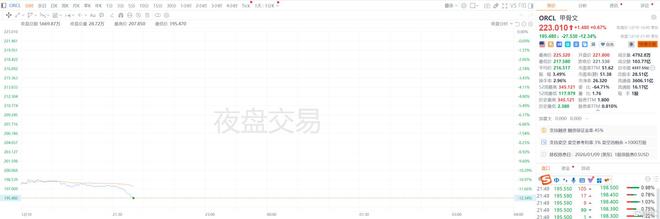
甲骨文盘后暴跌近14%,剧增的资本开支引发恐慌?
Jin Rong Jie· 2025-12-11 06:05
Core Viewpoint - Oracle's latest quarterly earnings report has disappointed investors, leading to a significant drop in stock price, reflecting concerns over performance and AI bubble fears [1] Financial Performance - For Q2 of fiscal year 2026, Oracle reported total revenue of $16.1 billion, a year-over-year increase of 14% in USD terms and 13% in constant currency, falling short of analyst expectations [2] - Cloud business, a core part of Oracle's AI transformation, generated combined revenue of $8 billion, with IaaS and SaaS revenues growing 34% year-over-year, but slightly below the expected $8.04 billion [2] - IaaS revenue reached $4.1 billion, up 68% year-over-year, while SaaS revenue was $3.9 billion, growing 11% year-over-year [2] - Software revenue declined by 3% year-over-year to $5.9 billion, while hardware and service revenues showed single-digit growth [2] Profitability and Guidance - Oracle achieved a non-GAAP net profit of $6.6 billion, a 57% increase in USD terms, with non-GAAP earnings per share at $2.26, up 54% [3] - The company provided positive guidance for Q3, expecting total revenue growth of 16%-18% in constant currency and 19%-21% in USD terms, with cloud revenue growth projected at 37%-41% [3] Remaining Performance Obligations and Capital Expenditure - Remaining Performance Obligations (RPO) increased by $68 billion to $523 billion, a year-over-year surge of 438%, driven by new contracts with companies like Meta and Nvidia [4] - Free cash flow for Q2 was -$10 billion, raising investor concerns, while capital expenditures reached $12 billion, significantly exceeding the previous quarter's $8.5 billion [5] Investment Focus and Market Reaction - Oracle's capital expenditures are primarily directed towards data center equipment, with executives emphasizing the quick conversion of spending into revenue [6] - Despite the positive outlook on RPO monetization, the market reacted negatively to the increased capital spending, reflecting skepticism about potential debt and spending issues related to AI infrastructure [7]
盘后暴跌11%,甲骨文上财季营收不及预期,强调AI基建资金远低于外界预期
Feng Huang Wang· 2025-12-11 05:38
Core Viewpoint - Oracle's recent quarterly earnings report fell short of market expectations, raising concerns among investors regarding the company's significant investments in AI technology [2][6]. Financial Performance - For the second fiscal quarter ending November 30, Oracle reported revenues of $16.06 billion, a year-over-year increase of 14%, but below the market expectation of $16.21 billion [2][4]. - Net income reached $6.14 billion, a substantial increase of 95% year-over-year, while adjusted EPS was $2.26, exceeding the market expectation of $1.64 [2][4]. - The operating profit margin stood at 42% [2]. Revenue Breakdown - Cloud revenue grew by 34% to $7.98 billion, accounting for 50% of total revenue [5]. - Software revenue decreased by 3% to $5.88 billion, representing 36% of total revenue [5]. - Hardware revenue increased by 7% to $776 million, while services revenue also grew by 7% to $1.43 billion [5]. - The Oracle Cloud Infrastructure (OCI) segment, which is critical for AI, saw revenue growth of 68% to $4.1 billion, aligning with market expectations [5]. Capital Expenditure and Future Guidance - Oracle's capital expenditures for the quarter reached $12 billion, with an expected total of approximately $50 billion for the fiscal year 2026, significantly higher than the previously projected $35 billion [5]. - The company anticipates adjusted EPS for the third fiscal quarter to be in the range of $1.70 to $1.74, with revenue growth projected at 19% to 21% year-over-year [4]. Market Reaction and Investor Sentiment - Following the earnings report, Oracle's stock price fell over 11%, reflecting investor dissatisfaction despite a slight increase prior to the report [6]. - The company's free cash flow deficit expanded to approximately -$13.2 billion, compared to market expectations of -$5.2 billion, contributing to investor concerns [6]. Debt and Financing Strategy - Oracle's remaining performance obligations (RPO) surged by 438% to $523 billion, exceeding market expectations, driven by new agreements with major clients like Meta and Nvidia [5]. - The company aims to maintain its investment-grade debt rating, with management indicating that the required funding for infrastructure development will be less than previously anticipated [7]. - Oracle's five-year credit default swap (CDS) costs increased, indicating rising concerns about the company's debt risk [8][9].
Oracle Corporation's Mixed Earnings Report and Financial Health
Financial Modeling Prep· 2025-12-11 04:00
Core Viewpoint - Oracle Corporation reported earnings per share of $2.26, surpassing estimates, but its revenue of $16.06 billion fell short of expectations, leading to a decline in share price [1][2] Financial Performance - Earnings per share were $2.26, exceeding the estimated $1.63 [1] - Revenue was reported at $16.06 billion, below the expected $16.86 billion [1] Market Reaction - The revenue miss resulted in a share price drop of over 6% in after-hours trading [2] - Concerns regarding AI infrastructure spending and high debt levels contributed to the stock's decline [2] Debt and Valuation Metrics - Oracle's debt-to-equity ratio is approximately 4.36, indicating a high level of debt relative to equity [2] - The price-to-earnings (P/E) ratio is about 50.72, and the price-to-sales ratio is around 10.61, suggesting high valuation relative to earnings and sales [2] - The enterprise value to sales ratio is approximately 12.22, and the enterprise value to operating cash flow ratio stands at about 33.50, indicating high valuation relative to sales and cash flow [3] Liquidity and Profitability - The current ratio is approximately 0.62, suggesting potential liquidity challenges in meeting short-term obligations [3] - An earnings yield of about 1.97% reflects the company's profitability relative to its share price [3]
霍华德·马克斯最新投资备忘录:是泡沫吗?
3 6 Ke· 2025-12-11 03:58
Core Viewpoint - The investment memo by Howard Marks discusses the potential "bubble" in AI investments and emphasizes the need for rational evaluation amidst the current AI technology revolution [1][2]. Group 1: AI Investment Landscape - Oaktree Capital has invested in several data centers, with its parent company Brookfield raising a $10 billion fund for AI infrastructure investments [1]. - Major companies like Oracle, Meta, and Google have issued 30-year bonds for AI investments, with yields only slightly above risk-free rates, raising questions about the wisdom of such long-term debt under technological uncertainty [2][27]. - AI is seen as potentially the greatest transformative technology in history, with significant capital being allocated to it [3][16]. Group 2: Market Behavior and Speculation - The current enthusiasm for AI could lead to a bubble, characterized by excessive optimism and speculative behavior among investors [4][5]. - Historical patterns of bubbles suggest that new technologies often attract irrational exuberance, leading to overvaluation and subsequent losses [7][8]. - The memo highlights the cyclical nature of bubbles, where initial excitement can lead to significant financial losses for investors [5][6]. Group 3: Debt Financing in AI - The use of debt financing in AI infrastructure is increasing, with concerns that this could amplify risks associated with speculative investments [26][28]. - The memo warns that the current phase of speculative financing may lead to unsustainable practices, reminiscent of past financial crises [28][29]. - There is a distinction between healthy and unhealthy debt behaviors in the AI sector, with some companies leveraging debt aggressively without clear revenue prospects [27][28]. Group 4: Uncertainties and Future Outlook - Despite the potential of AI, there is considerable uncertainty regarding its commercialization, the identity of future winners, and the overall market dynamics [18][19]. - The memo raises questions about whether AI will lead to monopolistic markets or remain competitive, impacting profitability for companies involved [19][20]. - Concerns are also expressed about the sustainability of AI-related investments, particularly regarding the lifespan and economic viability of AI infrastructure [30][31].




天量支出吓崩股价?甲骨文电话会紧急救火:“客户自带芯片”将拯救现金流,“我们没有疯狂举债”(电话会实录)
美股IPO· 2025-12-11 03:50
Core Viewpoint - Oracle's aggressive capital expenditure plan of an additional $15 billion has alarmed investors despite holding over $523 billion in remaining performance obligations (RPO) [1][3][16]. Group 1: Capital Expenditure and Market Reaction - The company announced that its capital expenditure for FY2026 would increase by $15 billion, reaching a total of $50 billion, leading to a post-market stock drop of over 10% [3][16]. - Oracle's management defended the necessity of this expenditure, stating it was driven by urgent customer demand rather than reckless expansion [1][4]. Group 2: Innovative Business Model - Oracle introduced a "Bring Your Own Chips" model, allowing clients like OpenAI to bring their own chips to data centers, which is unprecedented in the cloud industry [2][4][12]. - This model aims to alleviate cash flow pressures and reflects a shift from traditional cloud vendor practices of purchasing hardware outright [2][12]. Group 3: Financial Performance and Growth - Oracle reported a staggering RPO of $523 billion, a 433% year-over-year increase, primarily driven by contracts with major clients like Meta and NVIDIA [7][30]. - The company's cloud infrastructure (OCI) revenue surged by 66%, with GPU-related revenue skyrocketing by 177% [6][9][22]. Group 4: Management's Strategic Insights - CEO Clay Magouyrk emphasized the flexibility of Oracle's AI infrastructure, stating it can reallocate computing power among clients within hours, reducing dependency risks on major customers [19][20]. - Larry Ellison articulated a vision for AI focusing on private data reasoning, suggesting that Oracle's AI data platform can connect various databases, breaking down data silos [8][21][40]. Group 5: Future Outlook and Guidance - Oracle expects a 40% increase in RPO to be recognized as revenue in the next 12 months, with a total revenue forecast of $67 billion for FY2026 remaining unchanged [30][33]. - The company is committed to maintaining its investment-grade credit rating while exploring various financing options to support its growth [32][53].
