Pony Ai(PONY)

Search documents
小马智行:管理层调研:车队规模扩张;与车队运营商合作推行轻资产模式;买入
2026-01-20 03:19
Summary of Pony AI Inc. Conference Call Company Overview - **Company**: Pony AI Inc. (PONY) - **Industry**: Autonomous Vehicle Technology Key Points Fleet Expansion and Business Model - Pony AI is expanding its fleet size from 1,000 Robotaxis by the end of 2025 to 3,000 by the end of 2026 [1][2] - The company is implementing an asset-light business model by collaborating with local fleet operators, which is expected to enhance operational efficiency and fleet utilization [1][2] Cost Reduction and Unit Economics - Management highlighted a decrease in the Bill of Materials (BOM) cost for Pony AI's Gen 7 Robotaxi, primarily due to reductions in ADK costs, enabling the company to achieve unit economics break-even in Guangzhou [1][2] Market Expansion - Pony AI is focusing on international markets, particularly through partnerships with local operators to leverage their market knowledge [1][2] Safety and Operational Track Record - Management expressed confidence in their successful operating and safety records in major tier-1 cities in China, which aids in obtaining permits for new cities more rapidly [2] Financial Projections - **12-Month Price Target**: $31.30, representing a potential upside of 92% from the current price of $16.30 [3][8] - **Market Capitalization**: $5.7 billion [8] - **Revenue Projections**: Expected revenue growth from $75 million in 2024 to $173.5 million by 2027 [8] - **EBITDA Projections**: Expected EBITDA losses decreasing from $(277.2) million in 2024 to $(181.1) million in 2026 [8] Risks - Key downside risks identified include: 1. Regulatory challenges 2. Supply chain issues 3. Growth of the robotaxi market 4. Personal information security concerns 5. Infrastructure limitations 6. Pricing competition 7. Product liability [4] Conclusion - The overall sentiment towards Pony AI's commercialization path remains positive, driven by fleet expansion, cost reductions, and increasing consumer acceptance of driverless taxis [1][2]
今夜 白银又爆了 再创历史新高!美股集体下挫 美最高法院未就特朗普政府关税合法性作出裁决
Mei Ri Jing Ji Xin Wen· 2026-01-14 17:11
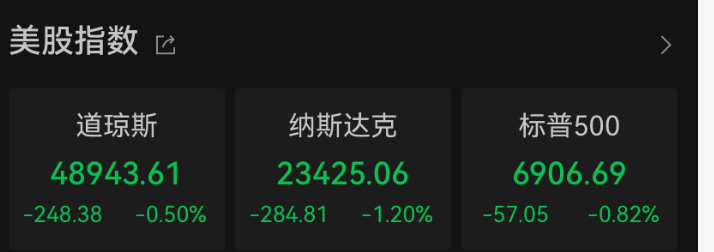
Market Overview - US stock indices opened lower, with the Dow Jones down 0.5%, Nasdaq down 1.2%, and S&P 500 down 0.82% [1] - Major tech stocks, including Nvidia, Tesla, Facebook, and Amazon, all experienced declines, with Nvidia dropping over 2% and others falling more than 1.5% [3] Chinese Stocks - Most Chinese stocks saw gains, with the Nasdaq Golden Dragon China Index up 0.31%. Bilibili rose nearly 5%, while Pony.ai and EHang increased over 3%. Alibaba gained 2.9% [3] - Ctrip's stock fell nearly 16%, resulting in a market value loss of $7.88 billion (approximately 55 billion RMB), bringing its total market value to $41.6 billion. This decline is linked to an investigation by the State Administration for Market Regulation regarding alleged monopolistic practices [3] Precious Metals - Silver prices surged, with spot silver reaching a historic high of $92 per ounce, marking a 5.45% increase for the day and over 28% year-to-date [4] - Gold also hit a record high of $4,641.853 per ounce, although its daily increase narrowed to 0.39% [4] - Citigroup strategists have raised their three-month price targets for gold to $5,000 per ounce and silver to $100 per ounce, citing geopolitical risks, persistent physical market shortages, and concerns over the independence of the Federal Reserve as key factors [5] Geopolitical Factors - The recent rise in precious metals is attributed to heightened geopolitical tensions, particularly between the US and Iran, which have increased risk aversion among investors. However, there are concerns regarding insufficient monetary policy support, as the core CPI in the US was slightly below expectations and the probability of a rate cut by the Federal Reserve in January is less than 5% [6] Oil Market - International oil prices saw a slight increase, with WTI and Brent crude both rising by nearly 1% [7] Legal Developments - The US Supreme Court has not yet ruled on the legality of the Trump administration's tariff policies, with the decision postponed to January 14. This follows previous rulings by lower courts deeming the tariff measures illegal [8]


纳斯达克中国金龙指数转涨
Zheng Quan Shi Bao Wang· 2026-01-14 14:51
Group 1 - The Nasdaq China Golden Dragon Index has turned positive, indicating a shift in market sentiment [1] - Xiaoma Zhixing and Bilibili have both seen their stock prices increase by over 5% [1]
热门中概股多数走低,小马智行跌超6%
Mei Ri Jing Ji Xin Wen· 2026-01-13 15:30
Group 1 - The majority of popular Chinese concept stocks experienced declines on January 13, with Xiaoma Zhixing falling over 6% [1] - Pinduoduo saw a drop of more than 5% [1] - Kingsoft Cloud and Baidu both decreased by 4% [1] - NIO and Li Auto each fell by over 2% [1]

美股中概股盘前多数上涨,阿里巴巴涨4%


Jin Rong Jie· 2026-01-12 09:19
Core Viewpoint - The majority of Chinese concept stocks in the US pre-market are experiencing gains, indicating positive market sentiment towards these companies [1] Group 1: Company Performance - Alibaba's stock has increased by 4% [1] - Baidu's stock has risen by 3% [1] - NIO's stock has gone up by 2% [1] - Pinduoduo's stock has seen a modest increase of 0.8% [1] - Pony.ai's stock remains unchanged [1]
Pony AI: Shoring Up Cash Reserves And Bolstering Fare Revenue
Seeking Alpha· 2026-01-12 07:03
Group 1 - The core viewpoint suggests that as 2026 approaches, a market rotation is anticipated, indicating that large-cap tech stocks are currently overvalued and investors should seek opportunities elsewhere [1] Group 2 - The analyst has extensive experience in covering technology companies on Wall Street and has worked in Silicon Valley, providing insights into current industry trends [2]

北汽新能源与小马智行宣布战略合作迈入2.0阶段
Ge Long Hui A P P· 2026-01-12 02:14
Core Insights - Beijing Automotive Group's new energy division has launched significant advancements in smart mobility, including the initiation of large-scale trial operations for the Arcfox Alpha S (L3 version) [1] - A strategic partnership with Pony.ai has entered its 2.0 phase, focusing on L4 autonomous driving technology [1] - The event featured nearly 30 companies from the intelligent connected vehicle ecosystem showcasing cutting-edge technologies [1]

北汽新能源与小马智行全面深化战略合作
Xin Hua Cai Jing· 2026-01-12 01:48
Group 1 - The core viewpoint of the article is that BAIC New Energy and Pony.ai have officially established a comprehensive strategic cooperation to promote the "Chinese solution" of the Arcfox Alpha T5 Robotaxi globally, focusing on markets in the Middle East and Europe [1] - The partnership aims to develop a benchmark system that includes technology standards, efficient and replicable operational models, and a collaborative business ecosystem [1] - Since the strategic signing at the first Technology Day in November 2024, the two companies have completed the mass production of 600 Arcfox Alpha T5 Robotaxis and have initiated full operations in Beijing and Shenzhen [1]
贾可吴伯凡吴声张晓亮,4万字2025-2026跨年对谈全文(下)
汽车商业评论· 2026-01-11 23:06
Core Viewpoint - The article discusses the evolving landscape of the Chinese automotive industry, focusing on the impact of personal branding (IP) of industry leaders, the rise of Huawei in automotive technology, and the trends in global expansion and regulatory changes in autonomous driving [4][5][6]. Group 1: Personal Branding in Automotive Industry - The debate on whether automotive leaders like Lei Jun and Wei Jianjun should develop personal brands (IP) has intensified, with differing opinions on its effectiveness and potential backlash [5][25]. - Lei Jun's recent challenges with Xiaomi's automotive ventures highlight the risks of personal branding, while Wei Jianjun's successful IP development reflects a more grounded approach [26][30]. - The article emphasizes the need for automotive leaders to focus on product quality and strategic management rather than solely on personal branding [31][35]. Group 2: Huawei's Role in Automotive Technology - Huawei's positioning as a service provider rather than a car manufacturer allows it to play a unique role in the automotive industry, focusing on empowering car manufacturers with advanced technologies [7][10]. - The introduction of Huawei's "Jing" and "Jie" series vehicles indicates a strategic expansion into the automotive market, with a focus on high-end segments [9][10]. - Huawei's technology capabilities, including smart cockpit and driving technologies, are seen as critical to its success in the automotive sector, potentially reshaping the competitive landscape [12][15]. Group 3: Trends in Global Expansion - The article notes a significant trend of Chinese automotive companies pursuing IPOs in Hong Kong, reflecting a renewed interest in capital markets and the need for ongoing funding in a capital-intensive industry [38][39]. - The global expansion of Chinese automotive brands is characterized by a shift towards local production and partnerships, moving beyond simple export strategies to more integrated approaches [43][45]. - The necessity for Chinese companies to adapt to local markets and consumer behaviors is emphasized, indicating a more mature approach to globalization [47][49]. Group 4: Regulatory Changes in Autonomous Driving - The Chinese government has implemented stricter regulations on L2 autonomous driving systems, reflecting a growing emphasis on safety following recent incidents [58][60]. - The approval of L3 autonomous driving systems indicates a positive regulatory environment for advanced driving technologies, with companies like Deep Blue and BAIC leading the way [58][61]. - The article suggests that the development of Robotaxi services is gaining momentum, with a focus on subscription-based models as a viable business strategy [61][63].




【重磅深度】全球Robotaxi商业化拐点将现,看好国内L4公司出海再扬帆
东吴汽车黄细里团队· 2026-01-11 14:10
Core Viewpoint - The global shared mobility market is undergoing a critical transition from human-driven to automated services, exhibiting significant regional differentiation [4][9]. North America Market - The North American ride-hailing market is dominated by Uber and Lyft, creating a stable pricing power. In the Robotaxi sector, Waymo holds a monopoly while Tesla aggressively disrupts the market. Chinese Robotaxi companies face barriers due to a 2025 U.S. Department of Commerce ban on hardware and software, complicating their commercialization path [4][9][16]. European Market - The European regulatory environment is fragmented and stringent, with local automakers lagging in L4 algorithm development. This creates a unique "hybrid model" opportunity, where "U.S./local platforms + Chinese technology" could break through. Uber and Lyft's collaboration with Baidu Apollo indicates that de-branding technology output is a favorable solution for entering the European market [4][9][16]. Middle East Market - The Middle East presents a unique "three highs and one low" characteristic: high customer spending, high policy support, high infrastructure investment, and low energy costs. Gulf countries are eager to reduce oil dependency, viewing autonomous driving as a national strategy. Chinese companies like WeRide and Pony.ai benefit from dual advantages of road rights and licenses, making it an ideal training ground and commercialization area for overseas expansion [4][9][16]. Southeast Asia Market - The Southeast Asian ride-hailing market is large but has low customer spending. Low labor costs may lead to economic challenges for Robotaxi operations. In the short term, large-scale deployment of Robotaxis is not cost-effective, and two-wheeled vehicles remain mainstream. Singapore, with its high labor costs, may achieve Robotaxi commercialization [4][5][9]. Investment Focus - Focus on the L4 RoboX industry chain, prioritizing B-end software over C-end hardware. Recommended stocks include: - Hong Kong stocks: Xpeng Motors, Horizon Robotics, Pony.ai, WeRide, Cao Cao Mobility, and Black Sesame Technology - A-shares: Qianli Technology, Desay SV, and Jingwei Hirain - Downstream application-related stocks from the Robotaxi perspective include integrated models (Tesla, Xpeng Motors), technology providers with revenue-sharing models (Horizon, Baidu, Pony.ai, WeRide, Qianli Technology), and the transformation of ride-hailing/taxi services (Didi, Cao Cao Mobility, Ruqi Mobility, Dazhong Transportation, Jinjiang Online) [6][9]. Regulatory and Market Barriers - The regulatory landscape for Robotaxis abroad features a dual approach of support and regulation. Companies must assume clear accident liability and purchase sufficient liability insurance. Vehicles must have complete data recording capabilities and undergo third-party safety assessments. Operationally, there are restrictions on operational areas, fleet size, and speed [12][14]. Market Size and Growth - The North American shared mobility market is projected to grow significantly, with the total Gross Transaction Value (GTV) expected to reach billions by 2030. The European market also shows substantial potential, albeit with slower conversion rates. The Middle East is characterized by strong government support, while Southeast Asia presents a high-growth potential due to infrastructure gaps [21][22][27]. Pricing Dynamics - Pricing dynamics vary significantly across regions, influenced by local labor costs and regulatory environments. North America has high labor costs, allowing Robotaxis to survive without extreme price reductions. In contrast, Europe faces stringent labor protections that increase operational costs. The Middle East's pricing is shaped by government-led transportation strategies, while Southeast Asia's ultra-low fares are supported by low labor costs [33][34]. Profitability Disparities - Profitability varies significantly across countries, with developed regions showing higher absolute margins per Robotaxi. Revenue per vehicle in China, UAE, UK, and the US is estimated at approximately $40,000, $90,000, $250,000, and $250,000 respectively, with gross margins reflecting these disparities [34][35].