
Roche(RHHBY)

Search documents
39%高关税,“中立国”瑞士缘何成特朗普贸易战痛击对象?
Feng Huang Wang· 2025-08-04 08:04
Group 1 - The U.S. will impose a 39% tariff on goods imported from Switzerland starting August 7, making Switzerland one of the few countries facing such high tariffs, second only to Brazil, Laos, Myanmar, and Syria [1][2] - The announcement coincided with Switzerland's National Day on August 1, which has been described as a significant humiliation for the country [2] - The trade deficit between the U.S. and Switzerland has surged, reaching nearly $50 billion in the first five months of the year, ranking Switzerland as the fifth largest trade deficit partner of the U.S. [5] Group 2 - Swiss officials were caught off guard by the high tariffs, as they believed negotiations with U.S. representatives were progressing well, with Switzerland expressing confidence in reaching a trade agreement [3][9] - The Swiss economy is heavily reliant on foreign trade, with approximately 19% of its exports going to the U.S., making it the largest export market for Switzerland [9] - The Swiss pharmaceutical industry, which exports about 60% of its products to the U.S., is under scrutiny, as it has been suggested that it may have hindered negotiations with the U.S. [12] Group 3 - The Swiss stock market is expected to open lower following the tariff announcement, with major companies like Novartis, Roche, and Nestlé listed on the Swiss exchange [12] - Analysts predict that if the tariffs remain unchanged, Switzerland's GDP could decline by approximately 0.6 percentage points, with more severe impacts if pharmaceuticals are excluded from tariff exemptions [13]


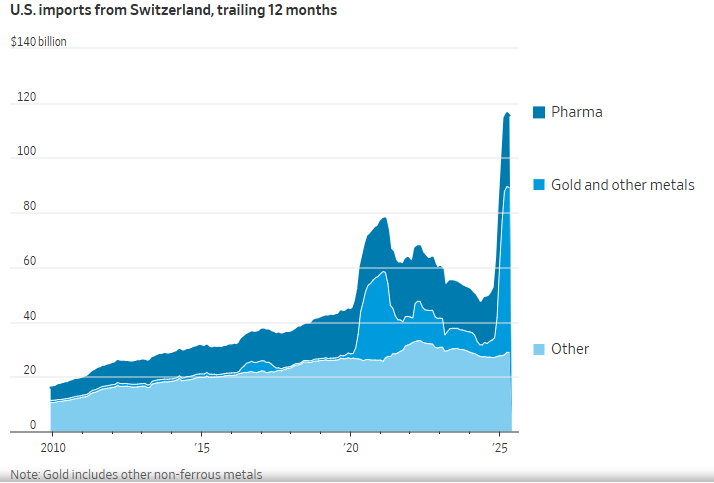
美国关税措施后,瑞士股市开盘补跌1.8%
news flash· 2025-08-04 07:40
美国关税措施后,瑞士股市开盘补跌1.8% 金十数据8月4日讯,由于美国对瑞士征收39%的关税,瑞士股市在早盘交易中大幅下跌。SMI指数下挫 1.8%,跌至4月以来的最低水平,这是瑞士市场在上周五因本地假期休市后首次对该关税消息作出反 应。苏黎世保险、瑞银(UBS)和罗氏(Roche)成为跌幅最大的几家公司。特朗普上周决定对瑞士实 施39%的关税,接近全球最高水平,甚至高于4月份曾讨论的31%税率,新关税税率将于本周四生效。 投行Vontobel分析师Mark Diethelm在一份报告中表示:"这使得瑞士出口商相比欧盟、日本或韩国的企 业处于明显劣势,因为这些地区的基准关税仅为15%。" ...

在美国就药品价格问题致函医药企业后,诺华制药股价在欧盘下跌1.2%;罗氏股价下跌1.9%。
news flash· 2025-08-04 07:12
在美国就药品价格问题致函医药企业后,诺华制药股价在欧盘下跌1.2%;罗氏股价下跌1.9%。 ...
Roche's Susvimo maintains vision over five years with two refills per year in people with neovascular age-related macular degeneration (nAMD)
GlobeNewswire News Room· 2025-08-01 18:00
Core Insights - Roche announced five-year efficacy, safety, and durability data for Susvimo® (ranibizumab injection) in treating neovascular age-related macular degeneration (nAMD), showing sustained treatment effects with approximately 95% of patients requiring no supplemental treatment before each refill [1][6]. Efficacy and Safety Data - The Phase III Portal study demonstrated that Susvimo maintained vision and retinal drying over five years, with best-corrected visual acuity (BCVA) in the Susvimo cohort decreasing from 74.4 letters at baseline to 67.6 letters at five years, while the IVT-Susvimo cohort showed a decrease from 76.3 letters to 68.6 letters [3][6]. - Average central subfield thickness (CST) remained stable, with a reduction of 1.0 µm in the Susvimo cohort and 10.3 µm in the IVT-Susvimo cohort [3]. Study Design and Population - The Portal study followed a cohort of 352 patients, with 220 receiving Susvimo refills every six months and 132 transitioning from monthly intravitreal (IVT) injections to Susvimo [2][5]. - The Archway study, which preceded the Portal study, was a randomized, multicenter trial involving 415 patients, comparing Susvimo to monthly IVT ranibizumab injections [5]. Treatment Mechanism - Susvimo utilizes a refillable eye implant that continuously delivers a customized formulation of ranibizumab, contrasting with other treatments that may require monthly injections [4][9]. - This delivery system aims to provide a more consistent treatment regimen, potentially leading to better real-world outcomes for patients with nAMD [2][4]. Industry Context - nAMD is the leading cause of vision loss in individuals over 60, affecting approximately 20 million people globally, with numbers expected to rise as the population ages [8]. - The innovative approach of Susvimo positions Roche as a leader in the treatment of nAMD, addressing a significant unmet need in the market [6][9].

创新药系列研究:自免疗法迈向双抗、多抗时代
Huachuang Securities· 2025-08-01 07:40
Investment Rating - The report indicates a positive outlook for the autoimmune therapy market, suggesting significant growth potential and investment opportunities in the sector [8]. Core Insights - The autoimmune market is the second largest after oncology, with a global market size of $132.3 billion in 2022, projected to reach $176.7 billion by 2030, reflecting a compound annual growth rate (CAGR) of 3.68% from 2022 to 2030 [8]. - The report highlights the potential for multi-target interventions to enhance treatment efficacy in autoimmune diseases, transitioning from monoclonal antibodies to bispecific and multispecific antibodies [19]. - The report emphasizes the significant market space for autoimmune therapies in China, where the autoimmune market size was only $2.9 billion in 2022, representing just 8% of the oncology market size of $34.7 billion, indicating substantial room for growth [8]. Market Overview - The global autoimmune drug market is expected to grow significantly, with the market size projected to increase from $1,323 million in 2022 to $1,767 million by 2030 [8]. - The report provides a detailed analysis of various autoimmune diseases, their prevalence, and the corresponding patient populations globally, including conditions like atopic dermatitis, chronic obstructive pulmonary disease, and rheumatoid arthritis [6][11]. Clinical Research Progress - The report outlines advancements in clinical research for dual-target and multi-target therapies, indicating a shift towards more effective treatment options for complex autoimmune diseases [19][22]. - It discusses the development of several blockbuster monoclonal antibody drugs in the autoimmune sector, with projected sales for top drugs in 2024, including Dupilumab at $14.15 billion and Risankizumab at $11.72 billion [9]. Key Companies to Watch - The report identifies key companies involved in the development of autoimmune therapies, including Sanofi, AbbVie, and Johnson & Johnson, highlighting their leading products and market positions [9][25].



帮主郑重:特朗普39%关税大刀砍向瑞士!全球贸易的“雪山崩”
Sou Hu Cai Jing· 2025-08-01 04:11
Group 1 - The U.S. has imposed a punitive tariff of 39% on Switzerland, significantly higher than tariffs on the EU (20%) and Japan (15%), due to a trade surplus of $38 billion and alleged non-tariff barriers [3][4] - The Swiss economy is heavily impacted, particularly in the luxury watch and chocolate sectors, with companies like Rolex and Patek Philippe facing increased export costs, while the pharmaceutical sector, which constitutes 40% of Swiss GDP, may also be affected despite initial exemptions [3][4] - Small and medium-sized enterprises, which make up 30% of Swiss exports, are at risk of severe financial strain due to the sudden increase in tariffs [3][4] Group 2 - The tariff escalation has disrupted global supply chains, particularly affecting precision manufacturing that relies on international collaboration, leading to layoffs and production cuts among Swiss suppliers [4][5] - The U.S. stands to lose as well, with Swiss companies employing 500,000 people in the U.S. and 90% of precision machine tools in the U.S. being imported from Switzerland, indicating a self-inflicted economic wound [5][6] - The Swiss franc depreciated by 0.8% in a single day, and the Swiss stock market index (SMI) fell below its February low, indicating a loss of investor confidence [6] Group 3 - The trade conflict has escalated the geopolitical dynamics among China, the U.S., and Europe, with Switzerland losing its role as a neutral mediator and potentially leading to closer ties between China and the EU [7] - The situation is prompting a shift in global supply chains, with ASEAN countries like Vietnam and Thailand benefiting from increased orders, and Swiss companies relocating production to Mexico to avoid tariffs [8] - The imposition of tariffs on Switzerland is seen as a threat to the post-World War II global trust system, leading to a potential reconfiguration of investment strategies focusing on cash reserves, growth sectors like AI and biotechnology, and new manufacturing locations [8][9]
新政策打消投资顾虑 跨国药企重金扩大 上海创新药产能
Sou Hu Cai Jing· 2025-07-31 16:15
Core Insights - The share of innovative drugs in China's core hospital market increased from 21% in 2015 to 29% in 2024, with innovative drugs approved after 2015 accounting for 10% of the overall drug market by 2024 [1][4] - China has become the second-largest pharmaceutical market globally, driven by advancements in biopharmaceutical technology and increasing demand for innovative biological drugs [1] Investment and Production Expansion - Roche announced an investment of 2.04 billion yuan to establish a biopharmaceutical production base in Shanghai, aimed at enhancing local production and supply chain [2] - The new facility will focus on the localized production of Roche's ophthalmic drug, which is the world's first approved bispecific antibody for ophthalmology, and is expected to be operational by 2031 [2] - Daiichi Sankyo plans to invest approximately 1.1 billion yuan in Shanghai for an ADC production facility to meet the growing demand for oncology products [2][3] Policy and Regulatory Developments - The introduction of the segmented production pilot policy by the National Medical Products Administration (NMPA) aims to enhance production efficiency and optimize industry division [5][6] - The segmented production allows for different stages of biopharmaceutical production to occur in various locations, providing flexibility for multinational companies [6][8] - Shanghai has initiated the segmented production pilot, which is expected to facilitate the local production of innovative drugs and improve regulatory oversight [7][8] Industry Collaboration and Local Support - Cytiva has launched a cell culture medium development base in Shanghai and is collaborating with local firms to reduce production costs for cell therapy products [4] - The Shanghai government is actively creating a favorable business environment for pharmaceutical companies, enhancing policy support and innovation services [9][10] - Multinational companies like Roche and Boehringer Ingelheim are benefiting from Shanghai's systematic policy layout, which supports the entire lifecycle of innovative drugs [11]
特朗普拟对进口药品征收高额关税 谁最可能受影响?
智通财经网· 2025-07-29 22:16
Core Viewpoint - The U.S. government, led by President Trump, plans to impose tariffs on imported pharmaceuticals, potentially reaching up to 200%, aiming to encourage domestic drug production [1][2] Group 1: Impact on Pharmaceutical Companies - Companies like AbbVie (ABBV.US), Bristol-Myers Squibb (BMY.US), and Eli Lilly (LLY.US) have a robust manufacturing base in the U.S., making them relatively stable against the tariff impact [1] - In contrast, Novartis (NVS.US) and Roche (RHHBY.US) face higher risks due to lower production capacity in the U.S. [1] - Amgen (AMGN.US) and Biogen (BIIB.US) are identified as the most sensitive biotech companies to the tariffs, while Gilead Sciences (GILD.US) and Vertex (VERX.US) are less affected [2] Group 2: Financial Implications - Analysts predict that the tariffs will significantly impact companies' free cash flow in the first two years post-implementation [2] - Companies may attempt to raise prices to offset costs, but substantial price increases could be politically unfeasible given the current scrutiny on drug prices [2] - Some firms might reduce R&D spending to counteract rising costs, although major cuts are unlikely due to the importance of innovation for long-term growth [2] Group 3: Responses from Companies - Roche has announced a $50 billion investment in the U.S. and emphasizes the need to exclude drugs and diagnostics from tariffs to protect patient access and future innovation [3] - Companies like Novartis, Zoetis (ZTS.US), AstraZeneca (AZN.US), and GlaxoSmithKline (GSK.US) have not immediately responded to requests for comments regarding the tariffs [3] Group 4: Manufacturing and Tax Strategies - Companies with strong U.S. manufacturing networks include AbbVie, AstraZeneca, Eli Lilly, Merck (MRK.US), and Pfizer (PFE.US), each having ten or more major factories in the U.S. [4] - Firms like AbbVie, Bristol-Myers Squibb, and Eli Lilly have a higher proportion of production in the U.S. compared to overseas [4] - The complexity of the pharmaceutical supply chain makes it challenging to assess the full impact of tariffs on pricing and availability [3][4] Group 5: Alternative Strategies - In response to potential cost increases from tariffs, companies are exploring alternative measures, such as sourcing active pharmaceutical ingredients from regions outside Europe and seeking new contract manufacturers in non-European countries [5]
罗氏制药将恢复在美国市场之外的基因疗法Elevidys发货工作
Hua Er Jie Jian Wen· 2025-07-29 14:38
近日,美国食品药品管理局(FDA)调查结果显示,一名八岁男童的死亡事故与Sarepta的基因疗法"无 关"。 (文章来源:华尔街见闻) 罗氏制药将恢复在美国市场之外的基因疗法Elevidys发货工作。 ...

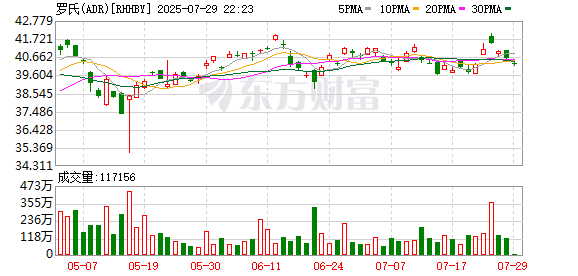
罗氏制药将恢复在美国市场之外的基因疗法Elevidys发货工作。近日,美国食品药品管理局(FDA)调查结果显示,一名八岁男童的死亡事故与Sarepta的基因疗法“无关”。
news flash· 2025-07-29 14:34
罗氏制药将恢复在美国市场之外的基因疗法Elevidys发货工作。 近日,美国食品药品管理局(FDA)调查结果显示,一名八岁男童的死亡事故与Sarepta的基因疗法"无 关"。 ...