
Rio Tinto(RIO)

Search documents
四大矿山二季度产销数据简析
Hua Tai Qi Huo· 2025-08-12 00:52
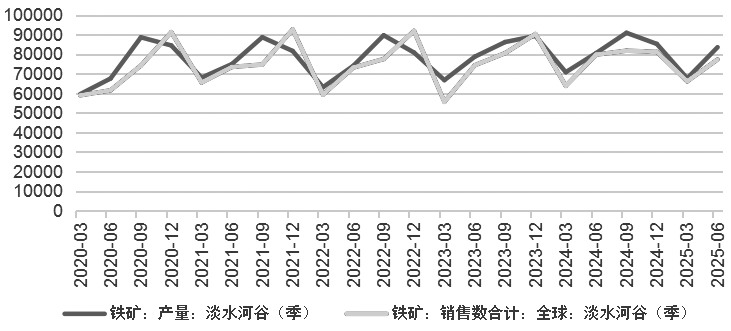
Report Industry Investment Rating No relevant content provided. Core Views - The production and sales of Vale in the second quarter showed differentiation, and the annual production target remained unchanged. Vale's quarterly iron ore production in the second quarter was 83.6 million tons, a quarter-on-quarter increase of 23.6% and a year-on-year increase of 3 million tons or 3.7%. The quarterly iron ore sales volume was 77.346 million tons, a quarter-on-quarter increase of 16.9% and a year-on-year decrease of 2.45 million tons or 3.1% [3][4]. - Rio Tinto's production and sales both increased significantly in the second quarter, and the shipment of Simandou iron ore was advanced to November. In the second quarter of 2025, Rio Tinto's iron ore production from its Pilbara operations was 83.74 million tons, a quarter-on-quarter increase of 20% and a year-on-year increase of 5.4%. The sales volume was 86.47 million tons, a quarter-on-quarter increase of 14.8% and a year-on-year decrease of 1.1%, with the decline significantly narrowing compared to the first quarter [5][6]. - BHP Billiton's iron ore production and sales both increased quarter-on-quarter and year-on-year in the second quarter, and the target for the 2026 fiscal year was slightly raised. In the second quarter of 2025, BHP Billiton's iron ore production from its Pilbara operations (100% basis) was 77.48 million tons, a quarter-on-quarter increase of 14.2% and a year-on-year increase of 0.9%. The total sales volume was 76.723 million tons, a quarter-on-quarter increase of 14.9% and a year-on-year increase of 1.1% [8][9]. - FMG's production and sales both increased quarter-on-quarter and year-on-year in the second quarter, and the single-quarter shipment reached a record high. In the second quarter, FMG's total iron ore processing volume was 54.4 million tons, a quarter-on-quarter increase of 14.3% and a year-on-year increase of 7.1%. The iron ore shipment volume reached 55.2 million tons, a quarter-on-quarter increase of 19.7% and a year-on-year increase of 2.8% [10]. Summary by Directory Vale - Production: The quarterly iron ore production in the second quarter was 83.6 million tons, a quarter-on-quarter increase of 23.6% and a year-on-year increase of 3 million tons or 3.7%. The increase was mainly due to the strong performance of the Brucutu mine in Minas Gerais and the record-high production of the S11D mine in Parana. The annual production target for 2025 is 325 - 335 million tons, and the new projects VGR1 and Capanema are expected to contribute incremental output in the second half of the year [3][16]. - Sales: The quarterly iron ore sales volume in the second quarter was 77.346 million tons, a quarter-on-quarter increase of 16.9% and a year-on-year decrease of 2.45 million tons or 3.1%. Sales decreased in most regions, with the overall sales volume turning negative year-on-year [4][21]. - Shipping and Arrival: From the steel shipping data, Vale's shipments showed a positive year-on-year growth in the second quarter. As of July 21, the cumulative year-on-year increase in iron ore shipments was 2.24 million tons, and the cumulative year-on-year decrease in China's port iron ore arrivals narrowed to about 5.6 million tons [26]. Rio Tinto - Production: In the second quarter of 2025, the iron ore production from its Pilbara operations was 83.74 million tons, a quarter-on-quarter increase of 20% and a year-on-year increase of 5.4%. The Simandou iron ore will ship its first cargo in November 2025, earlier than previously planned, with a limited supply volume this year [5][31]. - Sales: The sales volume in the second quarter was 86.47 million tons, a quarter-on-quarter increase of 14.8% and a year-on-year decrease of 1.1%, with the decline significantly narrowing compared to the first quarter. The 2025 Pilbara iron ore shipment target (100%) remains unchanged at 323 - 338 million tons, but the shipment volume is expected to be at the lower end of the guidance due to the difficult-to-make-up reduction caused by extreme weather events in the first quarter [6][36]. - Shipping and Arrival: The incremental iron ore shipments in the second quarter showed a pattern of high in the front and low in the back. As of July 21, the cumulative year-on-year decrease in iron ore shipments was 4.65 million tons, and the cumulative year-on-year decrease in shipments to China was 1.08 million tons. The cumulative year-on-year decrease in China's port iron ore arrivals was 1.66 million tons [44]. BHP Billiton - Production: In the second quarter of 2025, the iron ore production from its Pilbara operations (100% basis) was 77.48 million tons, a quarter-on-quarter increase of 14.2% and a year-on-year increase of 0.9%. The production in 2025 fiscal year was 288 million tons, the same as last year, meeting the fiscal year target. The target guidance for the 2026 fiscal year is 284 - 296 million tons (100% basis) [8][51]. - Sales: The total sales volume in the second quarter was 76.723 million tons, a quarter-on-quarter increase of 14.9% and a year-on-year increase of 1.1% [9][54]. - Shipping and Arrival: The shipments continued to recover year-on-year. As of July 21, the cumulative year-on-year decrease in iron ore shipments was 1.09 million tons, and the cumulative year-on-year decrease in shipments to China was 1.67 million tons. The cumulative year-on-year decrease in China's port iron ore arrivals reached 7 million tons [60]. FMG - Production and Sales: In the second quarter, the total iron ore processing volume was 54.4 million tons, a quarter-on-quarter increase of 14.3% and a year-on-year increase of 7.1%. The iron ore shipment volume reached 55.2 million tons, a quarter-on-quarter increase of 19.7% and a year-on-year increase of 2.8%, with a record-high single-quarter shipment [10][63]. - Iron Bridge Project: The Iron Bridge magnetite project contributed 2.4 million tons, with continuous production increase and still in the phased capacity ramp-up [63]. - Fiscal Year Target: The 2026 fiscal year shipment target is set at 195 - 205 million tons (with a target shipment volume of 10 - 12 million tons for the Iron Bridge project), with the upper and lower limits of the guidance target for the 2025 fiscal year increased by 5 million tons respectively [10][63]. - Shipping and Arrival: The cumulative year-on-year growth in shipments was maintained. As of July 21, the cumulative year-on-year increase in iron ore shipments was 5.59 million tons, and the cumulative year-on-year increase in shipments to China was 5.84 million tons. The cumulative year-on-year decrease in China's port iron ore arrivals was 3.07 million tons [66].



二季度四大矿山铁矿石产量同比均有增长
Qi Huo Ri Bao Wang· 2025-08-11 23:22
Core Insights - The global iron ore shipment volume in the first half of 2025 was 78.387 million tons, a slight year-on-year decrease of 0.23%, with the four major mining companies accounting for 67.2% of the total shipments, an increase of 0.4 percentage points from the previous year [1] - The production of the four major mining companies is expected to see a slight increase in the second half of the year, following a historical high in the second quarter [1] Group 1: Vale - Vale's iron ore production in Q2 reached 83.6 million tons, a quarter-on-quarter increase of 14.2% and a year-on-year increase of 4% [2] - The production showed regional differentiation, with the Northern system increasing production by 2.2 million tons, while the Southern system saw a decrease due to maintenance [2][6] - Vale maintained its annual production target of 325 million to 335 million tons, expecting to achieve the midpoint of this range [2] Group 2: Rio Tinto - Rio Tinto's Pilbara iron ore production in Q2 reached 83.74 million tons, a year-on-year increase of 20%, while shipments were 79.9 million tons, a slight decrease of 0.5% [7] - The West Angelas project is progressing well, with first shipments expected in November 2025, and a total output of 5 to 10 million tons anticipated for that year [7] - The company is also advancing other projects, including the Brockman Syncline 1, which has a projected investment of $1.8 billion and a design capacity of 34 million tons [8] Group 3: BHP - BHP's iron ore production in Q2 reached 70.3 million tons, a year-on-year increase of 2%, while shipments were 76.7 million tons, a year-on-year increase of 1.1% [10] - The company expects its total production for the 2025 fiscal year to reach 262.98 million tons, a year-on-year increase of 1% [10] - The South Flank project has significantly contributed to production, achieving over 80 million tons in its first year [12] Group 4: Fortescue Metals Group (FMG) - FMG's iron ore production in Q2 reached 54.4 million tons, a year-on-year increase of 14.3%, while shipments were 55.2 million tons, a year-on-year increase of 2.8% [13] - The company achieved record shipping volumes despite disruptions from tropical cyclones, demonstrating strong operational efficiency [14] - FMG's guidance for the 2026 fiscal year is set at 195 million to 205 million tons, indicating continued growth potential [14] Group 5: Overall Market Outlook - The four major mining companies collectively increased production in Q2, with a total estimated production of approximately 29.6 million tons, reflecting a significant recovery [15] - The overall market is expected to maintain stability in iron ore supply, with ongoing projects and production guidance indicating a slight increase in output for the second half of the year [15]

新浪财经ESG:力拓 MSCI(明晟)ESG评级调降至BBB
Xin Lang Cai Jing· 2025-08-11 23:05
Core Viewpoint - Rio Tinto's MSCI ESG rating has been downgraded from A to BBB as of August 11, 2025, indicating a decline in the company's environmental, social, and governance performance [1]. Group 1 - The downgrade reflects a significant change in Rio Tinto's ESG assessment by MSCI [1].
四大矿山供应显著改善
Guo Tou Qi Huo· 2025-08-06 11:16
Group 1: Production, Sales, and Shipping Volume - In Q2 2025, FMG's production was 83.6, a 23.6% increase from Q1 2025 and a 3.7% increase from Q2 2024; sales were 77.3, a 16.9% increase from Q1 2025 but a 3.1% decrease from Q2 2024 [7] - In Q2 2025, for another data set, production was 77.5, a 14.3% increase from Q1 2025 and a 0.9% increase from Q2 2024; sales were 76.7, a 14.8% increase from Q1 2025 and a 1.1% increase from Q2 2024 [7] - In Q2 2025, for yet another data set, production was 83.7, a 19.9% increase from Q1 2025 and a 5.3% increase from Q2 2024; shipping volume was 79.9, a 13.0% increase from Q1 2025 but a 0.5% decrease from Q2 2024; FMG's shipping volume was 55.2, a 19.7% increase from Q1 2025 and a 2.8% increase from Q2 2024 [7] Group 2: Product Data (PB and Others) - In Q2 2025, PB block was 11.2, with a -10% year - on - year change and a 14% quarter - on - quarter change; PB powder was 21.5, with a -13% year - on - year change and a 14% quarter - on - quarter change [15] - In Q2 2025, Robe River block was 1.4, with a 4% year - on - year change and a 20% quarter - on - quarter change; Robe River powder was 2.6, with a -15% year - on - year change and an 18% quarter - on - quarter change [15] - In Q2 2025, Yangdi powder was 10.6, with a -6% year - on - year change and a 14% quarter - on - quarter change; SP10 block was 8.3, with a 64% year - on - year change and a 3% quarter - on - quarter change; SP10 powder was 12.5, with a 52% year - on - year change and a 9% quarter - on - quarter change [15] Group 3: Other Product Data - In Q2 2025, Newman was 15.07, with a 5% year - on - year change and a 26% quarter - on - quarter change; Area C was 32.82, with a 13% year - on - year change and an 18% quarter - on - quarter change [22] - In Q2 2025, Yangdi was 3.85, with a -27% year - on - year change and a 1% quarter - on - quarter change; Jinbuba was 16.6, with a -14% year - on - year change and a 1% quarter - on - quarter change [22] Group 4: More Product Data - In Q2 2025, Tieqiao was 2.4, with a 300% year - on - year change and a 60% quarter - on - quarter change; Western Pilbara powder was 3.5, with a 192% year - on - year change and a 3% quarter - on - quarter change [25] - In Q2 2025, King powder was 3.5, with a 6% year - on - year change and a -13% quarter - on - quarter change; Mixed powder was 21.5, with a 4% year - on - year change and a 24% quarter - on - quarter change [25] - In Q2 2025, FMG block was 1.8, with no year - on - year change and a 0% quarter - on - quarter change; Super Special powder was 22.6, with a -19% year - on - year change and a 26% quarter - on - quarter change [25]
铁矿石与煤炭_中国的反内卷政策与大宗商品-Iron Ore & Coal_ China‘s Anti-Involution policy & commodities
2025-08-05 03:19
Summary of Key Points from the Conference Call Industry Overview - **Industry Focus**: The conference call primarily discusses the **basic materials sector** in China, particularly focusing on **coal**, **steel**, **cement**, and **lithium** in the context of China's **anti-involution policy** [5][12]. Core Insights and Arguments - **Anti-Involution Policy**: This policy aims to rectify low-price and disorderly competition, eliminate outdated capacity, and create a unified national market. It emphasizes sectors like **electric vehicles (EV)**, **solar**, and **e-commerce**, while focusing on **lithium** and **coal** in basic materials [5][12]. - **Coal Inspections**: The National Energy Administration (NEA) is inspecting coal mines in eight provinces to address overproduction. The impact is more significant in **metallurgical coal** (26% volume impact) compared to **thermal coal** (3% volume impact). Production cuts are anticipated, but execution remains uncertain [6][14]. - **Price Projections**: - **Met Coal**: Prices are expected to average around **RMB 1,200/ton** with potential curtailments [6][14]. - **Thermal Coal**: Prices may recover to **RMB 670/ton** during summer but are expected to soften in Q4, averaging **RMB 630/ton** in 2025 [14]. - **Steel Sector**: Steel is considered a lower priority in the anti-involution campaign due to previous successful reforms. Steel output has already declined by **7-9% year-on-year** in May-June [7][14]. Additional Important Insights - **Hydropower Project Impact**: The Yarlung Zangbo hydropower project, costing **RMB 1.2 trillion**, is expected to consume **4.3 million tons per annum (mtpa)** of cement and **0.6 mtpa** of steel, which is not anticipated to significantly impact overall commodity consumption [10][12]. - **Iron Ore Market**: Iron ore prices have increased from **$93/ton** to **$103/ton** due to expectations of property stimulus and supply reform. Steel production in China has slowed, and exports remain strong at **~112 million tons** in June [11][12]. - **Inventory Levels**: Both thermal and metallurgical coal inventories are healthier compared to earlier in 2025, with thermal coal inventories at Independent Power Producers (IPPs) remaining elevated [14]. Conclusion - The conference call provided a comprehensive overview of the implications of China's anti-involution policy on the basic materials sector, particularly coal and steel. The anticipated production cuts and price adjustments reflect the government's efforts to stabilize the market while addressing overproduction issues. The impact of new infrastructure projects on commodity demand appears limited, and the overall sentiment in the iron ore market remains cautiously optimistic.

Rio Tinto Will Benefit From New Battery Technology
Seeking Alpha· 2025-08-04 20:39
Group 1 - Friedrich Global Research is focused on identifying high-quality companies for stock investment, emphasizing free cash flow, efficient capital allocation, and superior management performance [1] - The founder of Bern Factor LLC has extensive experience in investment analysis, with nearly 40 years in the field and a background as a CPA and CFA charter holder [2] - The founder's diverse career experience spans various sectors, providing a broad perspective on macroeconomics and detailed operational insights [2] Group 2 - The article mentions a potential special situation that could yield significant gains and income for investors, although the frequency of such situations cannot be predicted [2] - The analysis is based on objective observations of unique patterns derived from research, although it does not constitute investment advice [4]
铁矿石四大矿山季度运营情况跟踪:主流矿山Q2产运追赶节奏显著加快
Guo Tai Jun An Qi Huo· 2025-08-04 11:55
Group 1: Report's Investment Rating - There is no information about the industry investment rating in the report. Group 2: Core Views of the Report - In Q2 2025, the production and transportation volume of the four major iron ore mines increased significantly, with a year - on - year growth of 3.5% and a quarter - on - quarter increase of nearly 20%, basically catching up to last year's level in the first half of the year [1][5]. - The trend of "increase in mainstream mines and decrease in non - mainstream mines" was further reflected in Q2, and the dominant position of mainstream mines in Australia and Brazil in the global seaborne iron ore market may be further strengthened [2][44]. Group 3: Summary of Each Section 1. Overview of the Four Major Mines' Q2 2025 Operations - The total production/transportation volume of the four major mines in Q2 2025 was 293 million tons, with a year - on - year increase of 3.5% and a quarter - on - quarter increase of nearly 20%. The significant volume boost by BHP and Fortescue in June was the main driver of the excellent performance in Q2 [1][5]. - In the first half of 2025, only Rio Tinto's production was still significantly behind last year's level. BHP and Fortescue both raised their production and transportation targets for FY26, indicating confidence in their supply chain efficiency and new production capacity [6]. 2. Key Points of the Four Major Mines' Quarterly Reports 2.1 Vale - **Overall Situation**: In Q2, Vale's iron ore production was 83.599 million tons, a year - on - year increase of 3.7%. Sales volume was 77.346 million tons, a year - on - year decrease of 3.1%. The C1 cash cost was 22.2 US dollars/wet ton, a year - on - year decrease of 10.8%. The AIC was 55.3 US dollars/wet ton, a year - on - year decrease of 9.6% [8][12][13]. - **Operation Details**: The northern system's Q2 production reached 41.222 million tons, a record high since 2021. The southeast system performed well, with the fourth processing line of Brucutu driving production to a new high. The southern system's production declined due to construction issues. The company plans to conduct maintenance on the São Luis pellet plant in Q3. Pellet sales in Q2 were about 7.5 million tons, a year - on - year decrease of 16% [15][16][19]. 2.2 Rio Tinto - **Overall Situation**: In Q2, Rio Tinto's Pilbara mine production was 83.743 million tons, a year - on - year increase of 5.4%, reaching a new high since 2018. The shipping volume was 79.887 million tons, a year - on - year decrease of 0.5%. The company maintained its Pilbara shipping volume guidance range of 323 - 338 million tons but expected the actual volume to be closer to the lower limit [22][23]. - **Operation Details**: The Western Range project was put into production in March and is expected to reach full production by the end of 2025. The Brockman Syncline 1 project is planned to be put into production in 2027, and the Hope Downs - 2 project started construction in June. The first shipment of the Guinea Simandou iron ore project is still expected in November, with an estimated shipment of 50 - 100 million tons in 2025 [25][27]. 2.3 BHP - **Overall Situation**: In Q2, BHP's equity production was 70.339 million tons, a year - on - year increase of 1.6%. Sales volume was 69.843 million tons, a year - on - year increase of 2.2%. In FY2025, the full - year equity production was about 263 million tons, higher than the previous guidance range. The company announced an upward - adjusted equity production guidance range of 258 - 269 million tons for FY2026 [31][32]. - **Operation Details**: In the Western Australia WAIO mine, the improvement of logistics efficiency and the full - production of the South Slope project contributed to the production increase. In the Brazilian Samarco, the production continued to rise with the help of the capacity ramp - up of the No. 2 concentrator [34][35]. 2.4 Fortescue - **Overall Situation**: In Q2, the company's iron ore shipping volume was 55.2 million tons, a year - on - year increase of 2.8%. In FY2025, the full - year shipping volume was 198.4 million tons, a year - on - year increase of 3.5%. The C1 cost of Pilbara hematite in Q2 was 16.29 US dollars/wet ton, a quarter - on - quarter decrease of 7.1%. The company announced a shipping volume guidance range of 195 - 205 million tons and a C1 cost guidance range of 17.50 - 18.50 US dollars/wet ton for FY2026 [37][38]. - **Operation Details**: The shipping volume of the Iron Bridge project in Q2 was 2.4 million tons, and the full - year volume in FY2025 was 7.1 million tons. The company aims to reach full production of 22 million tons/year in FY2028 [41]. 3. Summary and Future Outlook - In Q2, the four major mines made efforts to increase production. Rio Tinto and Vale contributed over 7 million tons of year - on - year incremental production. - The trend of "increase in mainstream mines and decrease in non - mainstream mines" was further strengthened. From January to June 2025, the global seaborne iron ore shipment volume decreased slightly year - on - year, while the shipments from Australia and Brazil increased, and their share in the global market reached 83.3% [44].
RIO2 Provides Mine Construction and Corporate Update
Globenewswire· 2025-07-31 12:00
Core Viewpoint - Rio2 Limited is progressing well with its Fenix Gold Project in Chile, with construction 41% complete and on track for first gold production in January 2026 [1][3]. Construction Update - The project has recorded 1,270,141 person-hours worked with a Lost Time Incident Frequency Rate (LTIFR) of 0.79 and a Total Incident Frequency Rate (TIFR) of 6.30 as of June 30, 2025 [2]. - Total expenditure since October 2024 is $56.4 million against a budget of $57.8 million, excluding corporate overheads and pre-construction costs from 2022 [3]. - Key construction milestones include the installation of 12.7 hectares of geosynthetics at the leach pad and 4 hectares of overliner material, ready for mineral placement in August 2025 [4]. Infrastructure Development - Haul Road 1 is 90% complete, while Haul Road 4 is at 40% completion, both crucial for connecting the Fenix South pit to the leach pad [5]. - The ADR Plant's structural assembly is complete, with building cladding at 90% [5]. - The first of three electrical switch rooms is being transported to the project site [6]. Human Resources - The project currently employs 1,514 personnel, with 94% being Chilean and 41% from the Atacama Region; 10% of the workforce is female [6]. Exploration Activities - Grade control drilling activities are nearing completion, focusing on the pit areas for the first three years of production, with results expected by the end of September [7]. Upcoming Milestones - Key upcoming milestones include the start of mineral stacking on the leach pad and finalization of the PLS pond in August 2025, commissioning of the ADR Plant in November 2025, and the first gold pour in January 2026 [13]. Corporate News - Rio2 has received conditional approval to graduate from the TSX Venture Exchange to the Toronto Stock Exchange, with final approval pending [9]. - The company has published its 2024 ESG Report, highlighting its commitment to responsible mining practices [10]. Project Overview - The Fenix Gold Project is one of the largest undeveloped gold oxide heap leach projects in the Americas, with a Measured and Indicated mineral resource of 4.8 million ounces of gold [11]. - The project represents a significant investment of approximately $235 million, generating employment for at least 1,200 people during construction and 800 during operations [11].

专题报告:下半年铁矿石供给与走势展望
Fo Shan Jin Kong Qi Huo· 2025-07-31 02:30
Group 1: Report's Investment Rating - No information provided Group 2: Core Views of the Report - In the first half of the year, global iron ore shipments decreased by 0.96% year-on-year. Australian and Brazilian shipments were affected by weather in Q1 and increased in Q2. Non-Australian and non-Brazilian shipments decreased significantly year-on-year, and non-mainstream shipments were more affected by ore prices compared to mainstream shipments from Australia and Brazil [2]. - It is expected that the output and shipments of the four major mines will increase in the second half of the year. Rio Tinto and Vale's output/shipments in the first half of the year did not reach half of their guidance targets, while FMG and BHP raised their guidance targets for fiscal year 2026 [2]. - The main contradiction in the black sector lies in the terminal demand for steel, which depends on policy support. The bargaining power of imported iron ore is relatively strong. It is expected that the downside space for iron ore in the second half of the year is limited, and the upside space depends on the trend of steel prices [2]. Group 3: Summary by Relevant Catalogs 1. Iron ore shipments in the first half of the year - In H1 2025, the cumulative global iron ore shipments were 778 million tons, a year-on-year decrease of 0.96%. Affected by cyclones in Australia and rainfall in Brazil in Q1, the cumulative shipments were 362 million tons, a year-on-year decrease of 3.39%. In Q2, shipments increased to make up for the previous shortfall and due to the end - of - quarter rush by Australian mines [3]. - From the source of shipments, the total shipments from Australia and Brazil in H1 were 648 million tons, accounting for 83% of global shipments, with a year-on-year increase of 0.84%. Non-Australian and non-Brazilian shipments were only 130 million tons, a year-on-year decrease of 9.09%. Iron ore prices have a greater impact on non-Australian and non-Brazilian shipments, and Australian and Brazilian shipments show obvious seasonal patterns [5]. 2. Expected increase in shipments of the four major mines in the second half of the year 2.1 Supply summary in the first half of the year - According to SteelHome data, the cumulative shipments of the four major mines in H1 2025 were 529 million tons, a year-on-year increase of 0.29%. Structurally, Rio Tinto and BHP's shipments decreased, FMG's shipments increased significantly, and Vale's shipments increased steadily [6]. - Rio Tinto's 2025 production guidance target remained unchanged. Affected by cyclones and capacity replacement in Q1, its H1 shipments decreased by 5% year-on-year. The Pilbara mine achieved its highest Q2 output since 2018, and the first shipment of iron ore from the Simandou project was advanced to around November 2025. The品位 of PB mixed ore decreased [8][11]. - FMG's Q2 output and shipments increased significantly quarter-on-quarter. In fiscal year 2025, it shipped 198 million tons of iron ore, a year-on-year increase of 4%, achieving its fiscal year target. It raised its 2026 fiscal year guidance target by 5 million tons to 195 - 205 million tons [12][13]. - BHP's Q2 2025 output was 77 million tons, and its fiscal year 2025 output was 290 million tons, a year-on-year increase of 1%. It raised its 2026 fiscal year guidance target by 2 million tons. It increased shipments in Q2 by optimizing operations [14][15]. - Vale's Q2 output was 83.6 million tons, a significant increase, mainly due to the strong performance of the Southeast and Northern systems. It adjusted its 2025 iron ore pellet target output downwards by 7 million tons due to weak demand [16][18]. 2.2 Supply outlook in the second half of the year - It is expected that the iron ore shipments of the four major mines will increase in the second half of the year. Rio Tinto is expected to speed up production and shipments, with the Xipo and Simandou projects as key sources of growth. FMG is expected to have some room for shipment growth. BHP's output and shipments are expected to remain sufficient. Vale's production is expected to accelerate in the second half of the year [19]. 3. Fundamental analysis 3.1 Domestic ore supply - In H1 2025, China's raw iron ore output was about 509 million tons, a year-on-year decrease of 9.1%. The cumulative output of iron concentrate from 433 domestic mines was 138 million tons, a year-on-year decrease of 8.0%. Domestically sourced iron accounted for about 19.0% of the total supply [20]. 3.2 Demand - More than half of the steel mills were profitable in H1. The total profit of规上 steel enterprises in H1 was 46.28 billion yuan, a year-on-year increase of 13.7 times. However, the revenue of the steel industry decreased by 7.5% year-on-year, and the cumulative crude steel output was 515 million tons, a year-on-year decrease of 3.0%. Steel mills' profits came from cost reduction. High steel mill profits supported high pig iron production and thus iron ore demand [21]. 3.3 Inventory - In H1, the inventory pressure on steel mills and ports was small. Steel mills' inventory was below 100 million tons after the Spring Festival, and the inventory - to - consumption ratio was around 30. The inventory of imported iron ore decreased by about 3 million tons year-on-year. The inventory at 47 ports decreased from about 156 million tons at the beginning of the year to 144 million tons by July, 14 million tons lower than last year [24][26]. 4. Future outlook - In Q1, iron ore prices were relatively firm. In Q2, coking coal prices rebounded, but iron ore price increases were limited. In July, affected by policy expectations, funds flowed into coking coal. The main contradiction in the black sector lies in steel terminal demand, which depends on policy support. In the second half of the year, iron ore supply is expected to be strong, demand depends on policies, and inventory pressure is not large. The downside space for iron ore is limited, and the upside space depends on steel prices [27][30].
Rio Tinto(RIO) - 2025 Q2 - Quarterly Report
2025-07-30 11:04
Exhibit 99.1 Rio Tinto Group Unaudited Condensed Consolidated Interim Financial Report for the six months ended 30 June 2025 TABLE OF CONTENTS | Interim | results 2025 | 2 | | --- | --- | --- | | Market | update | 4 | | Financial | performance | 6 | | Shareholders | returns | 11 | | Review of | operations | 12 | | Capital | projects | 18 | | Future | growth options | 22 | | Directors' | report for the half year ended 30 June 2025 | 24 | | Unaudited | condensed consolidated interim financial statements | 26 ...