TME(TME)

Search documents
摩根大通:中国消费,从商品到体验
摩根· 2025-06-25 13:03
Investment Rating - The report maintains a positive outlook on experience and learning-related services consumption names, recommending eight quality consumer services with an average forward P/E of 17x and 19% year-on-year sales growth [31]. Core Insights - Despite overall lackluster consumption trends in China post-reopening, selected "new consumption" stocks have significantly outperformed the MXCN index, with an average weighted index for Lunar New Year consumption rising by 21% compared to 10% for MXCN through June 12 [5][6]. - The ACGN sector has shown remarkable performance, with stocks like Pop Mart and Bloks rising by 155% and 94% respectively, while other sectors like Hainan travel/shopping and e-bikes lagged behind [5][6]. - The report highlights a structural shift in consumer behavior towards services over goods, with services consumption categories such as Transport & Communications and Education, Culture & Recreational Services growing at 15% and 18% year-on-year in 2023, compared to overall consumption growth of 9% [5][6]. - The report identifies nine experience and learning-related consumption names that are expected to benefit from favorable seasonal spending trends during the summer [5][31]. Summary by Sections New Consumption Trends - Two key trends identified are affordable treats, including ACGN goods and government-subsidized trade-ins, and experience-related consumption such as movies and travel [6][31]. - The report notes that leading affordable treats have outperformed year-to-date, indicating a shift in consumer preferences towards smaller pleasures rather than big-ticket items [5][6]. Valuation and Growth Potential - Valuation levels for top new consumption names are now comparable to established global brands, with significant upside potential for future growth [5][6]. - The report emphasizes that the ability to surprise on future growth is crucial for maintaining valuations in the new consumption space [5][6]. Recommendations - The report recommends focusing on experience and learning-related services, which are expected to benefit from seasonal trends and a structural shift towards services consumption in China [31]. - Specific companies highlighted include Tencent, NetEase, Trip.com, and Kuaishou, which are positioned well for growth in the digital entertainment and travel sectors [31].


高盛:腾讯音乐_对 SVIP 快速渗透持积极展望,非订阅业务具长期潜力;上调目标价,买入
Goldman Sachs· 2025-06-23 02:09
Investment Rating - The report maintains a Buy rating for Tencent Music Entertainment Group (TME) and raises the 12-month price target to US$21.00 from a previous US$15.50, indicating an upside potential of 15.4% [1][33]. Core Insights - The report highlights a constructive outlook on TME's faster Super VIP (SVIP) penetration and the long-term potential of its non-subscription business, particularly in live events and artist sponsorships [1][15]. - TME's stock has shown significant growth, rallying 69% year-to-date compared to HSTech's 18% [1]. - The report emphasizes the company's strong growth visibility and pricing power, particularly in the context of ARPU (Average Revenue Per User) growth driven by SVIP membership [1][15]. Summary by Sections Revenue and Growth Projections - TME's revenue is projected to grow from RMB 28,401 million in 2024 to RMB 38,385 million by 2027, with a compound annual growth rate (CAGR) of approximately 10.4% [3][13]. - Non-subscription revenue is expected to outpace subscription revenue in the long run, currently accounting for 30% of total music revenue, with significant growth anticipated in live events and artist agency business [24][30]. ARPU and SVIP Penetration - The report raises ARPU estimates due to faster SVIP penetration, which is expected to increase from low-teen percentages to 19% by 2027, driven by enhanced SVIP privileges [16][18]. - Monthly ARPU for SVIP is forecasted to reach RMB 19.5 by 2025, reflecting a strong upward trend [20][21]. M&A and Strategic Initiatives - TME's recent strategic investments, including a 10% stake in SM Entertainment and a full acquisition of Ximalaya, are aimed at enhancing content offerings and expanding its footprint across the music industry value chain [7][30]. - The report notes that TME's strategy includes diversifying revenue streams through artist merchandising and live events, which aligns with its long-term vision [30][29]. Valuation Metrics - The report adjusts TME's valuation methodology to a sum-of-the-parts (SOTP) approach, reflecting the value of its minority stakes in companies like Spotify and Universal Music [15][33]. - The new price target implies a 22X P/E for 2026, justified by TME's strong growth visibility compared to peers in the Chinese internet sector [15][33].
金十图示:2025年06月20日(周五)中国科技互联网公司市值排名TOP 50一览
news flash· 2025-06-20 02:56
Core Insights - The article presents the market capitalization rankings of the top 50 Chinese technology and internet companies as of June 20, 2025, highlighting their respective valuations in billions of dollars [1]. Group 1: Market Capitalization Rankings - The top three companies by market capitalization are: 1. Alibaba: $1,000.00 billion 2. Tencent: $900.00 billion 3. Baidu: $290.62 billion [3][4]. - Other notable companies in the top 10 include: - Kuaishou: $308.94 billion - Semiconductor Manufacturing International Corporation (SMIC): $403.59 billion - JD.com: $459.34 billion [3][4]. Group 2: Additional Rankings - Companies ranked from 11 to 20 include: - Ideal Automotive: $282.81 billion - Beike: $217.69 billion - Xpeng Motors: $177.13 billion [3][4]. - The rankings continue with companies like: - New Oriental: $76.78 billion - Vipshop: $75.79 billion - Kingsoft: $70.42 billion [4][5]. Group 3: Valuation Trends - The article indicates a competitive landscape among Chinese tech firms, with significant valuations reflecting their market positions and growth potential [1]. - The data is based on the latest exchange rates, converting values from Hong Kong dollars to US dollars [5].







Tencent Music: Lots Of Value To Be Unlocked
Seeking Alpha· 2025-06-19 13:08
Core Insights - Tencent Music Entertainment Group (TME) is positioned as the leading music streaming service in China, comparable to Spotify and Apple Music in the global market [1] - The company operates key music applications including QQ Music and Kugou Music, boasting over 550 million users as of the first quarter of 2025 [1] Company Overview - TME's primary products are music streaming apps that cater to a vast audience in China, indicating a strong market presence and user engagement [1] - The company is focused on expanding its user base and enhancing its service offerings to maintain competitive advantage in the rapidly evolving music streaming industry [1]


数娱工场 | 超20家基金公司抢滩播客蓝海,声音经济能否破局“叫好易叫座难”?
Xin Hua Cai Jing· 2025-06-19 05:23
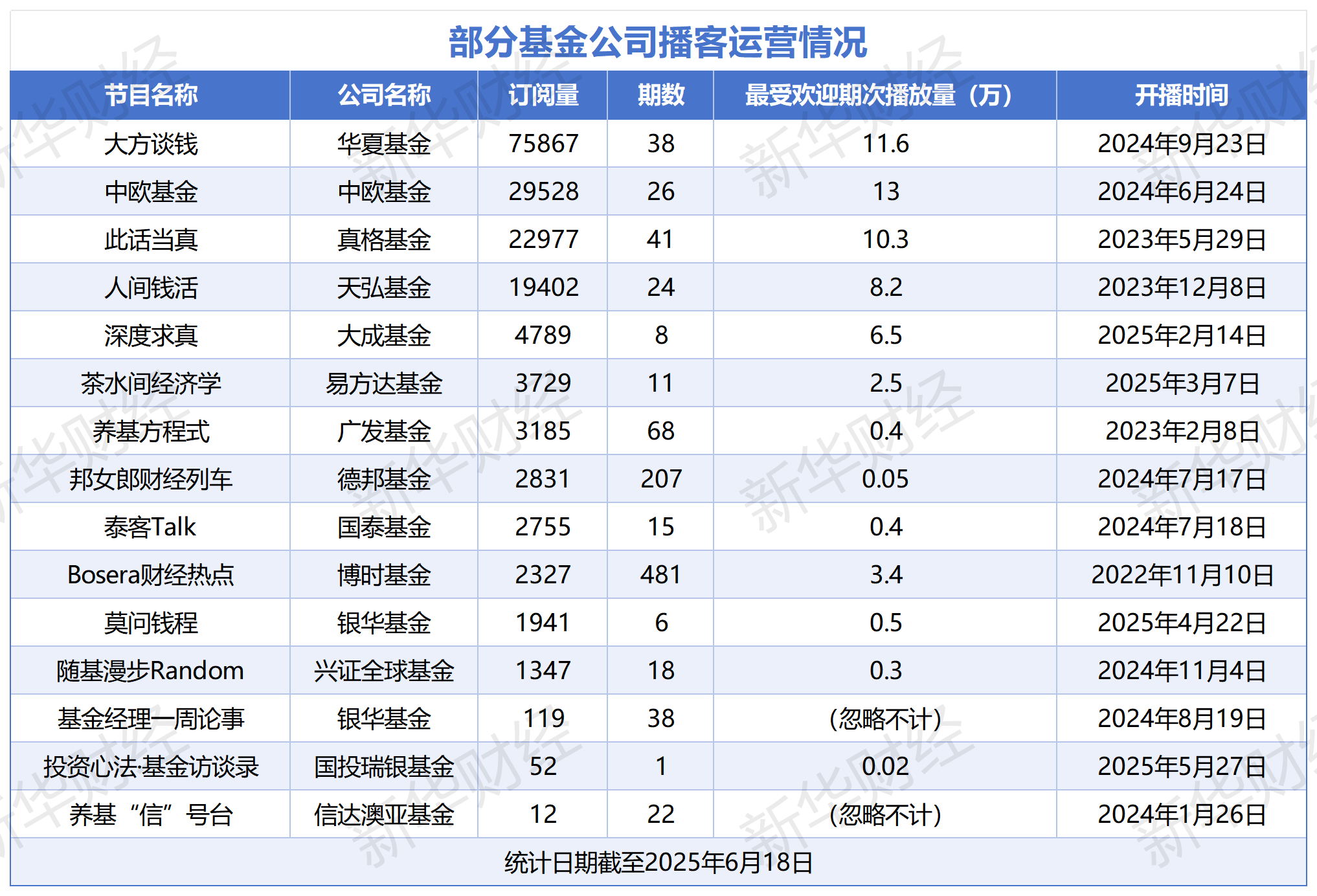
Core Viewpoint - The podcast industry is gaining significant attention from capital, with numerous fund companies entering the space as a new avenue for brand communication and investor education, indicating a growing trend in the financial sector [1][4]. Fund Companies and Podcast Engagement - Over 20 public fund companies, including Huaxia Fund, China Europe Fund, Tianhong Fund, and Dacheng Fund, have launched podcast channels on platforms like Ximalaya and Xiaoyuzhou [1]. - The podcast "Dafang Talks Money" from a certain fund company has a subscription count of 75,867, while China Europe Fund's podcast has 29,528 subscribers [2]. Audience Engagement and Listening Habits - A significant portion of podcast listeners, over 80%, tune in for more than three days a week, with 76.2% listening for over half an hour daily [8]. - The average completion rate for China Europe Fund's podcast is nearly 45%, with users averaging over 40 minutes of listening time [3]. Market Dynamics and Competition - The podcast market is rapidly evolving, with platforms like Ximalaya, Xiaoyuzhou, and NetEase Cloud Music leading in user base and content offerings [9]. - In 2024, Xiaoyuzhou added 46,000 new podcast programs and 484,000 episodes, with a total playback time of 840 million minutes [9]. Monetization Challenges - Despite the growing audience, monetization remains a challenge, with the podcast advertising market in China generating approximately 3.3 billion yuan, compared to 210 billion yuan for short video platforms [12]. - Many podcast hosts struggle with revenue generation, as evidenced by a popular podcast revealing only one advertising collaboration in a year, relying heavily on membership for income [11]. Technological Impact and Future Prospects - The rise of AI in podcasting, such as the introduction of AI-generated content, poses both challenges and opportunities for the industry, potentially leading to a reshaping of content creation and distribution [13][16]. - The integration of AI technology by major platforms like Ximalaya and Tencent is expected to enhance production efficiency and user engagement in the long audio market [17].
腾讯音乐上涨2.01%,报18.565美元/股,总市值287.55亿美元
Jin Rong Jie· 2025-06-18 17:58
Core Viewpoint - Tencent Music Entertainment Group (TME) shows strong financial performance with significant revenue and profit growth, indicating a robust position in the online music and audio entertainment industry in China [1][2]. Financial Performance - As of March 31, 2025, Tencent Music reported total revenue of 7.356 billion RMB, representing a year-on-year increase of 8.69% [1]. - The company's net profit attributable to shareholders reached 4.291 billion RMB, marking a substantial year-on-year growth of 201.76% [1]. Company Overview - Tencent Music is a leading online music and audio entertainment platform in China, operating popular music products such as QQ Music, Kugou Music, Kuwo Music, and WeSing [2]. - The platform offers a variety of services including online music streaming, audio content, karaoke, live performances, and social interactions centered around music [2]. - Tencent Music integrates social features like sharing, liking, commenting, and gifting into its music experience, enhancing user engagement and retention [2]. - The company collaborates closely with music labels and content owners for copyright protection and empowers artists in creation, distribution, and commercialization [2]. - Tencent Music's mission is to leverage technology to create limitless possibilities in music [2].
Tencent Music Taps Into In-Vehicle Audio Market With Ximalaya Deal
Benzinga· 2025-06-18 12:43
Core Viewpoint - Tencent Music's acquisition of Ximalaya Inc. signifies a strategic move to strengthen its position in the long-form audio content market, despite the current popularity of short videos [2][3]. Company Overview - Tencent Music Entertainment Group (TME) is China's leading online music streaming platform, and it plans to acquire Ximalaya, a prominent audio platform, to enhance its long-form audio offerings [3][4]. - The acquisition will involve a payment of $1.26 billion, which will account for up to 5.2% of Tencent Music's share capital, with additional shares contingent on performance goals [4]. Ximalaya's Market Position - Ximalaya holds a significant share of the online audio market in China, accounting for 25% of the market based on revenue in 2023, and has over 600 million users [7][8]. - The platform has faced challenges, including a combined loss of 3.17 billion yuan ($440 million) from 2018 to 2022, but turned a profit of 3.74 billion yuan in 2023 due to cost-cutting measures [8][9]. Strategic Implications - The acquisition will enhance Tencent Music's content library, adding over 5.2 million audiobooks and 240,000 podcast shows, which will help address its weaknesses in the long-form audio segment [11][12]. - Ximalaya's existing partnerships with over 80 car manufacturers, including Tesla and Nio, will provide Tencent Music with access to the in-vehicle audio market [12]. Financial Performance - Tencent Music reported a revenue of 7.36 billion yuan in Q1 2023, an increase of 8.7% year-on-year, with a net profit rise of 22.8% to 2.23 billion yuan, although it lost 20 million monthly active users during the same period [13]. Market Reactions - Following the announcement of the acquisition, Tencent Music's U.S. stock initially rose by 8% but closed down 0.92%, indicating mixed investor sentiment [15]. - Concerns regarding potential regulatory scrutiny over the acquisition may have contributed to the cautious market response [15]. Future Outlook - The deal is expected to diversify Tencent Music's content offerings and potentially boost profits, with investment bank CICC maintaining an "overperform" rating on the company [16]. - Tencent Music's current P/E ratio of approximately 21.8 times suggests it still holds investor appeal, and successful integration of Ximalaya's content could lead to a new growth phase for the company [17].

在线音乐行业深度解析:复杂投资环境下的优质长期现金流资产
Guoxin Securities· 2025-06-18 11:34
Investment Rating - The report maintains an "Outperform" rating for the online music industry [1] Core Insights - The online music industry exhibits strong bilateral effects and is less correlated with the economy, with "one super and one strong" company identified as high-quality long-term cash flow assets [2] - The industry is characterized by high concentration due to significant copyright fees, making it difficult for new entrants [2] - The growth of music subscriptions is driven by supply-side factors, with low churn rates observed in subscription services [2][32] - The Chinese digital music market is expected to grow by 15% year-on-year in 2024, outpacing global growth [7][12] Summary by Sections 01 Overview of Domestic and International Online Music Industry - The online music industry has a high concentration, with Tencent Music holding approximately 66% market share and NetEase Cloud Music around 27% [25] - The industry is experiencing a shift towards subscription models, with significant growth in paid users [32] 02 Tencent Music and Spotify Stock Review - Tencent Music's subscription business is a key growth driver, with a projected CAGR of 19% for subscription revenue from 2024 to 2027 [5] - Spotify is expected to achieve profitability in 2024, with a focus on cost reduction and efficiency improvements [4] 03 Financial Analysis - The subscription penetration rates for Tencent Music and NetEase Cloud Music are projected to reach 25% and 20.6% respectively by 2024 [5] - The average revenue per paying user (ARPPU) for Tencent Music is expected to increase, driven by the development of premium services [5] 04 Valuation Analysis and Investment Recommendations - The online music industry is projected to maintain a CAGR of 15% over the next three years, indicating growth potential [5] - Current price-to-earnings (PE) ratios for Tencent Music, NetEase Cloud Music, and Spotify are 23x, 27x, and 38x respectively for 2025 [5]

美股普跌、油价大涨逾4%,以伊紧张局势加剧
Di Yi Cai Jing· 2025-06-17 23:06
Group 1: Market Reactions - The U.S. stock market experienced a significant decline, with major indices falling sharply amid rising geopolitical tensions and concerns over U.S. intervention in the Israel-Iran conflict [2][3] - The VIX index surged to its highest level since May 23, closing at 21.6 points, indicating increased market volatility and investor anxiety [2][3] Group 2: Sector Performance - All sectors of the S&P 500 index declined, except for the energy sector, which saw gains [3] - Defense and aerospace stocks rose, with Lockheed Martin increasing by 2.6% [3] - Clean energy stocks plummeted due to proposed tax reforms that aim to phase out renewable energy tax credits by 2028, with Enphase Energy dropping 24% and Sunrun falling 40% [3] Group 3: Company News - Eli Lilly announced plans to acquire gene-editing company Verve Therapeutics for up to $1.3 billion, resulting in a 2% drop in Eli Lilly's stock, while Verve's stock surged by 81.5% [3] - Tesla led declines in technology stocks, falling nearly 4%, while other major tech companies like Apple, Microsoft, and Amazon also experienced varying degrees of decline [3] Group 4: Economic Data - U.S. retail sales fell by 0.9% in May, marking the largest decline in four months, with a 0.3% decrease excluding auto sales [4] - Industrial output declined for the second time in three months, with utility output down by 2.9% and weak manufacturing growth [4] Group 5: Commodity Market - Oil prices rebounded strongly due to Middle Eastern risks, with WTI crude futures rising by 4.3% to $73.27 per barrel and Brent crude increasing by 4.4% to $76.45 [5] - Gold prices faced pressure, with COMEX gold futures falling by 0.3% to $3,406.9 per ounce [5]




28亿美金收购喜马拉雅!喜马拉雅估值缩水35%,音频进入存量时代
Sou Hu Cai Jing· 2025-06-17 08:34
Group 1 - Tencent Music Entertainment Group (TME) announced a strategic acquisition of Himalaya for approximately $2.8 billion, consisting of $1.26 billion in cash, $1.49 billion in equity, and $106 million in performance-based shares [1] - The acquisition price represents a 35% decrease from Himalaya's peak valuation of $4.3 billion in 2021, marking it as a "bloody acquisition" in the industry [2] - Himalaya's revenue growth has stagnated, with 2023 revenue at 6.16 billion yuan, a mere 1.7% increase year-over-year, and a low paid user rate of 11.9% compared to Tencent Music's 21.7% [2][5] Group 2 - The acquisition allows Tencent Music to enhance its audio content ecosystem by leveraging Himalaya's 300 million monthly active users and its strengths in knowledge payment and podcasting [4] - The deal is facilitated by a more relaxed antitrust environment in 2025, allowing for greater consolidation among industry giants [4] - The audio industry faces structural challenges, including low advertising monetization efficiency and a subscription rate below 15% in China, compared to over 40% in the U.S. [7][8] Group 3 - The acquisition is seen as a necessary exit strategy for Himalaya's early investors amid a liquidity crisis in the audio industry, with a 70% drop in financing since 2021 [7] - The deal signifies a shift in the audio sector from incremental competition to stock consolidation, highlighting the need for companies to adapt to changing market dynamics [8] - Future success will depend on Tencent Music's ability to integrate Himalaya's content ecosystem with its music resources effectively [8]