TI(TXN)

Search documents
2 High-Yield Dividend Stocks You'll Wish You Had Bought 10 Years From Now
The Motley Fool· 2025-09-17 09:16
Core Insights - Dividend-paying stocks have historically outperformed non-dividend stocks, with an average annual return of 9.2% for dividend payers in the S&P 500 from 1973 to 2024, compared to 4.3% for non-payers [2] Company Analysis: Novo Nordisk - Novo Nordisk's stock has seen a significant decline of approximately 62% from its previous peak, primarily due to underestimated demand for its semaglutide products, leading to a shortage [7] - The company reported a 16% year-over-year increase in total U.S. sales in the first half of 2025, with operating profits expected to rise by 10% to 16% in 2025 [9] - Novo Nordisk has more than doubled its dividend payments since 2020, currently offering a yield of 3.1%, with potential for significant payout increases in the future [10] Company Analysis: Texas Instruments - Texas Instruments has diversified its product offerings beyond graphing calculators, focusing on specialized semiconductors that convert real-world signals into digital data [11] - The company's stock is down about 20% from its peak in July, attributed to a lower-than-expected earnings outlook, but the midpoint of its revenue guidance suggests an 11% year-over-year sales gain [13] - Texas Instruments has increased its dividend payout by 258% over the past decade, currently offering a yield of 3.1%, with potential for higher payouts in the future [14]



中国或将改变模拟芯片格局
半导体行业观察· 2025-09-17 01:30
Core Viewpoint - The recent anti-dumping investigation initiated by China against U.S. analog chip imports may reshape the global market landscape, indicating escalating geopolitical tensions between China and the U.S. and accelerating domestic substitution of analog products [2]. Group 1: Investigation Details - The investigation began on September 13, 2025, following a complaint from the Jiangsu Semiconductor Industry Association [2]. - The focus of the investigation includes interface and gate driver chips, such as CAN and RS485 transceivers, which are widely used in automotive, industrial, and power electronics applications [2]. - The investigation is expected to last one year, with a possible six-month extension, assessing import conditions since 2024 and industry damage dating back to 2022 [3]. Group 2: Impact on Companies - Bernstein estimates the revenue exposure of major U.S. suppliers: TI at 11.4%, ADI at 7.8%, and Onsemi at 10.2%, with the Chinese market accounting for about 20% of revenue for TI and ADI [2]. - The investigation may have a limited impact on U.S. analog processor manufacturers, according to UBS analysts, who suggest that the effects on companies like Texas Instruments and ADI are expected to be minimal [3]. - Local companies such as Silergy, Novosense, 3Peak, SG Micro, and Joulwatt may benefit from this investigation, while U.S. firms face downside risks [3]. Group 3: Geopolitical Context - The investigation is seen as a response to recent U.S. trade restrictions on several Chinese companies, with the U.S. Commerce Department adding 32 entities to the trade restriction list, including 23 Chinese entities [4]. - The investigation may be similar to previous U.S. investigations into Chinese analog chip manufacturers, indicating a tit-for-tat dynamic in trade relations [4].


中国商务部发起美国模拟芯片和对华政策调查,影响几何?
Sou Hu Cai Jing· 2025-09-16 17:05
Group 1 - The U.S. Department of Commerce has placed 23 Chinese entities, including 13 integrated circuit companies, on an export control "entity list," impacting the global semiconductor industry and international trade [2][3] - The Chinese Ministry of Commerce has expressed strong opposition to the U.S. actions, accusing it of abusing export controls and harming normal business exchanges between countries [2][3] - The Ministry of Commerce has initiated anti-dumping investigations against U.S. imported analog chips, with the investigation period set from January 1, 2024, to December 31, 2024 [4][6] Group 2 - The anti-dumping investigation was triggered by a formal complaint from the Jiangsu Semiconductor Industry Association, citing a 37% increase in imports and a 52% decrease in prices of the investigated products from the U.S. [8] - The investigation targets general interface chips and gate driver chips produced using 40nm and above process technology, covering various product forms to prevent evasion [8][10] - The Chinese semiconductor industry is expected to benefit from the investigation, as it may lead to a reassessment of supply chains and increased domestic chip usage [11][12] Group 3 - Major U.S. companies affected by the investigations include Texas Instruments and Analog Devices, which have significant revenue from the Chinese market [14][18] - Texas Instruments generated approximately $3 billion in revenue from China in 2024, accounting for about 19% of its total revenue, while Analog Devices earned around $2.1 billion, representing 23% of its revenue [14] - The Chinese analog chip market is projected to grow significantly, with a compound annual growth rate of 11% from 2025 to 2029, driven by demand from automotive and industrial sectors [18] Group 4 - The Ministry of Commerce has also launched an anti-discrimination investigation against U.S. measures in the integrated circuit sector, citing discriminatory practices that harm China's technological development [19][20] - This investigation aims to review a range of U.S. policies affecting China's semiconductor industry since 2018, including tariffs and export controls [22] - The anti-discrimination investigation is part of China's broader strategy to counteract U.S. trade measures and protect its domestic industries [21][22]
中美芯片战,中国大反击
虎嗅APP· 2025-09-16 14:05
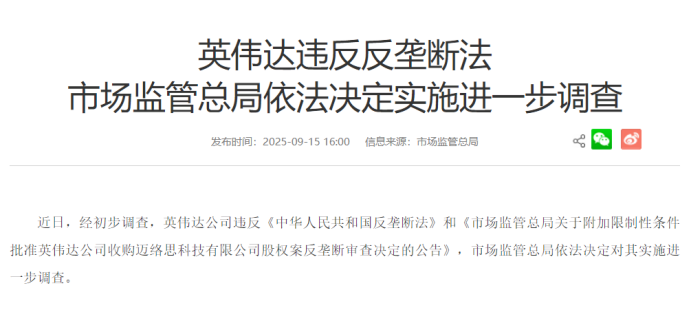
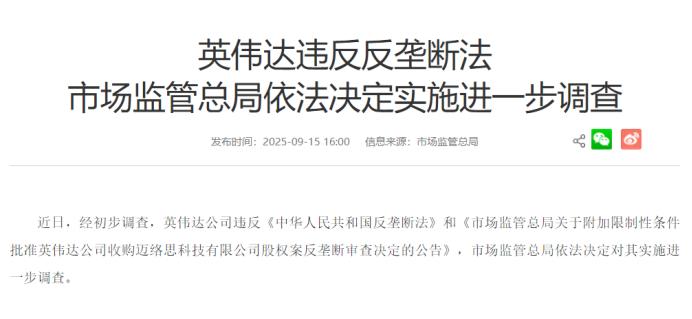
Core Viewpoint - The article discusses China's recent countermeasures in the ongoing chip war with the United States, highlighting three specific actions taken against American semiconductor companies, particularly Nvidia, in response to U.S. export controls and anti-competitive practices [4][5][6]. Group 1: China's Countermeasures - On September 13, China initiated an anti-dumping investigation into American-made analog chips [4]. - On the same day, China launched an anti-discrimination investigation against U.S. measures affecting the integrated circuit sector [4]. - On September 15, China determined that Nvidia violated antitrust laws, leading to further investigations [4][9]. Group 2: Nvidia's Antitrust Issues - Nvidia recently received U.S. government approval to sell H20 chips to China but faced scrutiny from the Chinese government for alleged antitrust violations [8][9]. - The investigation relates to Nvidia's 2019 acquisition of Mellanox Technologies, which was approved under specific conditions to prevent anti-competitive practices [11][14]. - Nvidia's supply of H20 chips to China has been criticized for not adhering to fair and non-discriminatory principles, as the performance of these chips is significantly lower than their counterparts available in other markets [16][17]. Group 3: Impact on the Semiconductor Industry - The anti-dumping investigation targets analog chips, with significant price discrepancies noted, such as a dumping margin of 340.10% for certain products [24][25][26]. - Major U.S. companies like Texas Instruments, ADI, Broadcom, and ON Semiconductor are implicated, with their combined revenue in China exceeding $10 billion, indicating potential significant financial repercussions [33]. - Following the announcement of these investigations, Chinese semiconductor stocks surged, while U.S. counterparts like Texas Instruments experienced declines [33]. Group 4: Broader Trade Implications - The article suggests that the ongoing trade tensions involve not only direct actions like anti-dumping and antitrust investigations but also broader issues of discrimination in trade practices [35][36]. - The ultimate goal for China is to enhance its self-sufficiency in semiconductor manufacturing, reducing reliance on foreign technology [37][38].



对美模拟芯片反倾销,业内怎么看?
3 6 Ke· 2025-09-16 04:26
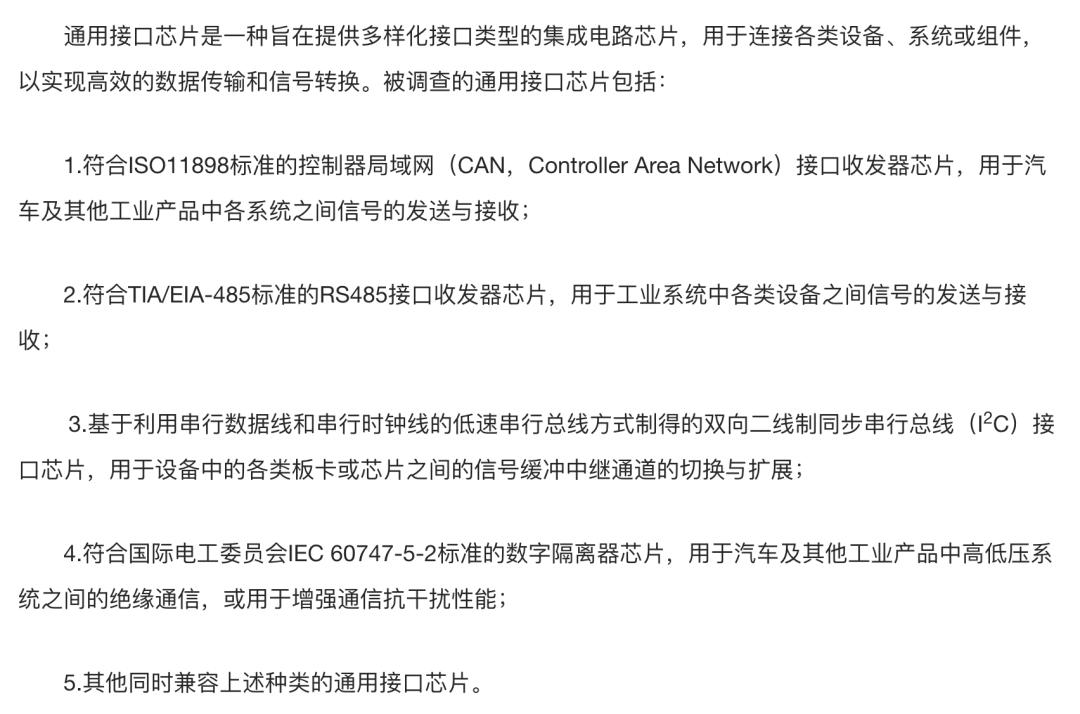
Group 1 - The Ministry of Commerce has initiated an anti-dumping investigation into imported analog chips from the United States, leading to a significant rise in the A-share analog chip sector [1][5] - Major companies such as Shengbang Co., Shanghai Beiling, and Naxinwei saw their stock prices hit the daily limit, while others like SIRUI and Aiwai Electronics also experienced notable gains [1][10] - The investigation was prompted by a formal request from the Jiangsu Semiconductor Industry Association, citing a significant price drop and a dumping margin exceeding 300% for the products in question [2][3] Group 2 - The investigation will cover products primarily used in automotive and industrial systems, specifically general-purpose interface chips and gate driver chips [8][9] - The products under investigation include both finished chips and raw materials like wafers and die, emphasizing the importance of product origin [10][12] - The investigation period is set from January 1, 2024, to December 31, 2024, with the industry damage assessment covering from January 1, 2022, to December 31, 2024 [12] Group 3 - The Chinese Semiconductor Industry Association and other industry groups have expressed support for the investigation, emphasizing the need for a fair market environment [5][6] - Despite improvements in domestic analog chip self-sufficiency, major players like Texas Instruments and Analog Devices still dominate the market [11] - The price competition from U.S. manufacturers has significantly impacted domestic small and medium-sized enterprises, highlighting the challenges faced by local firms in the high-end market [12][13]
反倾销反歧视反垄断:中国还击美国芯片战
Hu Xiu· 2025-09-16 04:05
Group 1 - China has initiated anti-dumping investigations against American-made analog chips and anti-discrimination investigations related to integrated circuits on the same day, marking a significant counteraction in the ongoing chip war with the U.S. [1][2] - The U.S. Department of Commerce recently added 32 entities to its export control "entity list," with 23 of them located in China and many involved in the chip business, which may have triggered China's response [2][3] - The ongoing trade talks between China and the U.S. in Spain may be influenced by these actions, suggesting a strategy of "fighting while negotiating" [3][4] Group 2 - Nvidia has been found in violation of antitrust laws by China's State Administration for Market Regulation (SAMR), which has decided to conduct further investigations [8][10] - The investigation relates to Nvidia's acquisition of Mellanox Technologies in 2019, which was approved under certain conditions to prevent anti-competitive practices [12][15] - Nvidia's current supply of H20 chips to China is significantly limited in performance compared to its H200 chips, raising concerns about compliance with fair trade practices [18][17] Group 3 - The anti-dumping investigation targets analog chips produced by U.S. companies, with the investigation period set from January 1, 2024, to December 31, 2024 [31][32] - The application for the investigation cites that U.S. companies have significantly increased their product imports to China while simultaneously lowering prices, adversely affecting domestic producers [36][39] - If the anti-dumping investigation is upheld, it could lead to substantial penalties for major U.S. chip companies, potentially impacting their revenues in China, which exceed $10 billion collectively [41] Group 4 - The Chinese government is also conducting an anti-discrimination investigation against U.S. measures that restrict high-end chips while allowing low-end chips to flood the market, which are seen as discriminatory trade practices [44][45] - The outcome of these investigations could lead to increased tariffs or restrictions on U.S. products if found to be unfair [45][46] - The ongoing investigations and trade tensions highlight the complex dynamics of the U.S.-China trade relationship, particularly in the semiconductor sector [46][47]

开盘:沪指涨0.14%、创业板指涨0.2%,黄金及旅游概念股走高
Jin Rong Jie· 2025-09-16 02:12
Market Overview - On September 16, A-shares opened slightly higher with the Shanghai Composite Index up 0.14% at 3865.98 points, the Shenzhen Component Index up 0.09% at 13017.58 points, and the ChiNext Index up 0.2% at 3072.3 points [1] - The market focus included stocks like Shoukai Co., which opened up 1.65% after a significant price increase, and other sectors such as gold and real estate showing strong performance [1] Company News - CATL announced that its sodium-ion battery has passed the new national standard certification, making it the first globally certified sodium-ion battery for passenger vehicles [2] - Shoukai Co. experienced a significant stock price fluctuation, with a cumulative increase of 100% over a short period, indicating abnormal trading activity [2] - Shanghai Construction Group reported an increase in gold mine resources, valued at approximately 4.27 billion RMB, although this has minimal impact on the company's overall revenue [2] - New Dazheng is planning a major asset restructuring involving the acquisition of at least 51% of Jiaxin Liheng Facility Management [3] - Jiugui Liquor's collaboration with a partner has led to strong sales of a new product, with plans to accelerate the development of innovative alcoholic beverages [3] - Longpan Technology signed a procurement agreement with CATL for lithium iron phosphate cathode materials, with total sales expected to exceed 6 billion RMB [3] - Dingtong Technology plans to invest up to 15 million USD in Vietnam for the development of high-speed communication connectors and other products [3] - Borui Pharmaceutical received approval for clinical trials of a new drug targeting obesity, marking a significant milestone in its product development [3] Stock Movements - Siwu Fushi's major shareholder reduced their stake by approximately 0.94%, bringing their total holding down to 64.8% [4] - Junsheng Electronics secured projects with major automotive brands, with a total lifecycle order value estimated at around 15 billion RMB [4] Investment Opportunities - Crystal Morning plans to acquire 100% of Chip Micro Semiconductor for 316 million RMB, focusing on IoT and automotive applications [5] - Nanfeng Co. is in the early stages of a 3D printing service project, with an initial investment of 50 million RMB [5] - Zhenghai Magnetic Materials' convertible bonds will cease trading after September 16, with a forced redemption price set at 100.50 RMB per bond [5] Regulatory Updates - ST Suwu's stock price fell below 1 RMB, risking delisting if it remains below this threshold for 20 consecutive trading days [6] Industry Trends - Keli Yuan plans to accelerate the construction of energy storage projects in various regions, aiming for at least 4 GWh of new projects by the end of 2025 [7] - The electronic industry is seeing a shift towards advanced packaging and thermal management solutions, driven by the demands of AI and data centers [11] - The new policies from the National Development and Reform Commission and the National Energy Administration are expected to boost the growth of energy storage and wind power projects [19]




中美芯片战:中国大反击,上了 3 个反制手段,直戳美国痛处
3 6 Ke· 2025-09-16 01:19
Group 1 - China has initiated anti-dumping investigations against American semiconductor chips, marking a significant response in the ongoing chip war with the U.S. [1] - The investigations were triggered by the U.S. Department of Commerce's recent addition of 32 entities to the export control "entity list," including 23 from China involved in chip business [1][2] - The Chinese government has also launched an anti-discrimination investigation against U.S. measures in the integrated circuit sector [1] Group 2 - Nvidia is under investigation by China's State Administration for Market Regulation (SAMR) for violating antitrust laws, particularly related to its acquisition of Mellanox Technologies in 2019 [4][7] - The acquisition raised concerns due to Nvidia's dominant market share in GPU accelerators and Mellanox's significant presence in high-speed networking equipment [9][10] - Nvidia's H20 chip, which is being sold to China, has significantly reduced performance compared to its H200 counterpart, raising fairness concerns in supply [14] Group 3 - The anti-dumping investigation targets American analog chips, with reported dumping margins of 340% for certain products [22][30] - The investigation period is set from January 1, 2024, to December 31, 2024, with the domestic industry claiming significant harm due to price suppression by U.S. companies [23][30] - The outcome of the anti-dumping investigation could lead to substantial penalties for U.S. companies like Texas Instruments and Broadcom, which collectively earn over $10 billion in China [31][32] Group 4 - The Chinese government is also conducting an anti-discrimination investigation against U.S. trade practices, which may result in tariffs or restrictions on U.S. products [32] - The ultimate countermeasure for China may involve enhancing its self-reliance in semiconductor manufacturing capabilities [33][34]
Texas Instruments (TXN) Stock Drops Despite Market Gains: Important Facts to Note
ZACKS· 2025-09-15 22:51
Company Performance - Texas Instruments (TXN) closed at $178.20, reflecting a -2.41% change from the previous day, underperforming the S&P 500's 0.47% gain [1] - Over the past month, TXN shares have depreciated by 6.15%, while the Computer and Technology sector gained 3.88% and the S&P 500 gained 2.32% [1] Upcoming Earnings - Texas Instruments is projected to report earnings of $1.48 per share, indicating a year-over-year growth of 0.68% [2] - The consensus estimate for revenue is $4.64 billion, representing an 11.83% increase compared to the same quarter of the previous year [2] Full Year Estimates - For the full year, earnings are projected at $5.6 per share and revenue at $17.67 billion, showing changes of +7.69% and +12.94% respectively from the previous year [3] - Recent changes to analyst estimates suggest a favorable outlook on the business health and profitability of Texas Instruments [3] Valuation Metrics - Texas Instruments has a Forward P/E ratio of 32.61, which is a discount compared to the industry average Forward P/E of 38.67 [5] - The current PEG ratio for TXN is 2.98, while the average PEG ratio for the Semiconductor - General industry is 3.62 [6] Industry Ranking - The Semiconductor - General industry is part of the Computer and Technology sector and holds a Zacks Industry Rank of 27, placing it in the top 11% of over 250 industries [6] - The Zacks Industry Rank assesses the strength of industry groups based on the average Zacks Rank of individual stocks, with the top 50% rated industries outperforming the bottom half by a factor of 2 to 1 [7]
S&P 500 and Nasdaq 100 Post Record Highs on Fed Easing Expectations
Nasdaq· 2025-09-15 17:17
Market Overview - The S&P 500 and Nasdaq 100 have reached new all-time highs, supported by falling bond yields and expectations of a 25 basis point interest rate cut by the Federal Reserve [2][5] - Major US stock indexes, including the S&P 500, Dow Jones, and Nasdaq 100, continue to post record highs due to expectations of Fed interest rate cuts [5] Economic Indicators - The September Empire manufacturing survey showed a significant decline in general business conditions, falling -20.6 to a three-month low of -8.7, which was weaker than the expected 5.0 [4] - China's August industrial production rose +5.2% year-on-year, below expectations of +5.6%, while retail sales increased +3.4% year-on-year, also weaker than the expected +3.8% [6] Company Performance - Tesla's stock rose more than +5% after Elon Musk purchased nearly $1 billion in shares, leading gains in megacap technology stocks [2][14] - Nvidia's stock fell more than -1% after a ruling from China that the company violated anti-monopoly laws related to its acquisition of Mellanox Technologies [3][18] - Texas Instruments saw a decline of more than -2% following news of an anti-dumping investigation by China targeting its semiconductor products [3][17] Upcoming Economic Events - The FOMC meeting is anticipated to result in a 25 basis point rate cut, with markets pricing in a 100% chance of this outcome [8] - Upcoming economic data includes expected increases in August retail sales and a decline in manufacturing production [7]