UBS(UBS)

Search documents
CPKC's President and CEO Keith Creel; SVP, Accounting, Planning and Procurement Ian Gray to address the 2025 UBS Global Industrials and Transportation Conference
Prnewswire· 2025-11-19 15:59
Core Insights - Canadian Pacific Kansas City (CPKC) will participate in the 2025 UBS Global Industrials and Transportation Conference on December 2, 2025, at 9:40 a.m. ET, with President and CEO Keith Creel and Senior Vice President Ian Gray addressing the audience [1][2]. Company Overview - CPKC is the first and only single-line transnational railway connecting Canada, the United States, and Mexico, providing access to major ports from Vancouver to Atlantic Canada, the Gulf Coast, and Lázaro Cárdenas, Mexico [2]. - The railway spans approximately 20,000 route miles and employs around 20,000 railroaders, offering extensive rail service and network reach to key markets across North America [2]. - CPKC is focused on growth alongside its customers, providing a range of freight transportation services, logistics solutions, and supply chain expertise [2].



Payoneer to Participate in the UBS Global Technology and AI Conference
Prnewswire· 2025-11-19 15:00
Group 1 - Payoneer Global Inc. will have its CFO, Bea Ordonez, participate in a fireside chat at the UBS Global Technology and AI Conference on December 3, 2025 [1] - The company provides a financial platform for cross-border business and global payments, empowering millions of businesses, especially SMBs in emerging markets [2][3] - Payoneer aims to facilitate connections to the global economy, enabling businesses to manage funds across multiple currencies and grow their operations [2] Group 2 - The company is set to report its Third Quarter 2025 financial results on November 5, 2025 [4] - Investors and interested parties can access the live webcast and replay of the presentation through the company's investor relations website [2] - Payoneer has seen a 21% increase in press release views, indicating growing interest in its financial updates [3]


2025全球财富报告:财富扩张下的结构重塑,“大众百万富豪”崛起
Sou Hu Cai Jing· 2025-11-19 12:06
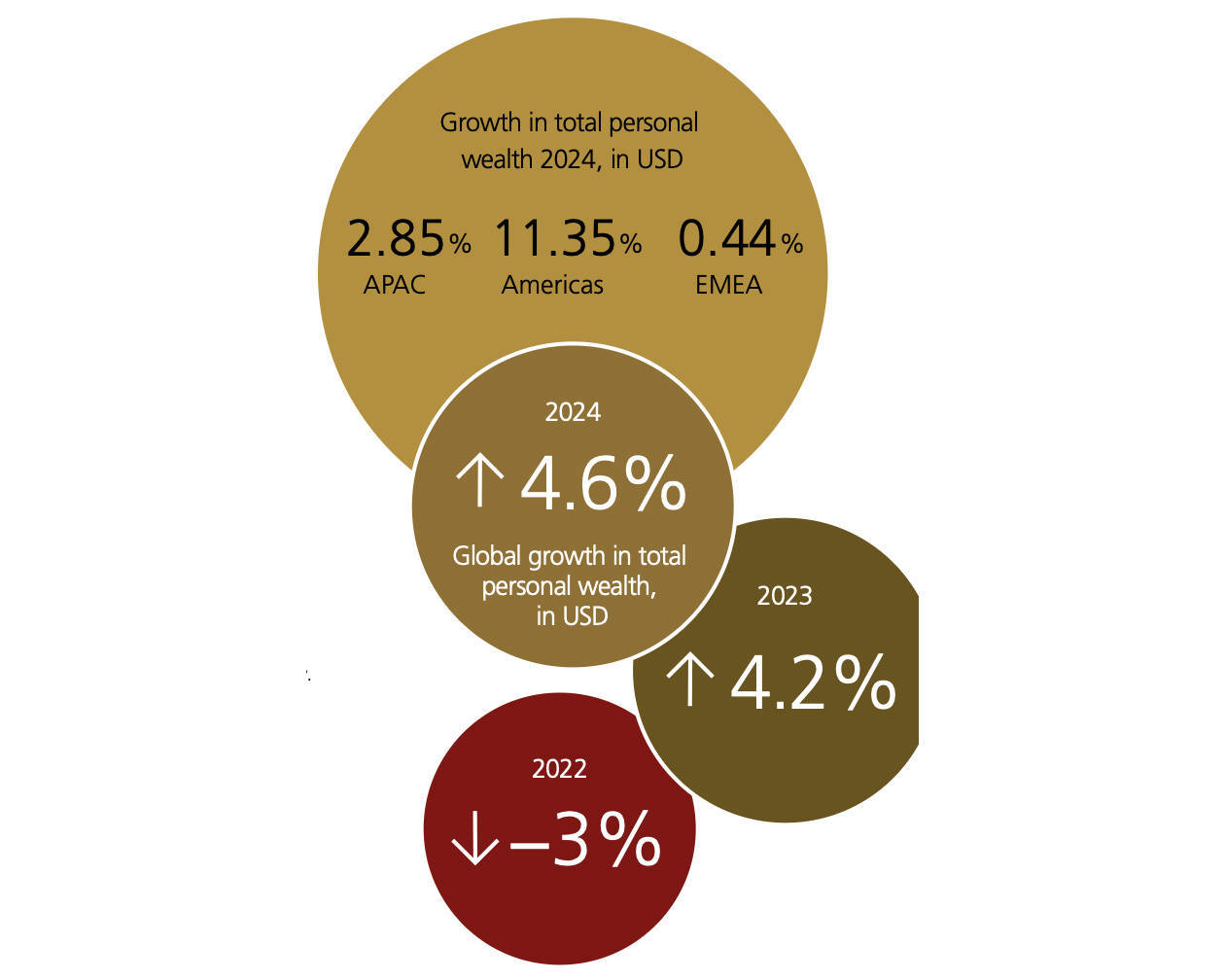
瑞银(UBS)近期发布了《2025全球财富报告》(以下简称报告),这也是该机构发布的第16版报告。报告覆盖全球56个市场,数据显示,尽管全球经济仍 处在不确定的大环境下,但全球财富规模在过去两年保持了稳健增长:继2023年增长4.2%后,2024年增长了4.6%;与此同时,百万富豪*的数量也在稳步增 加。 尽管全球财富总量创下新高,但增长却并不均衡。报告指出,2024年的财富增长主要集中在北美及美洲地区,增幅超过11%,这一增长得益于美元走强和金 融市场活跃。相反,亚太地区(APAC)的增速不足3%,而欧洲、中东和非洲地区(EMEA)更低于0.5%,增长明显放缓。 从长期视角看,报告强调,自千禧年以来,全球财富总量以年均3.4%的速度增长。换言之,尽管短期会因汇率或资产价格波动出现起伏,但整体扩张态势 并未改变。 * 注:报告以美元为单位,文中的百万富豪资产在100万美元以上,折合人民币约720万以上。 美国中国百万富豪年增速最猛 财富总量不断上升的同时,全球财富的分布格局也在发生微妙变化。根据报告,2024年新增百万富豪超过68万人,同比增长1.2%,总人数接近6000万,合 计掌握约226万亿美元的资产, ...
X @Bloomberg
Bloomberg· 2025-11-19 09:54
Switzerland’s top trade diplomat expressed her country’s heartfelt desire for UBS not to move abroad https://t.co/bREP9qgTsD ...
利好!外资机构:看好中国资产
Zhong Guo Zheng Quan Bao· 2025-11-19 08:48
Core Viewpoint - Multiple foreign securities and fund companies have released outlook reports for 2026, indicating that the current Chinese stock market has medium to long-term allocation value driven by ample liquidity and improving profitability [1] Group 1: Market Outlook - UBS sets the MSCI China Index target for the end of 2026 at 100, representing a 14% upside from current levels [3] - Morgan Stanley raises its target for the CSI 300 Index to 4840 points by December 2026, citing moderate corporate profit growth and a more favorable external environment [3] Group 2: Investment Strategies - Foreign institutions favor sectors such as technology, internet, and high-dividend assets [4] - UBS is optimistic about technology stocks, internet stocks, and the brokerage sector, while Morgan Stanley recommends a "barbell strategy" focusing on high-quality internet and technology leaders alongside some high-dividend assets for stable cash returns [4] - Goldman Sachs has identified 50 stocks across 21 sub-industries, including 30 A-shares and 20 overseas-listed Chinese stocks, expected to outperform the market in the future [4] Group 3: Cross-Border Investment Facilitation - Foreign institutions express confidence in China's capital market due to a series of landmark opening measures aimed at enhancing cross-border investment and financing convenience [5] - The recent approval of Huafu International Asset Management Co., Ltd. as a qualified foreign investor by the China Securities Regulatory Commission (CSRC) exemplifies the expedited approval process [6] - The CSRC has introduced an optimization plan for the qualified foreign investor system, aiming to streamline the investment pre-approval process and enhance efficiency in various related procedures [6][7]


瑞银:AI潜力越发取决于电力和资源执行能力
Zheng Quan Shi Bao Wang· 2025-11-19 06:32
Core Insights - The potential of AI increasingly depends on the execution capabilities in the electricity and resources sectors, creating attractive opportunities for global investors [1] - Increased capital expenditure in AI is expected to benefit the entire value chain, from electrical equipment and grid infrastructure to energy storage and renewable energy [1] - By 2030, annual investments in power generation, energy storage, grid, data centers, and electric transportation and industrial sectors are projected to reach $3 trillion, prompting investors to consider diversified and flexible allocations within this value chain [1] Investment Landscape - The U.S. AI strategy requires significant energy investments, with domestic resources only meeting 25% of energy storage needs, which will catalyze a wave of investment and innovation in U.S. energy infrastructure [1] - China's new energy structure emphasizes both environmental sustainability and strategic significance, aiming to reduce dependence on imported fossil fuels while supporting domestic technology sectors [1] - This approach may create cost advantages for Chinese tech companies, allowing local AI chip manufacturers to compete effectively [1] Investment Strategy - Investors should not view the electricity and resources sectors as mere alternatives for AI investments, as the correlation between AI and these sectors is relatively low, potentially making them valuable tools for portfolio diversification [1]
利好来了!中国股票突传重磅!
天天基金网· 2025-11-19 05:20
Core Viewpoint - Foreign institutions are increasingly optimistic about Chinese assets, predicting a strong performance for Chinese stocks by 2026, driven by various favorable factors including innovation and supportive policies [4][6][12]. Group 1: Foreign Institutions' Predictions - UBS forecasts that the MSCI China Index will reach 100 points by the end of 2026, representing a potential increase of approximately 14% from the current level [6]. - The Hang Seng Index target is set at 30,000 points, indicating a potential rise of about 12.9% [6]. - Morgan Stanley anticipates a moderate increase in the Chinese stock market, with year-end targets of 27,500 points for the Hang Seng Index and 4,840 points for the CSI 300 Index, reflecting increases of around 6% and 5.9% respectively [12]. Group 2: Market Drivers and Conditions - Key drivers for the Chinese stock market in 2026 include: 1. Innovation, particularly in artificial intelligence (AI), where China offers significant investment opportunities outside the U.S. [6][10]. 2. Continued supportive policies for enterprises and capital markets [7]. 3. Ample liquidity due to ongoing fiscal expansion and a loose monetary policy environment, with expectations of interest rate cuts from both the Federal Reserve and the People's Bank of China [7]. 4. Potential capital inflows from domestic and foreign institutional investors [7]. Group 3: Earnings and Valuation Outlook - UBS projects a 5% revenue growth and a 10% earnings per share (EPS) growth for MSCI China Index constituents in 2026 [9]. - The report indicates a 4% expected valuation increase, driven by inflows from domestic institutions, retail investors seeking higher returns in a low-interest environment, and foreign investors looking for diversified and relatively cheap assets [9]. - Morgan Stanley expects a 6% profit growth for Chinese companies in 2026, potentially rising to 10% by 2027, supported by trade benefits and anticipated interest rate cuts [12][13].

美股AI泡沫论持续发酵,瑞银发声:“对冲利器”在中国!
Jin Shi Shu Ju· 2025-11-19 04:22
Group 1 - The core viewpoint is that Chinese AI stocks are becoming increasingly attractive for investors seeking portfolio diversification, especially in light of high valuations in U.S. tech stocks [2] - UBS's Jason Draho suggests that the Chinese tech sector offers a compelling alternative to balance U.S. tech holdings, as the correlation between the two markets is relatively low despite their apparent synchronized movements [2] - The differing driving factors behind Chinese and U.S. tech stocks, including domestic policies and technological differences, may allow for independent performance, potentially leading to diversification benefits [2] Group 2 - Chinese tech companies are valued at only one-third to half of their U.S. counterparts, making them competitive in the AI product space [3] - Despite lower absolute valuations, Chinese tech stocks are currently trading at a forward P/E ratio of 14, up from 11 a year ago, indicating they may be relatively high compared to their historical valuations [3] - Investment vehicles such as Invesco China Technology ETF (CQQQ) and iShares MSCI China Tech UCITS ETF (CTEC) have shown strong performance, with the Invesco ETF returning 38% year-to-date, outperforming the Nasdaq 100's 19% increase [3]
利好来了!中国股票突传重磅!
Zheng Quan Shi Bao Wang· 2025-11-19 03:12
Core Viewpoint - Foreign investment institutions are increasingly optimistic about Chinese assets, predicting a significant rise in Chinese stocks by 2026, driven by various favorable factors including innovation and easing trade tensions [1][2]. Group 1: UBS Insights - UBS forecasts that the MSCI China Index will reach 100 points by the end of 2026, representing a potential increase of approximately 14% from the current level [2]. - The Hang Seng Index target is set at 30,000 points, indicating a potential rise of about 12.9% [2]. - Key supportive factors for the Chinese market include: 1. Innovation, particularly in AI, where China offers extensive investment opportunities outside the U.S. [2]. 2. Continued supportive policies for enterprises and capital markets [2]. 3. Ample liquidity due to ongoing fiscal expansion and a loose monetary policy environment, with expectations of interest rate cuts from both the Federal Reserve and the People's Bank of China [2]. 4. Potential capital inflows from domestic and foreign institutional investors [2]. Group 2: Market Dynamics - The focus for 2026 will shift towards substantial improvements in corporate profitability, with UBS emphasizing that profit growth will drive market increases rather than valuation recovery [3]. - UBS anticipates a 5% revenue growth and a 10% earnings per share (EPS) growth for MSCI China Index constituents in 2026 [3]. - A 4% valuation uplift is expected, primarily from inflows of domestic institutional investors, retail investors seeking higher returns in a low-interest environment, and foreign institutional investors looking for diversification [3]. Group 3: Sector Focus - UBS highlights the technology and internet sectors as promising areas for investment in 2026, noting that China provides diverse investment opportunities outside the U.S. [4]. - Chinese AI stocks are seen as undervalued compared to their U.S. counterparts, presenting an attractive investment opportunity [4]. Group 4: Morgan Stanley's Outlook - Morgan Stanley projects a moderate increase in the Chinese stock market in 2026, with year-end targets of 27,500 points for the Hang Seng Index and 4,840 points for the CSI 300 Index, reflecting increases of about 6% and 5.9% respectively [5]. - The firm expects a 6% profit growth for Chinese companies in 2026, potentially rising to 10% by 2027, supported by trade benefits and anticipated interest rate cuts [5]. - The MSCI China Index's expected price-to-earnings ratio will remain stable at 12 to 13 times, aligning with current levels [5]. Group 5: Investment Strategy - Morgan Stanley emphasizes the importance of stock selection, recommending an overweight position in high-quality internet and technology stocks while reducing exposure to real estate, consumer staples, and energy sectors [6].
对冲AI泡沫风险,外资巨头加码中国科技股
Huan Qiu Wang· 2025-11-19 03:03
【环球网财经综合报道】近日,伴随着市场对"AI泡沫"的担忧加剧,美国科技股正持续遭到猛烈抛售,投资者信 心受到严峻考验。然而,在此背景下,华尔街的目光正悄然转向东方。一位管理着6.6万亿美元资产的瑞银全球财 富管理高管最新发声,高呼是时候将目光投向中国的人工智能股票了。 瑞银全球财富管理美洲区资产配置主管Jason Draho日前明确表示,中国科技板块提供了一种颇有吸引力的方式来 平衡美国科技股持仓,尤其是在当前美国科技股估值过高、市场疑虑逐渐升温的背景下。他强调了一个关键洞 察:"虽然看起来中美科技板块可能会走势同步,但实际上二者相关性较低。"Draho解释说,这种低相关性源于双 方存在的竞争关系以及背后驱动因素的差异。他举例称,今年早些时候中国深度求索(DeepSeek)聊天机器人的 发布,就曾导致美国科技股的显著下跌。"如果中国科技或人工智能模型最终表现出色,就能起到多元化配置的作 用,"Draho在接受采访时表示,"它们背后的驱动因素既有国内政策,也有技术本身的差异,因此不仅可能跑赢各 自市场,走势也可能在一定程度上相互独立。" 在过去几天内,摩根士丹利和摩根大通等顶级投行也纷纷发表看涨观点。摩根士丹 ...