
UBS(UBS)

Search documents
“动荡”提振交易业务,瑞银Q2利润同比翻倍
Hua Er Jie Jian Wen· 2025-07-30 07:44
Group 1: Financial Performance - UBS reported a strong Q2 2025 performance with net profit doubling to approximately $2.4 billion, significantly exceeding analyst expectations [1] - The net profit surpassed the market consensus estimate of $2.045 billion and was well above last year's figure of $1.136 billion [1] - The core driver of this performance was the investment banking division's global markets business, which saw a revenue increase of 25% to $2.3 billion [1] Group 2: Market Conditions - Increased trading activity was attributed to market volatility, particularly due to market fluctuations triggered by U.S. President Trump's tariff policies [1] - Wealth management trading income also grew by 12% during the quarter [1] - Despite the opportunities presented by market volatility, UBS CEO Sergio Ermotti noted that clients remain in a "wait-and-see" mode and have not yet reached a high level of activity [1] Group 3: Regulatory Challenges - UBS is facing a stricter regulatory environment following its acquisition of Credit Suisse, with one-third of Credit Suisse's client accounts already migrated [2] - The Swiss government has proposed stricter rules for UBS, the only remaining "too big to fail" bank in Switzerland, which UBS strongly disagrees with [2] - UBS estimates that the proposed regulations could require an additional $24 billion in common equity tier 1 capital [2]

X @Bloomberg
Bloomberg· 2025-07-30 07:08
Strategy & Capital Requirements - UBS Group CEO Sergio Ermotti states the bank will not be downsized to lessen the impact of future Swiss capital requirements [1]
瑞银(UBS.US)Q2利润超预期 投资活动有望复苏
Zhi Tong Cai Jing· 2025-07-30 06:59
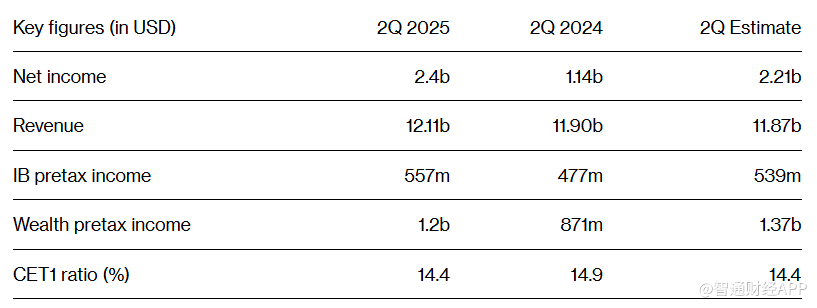
瑞银(UBS.US)公布好于预期的第二季度利润,并表示,随着全球贸易紧张局势降温,投资者活动复苏的前景将支撑 其业绩。数据显示,瑞银第二季度净利润为24亿美元,好于市场预期的22亿美元。其核心财富管理部门的客户资金 流入达到230亿美元,与预期相符。 瑞银表示:"我们与客户的对话以及交易渠道数据表明,随着对宏观前景的信心增强,投资者和企业表现出较强的部 署资本意愿。" 作为全球最大的财富管理公司,瑞银数月来一直警告称,美国总统唐纳德.特朗普关税计划的不确定性导致投资者持 观望态度,并阻碍了交易。有迹象表明,包括欧盟和日本在内的主要贸易伙伴正在与白宫达成协议,这缓解了一些 担忧,但不确定性依然存在。 瑞银第二季度的出色表现主要受到技术因素的推动,其中包括负责处理原瑞士信贷资产的亏损部门实现了微薄盈 利,以及与遗留法律案件相关的拨备得以释放。 | Key figures (in USD) | 2Q 2025 | 2Q 2024 | 2Q Estimate | | --- | --- | --- | --- | | Net income | 2.4b | 1.14b | 2.21b | | Revenue | 12 ...

美联储决议前瞻:或现30年来罕见双反对票
Sou Hu Cai Jing· 2025-07-30 06:52
Group 1 - The Federal Reserve is expected to maintain the federal funds rate in the range of 4.25% to 4.50% for the fifth consecutive time during the July meeting [1] - Barclays anticipates at least one dissenting vote in the upcoming decision, with a possibility of two dissenting votes, indicating growing internal divisions within the FOMC [1] - Fed officials Waller and Bowman have expressed support for rate cuts, citing inflation nearing the 2% target and signs of labor market weakness [1] Group 2 - The June meeting minutes reveal that some officials still prefer to keep rates unchanged for the year, with Barclays predicting a 25 basis point cut in December [2] - Deutsche Bank shares a similar outlook, forecasting two additional rate cuts in the first quarter of 2026 [2] - UBS believes that the FOMC's collective decision-making will remain stable despite potential changes in leadership, although upcoming departures may tilt the voting structure towards a dovish stance [2] Group 3 - Market analysts note that tariff policies are increasing prices for trade-sensitive goods, contributing to inflationary pressures [2] - UBS is optimistic about high-rated bonds and gold allocations, projecting a year-end target price of $3,500 per ounce for gold [2] - The dollar is expected to stabilize after recent fluctuations, with a year-end target of 1.21 for the euro against the dollar [2]

UBS CEO Sergio Ermotti on Earnings, Capital Requirements, Trade
Bloomberg Television· 2025-07-30 06:47
Financial Performance & Integration Progress - Core underlying profits increased by 25% year-on-year, with wealth management businesses in every region growing on a PBT basis in double digits [1] - Alternative business in asset management reached 300 billion in assets under management [1] - Achieved 9 billion in cost savings out of the targeted 13 billion, with an additional 1 billion expected by year-end and 3 billion in 2026 from shutting down legacy systems [3] - Successfully migrated 400,000 clients in Switzerland and is progressing with the second wave in the third quarter [2] - UBS is accruing for a double-digit increase in dividends and executing capital return plans through share buybacks [15] Strategic Outlook & Regulatory Landscape - Shrinking is not an option, as diversification benefits both UBS and Switzerland [9][10][11] - The combination of UBS and Credit Suisse creates a stronger bank globally in core activities [13] - UBS is fully implementing Basel III in Switzerland, effective January 1st of this year [17] - A tariff discussion outcome around 15% on average is a base case scenario, which is six times higher than at the beginning of the year [22] Client Relations & Risk Management - Serves over 250万 (2.5 million) clients, including over 20万 (200,000) SMEs in Switzerland, indicating a solid relationship with the community [5] - Addressed an issue affecting less than 200 clients related to FX packages and compensated affected clients, which was reflected in Q2 results [27][28]

瑞银二季度净利润24亿美元
Xin Lang Cai Jing· 2025-07-30 05:40
瑞银7月30日披露财报,第二季度总营收121.1亿美元,同比增加1.7%;净利润24亿美元,上年同期为 11.4亿美元。 ...
瑞银Q2净利润24亿美元超预期 拟回购至多20亿美元股份
Ge Long Hui A P P· 2025-07-30 05:05
Group 1 - UBS reported total revenue of $12.11 billion for the second quarter, exceeding market expectations of $11.87 billion [1] - The net profit for UBS in the second quarter was $2.4 billion, surpassing market estimates of $2.21 billion [1] - UBS plans to complete up to $2 billion in stock buybacks in the second half of the year, while continuing to reserve for double-digit growth in dividends [1]
UBS posts better-than-expected quarterly profit
CNBC· 2025-07-30 04:56
Net profitable attributable to shareholders hit $2.395 billion in the second quarter, compared with a mean LSEG analyst forecast of $1.901 billion. The bank's revenues over the period reached $12.112 billion, just below analyst expectations of $12.45 billion. This breaking news story is being updated. A logo of Swiss banking giant UBS in Zurich, on March 23, 2023. Swiss banking titan UBS on Wednesday beat expectations on the bottom line, as group invested assets soared on the back of increases in the lender ...

瑞银第二季度净利润24.0亿美元,上年同期11.4亿美元,预估22.1亿美元。总营收121.1亿美元,同比+1.7%,预估118.7亿美元。净利息收入19.7亿美元,同比+28%,预估19.4亿美元。
news flash· 2025-07-30 04:54
Core Insights - UBS reported a net profit of $2.4 billion for the second quarter, up from $1.14 billion in the same period last year, exceeding the forecast of $2.21 billion [1] - Total revenue reached $12.11 billion, reflecting a year-on-year increase of 1.7%, surpassing the expected $11.87 billion [1] - Net interest income was $1.97 billion, marking a year-on-year growth of 28%, slightly above the forecast of $1.94 billion [1]