
Walmart(WMT)

Search documents
山姆又出事!蛋糕吃出“金属牙”?1000元赔偿附“禁拍令”遭消费者拒绝
Guo Ji Jin Rong Bao· 2025-10-16 14:13
Core Viewpoint - A high-end membership supermarket, Sam's Club, is facing public scrutiny due to a consumer report of finding a metal object in a popular cake product, raising concerns about food safety and quality control [2][5]. Group 1: Incident Details - On October 14, a consumer in Shanghai posted a video showing a metal object resembling a tooth with threads found in a "MM Date and Walnut Cake" purchased from Sam's Club [2]. - The cake, priced at 27.8 yuan and produced on October 10, is known for its large size (520g) and short shelf life of 3 days, making it a popular choice among consumers [2]. - The store's initial response was to express surprise and assure customers of strict hygiene controls, but this was criticized by the public as lacking sincerity [2]. Group 2: Consumer Interaction and Compensation - On October 15, the store claimed to have reached a settlement with the consumer, but the consumer later stated that they rejected a 1000 yuan compensation offer due to unreasonable conditions [3]. - The store's customer service was unable to confirm the settlement details when contacted by media, indicating a lack of clear communication [3]. Group 3: Broader Implications and Trust Issues - This incident marks the second food safety controversy for Sam's Club in October, following a report of spoiled pork ribs delivered to another customer [5]. - Consumers perceive the membership fee (260 or 680 yuan annually) as a guarantee of quality, which is now being undermined by these safety issues and previous product selection controversies [5]. - Despite ongoing issues, the problematic cake remains available for sale on the Sam's Club app, and local regulatory authorities have begun an investigation [5].


Thousands of Jobs at Risk as Walmart Moves to ChatGPT
247Wallst· 2025-10-16 13:15
Group 1 - The core viewpoint is that ChatGPT is expected to lead to significant layoffs at Walmart Inc. [1]
美股前瞻 | 三大股指期货齐涨,台积电(TSM.US)Q3业绩超预期
Zhi Tong Cai Jing· 2025-10-16 12:38
Market Overview - US stock index futures are all up, with Dow futures rising by 0.23%, S&P 500 futures up by 0.35%, and Nasdaq futures increasing by 0.48% [1] - European indices show mixed results, with Germany's DAX down by 0.14%, UK's FTSE 100 down by 0.24%, France's CAC40 up by 0.92%, and the Euro Stoxx 50 up by 0.40% [1] - WTI crude oil prices increased by 0.50% to $58.56 per barrel, while Brent crude rose by 0.71% to $62.35 per barrel [1] Employment Trends - There is a significant increase in job seekers looking for temporary holiday positions, with seasonal job search volume up by 27% year-over-year and 50% compared to 2023 [2] - Despite the high demand from job seekers, the number of seasonal job postings has only increased by 2.7%, indicating a competitive job market for temporary positions [2] Federal Reserve Speculations - Traders are betting on an unconventional rate cut of 50 basis points by the Federal Reserve before the end of the year, with SOFR options trading volume surging [3] - The market anticipates that the Fed's actions may be more aggressive than currently expected by other market observers [3] Banking Sector Insights - Major US banks reported record quarterly earnings driven by trading activity and accounts receivable, partly fueled by the AI boom [4] - However, several Wall Street executives warned of potential AI bubble risks, highlighting concerns over high stock valuations and price-to-earnings ratios [4] Economic Impact of Government Shutdown - A senior US Treasury official indicated that the ongoing federal government shutdown could result in economic losses of up to $15 billion per week, correcting earlier misstatements about daily losses [4] - This situation is seen as a positive catalyst for gold prices, which have surged over 60% this year [4] Company-Specific Developments - TSMC reported Q3 revenue of $33.1 billion, a 40.8% year-over-year increase, and raised its 2025 revenue growth forecast to the mid-30% range, reflecting strong demand for AI components [5] - Charles Schwab's Q3 net new assets reached $134.4 billion, a 48% year-over-year increase, exceeding market expectations [6] - Nestlé's Q3 sales growth was driven by price increases in its candy and coffee products, with organic sales growth of 4.3%, surpassing analyst expectations [7] - United Airlines reported Q3 revenue growth of 2.6% to $15.23 billion, driven by strong demand for premium seating [8] - Hewlett Packard Enterprise's profit and cash flow guidance for the next fiscal year fell short of analyst expectations, reflecting pressure on profit margins due to expensive AI chips [9] - Walmart's partnership with OpenAI is expected to boost its stock price, with analysts predicting it could join the trillion-dollar market cap club [10]

当豆包成为售货员,商家“一脸懵”消费者分两派,AI电商会成为新热点吗?
Sou Hu Cai Jing· 2025-10-16 10:30
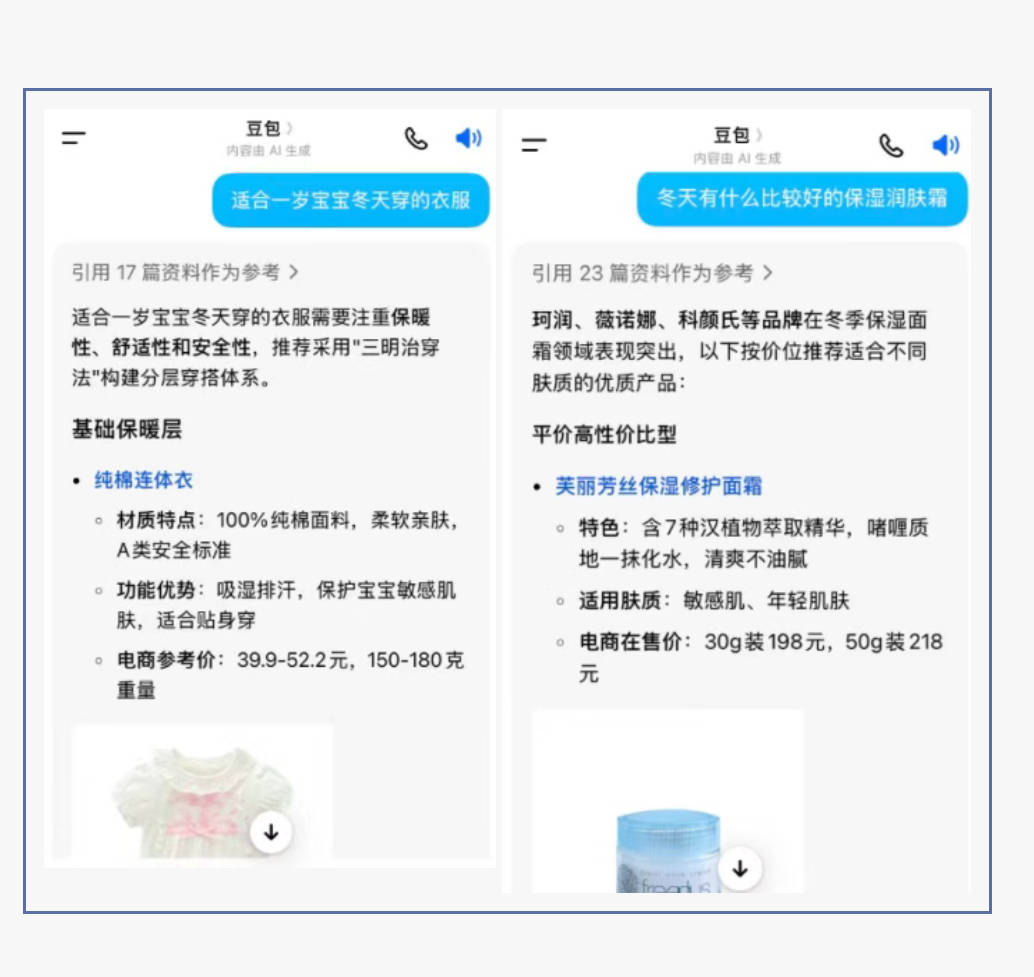
Core Viewpoint - The collaboration between OpenAI and Walmart to launch conversational shopping features on the ChatGPT platform highlights a significant trend in AI and e-commerce, while China's AI e-commerce initiatives, such as Doubao, are still in a cautious testing phase [1][11][17] Group 1: Doubao's AI E-commerce Initiative - Doubao has introduced a feature allowing users to browse and purchase products through natural language conversations, similar to the ChatGPT and Walmart collaboration [1] - Merchants on Douyin have expressed uncertainty regarding Doubao's product recommendation mechanism, viewing it primarily as an advertising tool [2][4] - Some merchants have not noticed significant changes in traffic or sales linked to Doubao's new feature, indicating a need for further observation [6] Group 2: Consumer Reactions - Consumer responses are divided into two main groups: those who firmly reject AI recommendations due to distrust and habitual shopping methods, and those who are hesitant but open to considering AI recommendations if they offer good value [9][10] - A small sample of consumers showed a lack of trust in AI recommendations, with concerns about accountability if prices change after recommendations [10] Group 3: Market Context and Challenges - The Chinese e-commerce landscape is characterized by highly integrated platforms like Taobao and Douyin, which already provide seamless shopping experiences, making the introduction of standalone conversational shopping features less appealing [13][14] - Experts suggest that the cautious approach of Chinese platforms towards conversational shopping stems from concerns about model reliability and the potential negative impact on user trust and conversion rates [15][16] - The current low acceptance of AI e-commerce among consumers and merchants indicates that further refinement and adaptation to user habits are necessary for successful implementation [17]
沃尔玛(WMT.US)凭AI东风再“起飞”!或跻身万亿美元市值俱乐部
智通财经网· 2025-10-16 00:28
Core Insights - Walmart has announced a partnership with OpenAI to enhance its shopping experience, which has led to a significant increase in its stock price, reaching an all-time high [1][2] - Analysts predict that Walmart could join the "trillion-dollar market cap elite club" if its market value surpasses $1 trillion [2] Group 1: Partnership and Technology - The collaboration with OpenAI will allow customers to use the ChatGPT platform for "instant checkout" features, although it currently excludes fresh food items [1] - Walmart's CEO Doug McMillon emphasized the shift towards a more integrated AI shopping experience, moving away from traditional search results [1] - The partnership is part of Walmart's broader AI strategy, which includes the AI shopping assistant "Sparky" [2] Group 2: Market Performance and Analyst Opinions - Following the announcement, Walmart's stock surged by 5% on Tuesday, marking its largest single-day increase since April, and rose another 1.7% on Wednesday, bringing its market cap to $869.3 billion [2] - Analyst David Bellinger noted that Walmart is leading the industry in adopting AI technologies, contrasting it with competitors who are slower to adapt [2] - Despite economic uncertainties, Bellinger maintains a "buy" rating for Walmart, citing its innovative initiatives and strong stock performance over the past three years [3] Group 3: Historical Stock Performance - Walmart's stock has shown strong performance, with an increase of over 11% in 2023 and a nearly 72% rise in 2024, marking its largest annual gain since 1998 [3] - The company's low-price strategy has attracted more price-sensitive consumers, contributing to its market share growth [3]
沃尔玛与OpenAI合作推出ChatGPT智能购物功能
Sou Hu Cai Jing· 2025-10-15 21:16
Core Insights - Walmart has announced a new partnership with OpenAI to allow consumers to purchase products through an AI chatbot, enhancing the online shopping experience [2][3] - The AI shopping feature will enable Sam's Club members to plan meals and discover new products while interacting with the AI [2] - Customers will need to link their Walmart accounts to ChatGPT to use the shopping feature, which will support third-party seller products when launched later this fall [2] Group 1: Partnership and Features - The collaboration with OpenAI aims to improve Walmart's ability to learn and predict customer needs, making online shopping more personalized and proactive [2] - OpenAI's recent plans to enter the e-commerce space include a smart shopping system that covers product discovery, recommendations, and payments [2] - Walmart has also launched its own generative AI shopping assistant, Sparky, to help customers discover, compare products, and make purchases [2][4] Group 2: AI Utilization in Operations - Walmart and Sam's Club utilize AI to optimize various business operations, such as reducing fashion product production time by up to 18 weeks and improving customer service response times by up to 40% [3][4] - The company has adopted OpenAI certification and ChatGPT Enterprise for its internal teams, indicating a broader integration of AI technologies [3][4] Group 3: Future of Shopping Experience - Walmart's CEO Doug McMillon emphasized that the traditional e-commerce shopping experience is set to change, moving towards a more multimedia, personalized, and contextual AI experience [3]

Walmart Stock Hits Record High for Second Straight Day—Monitor These Price Levels
Investopedia· 2025-10-15 20:50
Core Insights - Walmart shares reached an all-time high, driven by a partnership with OpenAI to enhance the shopping experience through AI technology [2][6] - The stock has increased by 21% year-to-date, outperforming the broader market due to strong e-commerce sales amid economic uncertainty [3] Stock Performance - Walmart shares rose nearly 2% to over $109, leading the Dow Jones Industrial Average for the second consecutive day [3] - The stock's breakout from a symmetrical triangle pattern indicates potential for further price increases [4][6] Technical Analysis - A bullish near-term price target of $113 has been projected using the measured move technique, which adds $10 to the breakout point of $103 [7] - Key support levels to monitor include $105, $100, and $96, which may provide buying opportunities during potential retracements [8][9]

Top Walmart exec says American manufacturing comeback is real and good for business
CNBC· 2025-10-15 20:46
Core Insights - Walmart is reaffirming its commitment to domestic production, increasing investments in U.S.-made products and suppliers as a strategic priority [1][2] - The focus on U.S. manufacturing is seen as beneficial for business, employment, and supply chain flexibility [2] - Nearly two-thirds of Walmart's products are sourced from the U.S., with new initiatives like a beef processing facility in Kansas expected to create over 600 jobs [3] Investment and Job Creation - Walmart is expanding its domestic production efforts, including a significant investment in a new beef processing facility [3] - The facility in Olathe, Kansas, is projected to create over 600 jobs, highlighting the company's focus on sustainable sourcing [3] Partnerships and Product Revival - Walmart has partnered with USAntibiotics to revive domestic production of essential products like amoxicillin [4] - This partnership reflects a broader trend of bringing manufacturing back to the U.S. while still relying on global sourcing for certain products [4][5] Global Sourcing and Trade Policy - Despite the emphasis on domestic production, Walmart continues to source products globally, acknowledging that some items are better suited to different climates [5] - The current trade policy environment, including tariffs and interest rates, influences Walmart's inventory and pricing strategies [5][6] Pricing Strategy - Walmart aims to keep prices low for consumers, even amidst economic uncertainties [6][7] - The company recognizes the resilience of its customers, who make informed choices based on their needs [7]
Why Walmart will track its merchandise with millions of sensors starting this year
Yahoo Finance· 2025-10-15 20:45
Group 1 - Walmart is deploying millions of ambient IoT sensors on its pallets across its supply chain, marking the first large-scale deployment of such technology in the retail industry [1][2] - The technology is currently in use at 500 Walmart locations, with plans for nationwide expansion to 4,600 Supercenters, Neighborhood Markets, and over 40 distribution centers by 2026 [2] - The battery-free sensors harvest energy from various sources, generating high-resolution supply chain data that integrates with Walmart's AI systems [2] Group 2 - Walmart aims to enhance supply chain efficiency, improve inventory accuracy, and ensure cold chain compliance through real-time insights on merchandise location [3] - The company's fiscal second-quarter earnings report for 2026 showed revenue of $116.9 billion, a 2.3% increase from the previous year, with net income rising to $4.1 billion, up 1.3% [4] - Diluted earnings per share (EPS) for the quarter were $1.24, reflecting a 5.1% increase compared to $1.18 in the prior year [4]
Walmart on Path to Trillion Dollar Status After OpenAI Pact
Yahoo Finance· 2025-10-15 20:11
Core Viewpoint - Walmart Inc. is poised to reach a trillion-dollar valuation following its partnership with OpenAI, which has significantly boosted its stock price [1][4]. Group 1: Partnership Details - The partnership with OpenAI allows Walmart customers to browse and purchase products directly through ChatGPT, although fresh foods will not be included in this offering [2]. - The collaboration is seen as a major advancement in the adoption of agentic commerce, positioning Walmart ahead of competitors who have been slower to adapt to AI technologies [4]. Group 2: Stock Performance - Following the announcement, Walmart shares surged by 5%, marking the largest one-day gain since April, and bringing the company's market capitalization to over $854 billion [3]. - Walmart's stock has experienced significant growth, with an increase of more than 11% in 2023 and a nearly 72% rise in the previous year, the largest annual gain since 1998 [6]. Group 3: Analyst Insights - Analysts view the OpenAI partnership as a unique opportunity for Walmart, enhancing its reputation for technological innovation in the retail sector [5]. - Despite economic uncertainties, analysts maintain a bullish outlook on Walmart shares, suggesting they remain a strong investment in the consumer space [6].