XIAOMI(XIACY)
Search documents
凌晨重磅!美联储,降息大消息
Sou Hu Cai Jing· 2025-08-29 00:14
Core Viewpoint - Federal Reserve officials support a 25 basis point rate cut in September, indicating a shift towards a more accommodative monetary policy to prevent labor market deterioration and to guide inflation back to the 2% target [13]. Group 1: Market Performance - The Dow Jones Industrial Average and S&P 500 index both reached record closing highs, with the Dow up 0.16% at 45,636.9 points and the S&P 500 up 0.32% at 6,501.86 points [1]. - The Nasdaq also saw a slight increase of 0.53%, closing at 21,705.16 points [1]. - Major tech stocks mostly rose, with the US Tech Giants Index increasing by 0.47% [2]. Group 2: Individual Stock Movements - Google (Alphabet) rose over 2%, Amazon increased by more than 1%, Apple by nearly 1%, and Microsoft by 0.57%, while Nvidia fell by 0.82% and Tesla dropped over 1% [5][6]. - Among Chinese concept stocks, the Nasdaq Golden Dragon China Index rose by 0.14%, while the Wande Chinese Tech Leaders Index fell by 0.01% [7]. Group 3: Chinese Concept Stocks - Meituan fell by 4.78%, Alibaba by 2.18%, and JD.com by 1.40%, leading the decline in the Wande Chinese Tech Leaders Index [10]. - Notable gainers included NetEase, which rose by 2.35%, Baidu by 1.24%, and Xiaomi by 1.15% [10]. - Ctrip Group surged nearly 15%, while Newegg fell over 18% [10]. Group 4: Federal Reserve Insights - Federal Reserve Governor Waller emphasized the need for immediate action to lower rates, citing labor market and inflation data as supportive of this move [13]. - Morgan Stanley's Chief Investment Officer Lisa Shalett noted that while the market anticipates an over 80% chance of a rate cut in September, the actual likelihood may be closer to 50% due to strong economic indicators [15][16].
北水成交净卖出13.76亿 北水全天加仓科网股 抛售小米集团-W超15亿港元
Zhi Tong Cai Jing· 2025-08-27 00:29
Core Insights - The Hong Kong stock market experienced significant net selling from northbound capital, totaling HKD 13.76 billion, with a net sell of HKD 24.36 billion from the Shanghai Stock Connect and a net buy of HKD 10.6 billion from the Shenzhen Stock Connect [2] Group 1: Stock Performance - ZTE Corporation (中兴通讯) saw a net buy of HKD 4.07 billion, while Semiconductor Manufacturing International Corporation (中芯国际) and Hua Hong Semiconductor (华虹半导体) faced net sells of HKD 8.11 billion and HKD 1.29 billion, respectively [7] - Alibaba (阿里巴巴-W) and Kuaishou (快手-W) were the most bought stocks, while Xiaomi Group (小米集团-W) and the Tracker Fund of Hong Kong (盈富基金) were the most sold [2][8] Group 2: Trading Volume and Activity - The trading volume for ZTE Corporation reached 11.50 billion, with a buy amount of HKD 7.06 billion and a sell amount of HKD 4.44 billion [5] - The total trading volume for Semiconductor Manufacturing International Corporation was HKD 70.23 billion, with a buy amount of HKD 30.73 billion and a sell amount of HKD 39.50 billion [3] Group 3: Market Trends and Insights - The report from Dongfang Securities suggests that the market for domestic AI chips is expected to grow, driven by advancements in design technology and manufacturing processes [7] - Citigroup indicated that major e-commerce platforms will likely maintain a degree of subsidies to secure market share amid changing consumer behaviors in China [6]
小米集团-W(01810):汽车毛利率表现持续强劲,看好公司长期价值成长
SPDB International· 2025-08-26 07:55
Investment Rating - The report maintains a "Buy" rating for the company, Xiaomi Group, with a target price of HKD 75.0, indicating a potential upside of 43% from the current price of HKD 52.55 [1][3][27]. Core Views - The short-term and long-term fundamentals of Xiaomi show growth potential, driven by strong demand in the new energy vehicle sector and ongoing investments in technology such as chips and AI [1][2]. - The company is expected to achieve a smartphone shipment of 175 million units in 2025, with high-end products supporting margin growth [1][3]. - The IoT segment is projected to grow nearly 50% due to the expansion of major appliances and overseas business [1][3]. - The internet business is anticipated to maintain stable revenue growth and high margins due to a growing user base [1][3]. - The automotive segment is expected to exceed the delivery target of 350,000 units, with scale effects and high-end models improving margins [1][3]. Financial Projections - Revenue is forecasted to grow from RMB 270.97 billion in 2023 to RMB 756.75 billion by 2027, with a compound annual growth rate (CAGR) of approximately 20% [3][12]. - Adjusted net profit is expected to increase significantly from RMB 19.27 billion in 2023 to RMB 71.50 billion in 2027, reflecting a CAGR of around 39% [3][12]. - The target price corresponds to a price-to-earnings (P/E) ratio of 29.9x, indicating room for valuation growth [2][13]. Segment Valuation - The report employs a sum-of-the-parts valuation method, assigning target P/E ratios of 23.0x for smartphones, 27.0x for IoT, and 20.0x for internet services, along with a target price-to-sales (P/S) ratio of 2.5x for electric vehicles [2][13]. - The total valuation for Xiaomi is estimated at HKD 75.0, based on projected revenues and net profits across its business segments [2][13].
北水动向|北水成交净卖出13.76亿 北水全天加仓科网股 抛售小米集团-W(01810)超15亿港元
智通财经网· 2025-08-25 10:01
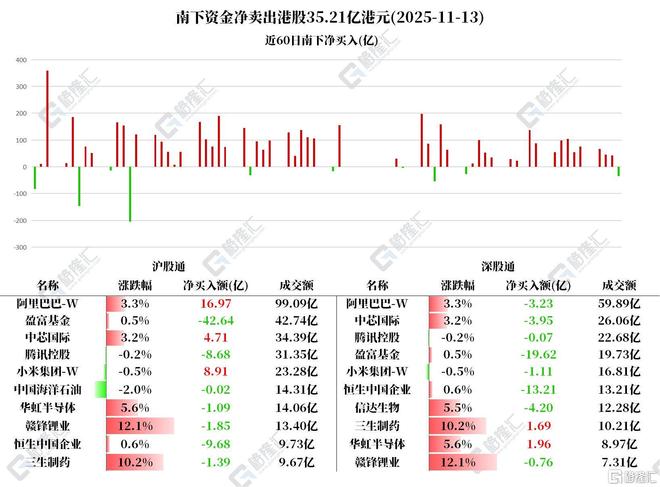
Summary of Key Points Core Viewpoint - The Hong Kong stock market experienced significant net selling from Northbound funds, totaling 1.376 billion HKD on August 25, with notable movements in various stocks [1]. Northbound Fund Activity - Northbound funds had a net selling of 2.436 billion HKD through the Shanghai Stock Connect and a net buying of 1.06 billion HKD through the Shenzhen Stock Connect [1]. - The stocks with the highest net buying included Alibaba-W (09988), Kuaishou-W (01024), and ZTE Corporation (00763) [1]. - The stocks with the highest net selling included the Tracker Fund of Hong Kong (02800), Xiaomi Group-W (01810), and Semiconductor Manufacturing International Corporation (00981) [1]. Stock-Specific Transactions - Semiconductor Manufacturing International Corporation (00981) had a total transaction of 7.023 billion HKD, with a net outflow of 878 million HKD [2]. - Alibaba-W (09988) recorded a total transaction of 6.576 billion HKD, with a net outflow of 36.31 million HKD [2]. - Xiaomi Group-W (01810) had a total transaction of 4.025 billion HKD, with a net outflow of 887 million HKD [2]. Market Trends and Insights - Kuaishou-W (01024) received a net inflow of 471 million HKD, supported by the launch of its AI model and significant revenue growth [5]. - ZTE Corporation (00763) saw a net inflow of 407 million HKD, while Semiconductor Manufacturing International Corporation (00981) and Hua Hong Semiconductor (01347) faced net outflows of 811 million HKD and 129 million HKD, respectively [6]. - Xiaomi Group-W (01810) faced a net outflow of 15.24 billion HKD, with concerns over its smartphone business margins due to rising storage costs [7]. Additional Notable Transactions - Dongfeng Motor Group (00489) received a net inflow of 149 million HKD, with ongoing discussions about privatization and other strategic transactions [6]. - Tencent Holdings (00700) and Oriental Selection (01797) had net inflows of 180 million HKD and 202 million HKD, respectively [8].
小米集团(1810.HK):全生态协同发力 盈利创历史新高
Ge Long Hui· 2025-08-23 02:40
Core Viewpoint - Xiaomi Group reported strong financial results for Q2 2025, with revenue of 115.96 billion RMB, a year-on-year increase of 30.5%, and adjusted net profit of 10.83 billion RMB, up 75.4% year-on-year, exceeding Bloomberg consensus expectations and setting historical highs [1] Group 1: Smartphone Performance - Xiaomi's smartphone revenue decreased by 2.1% year-on-year to 45.52 billion RMB, primarily due to a 2.7% decline in average selling price (ASP) to 1,073.2 RMB, partially offset by a 0.6% increase in shipment volume to 42.4 million units [1] - Despite an increase in high-end smartphone shipments in mainland China, the launch of the REDMIA5 series in April 2025 led to a decline in ASP in overseas markets, contributing to a 0.6 percentage point drop in smartphone gross margin to 11.5% [1] Group 2: IoT and Internet Services - IoT and lifestyle consumer products achieved revenue of 38.71 billion RMB in Q2, a year-on-year growth of 44.7%, setting a historical high, with a gross margin of 22.5%, up 2.8 percentage points year-on-year [2] - Internet services revenue reached 9.1 billion RMB, growing 10.1% year-on-year, with a gross margin of 75.4%, slightly down year-on-year but still a core profit contributor [2] - Global monthly active users increased to 731.2 million, up 8.2% year-on-year, supporting revenue growth in services [2] Group 3: Automotive Business - The company delivered 81,302 new vehicles in Q2, a historical high, with the Xiaomi YU7 series SUV achieving over 240,000 orders within 18 hours of launch, indicating strong market interest [2] - The vehicle models feature high-end configurations such as an 800V silicon carbide high-voltage platform and laser radar, with an ASP of 253,700 RMB, up 10.9% year-on-year, contributing to improved profitability [2] Group 4: Investment Outlook - The company's effective execution of its "high-end + full ecosystem + globalization" strategy led to another quarter of unexpected growth in Q2 2025, with short-term growth driven by YU7 vehicle deliveries and AIoT product launches [3] - Long-term growth potential is anticipated from the implementation of large model technology and the synergy of the "people, vehicle, home" ecosystem [3] - The company is assigned a target price of 62.3 HKD per share, indicating an upside potential of 18.6% from the recent closing price, maintaining a "buy" rating [3]
小米集团(1810.HK):2Q25汽车业绩表现亮眼 智能手机业务调整基本符合预期
Ge Long Hui· 2025-08-23 02:40
Group 1 - The core viewpoint of the articles highlights Xiaomi's strong performance in the automotive sector, with a significant increase in revenue and profit margins, while the smartphone business faces challenges due to ASP declines and rising component costs [1][2][3] Group 2 - In Q2 2025, Xiaomi reported revenues of 116 billion yuan and adjusted net profits of 10.8 billion yuan, meeting market expectations [1] - Automotive revenue grew by 40% year-on-year, with a gross margin reaching a historical high of 26.4%, driven by ASP growth and economies of scale [1] - Smartphone revenue declined by 2% year-on-year, primarily due to the impact of the REDMI A5 release on overseas ASP, while ASP in mainland China benefited from a higher proportion of high-end models [1] - AIOT revenue increased by 45% year-on-year, although gross margin decreased by 2.7 percentage points to 22.5% due to promotional activities [1] - The management maintains a sales target of 350,000 vehicles for the year, emphasizing the scale effects of the platform [1] Group 3 - In Q2 2025, 81,000 smart vehicles were delivered, with ASP increasing by 6.7% to 254,000 yuan, and adjusted net losses narrowed to 300 million yuan [2] - The automotive gross margin increased by 3.2 percentage points to 26.4% in Q2 2025, with forecasts for 2025/26 adjusted to 26.0% and 27.1% respectively [2] - The smartphone gross margin is expected to stabilize and recover with the release of new high-end models, despite a downward trend due to rising memory prices [2] Group 4 - The target price for Xiaomi has been lowered to 60 HKD, with revenue forecasts for 2025/26 adjusted to 483 billion and 605.8 billion yuan respectively [3] - Adjusted EPS for 2025/26 has been revised down to 1.67 and 2.01 yuan, reflecting uncertainties in the smartphone and AIoT businesses [3] - The valuation for the smartphone and AIoT segment is set at 25 times earnings, while the automotive business maintains a sales multiple of 2.2 times [3]
小米集团-W(01810.HK):品牌势能仍足 待汽车产能释放及新车周期启动
Ge Long Hui· 2025-08-23 02:40
Group 1 - The core viewpoint indicates that the company maintains strong brand momentum in the mid-term, but requires the release of automotive production capacity and the 2026 new vehicle product cycle to drive growth [1] - The company's net profit forecast for 2025-2027 has been revised down from 471/674/731 billion to 415/555/686 billion, reflecting a year-on-year growth of 52%/34%/24% [1] - The current stock price of 52.55 HKD corresponds to a PE ratio of 30.1/22.6/18.2 for 2025-2027 [1] Group 2 - In Q2 2025, the company's non-GAAP net profit was 10.8 billion, a year-on-year increase of 75%, which was in line with expectations [1] - Mobile business revenue was 45.5 billion, with an average selling price (ASP) declining by 3% and 11% quarter-on-quarter and year-on-year respectively, primarily due to increased shipment volume in Africa and intense price competition in overseas markets [1] - IoT revenue reached 38.7 billion, showing a year-on-year growth of 45% and a quarter-on-quarter growth of 20%, exceeding previous expectations, mainly driven by large home appliances [1] Group 3 - The automotive and new business segment is expected to achieve profitability in a specific month or quarter in H2 2025 [2] - The company anticipates a decline in main business net profit in Q3 2025, primarily due to rising storage costs and the absence of new product launches, with a projected gross margin drop to 11% [2] - The IoT business is expected to see seasonal revenue decline to around 30 billion, while gross margin is anticipated to improve [2]
小米集团-W(01810.HK)2025年半年报业绩点评:汽车业务量价齐升 经营亏损继续收窄
Ge Long Hui· 2025-08-23 02:40
Core Insights - The company reported a significant increase in revenue and net profit for the first half of 2025, with a revenue of 227.25 billion yuan, up 38.2% year-on-year, and a net profit of 21.51 billion yuan, up 69.8% year-on-year [1] - The automotive business achieved record revenue and sales, with Q2 revenue reaching 21.26 billion yuan, a year-on-year increase of 233.9%, and a narrowing operating loss [2] - The smartphone business showed strong performance in overseas markets despite a decline in domestic ASP, with Q2 revenue of 45.52 billion yuan, down 2.1% year-on-year [3] - The company maintained stable growth in R&D investment, with R&D expenses increasing by 35.8% year-on-year to 14.48 billion yuan in H1 2025 [4] Financial Performance - For H1 2025, the company achieved an operating profit of 26.56 billion yuan, up 177.5% year-on-year, and an EPS of 0.90 [1] - In Q2 2025, the company recorded an operating revenue of 115.96 billion yuan, a year-on-year increase of 30.5% and a quarter-on-quarter increase of 4.2% [1] Automotive Business - The automotive segment's Q2 revenue reached 21.26 billion yuan, with a record delivery of 81,300 vehicles, up 7.2% from Q1 [2] - The average selling price (ASP) of vehicles increased by 6.8% to 262,000 yuan, contributing to a Q2 automotive gross margin of 26.4%, up 11.0 percentage points year-on-year [2] - The company plans to enter the European market by 2027, leveraging high brand recognition to replicate its domestic success [2] Smartphone and IoT Business - The smartphone business saw a total shipment of 42.4 million units in Q2, with a 3.6% increase in domestic shipments [3] - The IoT and consumer products segment reported a revenue of 38.71 billion yuan, up 447% year-on-year, with major appliances achieving a 66.2% growth [3] R&D and Future Outlook - R&D expenses for H1 2025 were 14.48 billion yuan, with a focus on electric vehicles and AI technologies [4] - The company aims to achieve revenues of 497.73 billion yuan, 630.36 billion yuan, and 724.57 billion yuan from 2025 to 2027, with corresponding net profits projected at 41.72 billion yuan, 55.71 billion yuan, and 66.79 billion yuan [4]
小米集团-W(01810):创新业务快速发展,IoT业务收入创新高
Yong Xing Zheng Quan· 2025-08-22 13:17
Investment Rating - The report maintains a "Buy" rating for Xiaomi Group [4][7]. Core Insights - The innovative business segment is rapidly developing, with revenue from smart electric vehicles and AI reaching 21.3 billion yuan in Q2 2025, despite an operating loss of 300 million yuan. The Xiaomi YU7 series launched with over 240,000 units locked in within 18 hours, indicating strong demand [2]. - The overseas penetration of the smartphone business is increasing, with Q2 2025 smartphone revenue at 45.5 billion yuan and a gross margin of 11.5%. Global shipments reached 42.4 million units, a year-on-year increase of 0.6%, with a market share of 14.7% [2]. - IoT and lifestyle product revenue reached a record high of 38.7 billion yuan in Q2 2025, growing 44.7% year-on-year, driven by demand for smart appliances and wearable products in mainland China [3]. Financial Projections - The report forecasts adjusted EPS for 2025-2027 to be 1.80, 2.32, and 2.99 yuan, corresponding to P/E ratios of 26.82, 20.88, and 16.19 respectively [4][6]. - Revenue projections for 2025-2027 are 483.38 billion yuan, 595.47 billion yuan, and 726.58 billion yuan, with year-on-year growth rates of 32.11%, 23.19%, and 22.02% [6][13]. - The net profit attributable to the parent company is expected to grow from 40.72 billion yuan in 2025 to 67.37 billion yuan in 2027, with growth rates of 72.11% and 28.87% respectively [6][12]. Market Position - Xiaomi ranks among the top three global smartphone vendors, with significant market share increases in Southeast Asia, Europe, and Africa [2]. - The company is expected to leverage its high-end strategy and overseas expansion to drive steady growth in its smartphone business despite short-term margin pressures [2]. Strategic Outlook - The report expresses optimism regarding Xiaomi's high-end product strategy, the continuous development of AI technology and ecosystem, and the ongoing growth of its automotive business [4].
中证港股通TMT主题指数报4738.83点,前十大权重包含小米集团-W等
Jin Rong Jie· 2025-08-22 12:40
Group 1 - The core viewpoint of the article highlights the performance of the China Securities TMT Index, which has shown significant growth over various time frames, including a 39.12% increase year-to-date [1] - The China Securities TMT Index is composed of 50 listed companies in the TMT sector selected from the Hong Kong Stock Connect, reflecting the overall performance of related industry companies [1] - The index has a base date of November 14, 2014, with a base point of 3000.0 [1] Group 2 - The top ten weighted companies in the China Securities TMT Index include Tencent Holdings (15.09%), China Mobile (13.35%), and Xiaomi Group-W (12.64%) [1] - The index's holdings are entirely composed of companies listed on the Hong Kong Stock Exchange, with a sector breakdown of 55.70% in communication services and 44.30% in information technology [1] - The index samples are adjusted biannually, with adjustments occurring on the next trading day after the second Friday of June and December [2]