
XPENG(XPEV)

Search documents
Xpeng, Dell And Other Big Stocks Moving Lower In Monday's Pre-Market Session - Lexicon Pharmaceuticals (NASDAQ:LXRX), Dell Technologies (NYSE:DELL)


Benzinga· 2025-11-17 13:15
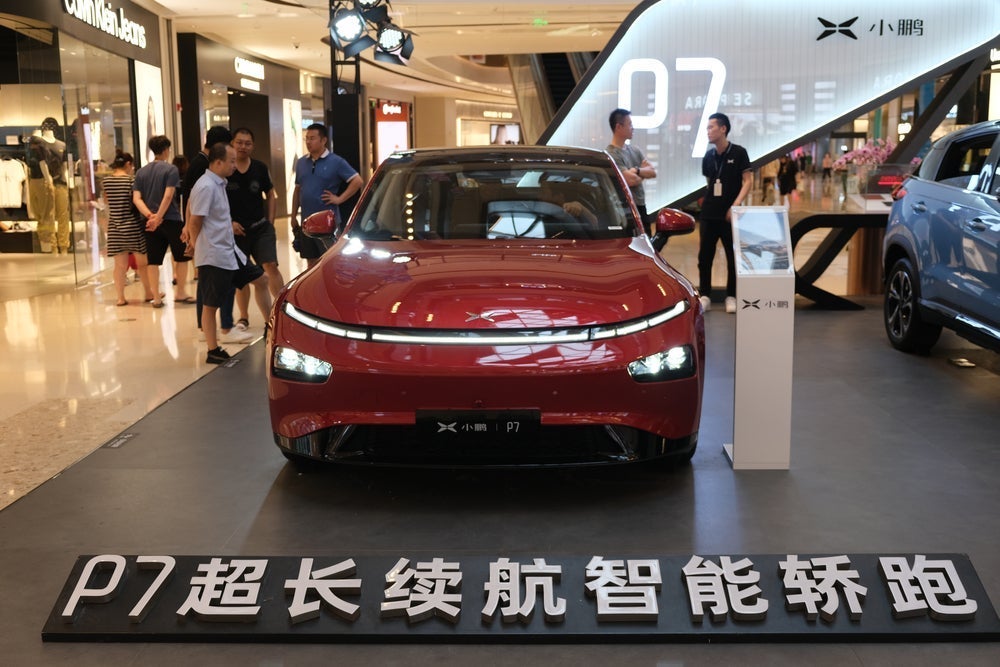
Core Viewpoint - U.S. stock futures showed mixed results, with notable declines in several companies following their financial reports [1]. Group 1: Xpeng Inc Financial Results - Xpeng Inc reported third-quarter revenue of 20.38 billion Chinese yuan ($2.86 billion), marking a 101.8% year-over-year increase, but slightly below the consensus forecast of $2.87 billion [2]. - The adjusted net loss per ADS was 0.16 Chinese yuan, which was better than the analyst consensus loss estimate of 0.47 Chinese yuan. In USD terms, the adjusted EPADS was a loss of 2 cents [2]. - Xpeng shares fell 3.6% to $24.11 in pre-market trading following the earnings report [2]. Group 2: Other Companies in Pre-Market Trading - Plug Power Inc shares decreased by 6.1% to $2.11 after a 10% decline on Friday [4]. - Lexicon Pharmaceuticals Inc fell 6% to $1.40 in pre-market trading [4]. - WEYCO Group Inc declined 5.2% to $32.95, despite declaring a special cash dividend of $2.00 per share [4]. - Nomura Holdings Inc shares dropped 5% to $7.02 [4]. - Dell Technologies Inc saw a decline of 4.7% to $127.50 after Morgan Stanley analyst Erik Woodring downgraded the stock from Overweight to Underweight and reduced the price target from $144 to $110 [4]. - Solid Biosciences Inc fell 4.5% to $4.05 [4]. - Yueda Digital Holding decreased by 3.5% to $1.64 after a 15% drop on Friday [4].

Xpeng, Dell And Other Big Stocks Moving Lower In Monday's Pre-Market Session
Benzinga· 2025-11-17 13:15
Core Viewpoint - U.S. stock futures showed mixed results, with notable declines in several companies following their financial reports [1] Group 1: Xpeng Inc Financial Results - Xpeng Inc reported third-quarter revenue of 20.38 billion Chinese yuan ($2.86 billion), marking a 101.8% year-over-year increase, but slightly below the consensus forecast of $2.87 billion [2] - The adjusted net loss per ADS was 0.16 Chinese yuan, which was better than the analyst consensus loss estimate of 0.47 Chinese yuan; in USD terms, the adjusted EPADS was a loss of 2 cents [2] - Xpeng shares fell 3.6% to $24.11 in pre-market trading following the earnings report [2] Group 2: Other Companies in Pre-Market Trading - Plug Power Inc shares decreased by 6.1% to $2.11 after a 10% decline on Friday [4] - Lexicon Pharmaceuticals Inc fell 6% to $1.40 in pre-market trading [4] - WEYCO Group Inc declined 5.2% to $32.95, despite declaring a special cash dividend of $2.00 per share [4] - Nomura Holdings Inc shares dropped 5% to $7.02 [4] - Dell Technologies Inc saw a decline of 4.7% to $127.50 after Morgan Stanley analyst Erik Woodring downgraded the stock from Overweight to Underweight and lowered the price target from $144 to $110 [4] - Solid Biosciences Inc fell 4.5% to $4.05 [4] - Yueda Digital Holding decreased by 3.5% to $1.64 after a 15% drop on Friday [4]

“史上最强”!零跑、小鹏,交卷!
Zhong Guo Ji Jin Bao· 2025-11-17 13:12
Core Insights - Both Leap Motor and Xpeng Motors reported their strongest Q3 results in history, with Leap Motor's revenue at 19.45 billion RMB and Xpeng's at 20.38 billion RMB, reflecting year-on-year growth of 97.3% and 101.8% respectively [2][11] - Leap Motor achieved profitability for two consecutive quarters, with a net profit of 150 million RMB in Q3 2025, while Xpeng's net loss decreased to 380 million RMB [2][11] Leap Motor Highlights - Leap Motor's Q3 2025 net profit was 150 million RMB, a significant improvement from a net loss of 690 million RMB in Q3 2024 [2][3] - The company reported a total vehicle sales of 173,900 units in Q3 2025, marking a year-on-year increase of 101.77% and a quarter-on-quarter increase of 29.63% [5] - Leap Motor's gross margin rose to 14.5% in Q3 2025, up from 8.1% in Q3 2024 and 13.6% in Q2 2025 [8] - The company anticipates total sales for 2025 to exceed 600,000 units, having already surpassed its initial target of 500,000 units by mid-November [9] Xpeng Motors Highlights - Xpeng's Q3 2025 net loss was 380 million RMB, down from 480 million RMB in Q2 2025 and 1.81 billion RMB in Q3 2024 [11][18] - The company achieved a record delivery of 116,007 units in Q3 2025, representing a year-on-year growth of 149.3% [13][15] - Xpeng's gross margin reached a historical high of 20.1% in Q3 2025, an increase of 4.8 percentage points year-on-year [17] - The company projects Q4 2025 deliveries between 125,000 and 132,000 units, indicating a year-on-year growth of 36.6% to 44.3% [15] Industry Trends - The new energy vehicle sector is witnessing a significant focus on profitability among leading manufacturers, with both Leap Motor and Xpeng Motors demonstrating improved financial performance [2][10] - The automotive industry's scale effects are becoming increasingly evident, with rising sales volumes contributing to enhanced gross margins for manufacturers like Leap Motor [7]

“史上最强”!零跑、小鹏,交卷!
中国基金报· 2025-11-17 13:08
Core Viewpoint - Both Leap Motor and Xpeng Motors reported their strongest Q3 results in history, with significant revenue growth and improvements in profitability [2]. Group 1: Leap Motor Performance - In Q3 2025, Leap Motor achieved a revenue of 19.45 billion, a year-on-year increase of 97.3% [2]. - Leap Motor reported a net profit of 150 million in Q3 2025, marking its second consecutive quarter of profitability [4][5]. - The company’s vehicle sales reached 173,900 units in Q3 2025, a year-on-year growth of 101.77% [11]. - Leap Motor's gross margin improved to 14.5% in Q3 2025, up from 8.1% in Q3 2024 [12]. - The company anticipates total sales for 2025 to exceed 600,000 units, having already surpassed its initial target of 500,000 units by mid-November [13]. Group 2: Xpeng Motors Performance - Xpeng Motors reported a revenue of 20.38 billion in Q3 2025, reflecting a year-on-year increase of 101.8% [23]. - The net loss for Xpeng Motors in Q3 2025 was 380 million, a decrease from 480 million in Q2 2025 and 1.81 billion in Q3 2024 [16][23]. - Xpeng's vehicle deliveries reached 116,000 units in Q3 2025, a year-on-year increase of 149.3% [17]. - The company’s gross margin reached a record high of 20.1% in Q3 2025, up 4.8 percentage points year-on-year [22]. - Xpeng Motors has set a delivery guidance of 125,000 to 132,000 units for Q4 2025, indicating a year-on-year growth of 36.6% to 44.3% [22].
Earnings live: XPeng stock sinks as guidance comes up short
Yahoo Finance· 2025-11-17 12:59
Core Insights - The third quarter earnings season is showing positive results, with a significant increase in earnings per share expected for S&P 500 companies [2][3] Group 1: Earnings Performance - As of November 14, 92% of S&P 500 companies have reported their Q3 results, with analysts projecting a 13.1% increase in earnings per share [2] - This anticipated growth would represent the fourth consecutive quarter of double-digit earnings growth, accelerating from the 12% growth rate reported in Q2 [2] - Initial expectations for Q3 were lower, with analysts forecasting only a 7.9% increase in earnings per share as of September 30 [3] Group 2: Upcoming Reports - Key companies to watch this week include Nvidia and Walmart, alongside earnings reports from Palo Alto Networks, Home Depot, Lowe's, Target, TJX, and XPeng [4]


小鹏汽车发了三季报,何小鹏:收入、毛利率、在手现金创新高
Nan Fang Du Shi Bao· 2025-11-17 12:51
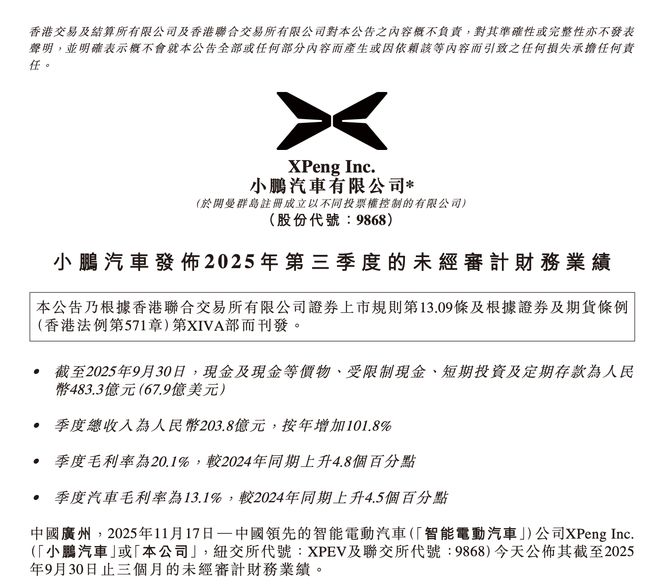
Core Viewpoint - Xiaopeng Motors reported strong financial performance for Q3 2025, with significant increases in key operational metrics such as delivery volume, revenue, and gross margin [1][3]. Group 1: Delivery and Sales Performance - In Q3, Xiaopeng Motors delivered approximately 116,000 vehicles, a year-on-year increase of 149.3% [1]. - The monthly delivery volume reached a new high of 42,013 vehicles in October [1]. Group 2: Revenue Growth - Automotive sales revenue for Q3 amounted to 18.05 billion yuan, representing a year-on-year increase of 105.3% and a quarter-on-quarter growth of 6.9% [3]. - Total revenue for the quarter was 20.38 billion yuan, up 101.8% year-on-year and 11.5% quarter-on-quarter [3]. Group 3: Profitability and Margins - Xiaopeng Motors reported a net loss of 380 million yuan in Q3, significantly reduced from 1.81 billion yuan in the same period last year [3]. - The gross margin improved to 20.1%, an increase of 4.8 percentage points year-on-year, with automotive gross margin at 13.1% [3]. Group 4: Research and Development Focus - The company is committed to investing in physical AI research, with planned R&D expenditures reaching approximately 9.5 billion yuan by 2025, including 4.5 billion yuan specifically for AI [5]. - Xiaopeng Motors has already invested over 2 billion yuan in training costs for VLA technology since 2024 [5]. Group 5: Financial Position and Future Outlook - As of September 30, Xiaopeng Motors had cash and cash equivalents totaling 48.33 billion yuan, a record high [6]. - For Q4, the company expects vehicle deliveries to range between 125,000 and 132,000, with total revenue projected between 21.5 billion and 23 billion yuan [6].
小鹏汽车-W(09868.HK):委任陈玉东为独立非执行董事
Ge Long Hui· 2025-11-17 12:21
格隆汇11月17日丨小鹏汽车-W(09868.HK)宣布,陈玉东已获委任为公司的独立非执行董事,自2026年1 月1日生效。 ...
XPeng Earnings Beat Wall Street Estimates. Why the Stock Is Falling.
Barrons· 2025-11-17 12:20
XPeng reports a third-quarter per-share loss of 1 cent from sales of $2.9 billion. ...
小鹏汽车-W:陈玉东获委任为独立非执行董事
Zhi Tong Cai Jing· 2025-11-17 12:15
小鹏汽车-W(09868)发布公告,陈玉东先生已获委任为公司的独立非执行董事,自2026年1月1日生效。 ...
小鹏汽车-W(09868):陈玉东获委任为独立非执行董事
智通财经网· 2025-11-17 12:14
智通财经APP讯,小鹏汽车-W(09868)发布公告,陈玉东先生已获委任为公司的独立非执行董事,自 2026年1月1日生效。 ...