国家电投

Search documents
国庆假期不停工!重点工程建设“火力全开”
Zhong Guo Zheng Quan Bao· 2025-10-03 09:35
Group 1 - Central enterprises are actively promoting projects and investments during the National Day holiday to stabilize the economy, with significant engineering projects continuing without interruption [1] - The world's first "dual-tower one machine" solar thermal energy storage power station has entered full system trial operation, marking a breakthrough in tower solar power generation technology [2] - The successful installation of the last wind turbine in the 200,000-kilowatt wind-storage project in Hegang, Heilongjiang, signifies the completion of the main engineering work [3] Group 2 - The G228 Binhai section's Tauer River Bridge has been completed and opened to traffic, significantly reducing travel time between the two banks [4] - The construction of the Zhongsha Gule Ethylene project is progressing rapidly, with over 4,000 workers on-site, achieving 82.5% overall progress [5] - The world's highest high-proportion co-firing high-alkali coal 660 MW ultra-supercritical thermal power unit has been put into operation, expected to generate 8 billion kilowatt-hours annually [6] Group 3 - The first batch of dam sections for the highest hyperbolic arch dam under construction in the domestic plateau has been successfully poured to the top, marking a significant milestone [7] - The National Development and Reform Commission is accelerating fund disbursement for the fourth quarter, with a new policy financial tool scale of 500 billion yuan aimed at supplementing project capital [8]


世纪难题被破解!中国攻克海水制氢,外媒:石油要变“廉价货”?
Sou Hu Cai Jing· 2025-10-02 09:46
Core Insights - The global research community has been exploring seawater hydrogen production as a clean fuel alternative to fossil fuels, but challenges such as high costs and efficiency have hindered progress [2][5] Group 1: Technological Advancements - A team led by Academician Xie Heping in China has developed a method to directly electrolyze seawater without the traditional desalination step, utilizing phase transition technology [5][9] - The first offshore trial of this technology, named "Dongfu No. 1," demonstrated stable hydrogen output with a purity of 99.9% and a cost of 0.4 yuan per cubic meter, significantly cheaper than coal-based hydrogen [7][9] - In 2025, a 250 kW seawater hydrogen production system was tested, achieving a direct current consumption of 3.8 kWh per cubic meter of hydrogen with a purity of 99.999% [11] Group 2: Industry Impact - The hydrogen demand in China is projected to exceed 10 million tons by 2030, positioning the country as a major player in the hydrogen industry [11] - The successful integration of renewable energy sources, such as wind and solar, with seawater electrolysis addresses water scarcity issues and enhances the feasibility of hydrogen production in coastal areas [9][11] - International media has highlighted China's advancements in seawater hydrogen production, suggesting a potential shift in the global energy landscape, particularly concerning oil prices [13][15] Group 3: Market Dynamics - In 2023, global hydrogen production reached 97 million tons, with low emissions accounting for less than 1%, while China's electrolyzer manufacturing capacity doubled to 25 GW, representing 60% of the global market [15] - The technology's ability to utilize seawater directly could alleviate water shortages in arid regions, making it a viable solution for countries facing water scarcity [15] - The rapid development of hydrogen technology in China contrasts with Japan's earlier investments, which faced higher production costs, indicating a competitive edge for China in the hydrogen market [15]

企业利润修复,工业硅区间震荡
Tong Guan Jin Yuan Qi Huo· 2025-09-29 01:53
Report Overview - Report Date: September 29, 2025 [1] - Title: Corporate Profit Recovery, Industrial Silicon Rangeside Fluctuation 1. Report Industry Investment Rating - Not provided in the given content 2. Core Views - Last week, industrial silicon fluctuated within a range. The main reasons were the overall cooling of the domestic industrial product market sentiment, the high - level decline of polysilicon futures with obvious support below, the significant year - on - year increase in the profit growth rate of Chinese industrial enterprises, and the entry of the anti - involution policy effect into the implementation period. The supply side was generally stable, and the demand side had mixed performance. The industrial silicon spot market operated steadily due to the range - bound fluctuation of the futures [2][5][9]. - Overall, China's anti - involution policy effect is in the implementation period, the corporate profits at the silicon material end are continuously recovering, the year - on - year growth rate of industrial enterprise profits has increased significantly, the industrial product market sentiment has cooled but the price center has stabilized. Technically, the 8800 level on the futures chart still has strong support. Although the polysilicon futures' high - level decline slightly dampens short - term sentiment, the futures price is expected to maintain a relatively strong range - bound fluctuation in the short term [2][9] 3. Summary by Directory 3.1 Market Data | Contract | September 26 | September 19 | Change | Change Rate | Unit | | --- | --- | --- | --- | --- | --- | | Industrial Silicon Main Contract | 8960.00 | 9305.00 | - 345.00 | - 3.71% | Yuan/ton | | Oxygen - Blown 553 Spot | 9500.00 | 9350.00 | 150.00 | 1.60% | Yuan/ton | | Non - Oxygen - Blown 553 Spot | 9300.00 | 9100.00 | 200.00 | 2.20% | Yuan/ton | | 421 Spot | 9700.00 | 9600.00 | 100.00 | 1.04% | Yuan/ton | | 3303 Spot | 10550.00 | 10450.00 | 100.00 | 0.96% | Yuan/ton | | Organic Silicon DMC Spot | 11050.00 | 10800.00 | 250.00 | 2.31% | Yuan/ton | | Polysilicon Dense Material Spot | 51.00 | 51.00 | 0.00 | 0.00% | Yuan/ton | | Industrial Silicon Social Inventory | 54.3 | 54.3 | 0 | 0.00% | Ten thousand tons | [3] 3.2 Market Analysis and Outlook - **Macro Aspect**: In August, the total profit of China's above - scale industrial enterprises increased by 20.4% year - on - year, and the cumulative year - on - year growth from January to August was 0.9%. The equipment manufacturing industry played an obvious "ballast stone" role [6]. - **Supply Aspect**: The operating rate in Xinjiang remained at 69%. The output in Sichuan and Yunnan during the wet season continued to decline, and the new production capacity in Inner Mongolia and Gansu was limited. The overall supply was stable. As of September 26, the weekly output of industrial silicon was 95,600 tons, a month - on - month increase of 0.94% and a year - on - year increase of 0.21%. The number of open furnaces in the three major production areas of industrial silicon was 310, and the overall furnace - opening rate was maintained at 38.9% [5][6][9]. - **Demand Aspect**: The quotation center of polysilicon moved up again, but silicon enterprises faced large inventory pressure, and the production cut in October might still be less than expected. The space for silicon wafers to support prices in the future was limited, and the market sentiment weakened. The supply and demand of photovoltaic cells remained in a tight balance, and the demand for high - efficiency cells was good. Leading enterprises at the component end showed signs of reluctant to sell, the centralized price increased slightly, but the terminal tender volume decreased, and some projects continued to postpone construction. The recycling of old photovoltaic components will become an important issue in the industry. The winning bid price range of components disclosed last week was 0.69 - 0.75 yuan/watt [2][5][7]. - **Inventory Aspect**: As of September 26, the national social inventory of industrial silicon remained at 543,000 tons, unchanged from the previous period. The exchange - registered warehouse receipt volume continued to increase. After the exchange introduced the new standard for delivery products, most of the 4 - series warehouse receipts could not be re - registered due to excessive titanium content, and the 5 - series warehouse receipts that met the new standard were actively registered and stored, becoming a new source of warehouse receipt inventory [8] 3.3 Industry News - As of the end of August, the country's cumulative installed power generation capacity was 3.69 billion kilowatts, a year - on - year increase of 18.0%. Among them, the installed capacity of solar power generation was 1.12 billion kilowatts, a year - on - year increase of 48.5%; the installed capacity of wind power was 580 million kilowatts, a year - on - year increase of 22.1%. From January to August, the cumulative average utilization hours of the country's power generation equipment were 2105 hours, 223 hours less than the same period last year [10]. - South Africa added about 928MW of photovoltaic installed capacity in the first quarter of 2025. It is expected that the new installed capacity this year will exceed 1.1GW in 2024. As of mid - 2025, the cumulative photovoltaic installed capacity in South Africa was estimated to be 9457MW. In July this year, the South African government approved six new photovoltaic projects in the seventh - round procurement, with a total installed capacity of 1290MW. The South African market is gradually adopting the scheme of matching energy storage with renewable energy, and the commercial and industrial market has good prospects, while the residential photovoltaic market shows signs of slowing down [11]. - On September 5, the Hebei Provincial Development and Reform Commission issued a notice on the second batch of projects in the 2025 annual development and construction plan for wind power and photovoltaic power generation in Hebei Province. This batch included 76 projects with a total capacity of 7.27107 million kilowatts, including 42 photovoltaic projects with a total scale of 3.12907 million kilowatts and 34 wind power projects with a total scale of 4.142 million kilowatts [11] 3.4 Related Charts - The report includes charts on industrial silicon production, exports, social inventory, Guangzhou Futures Exchange warehouse receipt inventory, weekly production in main production areas, organic silicon DMC production, polysilicon production, and spot prices of various grades of industrial silicon, polysilicon, and organic silicon [13][14][15][17][18]
【财经分析】AI驱动能源革命步入“深水区” 国资央企如何下好“一盘棋”?
Xin Hua Cai Jing· 2025-09-28 14:10
Core Insights - Artificial intelligence is accelerating the global energy transition and sustainable development, with state-owned enterprises (SOEs) playing a crucial role in integrating AI into the energy sector [1][2][4] Group 1: AI Integration in Energy Sector - SOEs are driving the integration of AI in various energy sectors, including oil, nuclear, coal, and electricity, aiming to create replicable and high-value application scenarios [1][2] - The application of AI in the energy sector is still in its early stages compared to other industries like military, but the complete industrial chain and diverse application scenarios provide a competitive advantage for rapid development [2][4] - AI's core value lies in deep coupling with application scenarios, maximizing data value, and promoting systemic transformation across the energy supply chain [3][4] Group 2: Practical Applications and Achievements - In oil and gas exploration, AI applications have shown significant advancements, such as the high accuracy of AI in drilling analysis and improved bidding success rates [4][5] - AI is enhancing efficiency in the electricity sector, with notable improvements in load forecasting accuracy and operational decision-making speed [4][5] - In the nuclear sector, AI supports high-quality construction and safety management by identifying technical discrepancies in project documentation [4][5] Group 3: Challenges and Future Directions - Despite progress, the energy sector faces challenges such as data security, cost pressures, and technological reliability, necessitating collaborative efforts to overcome these hurdles [6][7] - The need for a robust digital ecosystem involving government, industry, academia, and research institutions is emphasized to facilitate the intelligent transformation of the energy sector [7] - A new research initiative has been launched to develop high-value AI scenarios across the entire energy industry chain, focusing on scientific discovery, intelligent scheduling, and green low-carbon practices [7]
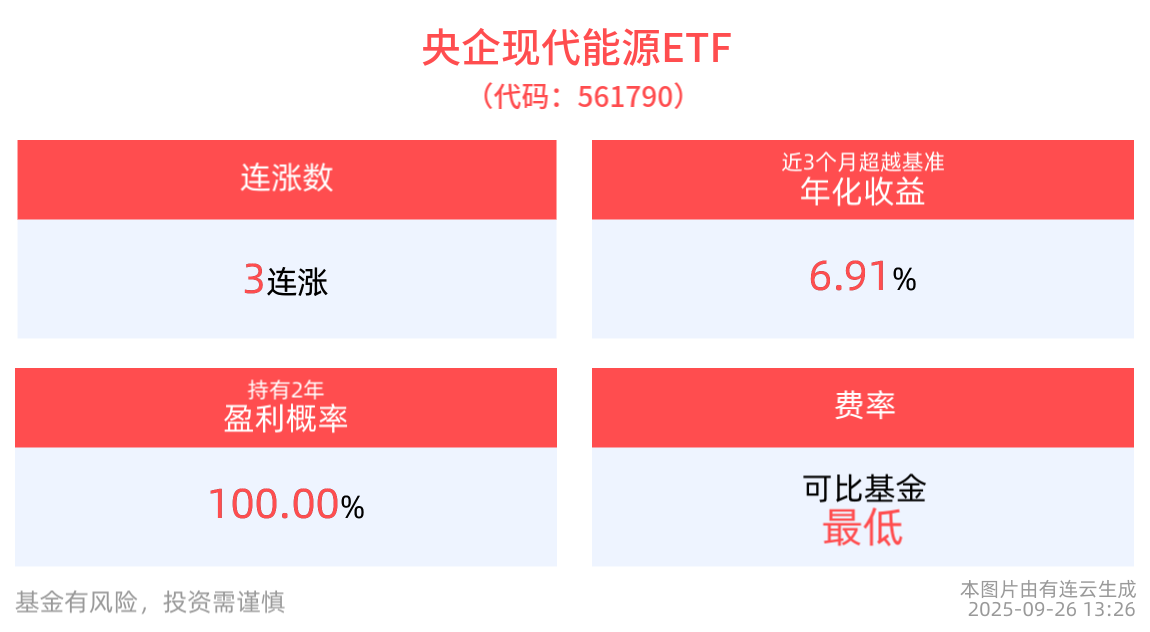
新型电力系统建设换挡提速,能源央企积极布局,央企现代能源ETF(561790)飘红冲击3连涨
Xin Lang Cai Jing· 2025-09-26 06:05
Group 1 - The core viewpoint of the news highlights the positive performance of the Central State-Owned Enterprises Modern Energy Index and its related ETF, indicating a growing interest in the modern energy sector [3][5] - As of September 25, 2025, the Central State-Owned Enterprises Modern Energy ETF has seen a cumulative increase of 6.23% over the past three months, with a trading volume of 134.47 million yuan and a turnover rate of 3.18% [3] - The total installed power generation capacity in the country reached 3.69 billion kilowatts by the end of August, reflecting an 18% year-on-year growth, with solar power capacity increasing by 48.5% and wind power capacity by 22.1% [3] Group 2 - At the 2025 New Power System Development Forum, experts emphasized the importance of accelerating the construction of a new power system to achieve carbon neutrality goals, advocating for the integration of production, education, research, and application of technological innovations [4] - Major energy state-owned enterprises proposed strategies for the 14th Five-Year Plan, focusing on large-scale and efficient development of renewable energy, enhancing system regulation capabilities, and building a unified national electricity market [4] - The energy transition during the 14th Five-Year Plan period will require balancing the relationship between renewable and traditional energy, as well as between government and market dynamics [4] Group 3 - The Central State-Owned Enterprises Modern Energy Index, customized by Guoxin Investment Co., includes 50 listed companies involved in green energy, fossil energy, and energy transmission, reflecting the overall performance of modern energy theme stocks [5] - The top ten weighted stocks in the index account for 48.28% of the total, with significant players including Changjiang Electric Power, China Nuclear Power, and China Petroleum [5]
宁夏17.6GW风光项目竞配:中国电建、宁夏国运、宁东新能源、华润等领衔
Xin Lang Cai Jing· 2025-09-23 12:10
Core Insights - The Ningxia Hui Autonomous Region plans to develop a total of 20.62 million kilowatts of renewable energy projects by 2025, focusing on green electricity parks and guaranteed grid connection projects [2][3] - The priority for 2025 includes 6.02 million kilowatts for characteristic advantage industry green electricity parks and 14.6 million kilowatts for guaranteed photovoltaic projects [2] - As of now, seven cities in Ningxia have announced the allocation of wind and solar projects, totaling 17.6 GW [2][3] Project Scale Summary - The total project scale for various cities in Ningxia is as follows: - Wuzhong City: 600,000 kW - Yinchuan City: 440,000 kW - Zhongwei City: 350,000 kW - Shizuishan City: 180,000 kW - Ningdong Modern Coal Chemical Industry Green Electricity Park: 170,000 kW - Guyuan City: 20,000 kW - Total: 1,760,000 kW [3] Project Owners - A total of 44 companies have been awarded the 17.6 GW wind and solar project scale, with the following key players: - China Power Construction: 3.37 GW - Ningxia Guoyun: 2 GW - Ningxia Ningdong New Energy: 1.7 GW [5][6][8] Central Enterprises Involvement - Eleven central enterprises have received wind and solar project quotas, including: - China Power Construction - China Nuclear Power - China Energy Engineering - State Power Investment Corporation - China National Petroleum Corporation [8][11] Competitive Configuration of Projects - In Wuzhong City, 29 photovoltaic projects were selected for competitive configuration, totaling 6 GW from an initial application of 16.1 GW [12] - In Yinchuan City, 9 projects were selected, with a total scale of 3.4 GW after adjustments [15] - Zhongwei and Guyuan cities have a combined planned scale of 3.5 GW for guaranteed grid connection projects [18]





负荷为王,风电开发投资的逻辑变了!
Sou Hu Cai Jing· 2025-09-22 03:16
Core Viewpoint - The investment logic in the wind power sector is shifting from "building where the wind is strong" to "building where the electricity is consumed," marking a new era focused on load demand [1][10]. Group 1: Policy Changes - The issuance of Document No. 136 is a watershed policy for the wind power industry, breaking the previous fixed-price model and requiring that all renewable energy project output enter the electricity market for price formation [3][6]. - A new "price difference settlement mechanism" has been established, providing compensation when market prices fall below the mechanism price and deducting the difference when they exceed it, favoring projects near load centers [3][6]. - The green electricity direct connection policy encourages investment in projects that allow direct transactions between power producers and large electricity consumers, reducing losses and increasing negotiation space for electricity prices [3][4]. Group 2: Regional Policy Implementation - Various local policies emphasize a "load priority" approach, supporting green electricity connections for high-energy-consuming industries like aluminum and silicon photovoltaic projects [4]. - Policies in regions like Inner Mongolia and Jiangsu are designed to connect wind power projects directly with high-energy industries, promoting integrated demonstration projects [4]. Group 3: Market Dynamics - The marketization of wind power pricing has been in the making since 2019, with a significant shift expected in 2025, where project revenues will depend on market prices rather than government-set prices [6][10]. - The disparity in wind power revenue across regions is increasing, with resource-rich areas facing price pressures due to limited local demand, while load centers can achieve higher prices through local electricity markets [6][10]. Group 4: Investment Trends - Wind power companies are increasingly focusing on load centers, as seen in recent investments aimed at integrating wind power with high-energy industries and data centers [7][10]. - Projects like the one by Goldwind in Inner Mongolia aim to convert wind power directly into industrial raw materials, addressing consumption issues [7][10]. - The trend indicates a shift towards projects that are closely linked to industrial parks and data centers, which are seen as ideal partners for wind power due to their stable electricity demand [9][10].
盐城港滨海港区:“港口+产业+能源”三位一体打造沿海综合枢纽港
Zhong Guo Xin Wen Wang· 2025-09-19 10:29
Core Insights - In 2024, Yancheng Port's coastal area is expected to handle over 19 million tons of cargo, representing a year-on-year growth of 6.8% [1] - By 2025, the addition of various cargo types such as coal, grain, and vehicles is projected to increase the cargo throughput to 24 million tons [1] Group 1: Port Characteristics and Infrastructure - Yancheng Port is classified as a first-class open port and serves as a gateway to the Huai River basin, with capabilities to construct 100,000 to 300,000-ton berths [2] - The port has a planned total of 78 berths with a designed throughput capacity of 200 million tons [2] - The operational areas include a main port area, a river-sea transport area, and a logistics storage area, with a total of 677,700 square meters of yard space and 107,600 square meters of modern warehouses [2] Group 2: Business Development and Revenue - The port is expected to generate revenue of 170 million yuan from the handling of seven types of cargo, including sand, nickel iron, and steel in 2024 [2] - The ongoing construction of the general cargo terminal phase III involves an investment of approximately 800 million yuan, with a design capacity of 4.15 million tons per year [2] Group 3: Strategic Initiatives and Growth - Yancheng Port has opened new international shipping routes to ports in Aqaba, Jordan, and Jebel Ali, UAE, significantly boosting the export volume of domestic brands like BYD and Changan [4] - The port aims to integrate with major energy projects in the region, promoting a "port + industry + energy" development model [4] - Future plans include the construction of dedicated container and vehicle roll-on/roll-off terminals, as well as a 200,000-ton channel project to enhance multi-modal transport capabilities [4]
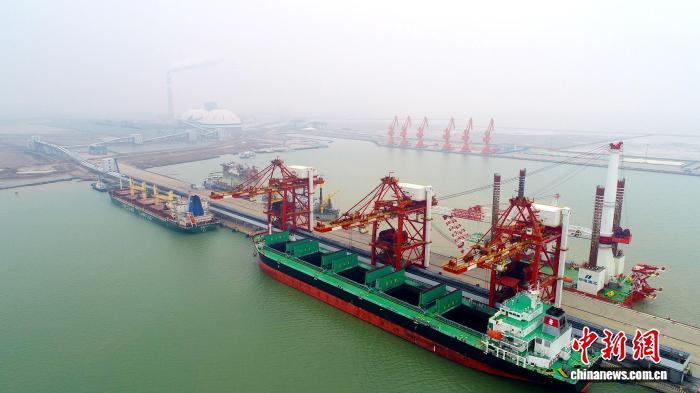
(活力中国调研行)盐城港滨海港区:“港口+产业+能源”三位一体打造沿海综合枢纽港
Zhong Guo Xin Wen Wang· 2025-09-19 03:33
Group 1 - In 2024, the cargo throughput of Yancheng Port Binhai Port Area is expected to exceed 19 million tons, representing a year-on-year growth of 6.8% [1] - By 2025, the port plans to increase the variety of goods handled, including coal, grain, vehicles, and ores, with an anticipated throughput of 24 million tons [1] - The port is a key open port in the Huai River basin and is designed to accommodate large vessels, with a planned capacity of 200 million tons [3] Group 2 - The port currently operates 78 berths and has a storage area of 677,700 square meters, along with eight modern warehouses totaling 107,600 square meters [3] - The ongoing construction projects include a general cargo terminal and a liquid bulk terminal, with a total investment of approximately 800 million yuan [3] - The port's roll-on/roll-off business has significantly increased, ranking among the top three coastal ports in Jiangsu [5] Group 3 - Yancheng Port Binhai Port Area has opened new international shipping routes to ports in Jordan and the UAE, boosting the export volume of domestic brands like BYD and Changan [5] - The port is collaborating with major energy projects to create a "port + industry + energy" development model [5] - Future plans include the construction of dedicated container and roll-on/roll-off terminals, as well as a 200,000-ton navigation channel project [5]
中国力量点亮绿色民生
中国能源报· 2025-09-18 13:09
Core Viewpoint - The article highlights the achievements of Chinese energy companies in international projects, particularly in renewable energy, under the Belt and Road Initiative, showcasing their contributions to global energy transition and cooperation [1][3][6]. Group 1: Project Highlights - The Al Shubakh 2.6 GW solar power plant in Saudi Arabia is noted as the largest single solar power project in the Middle East, with over 5 million solar panels [1]. - The Bukha solar project in Uzbekistan is expected to generate approximately 543 million kWh of green electricity annually, benefiting over 130,000 households and alleviating seasonal power shortages [3]. - The Yejue Village solar demonstration project in Myanmar has ended the village's history of being without electricity, significantly improving local living conditions [4]. Group 2: International Cooperation - The Belt and Road Initiative has led to significant international cooperation in energy, with many countries actively engaging in clean energy projects [6]. - Uzbekistan prioritizes energy structure transformation, with the Bukha solar project being a key initiative for its green low-carbon development [6]. - Saudi Arabia views China as a crucial partner in achieving its Vision 2030, with deep cooperation in various strategic areas, including energy [6]. Group 3: Technological Innovation - Chinese energy companies are leveraging technological innovations to reduce the cost of wind and solar energy generation significantly [6]. - The Al Shubakh solar project contributes to Saudi Arabia's carbon reduction goals, with each solar panel generating an average of 8.2 kWh daily, equivalent to saving 3.2 kg of crude oil per day [6]. Group 4: Future Outlook - The collaboration between China and Belt and Road countries in the energy sector is expected to continue growing, with more projects aimed at enhancing the welfare of local populations [7]. - The article emphasizes the potential for further energy projects to take root in Belt and Road countries, bringing light and benefits to more regions [7].