
圣邦股份

Search documents
“安永企业家奖”2025出炉,十二位企业家上榜
Di Yi Cai Jing Zi Xun· 2025-12-15 01:32
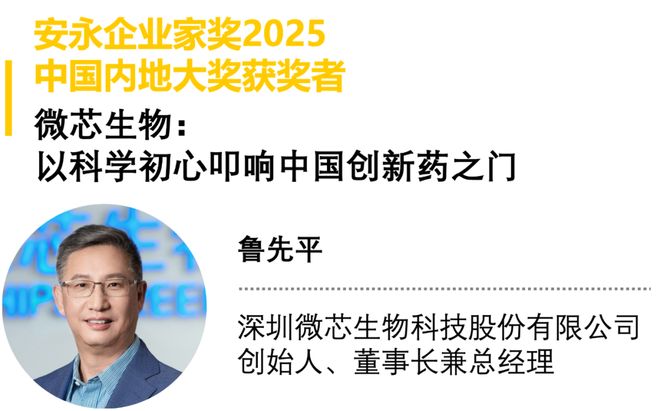
Group 1 - The 20th "Ernst & Young Entrepreneur Award" results were announced, highlighting 12 winners from mainland China and Hong Kong/Macau, including notable entrepreneurs in life sciences, precision manufacturing, artificial intelligence, and chip design [1] - Lu Xianping, founder and CEO of Microchip Biotech, and Li Peiliang, chairman of Dongjiang Group, received the awards for mainland China and Hong Kong/Macau respectively [1] Group 2 - Lu Xianping emphasized the responsibility to change the situation of high-priced or unavailable drugs in China, leading to the establishment of Microchip Biotech, which has developed two globally innovative drugs [4] - Microchip Biotech has created a drug discovery platform based on chemical genomics, resulting in the successful launch of the first original anti-tumor drug and the first PPAR full agonist in China [4][5] - The company faced significant challenges during commercialization, including unprecedented reviews and market recognition issues, highlighting the need for a supportive innovation ecosystem in China [4][6] Group 3 - Li Peiliang's philosophy of "profit is a byproduct of healthy operations" has guided Dongjiang Group through various industry cycles, emphasizing the importance of internal capabilities over short-term profits [8] - The company has proactively embraced smart manufacturing since 2015, leading to improved production efficiency and quality [9][10] - Li Peiliang believes that AI will be essential for future competitiveness, with plans to strengthen AI capabilities in high-end consumer electronics and medical precision manufacturing [10] Group 4 - Chen Ning founded Yuntian Lifa in Shenzhen after recognizing the potential of AI inference chips, aiming to address the growing demand for inference computing power [14] - The company has developed a "computing power building block" architecture to meet diverse product needs while maintaining compatibility with existing ecosystems [15][16] - Yuntian Lifa is focused on enhancing AI inference capabilities and has established partnerships with various industry players [15] Group 5 - Zhang Shilong, founder of Shengbang Microelectronics, has led the company from zero to over 40 billion chips shipped, establishing a significant presence in the global analog chip market [20] - The company faced initial challenges in gaining market acceptance despite having advanced technology, but secured key orders in 2005 that marked a turning point [20][21] - Shengbang Microelectronics continues to innovate and expand its product offerings, focusing on high-performance and high-quality solutions [21] Group 6 - Huang Wei, founder of Cloud Wisdom, recognized the potential of AI in 2012 and has since led the company to significant milestones, including the launch of its first AI chip [25][26] - The company aims to solve core industry problems with its AI technologies, positioning itself as a specialized provider rather than a generalist [26][27] - Cloud Wisdom is focused on creating measurable commercial value and ensuring a positive feedback loop between investment and returns [27] Group 7 - Jia Jiaya, founder of Simo Technology, is pioneering the integration of AI large models with robotics to create industrial intelligent systems [31][32] - The company has developed a comprehensive product ecosystem that includes AI models and industrial robots, achieving significant market penetration [32] - Simo Technology emphasizes the importance of integrating technology into complex industrial environments to create value [31] Group 8 - Jiang Haitao founded Macau Network Media Development to address the lack of digital services in Macau, leading to the creation of the "Aomi" app [36][37] - The company faced challenges in talent acquisition and infrastructure but successfully adapted mainland experiences to the local market [36][37] - Aomi has evolved into a comprehensive local service platform, leveraging high-frequency services to maintain user engagement [37] Group 9 - Jiang Xueming established Dongxin Semiconductor to address China's semiconductor needs, recognizing the significant import costs associated with chips [40][41] - The company faced initial challenges in talent and technology but made strategic acquisitions to gain a foothold in the industry [41][42] - Dongxin Semiconductor is focused on continuous innovation and development of a comprehensive technology matrix to meet future demands [42] Group 10 - Li Hong, chairman of Weisheng Information Technology, has positioned the company in the energy IoT sector, anticipating its importance in the energy revolution [45][46] - The company is exploring international markets while ensuring product localization to meet regional needs [45][46] - Weisheng Information is committed to long-term investments in technology and standards to support global energy transitions [46] Group 11 - Li Ping, co-founder of Zhi Zi Cheng Technology, emphasizes local decision-making in global markets to navigate cultural and operational differences [50][51] - The company has established a localized organizational structure to enhance its global operations and product offerings [50][51] - Zhi Zi Cheng Technology is leveraging AI to optimize product creation and operational processes, aiming for sustainable local operations [51]

“安永企业家奖”2025出炉,十二位企业家上榜
第一财经· 2025-12-15 01:21
Core Insights - The article highlights the achievements of the 2025 Ernst & Young Entrepreneur Awards, showcasing 12 winners from mainland China and Hong Kong/Macau, including notable figures in life sciences, precision manufacturing, and cutting-edge technologies like AI and chip design [1] Group 1: Microchip Biotech - Shenzhen Micron Biotech, founded by Lu Xianping, has developed two globally innovative drugs, Xidabena and Siglitazone, marking significant milestones in China's pharmaceutical innovation [4][5] - The company emphasizes "source innovation" and has established an integrated drug discovery platform based on chemical genomics, leading to the successful commercialization of its first original anti-tumor drug [4][5] - Lu Xianping reflects on the challenges faced during the commercialization phase, including unprecedented reviews, market recognition issues, and delayed medical insurance access [4][5] Group 2: East River Group - Li Peiliang, chairman of East River Group, emphasizes a long-term perspective in business, stating that profit is a byproduct of healthy operations, and companies should focus on internal capabilities rather than short-term gains [10][11] - The company has proactively adopted smart manufacturing technologies since 2015, leading to improved production efficiency and quality [11] - Li believes that AI will be essential for future competitiveness, and East River Group plans to strengthen its AI capabilities while exploring new opportunities in high-end consumer electronics and medical precision manufacturing [11][12] Group 3: Cloud Tianli Fei - Chen Ning, founder of Cloud Tianli Fei, returned to China to establish a company focused on AI inference chips, recognizing the critical role of chips in technological advancement [16][17] - The company has developed a "computing power building block" architecture to meet diverse product needs while maintaining compatibility with existing ecosystems [17] - Cloud Tianli Fei is positioned to capitalize on the shift from training to inference in AI, with a focus on enhancing efficiency and reducing latency in AI applications [17][18] Group 4: Saintbond Microelectronics - Zhang Shilong, founder of Saintbond Microelectronics, has led the company from a challenging start to becoming a key player in the high-end analog chip market, with over 400 billion chips shipped [22][23] - The company focuses on technological innovation and has expanded into emerging fields like automotive chips and AI, maintaining high-quality standards to win customer trust [23][24] - Zhang acknowledges the challenges posed by domestic and international competition but remains committed to high-quality development and strategic partnerships [23][24] Group 5: Yisheng Information Technology - Li Hong, chairman of Yisheng Information Technology, has recognized the potential of the energy IoT sector and has positioned the company to leverage this opportunity through advanced technology [52][53] - The company is exploring international markets while ensuring that products meet local standards and adapt to regional power grid characteristics [53] - Li emphasizes the importance of long-term investment in technology and international expansion to contribute to global energy transformation [53] Group 6: Red Children Technology - Li Ping, co-founder of Red Children Technology, emphasizes the importance of local decision-making in global markets, allowing teams to adapt to cultural and social differences [58][59] - The company has established a localized organizational system, integrating local and Chinese employees to enhance market understanding [58][59] - Red Children Technology is leveraging AI to optimize product creation and operational processes, aiming to enhance user engagement and operational efficiency [59][60]

圣邦股份:12月12日召开董事会会议
Mei Ri Jing Ji Xin Wen· 2025-12-12 12:52
Company Information - Shengbang Co., Ltd. (SZ 300661) announced on December 12 that its 14th meeting of the 5th Board of Directors was held, where the proposal to change the accounting firm was reviewed [1] - For the first half of 2025, Shengbang's revenue composition is entirely from the integrated circuit industry, accounting for 100.0% [1] - As of the report date, Shengbang's market capitalization is 40.9 billion yuan [1]

圣邦股份:截至2025年9月30日公司股东数量为110773户
Zheng Quan Ri Bao Wang· 2025-12-12 12:42
Group 1 - The core point of the article is that Shengbang Co., Ltd. (300661) reported on an interactive platform that as of September 30, 2025, the number of its shareholders will be 110,773 [1]
圣邦股份(300661) - 关于变更会计师事务所的公告
2025-12-12 11:31
证券代码:300661 证券简称:圣邦股份 公告编号:2025-107 圣邦微电子(北京)股份有限公司 关于变更会计师事务所的公告 本公司及董事会全体成员保证信息披露的内容真实、准确、完整,没有虚 假记载、误导性陈述或重大遗漏。 特别提示: 1、圣邦微电子(北京)股份有限公司(以下简称"公司")拟聘任的会计 师事务所:安永华明会计师事务所(特殊普通合伙)(以下简称"安永华 明")。 2、前任会计师事务所:致同会计师事务所(特殊普通合伙)(以下简称 "致同所")。 组织形式:特殊普通合伙 注册地址:安永华明总部设在北京,注册地址为北京市东城区东长安街1号 东方广场安永大楼17层01-12室 3、变更原因:综合考虑公司发展需求及整体审计工作需要,拟变更安永华 明为公司2025年度审计机构,负责公司2025年度财务及内部控制审计工作。 4、公司已就拟变更会计师事务所的相关事宜与前后任会计师事务所进行了 沟通,前后任会计师事务所已明确知悉本次拟变更事项并确认无异议。公司董 事会、审计委员会对本次拟变更审计机构的事项均不存在异议,该事项尚需提 交公司股东会审议。 5、本次变更会计师事务所符合财政部、国务院国资委、证监会 ...
圣邦股份(300661) - 关于召开公司2025年第四次临时股东会的通知
2025-12-12 11:30
经圣邦微电子(北京)股份有限公司(以下简称"公司")第五届董事会 第十四次会议审议通过,决定于 2025 年 12 月 29 日(星期一)召开公司 2025 年第四次临时股东会(以下简称"会议")。现将会议有关事项通知如下: 证券代码:300661 证券简称:圣邦股份 公告编号:2025-108 圣邦微电子(北京)股份有限公司 关于召开公司 2025 年第四次临时股东会的通知 本公司及董事会全体成员保证信息披露的内容真实、准确、完整,没有虚 假记载、误导性陈述或重大遗漏。 一、召开会议的基本情况 1、股东会届次:2025 年第四次临时股东会。 2、股东会的召集人:公司董事会,经公司第五届董事会第十四次会议审议 通过后,决定召开公司 2025 年第四次临时股东会。 3、会议召开的合法、合规性:本次股东会的召开符合有关法律、行政法规、 部门规章、规范性文件及《圣邦微电子(北京)股份有限公司章程》的相关规 定。 4、会议召开的日期、时间: (1)现场会议召开时间:2025 年 12 月 29 日(星期一)下午 14:45。 (2)网络投票时间:2025 年 12 月 29 日;其中,通过深圳证券交易所交易 系统进行 ...
圣邦股份(300661) - 第五届董事会第十四次会议决议的公告
2025-12-12 11:30
一、董事会会议召开情况 圣邦微电子(北京)股份有限公司(以下简称"公司")第五届董事会第十 四次会议于 2025 年 12 月 1 日以通讯形式发出通知,于 2025 年 12 月 12 日 13:00 在公司会议室以现场结合通讯方式召开。董事会会议应参会董事 6 人,实际参会 董事 6 人。本次会议由董事长张世龙先生召集并主持,公司高级管理人员列席了 会议。本次会议的召集、召开和表决程序均符合《中华人民共和国公司法》和《圣 邦微电子(北京)股份有限公司章程》的有关规定,会议决议合法有效。 二、董事会会议审议情况 证券代码:300661 证券简称:圣邦股份 公告编号:2025-106 圣邦微电子(北京)股份有限公司 第五届董事会第十四次会议决议的公告 本公司及董事会全体成员保证信息披露的内容真实、准确、完整,没有虚 假记载、误导性陈述或重大遗漏。 经公司董事会审议通过,公司定于 2025 年 12 月 29 日(星期一)召开公司 2025 年第四次临时股东会,就本次董事会审议通过的相关议案进行审议。 表决结果:6 票同意、0 票反对、0 票弃权。同意票数占本次董事会有效表 决票数的 100%,表决通过。 具体 ...
德银深度研究:2026年科技硬件行业七大核心主题与投资机会
Zhi Tong Cai Jing· 2025-12-11 14:19
Group 1: Semiconductor Market Trends - Severe memory shortages are driving a reevaluation of semiconductor equipment targets, with DRAM spot prices soaring by 300%-400% in the past three months, reaching $17 per GB for DDR4 and $13-14 per GB for DDR5 [2] - NAND flash market is experiencing similar trends, with core benchmark products seeing a 200% price increase over the last three months, and contract prices rising by 20%-60% [2] - The memory shortage is expected to continue until at least 2027, leading to significant increases in wafer fab equipment spending, particularly benefiting companies like ASML, VAT Group, and SUSS MicroTec [3][4] Group 2: AI and Component Supply Challenges - AI investments are crowding out supply for non-AI components, leading to potential shortages in memory, passive components, and optical components, which could impact consumer electronics, smartphones, PCs, and automotive electronics [4] - The automotive electronics sector is less affected due to dedicated production lines for automotive-grade products [5] Group 3: Optical and Testing Innovations - AI data centers are driving a surge in bandwidth demand, leading to advancements in optical components and the transition to higher-speed pluggable optical devices [3] - The testing sector is undergoing a structural transformation due to increased chip complexity and rising failure costs, with companies like Technoprobe expanding testing coverage to improve quality [6] Group 4: GaN and Power Semiconductor Opportunities - The shift to 800V architecture in AI data centers, driven by Nvidia, is creating opportunities for GaN technology, similar to the impact of SiC in Tesla applications [8] - AI processor power consumption is projected to grow from 7GW in 2023 to over 70GW by 2030, creating significant market opportunities for suppliers addressing power challenges [9] Group 5: Edge AI and Local Processing - Edge AI is gaining traction, with companies like AMD noting its growth potential, although it remains in the experimental phase [10] - Ambarella anticipates that its defined "edge AI" market will account for 80% of its total revenue by 2025, covering various applications [10] Group 6: Localization of Semiconductor Production in China - There is a significant shift in China's semiconductor capabilities, with local manufacturers facing increased pressure for domestic procurement and improving their scale and quality [11] - The year 2026 is expected to be pivotal as the market recognizes the potential shrinkage of Western companies' market size in China [11][12]
电子行业2026年投资策略:AI创新与存储周期
GF SECURITIES· 2025-12-10 09:08
Core Insights - The report emphasizes the synergy between AI innovation and capital expenditure (CAPEX), highlighting that model innovation is the core driver of AI development, with CAPEX serving as the foundation for the AI cycle [12][14] - The AI industry chain includes AI hardware, CAPEX, and AI models and applications, which collectively support the computational needs for large model training and inference [12][14] - The report suggests that the AI storage cycle is driven by rising prices and simultaneous expansion and upgrades in production capacity, particularly in cloud and edge storage [4][34] Group 1: AI Innovation and CAPEX - Model innovation is identified as the key driver of AI development, with significant capital expenditures from cloud service providers and leading enterprises providing a stable cash flow to support upstream hardware sectors [14][24] - The report notes that major companies like Google and OpenAI are making substantial advancements in multi-modal models, which are expected to enhance user engagement and monetization opportunities [19][25] - The integration of AI capabilities into various applications is projected to create a closed loop of high computational demand leading to high-value content and increased user willingness to pay [24][25] Group 2: Storage Cycle - The report indicates that storage prices are on the rise, significantly boosting the gross margins of original manufacturers, with capital expenditures in the storage sector entering an upward phase [4][34] - It highlights that traditional DRAM and NAND production is being approached cautiously, while HBM production is prioritized, indicating a shift in focus within the storage industry [4][34] - The report discusses the emergence of new opportunities in the storage foundry model, driven by the evolving demands of AI applications [4][34] Group 3: Investment Recommendations - The report recommends focusing on companies within the AI ecosystem, particularly those involved in AI storage, PCB, and power supply sectors, as they are expected to experience sustained growth [4][34] - It suggests that the ongoing upgrades in DRAM and NAND architectures will create new equipment demand, presenting investment opportunities in related companies [4][34] - The report encourages attention to the storage industry chain, particularly in light of the anticipated price increases and margin improvements for original manufacturers [4][34]
研判2025!中国无线电探空仪行业分类、产业链及市场规模分析:技术市场双轮驱动,智能化绿色化发展巩固全球领先地位[图]
Chan Ye Xin Xi Wang· 2025-12-09 03:31
Industry Overview - The Chinese radiosonde industry is currently experiencing a dual drive of technological upgrades and market expansion, with a projected market size of approximately 2.914 billion yuan in 2024, representing a year-on-year growth of 12.29% [1][8] - The frequency coding method has become mainstream, with BeiDou/GPS integration achieving comprehensive ground-to-air IoT coverage, detecting altitudes of 60-70 km and reaching international advanced precision levels [1][8] - Future developments are expected to lead the industry towards intelligent, green, and global directions, reinforcing China's leading position in global radiosonde technology and supporting high-quality development in meteorological warning, climate research, and low-altitude economy [1][8] Market Size - The market size of the Chinese radiosonde industry is projected to reach approximately 2.914 billion yuan in 2024, with a year-on-year growth of 12.29% [1][9] - The industry is driven by technological advancements, particularly the adoption of frequency coding and BeiDou/GPS integration, which enhances detection capabilities and precision [1][9] Industry Chain - The upstream of the radiosonde industry includes raw materials and components such as sensors, conversion circuits, encoding devices, radio transmitters, and power supplies [6] - The midstream involves the production and manufacturing of radiosondes, while the downstream focuses on applications in meteorological forecasting, aerospace, and military sectors [6] Key Enterprises - The competitive landscape of the Chinese radiosonde industry is characterized by a concentration of leading players driven by technology [9] - Shanghai Changwang, established in 1930, leads the market with its GTS1 digital radiosonde, producing 150,000 units annually and supplying 90 meteorological stations [10] - China Huayun Meteorological Technology Group, a subsidiary of the China Meteorological Administration, holds a significant market share in P-band and L-band systems and is a leader in the BeiDou radiosonde field [9][10] Development Trends 1. **Accelerated Technological Upgrades**: The industry is transitioning from electronic to intelligent digital radiosondes, with BeiDou/GPS dual-mode positioning technology expected to be fully implemented by 2025, enhancing wind measurement precision [11] 2. **Expansion of Low-altitude Economy**: The low-altitude economy in China is projected to reach 670.25 billion yuan in 2024, opening new growth avenues for radiosondes in various applications beyond traditional meteorological observation [11] 3. **Accelerated Domestic Substitution**: The core components of radiosondes are increasingly being domestically produced, with the BeiDou radiosonde system achieving 100% autonomy, and advancements in temperature detection precision [12]
