SHEIN

Search documents
珠三角地区企业参访,深圳、佛山企业参访
Sou Hu Cai Jing· 2025-12-16 10:16
Core Insights - The Pearl River Delta (PRD) is a leading area for China's reform and opening-up, showcasing top global manufacturing, technological innovation, and industrial clusters [1] - The visit focuses on four key areas: smart manufacturing, digital economy, green energy, and cross-border e-commerce, aiming to help participants gain insights into industry trends and connect with quality resources [1] Group 1: Benchmark Enterprises - The PRD is home to several benchmark enterprises, including Huawei, Tencent, BYD, and DJI, which are among the world's top 500 companies [3] - Participants will learn about strategic layouts, technological breakthroughs, and ecosystem construction from these leading companies, including Huawei's "1+N" strategy and Tencent's industrial internet transformation [3] Group 2: Advanced Technologies - Research and development investments are significant, with Huawei's annual R&D expenditure exceeding 100 billion yuan, making it a leader in global patent numbers [5] - Key technological methodologies include BYD's innovative materials for blade batteries and the collaborative model between industry and academia exemplified by Dongguan Songshan Lake Material Laboratory [5] Group 3: Knowledge System Upgrade - The visit provides a comprehensive understanding of strategic frameworks and management methodologies from leading companies, covering areas such as strategic planning, technology development, and global expansion [6] - This approach helps avoid the limitations of fragmented learning, enabling participants to build a complete cognitive system from macro trends to micro implementations [6] Group 4: Practical Experience - The visit emphasizes actionable solutions, such as Midea's "T+3" flexible production model, which can reduce delivery cycles by 30%, and OPPO's AI visual inspection technology, which can improve yield rates by 20% [8] - Participants will receive internal training materials and tools from leading companies, facilitating the rapid transformation of benchmark experiences into productivity [8] Group 5: Brand Influence - Participating companies will receive the "Pearl River Delta Benchmark Enterprise Learning Base" certification, enhancing their brand credibility and market competitiveness [9] - The visit serves as an accelerator for corporate upgrades, helping participants seize opportunities in the PRD economic wave for leapfrog development [9] Group 6: Resource Networking - The event creates a three-dimensional resource platform connecting government, capital, and industry chains, allowing participants to engage with local investment and technology agencies [10] - Post-visit, participants can join the "Pearl River Delta Enterprise Alumni Association" to continue receiving industry updates and invitations to internal sharing sessions, fostering a long-term value network [10]



林凡:AI将推动组织从“人人都是程序员”到“人人都是CEO”
Sou Hu Cai Jing· 2025-12-16 10:05
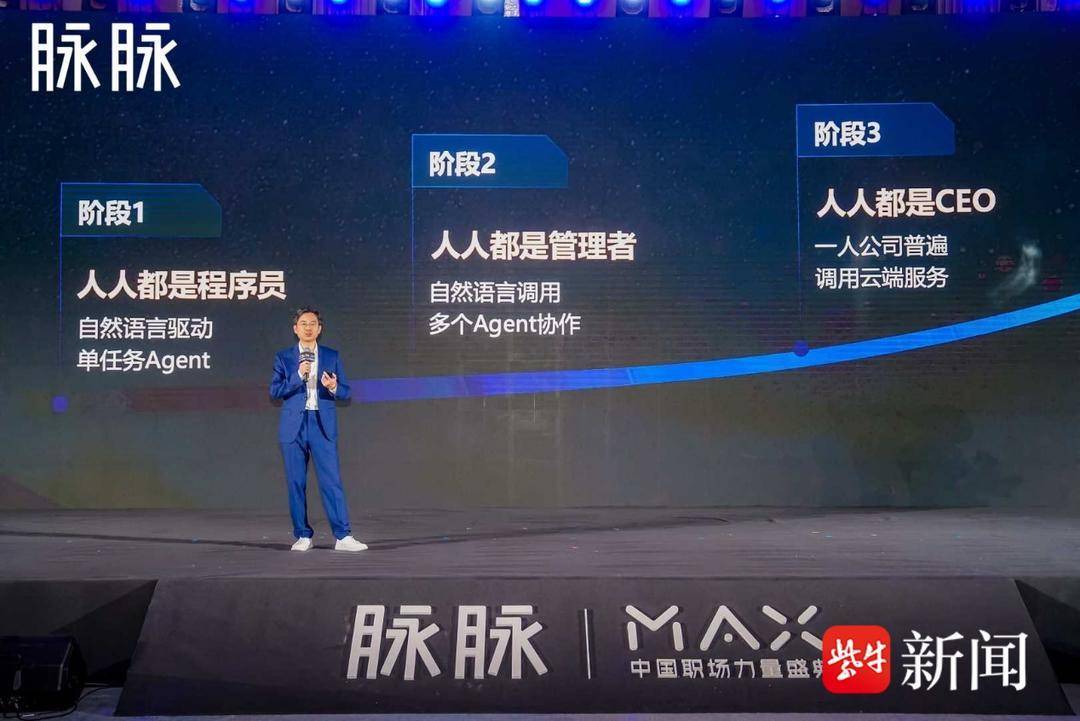
Core Insights - The talent standards in the AI era will shift from selecting individuals with high upper limits of capability to those with high lower limits of capability, as AI can provide superior suggestions but may struggle with basic tasks [4] - The recruitment market is gradually recovering, with new job postings in the new economy sector exceeding the same period last year starting from June 2025 [8] - AI will drive organizations through three evolutionary stages: from "everyone is a programmer" to "everyone is a manager" and finally to "everyone is a CEO" [2][4] Group 1: AI's Impact on Talent and Recruitment - AI will enable at least 20% of work to be completed by AI in the first stage, with employees needing to learn how to decompose tasks for AI execution [2] - By the second stage, 60% to 70% of work will be AI-driven, requiring collaboration between humans and AI agents [2] - The average monthly salary for AI scientists has surpassed 127,000 yuan, indicating a competitive job market for AI talent [8] Group 2: Organizational Changes and Recommendations - Companies should focus on hiring individuals with high lower limits of capability to complement AI's weaknesses, moving away from hiring inexperienced graduates [4] - Organizations are encouraged to implement AI capability assessments in interviews and to allow AI to handle 20% of employees' tasks [4] - The concept of "Agentization" is promoted, where employees can automate their tasks using AI, significantly increasing productivity [7] Group 3: Current Trends and Challenges - 80% of companies are still at a superficial level of AI application, indicating a need for deeper integration and understanding of AI's potential [11] - The recruitment process can be enhanced by using AI tools to quickly screen resumes and improve talent matching [10] - The 2025 MAX Annual "Best Employers" awards recognized over 80 companies, highlighting the competitive landscape for attracting talent in the AI era [13]
日本拟取消小额免税!对中国商品征收10%消费税
Sou Hu Cai Jing· 2025-12-16 03:21
不仅如此,日本财务省还计划取消"个人自用进口商品"的税基优惠政策。现行制度允许海关按商品海外售价的60%作为课税价格,相当于给予40%的减 免。若该特例被废止,税金将按照商品全额售价计算,包含10%的消费税和相应关税。该措施预计将使个人进口货物的综合税负提升约40%,进一步抬升 跨境商品的进入成本,对卖家造成新一轮压力。 此次税改如果落地,将直接影响跨境电商平台和低价出口商品的价格与销售策略。但政策细节及具体实施时间仍需等待官方正式公布,行业和卖家应持续 密切关注,并评估可行的运营和成本调整方案,提前做好应对准备。 近日,日本自民党税制调查会正式提出税制修正案,计划自2026年起取消所有价值1万日元以下进口商品的免税政策,所有进口小额货物均需缴10%的消 费税。 数据显示,2024年进口货值低于1万日元的小包裹就高达1.7亿件,总金额达4258亿日元,是2019年的整整五倍。如今,这类低价小包裹已占到日本全部进 口包裹的九成左右。正是这一迅速扩张的规模,成为本次税改直指的重点。 该税制修正案还要求,年销售额超过50亿日元的电商平台必须履行纳税义务,为其跨境电商卖家代扣代缴消费税。此举将使TEMU、SHEIN以 ...


Societal Standards | Sofia Neroni | TEDxAOSR Youth
TEDx Talks· 2025-12-15 16:59
and I'm in eighth grade. Today I'm going to be presenting my TEDex speech on societal standards and their impact on us and also other people we might not expect. Societal standards are day-to-day expectations that we all deal with since they're hold up society.However, this doesn't mean that all the standards have to positively contribute to our lives. And a great example is the beauty standard. Beauty standards can vary from place to place, but everywhere you go, it's something people pay a lot of attentio ...

品牌出海手册2.0:2026关键趋势+全链路策略
Sou Hu Cai Jing· 2025-12-15 05:40
Core Insights - The globalization process of Chinese brands is accelerating, with the "AI Empowering Brand Going Overseas" theme providing comprehensive guidance for enterprises [1] - The past year has seen trade frictions and regulatory changes increase costs and entry barriers for companies, but also create structural opportunities in emerging markets [1] - Key trends for 2025-2026 include a shift from "product going overseas" to "brand going overseas," AI-driven marketing intelligence, and a focus on market diversification and localization [1] Group 1: Impact of Trade and Regulations - Trade wars and new compliance regulations have significantly impacted cross-border e-commerce, with reliance on the US market declining by 10-15% [5] - Increased tariffs have raised costs by 15-20% for companies in sectors like medical devices and electronics, affecting profit margins and operational stability [7] - Compliance challenges have become critical, with many small sellers facing difficulties in meeting stringent regulations, leading to a significant portion of inquiries related to compliance issues [7] Group 2: Opportunities Arising from Challenges - The challenges have prompted companies to explore new markets, with rapid growth in regions like Southeast Asia, the Middle East, and Latin America [6] - The Belt and Road Initiative has shifted focus towards favorable policies in emerging markets, providing new opportunities for brand expansion [6] - AI tools are being utilized to enhance compliance capabilities, reducing the time needed for certification processes and enabling companies to gain market access more efficiently [7] Group 3: AI's Role in Brand Globalization - AI is becoming central to brand globalization, aiding in market insights, cultural adaptation, strategy optimization, and content generation [1][39] - Companies are encouraged to establish a "human + AI" collaborative decision-making mechanism to enhance market scanning, consumer understanding, and compliance management [1] - The integration of AI into marketing strategies is seen as essential for overcoming traditional barriers to international expansion [39] Group 4: Key Trends for Future Brand Expansion - The transition from "selling products" to "building brands" is crucial, as global consumers increasingly value brand culture and values [19] - AI-driven marketing intelligence and content production are reshaping the advertising industry, enhancing efficiency and effectiveness [20] - Companies should focus on market diversification and localization, particularly in emerging markets, to build resilience and adaptability [21] Group 5: Strategic Recommendations - Companies should embrace AI as a core tool for enhancing operational efficiency and market responsiveness [24][25] - Compliance with data security and environmental standards is becoming a competitive necessity, with proactive measures being essential for brand trust [26] - Building a localized brand presence through deep cultural understanding and tailored marketing strategies is vital for long-term success in international markets [23]
欧盟将对小额包裹征收关税
日经中文网· 2025-12-15 02:44
拿着SHEIN的纸袋的顾客(11月5日,法国巴黎,Reuters) 欧盟成员国在12月12日的部长级会议上决定,从2026年7月开始对此前属于免税对象的150欧元以下的小 额包裹征税。线上购买的所有进口产品中的93%将成为征税对象。 除了欧盟的新规之外,法国在2026年度预算案中加入了对进口包裹征税的内容。在法国参议院审议中, 把政府提出的2欧元增加到5欧元。法国经济与财政部表示,如果实现征税,进口包裹将根据商品的种类 征收欧盟和法国两方的税款。 日本经济新闻(中文版:日经中文网)北松圆香 巴黎 版权声明:日本经济新闻社版权所有,未经授权不得转载或部分复制,违者必究。 日经中文网 https://cn.nikkei.com 欧盟决定从2026年7月开始对此前属于免税对象的150欧元以下的小额包裹征税。继美国取消小额包裹免 税措施后,欧盟也决定对小额包裹征税3欧元。此外,法国正在考虑自主的征税方案…… 各国和地区相继采取了针对SHEIN等中国电商的对策。继美国取消小额包裹免税措施后,欧盟(EU) 也决定对小额包裹征税3欧元。 法国正在考虑自主的征税方案。各国和地区都担心低价中国产品涌入,挤压本国零售企业的盈利等 ...

ChatGPT“加剧用户妄想”,引发命案,OpenAI被起诉;宁德时代再发100亿债券丨Going Global
创业邦· 2025-12-14 11:22
Key Points - TikTok Shop will increase commission rates to 9% in five EU countries starting January 8, 2026, with some categories potentially reduced to 7% [5][7] - SHEIN has launched a new e-commerce logistics center in Poland, which will become a major logistics hub in the EU, creating 5,000 new jobs [8][10] - CATL plans to issue bonds worth up to 10 billion RMB despite having over 350 billion RMB in cash, raising questions about the necessity of this financing [11][12] - BYD achieved record sales in November, with a total of 4.182 million vehicles sold in the first 11 months of 2025, marking a 11.3% year-on-year increase [13][14] - Tesla's sales in the U.S. fell to a nearly four-year low in November, with a 23% year-on-year decline, attributed to the end of federal tax credits [16] - Microsoft AI CEO stated the company will not engage in high-salary talent poaching like Meta, focusing instead on cultural fit and necessary skills [17][19] - OpenAI is facing a lawsuit linking its ChatGPT to a murder case, marking the first instance of such a legal action in the U.S. [21][23] - Amazon will allow publishers to choose whether to enable DRM protection for e-books starting January 20, 2026, potentially changing the landscape of e-book ownership [24]


脉脉高聘:招聘市场回暖,AI岗位量单月增幅超过11倍
Feng Huang Wang· 2025-12-12 12:54
Core Insights - The recruitment market is expected to recover in the second half of 2025, with a significant increase in AI-related job postings, showing a year-on-year growth of over 11 times in September [1] - Positions explicitly requiring keywords like "AI" and "large models" account for 19.18% of new job postings [1] - The CEO of Maimai, Lin Fan, stated that AI will gradually reshape jobs, workflows, and organizational structures over the next 3 to 10 years [1] Job Market Trends - From January to October 2025, the overall talent supply-demand ratio in the new economy sector is 2.23 [1] - Algorithm engineers and large model algorithm engineers are the top two new job roles [1] - AI scientists have an average monthly salary exceeding 127,000 yuan, indicating a salary premium for AI-related positions [1] Company Recognition - Maimai announced the "Job Well Done" company awards, with JD.com, BYD, SHEIN, and Didi recognized as "Annual Job Well Done Employers" [1] - ByteDance and BYD received accolades as "Most Praised Employers for Fresh Graduates" [1] - Tesla and Bosch China were named "Most Popular Foreign Enterprises" [1] AI Tool Usage - Over 90% of professionals are currently using AI tools in their work, with DeepSeek and Doubao being the most utilized [1]
亚马逊放大招!全球低价电商混战再升级,谁才是最终赢家?
Sou Hu Cai Jing· 2025-12-11 11:01
Core Insights - Amazon has officially entered the ultra-low-price e-commerce market, launching its low-price mall Haul and the independent platform Bazaar in 26 countries, targeting products priced under $10, directly competing with Temu and SHEIN [1][5] - The competition is shifting from price wars to localized operations and ecosystem development, indicating a more strategic approach by major players [1][5] Group 1: Amazon's Strategy - Amazon's Haul and Bazaar are designed to appeal to different markets, with "Haul" resonating with younger audiences in the West and "Bazaar" connecting with local consumers in regions like the Middle East and Latin America [3] - The Bazaar app allows for flexible marketing strategies, including social giveaways and promotional pop-ups, enhancing its appeal to local sellers [3] Group 2: Competitive Advantages - Amazon possesses significant advantages such as a global logistics network, Prime membership trust, and a large base of loyal users, which positions it well against competitors like Temu and SHEIN [5] - The company aims to leverage Bazaar to engage the 69% of small sellers who currently only sell within their own countries, providing them with localized interfaces and compliance support [5] Group 3: Market Positioning - Amazon is pursuing a dual strategy: maintaining its main site for high-end brands while using Bazaar to capture price-sensitive consumers in lower-tier markets, thereby expanding its market share [7] - The low-price strategy is not merely about undercutting competitors; it is about establishing a long-term dominance in the market through a comprehensive ecosystem [7]


突发!南美与亚洲两国同时对中国商品加税!最高50%!2026年起实施→
Xin Lang Cai Jing· 2025-12-11 10:17
Core Viewpoint - The Mexican Congress has overwhelmingly approved a significant tariff bill that will impose tariffs on 1,463 products from Asian countries, including China, that do not have free trade agreements with Mexico, with rates ranging from 10% to 50% [1][6] Group 1: Tariff Details - The new tariffs will increase from the previous range of 0-20% to a new range of 10-50%, with most products falling between 10-30% [1][6] - The legislation is expected to be finalized by December 15, 2025, and will take effect on January 1, 2026 [1][6] - Affected countries include China, South Korea, India, Vietnam, Thailand, Indonesia, Russia, Turkey, Brazil, Nicaragua, the UAE, and South Africa, while countries with free trade agreements with Mexico, such as the EU, the US, and Canada, will not be affected [1][6] Group 2: Impact on Trade - Approximately 70% of the affected trade volume originates from China, with projected trade between China and Mexico reaching $109.426 billion in 2024, where Chinese exports are expected to be $90.232 billion, leading to a growing trade deficit that has prompted the tariff increase [3][8] - The Chinese Ministry of Commerce has expressed strong opposition to this unilateral and protectionist approach, stating that it will significantly harm Chinese interests and urging Mexico to correct its course [3][8] Group 3: Specific Industries Affected - The tariff bill will impact various industries, including: - Textiles and apparel (1,014 tariff codes, rates 10%-35%) - Steel and products (249 tariff codes, rates 15%-50%) - Automotive and parts (235 tariff codes, rates 20%-50%) - Plastics (81 tariff codes, rates 10%-35%) - Home appliances (18 tariff codes, rates 15%-30%) - Toys (37 tariff codes, rates 10%-25%) - Furniture (28 tariff codes, rates 15%-35%) - Footwear and leather (67 tariff codes, rates 10%-30%) - Paper and cardboard (47 tariff codes, rates 10%-20%) - Motorcycles (8 tariff codes, rates 20%-40%) - Aluminum products (21 tariff codes, rates 15%-35%) - Cosmetics and soaps (24 tariff codes, rates 10%-25%) [4][11]