博时基金

Search documents
黄金4000美元徘徊!资金还在流入
Shang Hai Zheng Quan Bao· 2025-11-09 04:37
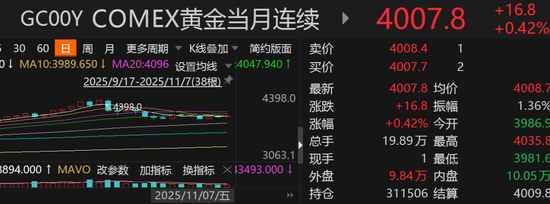
Core Viewpoint - The recent fluctuations in gold prices, particularly around the $4000 per ounce mark, have raised questions about its investment value, with a notable increase in inflows into gold ETFs despite recent price corrections [3][5]. Group 1: Gold Price Movements - After reaching a new high of $4398 per ounce in late October, COMEX gold has since corrected and is currently stabilizing around $4000 per ounce, with a slight increase of 0.42% to $4007.8 per ounce on November 7 [1]. - The total net subscription for gold ETFs has reached approximately 273 million shares since the beginning of November, indicating strong investor interest [4]. Group 2: Fund Inflows and Performance - Several gold ETFs have experienced a rebound, with some products seeing a cumulative increase of over 3% from November 5 to November 7, 2023 [4]. - The largest domestic gold ETF, Huaan Gold ETF, has seen a net subscription of 69.7 million shares, while another ETF, Huaxia Gold ETF, followed closely with 67 million shares [4]. Group 3: Investment Strategies and Outlook - Fund managers suggest that the recent adjustments in gold prices are primarily due to a temporary easing of risk aversion, but the long-term investment logic for gold remains intact [5]. - The ongoing trend of de-dollarization and potential interest rate cuts by the Federal Reserve are expected to support gold's long-term performance, with recommendations for investors to consider a systematic investment approach in gold ETFs, maintaining a portfolio allocation of 5% to 15% [5][6].

市场风格有望再平衡,货币政策或加速放松
Sou Hu Cai Jing· 2025-11-08 10:49
Focus Review - China's October export performance was disappointing, with a year-on-year decline of 1.1%, significantly below the market expectation of 3% growth, and a previous increase of 8.3% [1] - Imports grew by 1% in October, down from a previous increase of 7.4%, resulting in a trade surplus of $90.07 billion, slightly lower than the previous $90.45 billion [1] - For the first ten months of 2025, China's total goods trade maintained steady growth, with a total value of $520.46 billion, a year-on-year increase of 2.7%, including exports of $308.47 billion (up 6.2%) and imports of $211.99 billion (down 0.9%) [1] Equity Market - Morgan Asset Management expressed an optimistic outlook for risk assets over the next 6 to 18 months, supported by healthy consumer balance sheets, gradual easing of Federal Reserve monetary policy, and ongoing fiscal stimulus [1] - CITIC Construction Investment is bullish on resource products, anticipating price increases driven by global monetary easing, supply-demand gaps, and domestic replenishment cycles [2] - China Europe Fund suggests that the market's struggle around the 4000-point mark reflects policy signals, increased risk appetite, and long-term capital inflows, with a focus on technology and economic cycle resonance investment opportunities [3] Industry Research - CITIC Securities highlighted that 2026 will be a critical year for the asset-liability repair of Chinese real estate companies, with expectations of a long-term profit bottom for some firms [4] - Guotai Junan Securities noted that the liquor industry is undergoing an accelerated clearing adjustment, with inventory levels decreasing rapidly after reaching a bottom, suggesting potential price rebounds [6] - Penghua Fund is optimistic about the domestic economy over the next two to three years, supported by low interest rates and a shift in asset allocation towards equities, favoring high-quality dividend assets [6] Macro and Fixed Income Market - Huatai Securities recommended a focus on medium to short-term credit bonds, with a preference for bonds with strong demand and good odds [7] - CICC anticipates continued downward pressure on exports, necessitating more policy support, with expectations for accelerated monetary policy easing [8] - Bosera Fund noted that the central bank's actions to ease funding fluctuations and a friendly domestic financial policy environment support improvements in the bond market supply-demand structure [8] Asset Allocation Outlook - As of November, domestic liquidity is expected to remain relatively loose, with potential fluctuations in external Federal Reserve rate cut expectations, leading to a possible rebalancing of market styles back to a barbell structure [9]


基金分红:博时富乾3个月定开债发起式基金11月13日分红
Sou Hu Cai Jing· 2025-11-08 01:47
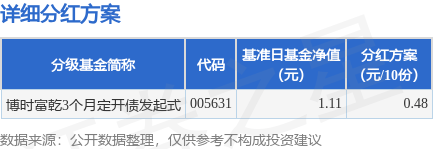
本次分红对象为权益登记日登记在册的本基金份额持有人,权益登记日为11月11日,现金红利发放日为 11月13日。选择红利再投资方式的投资者所转换的基金份额将以2025年11月11日的基金份额净值为计算 基准确定再投资份额,红利再投资所转换的基金份额于2025年11月12日直接划入其基金账户,2025年11 月13日起投资者可以查询、赎回。根据财政部、国家税务总局的财税[2002]128号《财政部 国家税务总 局关于开放式证券投资基金有关税收问题的通知》及财税[2008]1号《关于企业所得税若干优惠政策的 通知》的规定,基金向投资者分配的基金利润,暂免征收所得税。本基金本次分红免收分红手续费。选 择红利再投资方式的投资者其红利所转换的基金份额免收申购费用。 以上内容为证券之星据公开信息整理,由AI算法生成(网信算备310104345710301240019号),不构成 投资建议。 | 分级基金简称 代码 | 電准日基金净值 | | 分红方案 | | --- | --- | --- | --- | | | (元) | | (元/10份) | | 博时富乾3个月定开债发起式 005631 | | 1.11 | 0.4 ...
基金分红:博时民丰纯债债券基金11月13日分红
Sou Hu Cai Jing· 2025-11-08 01:47
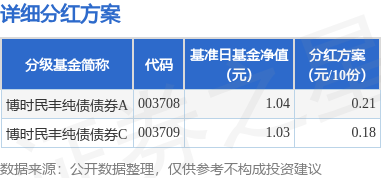
本次分红对象为权益登记日登记在册的本基金份额持有人,权益登记日为11月11日,现金红利发放日为 11月13日。选择红利再投资方式的投资者所转换的基金份额将以2025年11月11日的基金份额净值为计算 基准确定再投资份额,红利再投资所转换的基金份额于2025年11月12日直接划入其基金账户,2025年11 月13日起投资者可以查询、赎回。根据财政部、国家税务总局的财税[2002]128号《财政部 国家税务总 局关于开放式证券投资基金有关税收问题的通知》及财税[2008]1号《关于企业所得税若干优惠政策的 通知》的规定,基金向投资者分配的基金利润,暂免征收所得税。本基金本次分红免收分红手续费。选 择红利再投资方式的投资者其红利所转换的基金份额免收申购费用。 以上内容为证券之星据公开信息整理,由AI算法生成(网信算备310104345710301240019号),不构成 投资建议。 证券之星消息,11月8日发布《博时民丰纯债债券型证券投资基金分红公告》。本次分红为2025年度的 第2次分红。公告显示,本次分红的收益分配基准日为11月11日,详细分红方案如下: | 分级基金简称 | 代码 | 重准日重等净值 | | ...
天府证券ETF日报-20251107
天府证券· 2025-11-07 09:05
Report Summary 1. Report Industry Investment Rating No relevant content provided. 2. Core View of the Report On November 7, 2025, the A - share market generally declined, with the Shanghai Composite Index down 0.25%, the Shenzhen Component Index down 0.36%, and the ChiNext Index down 0.51%. Different sectors and ETFs showed varying performance [2][6]. 3. Summary by Related Catalogs Market Overview - The Shanghai Composite Index closed at 3997.56 points, down 0.25%; the Shenzhen Component Index closed at 13404.06 points, down 0.36%; the ChiNext Index closed at 3208.21 points, down 0.51%. The trading volume of A - shares in the two markets was 20205 billion yuan [2][6]. - The top - performing industries were basic chemicals (up 2.39%), comprehensive (up 1.45%), and petroleum and petrochemicals (up 1.38%); the worst - performing industries were computer (down 1.83%), electronics (down 1.34%), and household appliances (down 1.17%) [2][6]. Stock ETF - The top - trading - volume stock ETFs included Huaxia CSI A500 ETF (down 0.08%, discount rate - 0.14%), Guotai CSI A500 ETF (down 0.17%, discount rate - 0.18%), and Huatai - Ber瑞 CSI A500 ETF (unchanged, discount rate - 0.05%) [3][7]. - The report also listed the details of the top ten stock ETFs in terms of trading volume, including price, change rate, tracking index change rate, discount rate, trading volume, and latest share reference [8]. Bond ETF - The top - trading - volume bond ETFs were Haifutong CSI Short - Term Financing ETF (unchanged, discount rate 0.00%), Boshi CSI Convertible and Exchangeable Bond ETF (up 0.15%, discount rate - 0.12%), and Huaxia Shanghai Stock Exchange Benchmark Market - Making Treasury Bond ETF (down 0.06%, discount rate 0.01%) [4][9]. - The details of the top five bond ETFs in terms of trading volume were provided, including price, change rate, discount rate, and trading volume [10]. Gold ETF - Gold AU9999 was unchanged, and Shanghai Gold was up 0.31%. The top - trading - volume gold ETFs were Huaan Gold ETF (up 0.43%, discount rate 0.15%), Boshi Gold ETF (up 0.42%, discount rate 0.10%), and E Fund Gold ETF (up 0.42%, discount rate 0.12%) [12]. - The details of several gold ETFs were presented, including price, change rate, trading volume, IOPV, and discount rate [13]. Commodity Futures ETF - Huaxia Feed Soybean Meal Futures ETF was down 0.10%, discount rate 0.07%; Dacheng Non - Ferrous Metals Futures ETF was down 0.28%, discount rate - 0.13%; Jianxin Yisheng Zhengzhou Commodity Exchange Energy and Chemical Futures ETF was down 0.57%, discount rate 0.39% [13][14]. - The details of these commodity futures ETFs were provided, including price, change rate, trading volume, IOPV, discount rate, tracking index, and tracking index change rate [14]. Cross - Border ETF - The previous trading day, the Dow Jones Industrial Average was down 0.84%, the Nasdaq was down 1.90%, the S&P 500 was down 1.12%, and the German DAX was down 1.31%. On this day, the Hang Seng Index was down 0.92%, and the Hang Seng China Enterprises Index was down 0.94% [15]. - The top - trading - volume cross - border ETFs were E Fund CSI Hong Kong Securities Investment Theme ETF (down 1.17%, discount rate - 1.21%), GF CSI Hong Kong Innovative Drug ETF (down 2.22%, discount rate - 1.85%), and Huatai - Ber瑞 Hang Seng Technology ETF (down 1.27%, discount rate - 1.30%) [15]. - The details of the top five cross - border ETFs in terms of trading volume were given, including trading volume, change rate, and discount rate [16]. Currency ETF - The top - trading - volume currency ETFs were Yin Hua Day - to - Day Profit ETF, Hua Bao Tian Yi ETF, and Currency ETF Jian Xin Tian Yi [17][19]. - The trading volumes of the top three currency ETFs were provided [19].
哪些二级债基适配高波市场环境?
Shenwan Hongyuan Securities· 2025-11-07 08:45
1. Report Industry Investment Rating - No information provided about the industry investment rating in the report. 2. Core Views of the Report - Secondary bond funds have diverse strategies and significant differences in risk - return indicators. Higher -仓位 products generally perform better in 2025, with products having an excessively high convertible bond position achieving an average return of 14.43%, while low -仓位 products only have an average return of 3.88% [3][4]. - There are four strategies to select offensive secondary bond funds: high -仓位 convertible bond strategy, growth - style strategy, Hong Kong stock strategy, and tool - type product strategy [3][10]. 3. Summary by Related Catalogs 3.1 Strategy 1: High -仓位 Convertible Bond Funds - High -仓位 convertible bond funds vary in style. There are currently 64 secondary bond funds with an average convertible bond position exceeding 30%, including conservative, aggressive, and extreme - style products [20]. - A three - dimensional selection system is used to evaluate high - elasticity products based on three core indicators and five sub - indicators, focusing on high elasticity, good holding experience, and high cost - effectiveness [19][20]. - Some high - performance high -仓位 convertible bond funds are recommended, such as Huabao Enhanced Income A, with a 924 - since return of 50.44%, and Guangda Tianyi A, with a 924 - since return of 55.05% [22]. 3.2 Strategy 2: Growth - Style Funds - Growth - style funds are identified by a weighted average stock PE above 30 times. Fund evaluation focuses on holding experience (number of new high days, maximum drawdown recovery speed) and risk - return cost - effectiveness (Sharpe ratio) [52]. - Many growth - style secondary bond funds are listed, such as Invesco Great Wall Jinyi Yuli A, with a 924 - since return of 8.53%, and Penghua Enjoy A, with a 924 - since return of 11.92% [51]. - Different investment strategies of growth - style funds are analyzed, including industry rotation (e.g., Yongying Steady Enhancement, Huashang Credit Enhancement), industry concentration and stock dispersion (e.g., Huashang Credit Enhancement, Huashang Anheng), and the balance between booming growth and quality growth (e.g., Invesco Great Wall Jinyi Fengli, Penghua Double Debt Plus) [55][58]. - Some growth - style funds' investment in popular technology tracks is studied. For example, Yongying Steady Enhancement invests more in the cloud - computing theme, and Xingye Income Enhancement invests more in the semiconductor theme [64][65]. 3.3 Strategy 3: Hong Kong Stock Strategy Funds - The proportion of Hong Kong stock investment in secondary bond funds has been increasing continuously, reaching 11.21% in Q3 2025. Secondary bond funds invest in Hong Kong stocks through the Hong Kong Stock Connect, with an investment limit of up to 50% of the stock assets [98][99]. - Some secondary bond funds with relatively stable Hong Kong stock positions are mentioned, such as Huatai - PineBridge Double - Xin Tianli, Invesco Great Wall Jinyi Zunli, and China - Europe Fengli [99]. - The investment style of Hong Kong - stock secondary bond funds focuses on scarce, low - valuation, high - dividend, and high - quality growth stocks. They do not only invest in scarce Hong Kong - listed assets but also in stocks listed in both Hong Kong and A - shares, and prefer sectors such as technology innovation, finance, and medicine [100][103]. 3.4 Strategy 4: Tool - Type Products - Some secondary bond funds have clear track/style characteristics, such as the dual - innovation strategy (e.g., Fuguo Xingli Enhancement, Penghua Enjoy (Science and Technology Innovation 100 Enhancement)) and the micro - cap strategy (e.g., CITIC Prudential Anxin Return) [3]
天赐良基日报|跨境ETF规模突破9000亿元;“百亿基金经理”重回百人大关
Mei Ri Jing Ji Xin Wen· 2025-11-07 07:40
Group 1: Fund Market Overview - The cross-border ETF market has surpassed 900 billion yuan, reaching 915.47 billion yuan as of November 6, with an increase of 491.25 billion yuan since the beginning of the year and 48 new products launched [1] - The number of active equity fund managers managing over 10 billion yuan has increased to 109 by the end of Q3, a nearly one-third expansion compared to Q2. This number has risen to 112 with new products launched in Q4, driven primarily by performance [2] - Ten funds that had a net value below 0.6 yuan at the end of last year have seen their net value return above 1 yuan as of November 5, with one fund achieving a year-to-date return of 137.02% [3] Group 2: ETF Market Performance - The market experienced fluctuations, with all three major indices retreating after initial gains. The lithium battery sector surged in the afternoon, while the chemical sector continued to rise, and the organic silicon sector showed strength. Conversely, the robotics sector declined [5] - Chemical-related ETFs saw gains exceeding 3%, while internet-related ETFs in the Hong Kong market dropped over 2% [6][8] Group 3: Notable Fund Manager Updates - Fund managers Yan Siqian and Wang Zijian from Penghua Fund denied rumors of a conflict, stating that the claims are malicious defamation and urging the public to stop spreading false information [4] Group 4: Investment Opportunities - Current chemical product prices and spreads are at low levels, with leading companies' valuations also at the bottom. The strong safety margin in valuations, combined with the integrated supply chain and cost advantages of leading companies, suggests potential for profit and valuation recovery in core chemical assets [10]

“落袋为安”?130亿,跑了......
Zhong Guo Ji Jin Bao· 2025-11-07 06:23
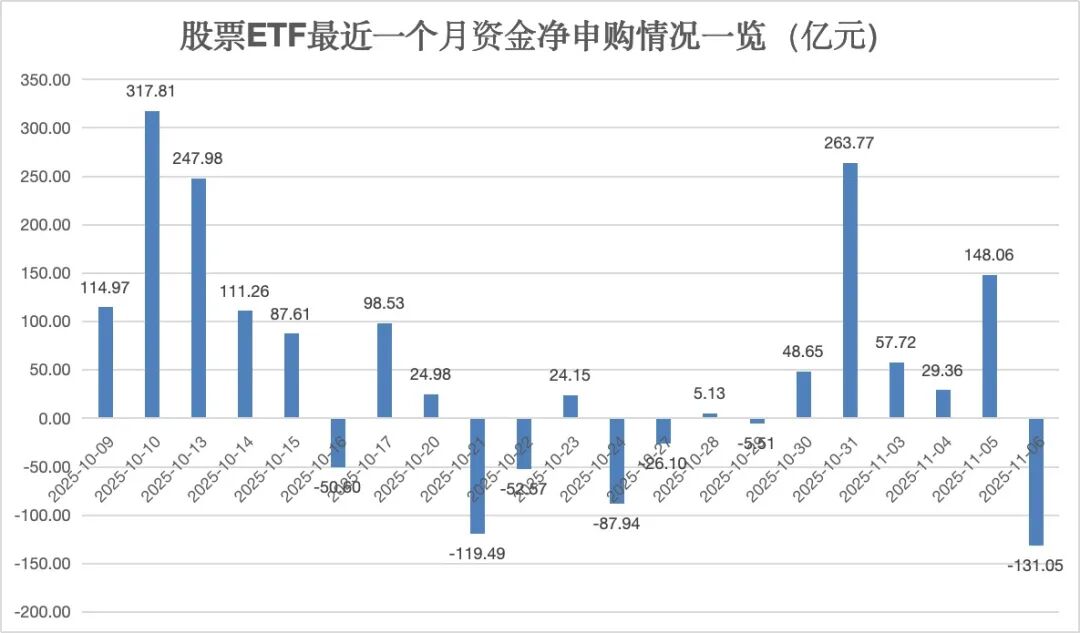
Core Viewpoint - The stock ETF market experienced a significant net outflow of over 130 billion yuan on November 6, indicating a trend of profit-taking among investors despite a rebound in the A-share market, which saw the Shanghai Composite Index recover above the 4000-point mark [1][3]. Fund Flow Summary - On November 6, the overall net outflow from the stock ETF market exceeded 131 billion yuan, with a total of 1241 stock ETFs (including cross-border ETFs) having a total scale of 4.45 trillion yuan [2][3]. - The market saw a reduction of 75.64 billion units in total ETF shares, translating to a net outflow of approximately 131.05 billion yuan based on average transaction prices [3]. - This marked the first occurrence of a net outflow exceeding 100 billion yuan after several days of continuous inflow, reflecting the characteristics of wave operations by market participants [5]. Sector Performance - The sectors with the highest net inflows included pharmaceuticals, Hang Seng Technology, food and beverage, and non-bank financials, with net inflow amounts of 8.1 billion yuan, 3.5 billion yuan, 2.4 billion yuan, 1.7 billion yuan, and 1.5 billion yuan respectively [7]. - The top three ETFs with net inflows were the Huaxia Electric Grid Equipment ETF, Southern CSI A500 ETF, and GF Hong Kong Innovative Medicine ETF, with net inflows of 3.81 billion yuan, 3.25 billion yuan, and 2.16 billion yuan respectively [7]. Notable ETFs - The Huaxia Electric Grid Equipment ETF saw a significant increase in scale, rising from 5.32 billion yuan to 15.78 billion yuan, marking a 197% increase [6]. - The top ten ETFs by net inflow on November 6 included the Electric Grid Equipment ETF, Company Bond ETF, and A500 ETF, with respective net inflows of 3.81 billion yuan, 3.55 billion yuan, and 3.25 billion yuan [8]. Outflow Analysis - The sectors with the highest net outflows included semiconductors, the Sci-Tech Innovation Board, the ChiNext, CSI 300, and securities, with net outflow amounts of 35.7 billion yuan, 26.3 billion yuan, 18.8 billion yuan, 13.3 billion yuan, and 9.6 billion yuan respectively [9]. - The top ten ETFs by net outflow included the Sci-Tech Innovation 50 ETF, Robot ETF, and Securities ETF, with respective outflows of 3.57 billion yuan, 3.65 billion yuan, and 5.89 billion yuan [10].
通合科技股价跌5.05%,博时基金旗下1只基金位居十大流通股东,持有257.36万股浮亏损失391.19万元
Xin Lang Cai Jing· 2025-11-07 06:23
Core Viewpoint - Tonghe Technology experienced a decline of 5.05% on November 7, with a stock price of 28.57 CNY per share and a total market capitalization of 5.007 billion CNY [1] Group 1: Company Overview - Tonghe Technology, established on December 21, 1998, is located in Shijiazhuang, Hebei Province, and was listed on December 31, 2015 [1] - The company specializes in the research, production, and sales of high-frequency switch power supplies and related electronic products, including military products [1] - The revenue composition of the company includes: 65.68% from new energy power conversion products, 20.15% from smart grid power supply products, 11.90% from customized power supplies and testing services, and 2.27% from other sources [1] Group 2: Shareholder Information - According to data, Bosera Fund has one fund among the top ten circulating shareholders of Tonghe Technology, specifically the Bosera Huixing Return One-Year Holding Mixed Fund (011056), which entered the top ten in the third quarter with 2.5736 million shares, accounting for 1.65% of circulating shares [2] - The estimated floating loss for this fund today is approximately 3.9119 million CNY [2] Group 3: Fund Performance - The Bosera Huixing Return One-Year Holding Mixed Fund (011056) was established on January 14, 2021, with a latest scale of 5.818 billion CNY [2] - Year-to-date, the fund has achieved a return of 42.2%, ranking 1738 out of 8148 in its category; over the past year, it has returned 47.24%, ranking 921 out of 8053; since inception, it has returned 3.45% [2]

“落袋为安”?130亿,跑了......
中国基金报· 2025-11-07 06:07
Core Viewpoint - The stock ETF market experienced a significant net outflow of over 131 billion yuan on November 6, marking a shift from previous inflows, indicating a trend of profit-taking among investors as the A-share market rebounded above the 4000-point mark [2][3][5]. Fund Flow Analysis - On November 6, the overall stock ETF market, including cross-border ETFs, saw a net outflow of approximately 131.05 billion yuan, with a total of 1241 stock ETFs having a combined scale of 4.45 trillion yuan [3][5]. - The ETFs tracking electric grid equipment, the CSI A500, and Hong Kong innovative pharmaceuticals saw the largest inflows, while those tracking the STAR Market, ChiNext, and semiconductor indices faced significant redemptions [3][10]. Sector Performance - The sectors with the highest net inflows included pharmaceuticals (8.1 billion yuan), Hang Seng Technology (3.5 billion yuan), food and beverage (2.4 billion yuan), and non-bank financials (1.7 billion yuan) [10]. - Conversely, the sectors with the largest net outflows were semiconductors (35.7 billion yuan), the STAR Market (26.3 billion yuan), and ChiNext (18.8 billion yuan) [12]. Notable ETFs - The top three ETFs by net inflow on November 6 were: - Huaxia Electric Grid Equipment ETF: 3.81 billion yuan - Southern CSI A500 ETF: 3.25 billion yuan - GF Hong Kong Innovative Pharmaceuticals ETF: 2.16 billion yuan [10][11]. - The Huaxia Electric Grid Equipment ETF saw a significant increase in scale, growing from 5.32 billion yuan to 15.78 billion yuan, a rise of 1.97 times [8]. Outflow Trends - The ETFs with the highest net outflows included: - STAR Market 50 ETF: -3.57 billion yuan - Robotics ETF: -3.65 billion yuan - Securities ETF: -5.89 billion yuan [13]. - Multiple ETFs tracking the STAR Market, ChiNext, and semiconductor indices were among those experiencing the most significant outflows [13].